


No American city sits inside its national parks the way San Francisco does. The Golden Gate National Recreation Area wraps the city’s entire ocean edge, a federal prison you can tour floats in the middle of the bay, and an old-growth redwood grove grows 45 minutes from downtown. You can reach a national park site here on a city bus.
The catch is that the famous stuff now runs on reservations. Alcatraz sells out weeks ahead. Muir Woods won’t let your car in without a booked parking spot. Knowing the booking windows matters more than knowing the trailheads.
And one piece of honesty up front. Yosemite is about 4 hours from the city, not the easy day trip the tour brochures suggest. It is on this list because it is the greatest valley on Earth, but it is a weekend. I’ve ordered everything by what it pays back against the drive, with the long hauls at the bottom and weekend plans at the end. The statewide rundown lives in our California national parks guide.
National Parks Near San Francisco at a Glance
| Site | Drive from San Francisco | Type | 2026 fee | Time needed |
|---|---|---|---|---|
| Golden Gate National Recreation Area | You’re in it | Coastal recreation area | Free | 2 hours to forever |
| Alcatraz Island | Ferry from Pier 33 | Historic prison island | $47.95/adult, ferry included | Half day |
| San Francisco Maritime National Historical Park | In the city, Aquatic Park | Maritime history | Free (pier closed for rebuild) | 1 to 2 hours |
| Muir Woods National Monument | 45 minutes | Old-growth redwoods | $15/person + $10 parking reservation | Half day |
| Point Reyes National Seashore | 1 hour 15 minutes | National seashore | Free | Full day |
| Rosie the Riveter WWII Home Front National Historical Park | 30 minutes | WWII home front history | Free | 2 to 3 hours |
| John Muir National Historic Site | 45 minutes | Muir’s home and orchards | Free | 2 to 3 hours |
| Pinnacles National Park | 2 hours | National park | $30/vehicle | Full day |
| Yosemite National Park | 4 hours | National park | $35/vehicle | Weekend minimum |
| Lassen Volcanic National Park | 4 hours | National park | $30/vehicle (summer) | Weekend |
| Redwood National and State Parks | 5 hours 30 minutes | National and state parks | Free (state day-use fees at some areas) | Weekend minimum |
| Sequoia and Kings Canyon National Parks | 4 hours 30 minutes | National parks | $35/vehicle, covers both | Weekend minimum |
1. Golden Gate National Recreation Area
It surrounds the city. Free, every acre of it.
117 public lands destinations are under threat. Get the free briefing that 27,000+ people use to stay informed and take action.
Start at the Presidio if you only have an afternoon. The Tunnel Tops park stitched the bluffs back to the waterfront in 2022, and the picnic lawns above the highway tunnels have the best free Golden Gate Bridge view in the city, with Crissy Field and Fort Point a flat walk below.
Established in 1972 and covering more than 80,000 acres on both sides of the Golden Gate, this is one of the most visited units in the entire park system, and most folks who use it daily never think of it as a national park. It is. Your morning run at Crissy Field counts as a park visit.
Our picks on the city side. Lands End for the cypress-lined coastal trail and the ruins of the Sutro Baths, a Gilded Age swimming palace the Pacific slowly took back. Fort Point, the brick Civil War fort tucked directly beneath the Golden Gate Bridge, where the arch overhead was added to the bridge design specifically to save the fort. The interior generally opens Friday through Sunday, 10 to 5, and the outside walk is open whenever you are.
Across the bridge, the Marin Headlands deliver the postcard. Battery Spencer is the bridge view you’ve seen a thousand times, and showing up at sunrise beats fighting for the pullout at sunset. Everything here is free, parking included, which makes this the best value in the entire park system given what houses cost within sight of it.
2. Alcatraz Island
Ferry from Pier 33. Day tour $47.95 for adults, and the ticket is the whole game.
Alcatraz is part of the recreation area, but it runs on its own rules, so it gets its own entry. There is no entrance fee. Instead you buy a ferry ticket from Alcatraz City Cruises, the only operator authorized to land there, and that ticket includes the ride, the island, and the cellhouse audio tour, which is narrated by former guards and former inmates and is genuinely one of the best audio tours anywhere.
The 2026 prices. Adults $47.95 for the day tour, kids 5 to 11 $29.15, under 5 free, night tour $59.65 for adults and worth the upgrade if you can get it. Tickets release 90 days out and summer dates sell out weeks ahead, sometimes longer. Book the morning your 90-day window opens if your dates are fixed. A national parks pass does not cover the ferry, and the people selling “skip the line” tickets on the wharf are reselling the same boats at a markup.
Plan a half day. The island is steeper than it looks from shore, the gardens and seabird colonies surprise people, and the view of the city from a prison yard explains the punishment better than the cells do.
3. San Francisco Maritime National Historical Park
Aquatic Park, at the foot of Fisherman’s Wharf. Free, with an honest asterisk.
The asterisk first. Hyde Street Pier, the park’s centerpiece, is closed while the pier itself is rebuilt, and the historic fleet, including the 1886 square-rigger Balclutha, has been towed to Mare Island for the duration. You cannot board the ships right now, and no reopening date has been announced. Most articles about this park haven’t caught up. Now you know.
What remains is still a pleasant hour or two. The Maritime Museum occupies a 1939 WPA building shaped like an ocean liner, with murals worth the visit on their own, and the Aquatic Park cove in front of it is where the city’s famously cold-blooded open-water swimmers do laps year round. Watch them from the bleachers of the municipal pier with a coffee and feel superior and warm.
4. Muir Woods National Monument
About 45 minutes north via US-101 and the Mount Tam switchbacks. $15 per person plus a parking reservation you must book before you go.
The closest old-growth coast redwoods to the city, saved in 1908 when William Kent gave the grove to the federal government and insisted it be named for John Muir instead of himself. The Main Trail runs along Redwood Creek beneath trees pushing 250 feet, with bridges that let you loop back at the half mile, mile, or 2 mile mark.
Here is the part that trips people. Since 2018, every single vehicle needs a parking reservation booked in advance at GoMuirWoods.com. Standard cars are $10, on top of the $15 per person entrance fee for everyone 16 and up. Reservations open 90 days out, a small batch releases 5 days before, and there is no legal roadside parking to fall back on. There is also no cell service in the canyon, so download or print your pass before you leave the city. A reserved shuttle from Sausalito runs $4.00 round trip for adults, free for kids 15 and under, if you’d rather skip the driving.
Are these the most impressive redwoods in California? No, and I say that as someone whose family has spent weeks filming the giants up north. But at 8 am on a weekday, with the fog still in the canopy and the crowds still at breakfast, Muir Woods makes the argument that proximity is its own kind of grandeur.

5. Point Reyes National Seashore
About 1 hour 15 minutes to Bear Valley, another 45 minutes out to the lighthouse. Free.
Seventy-one thousand acres of bluffs, beaches, and working dairy ranches on a peninsula that is sliding northwest along the San Andreas Fault, geologically speaking a piece of Southern California that got away. It is the best full day in this post and it costs nothing.
The lighthouse is the trophy. It sits at the end of Sir Francis Drake Boulevard, down a staircase of 313 steps, in what the park itself bills as the windiest spot on the Pacific coast. The stairs are open Thursday through Monday, 10 to 4, closed Tuesdays and Wednesdays, and they shut whenever winds top 40 mph, which out there is not a rare event. The walk back up is your cardio for the week.
Beyond the lighthouse, the hits keep coming. Tule elk on Tomales Point, elephant seals hauled out near Chimney Rock in winter, the Cypress Tree Tunnel for the photo everyone takes anyway, and gray whales passing offshore in January and March. Fog is the house specialty, especially in summer. If the headlands are socked in, the Bear Valley side and the Earthquake Trail usually aren’t.
6. Rosie the Riveter WWII Home Front National Historical Park
About 30 minutes northeast in Richmond via I-80. Free.
During World War II the Kaiser shipyards in Richmond launched 747 ships, a feat of industrial speed nobody has matched since, and they did it with a workforce of women and Black workers who had never been welcome in those jobs before. This park tells that story from the actual waterfront where it happened, and it tells it better than parks with ten times the visitation.
The Visitor Education Center sits in a converted oil house next to the old Ford Assembly Plant, and the SS Red Oak Victory, a surviving Richmond-built ship, floats nearby. For years the park’s signature was ranger Betty Reid Soskin, who worked the home front herself and interpreted it here until she retired in 2022 at age 100 as the oldest active ranger in the park service. Her recorded talks are part of the exhibits. Listen to them.
7. John Muir National Historic Site
About 45 minutes east in Martinez via I-80 and CA-4. Free.
The wilderness prophet spent his last 24 years in a 17-room Italianate mansion surrounded by fruit orchards, which surprises people who know Muir only from the granite quotes. This is where he wrote the books and ran the Sierra Club campaigns that gave us Yosemite as a national park. His upstairs study, the “scribble den,” still has the desk.
It is free, it pairs naturally with Rosie the Riveter for an East Bay history day, and the orchard fruit is fair game in season, which Muir would have endorsed. The full story of the man, including the fight he lost, is in our John Muir facts piece and our deep dive on Hetch Hetchy, the valley San Francisco drowned for its water supply. Reading that one before you visit changes the visit.
8. Pinnacles National Park
About 2 hours south via US-101 to the east entrance. $30 per vehicle. California’s least-known national park, and the closest one to the city.
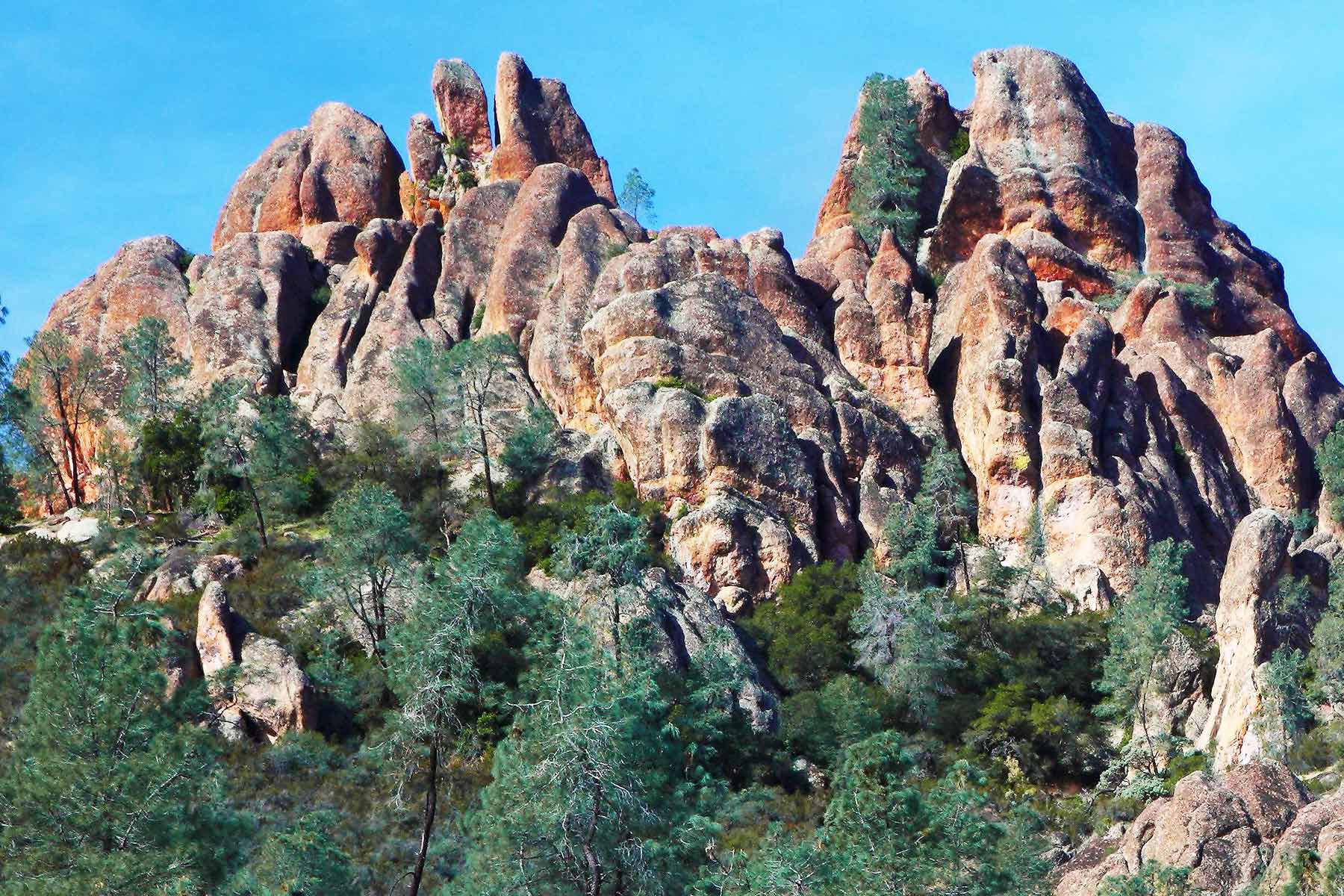
Quick trivia answer. The closest full national park to San Francisco is not Yosemite. It is Pinnacles, the eroded remains of an ancient volcano that has been riding the San Andreas Fault north for 23 million years, leaving the other half of itself 195 miles behind in Southern California.
You come for two things. California condors, which the park breeds and releases, and which ride the thermals over the High Peaks most mornings. And the talus caves, slot canyons roofed by giant fallen boulders that you walk through with a flashlight. Bear Gulch Cave shelters a bat colony and closes in sections seasonally to protect it, so check the park site before building the day around it.
Know the geography. The east and west entrances are not connected by any road through the park, and the east side has the visitor center, the campground, and Bear Gulch. Go between November and April. Summer afternoons here run past 100 degrees and the park has almost no shade. Full plans in our guide to the best things to do in Pinnacles and our Pinnacles facts post.
9. Yosemite National Park
About 4 hours east when traffic behaves, longer on summer weekends. $35 per vehicle. A weekend, not a day trip.
Yes, technically you can do Yosemite in a day from San Francisco. You will spend 8 or more hours driving to walk the Valley loop in a daze and watch sunset from a parking lot. The Valley deserves a dawn, and dawn belongs to people who slept within an hour of it.
The 2026 planning picture is actually friendlier than it has been in years. Yosemite is running no day-use reservation system at all this year, first time in a while, so you can decide on a Thursday to go on a Saturday. The flip side is gate backups that reporting around Memorial Day clocked at over 90 minutes, with Valley parking full by mid morning. Be through the arch before 7 am or after 3 pm and the park is yours. One more note for hosts of international guests, nonresidents now pay a $100 per person surcharge at the gate, waived with an America the Beautiful pass, so buy the pass.
What to do once you’re in is its own library. Start with our things to do in Yosemite guide and our Yosemite itinerary, and if you’re choosing dates, May is the best month nobody talks about, when the waterfalls are at full volume and the summer crowds aren’t.

10. The Long Hauls Worth Planning Around
Three more parks sit in the 4-to-6-hour band, and pretending they’re day trips is how vacations get ruined. As weekends, they’re spectacular.
Lassen Volcanic, about 4 hours northeast. Boiling mudpots, fumaroles, and a volcano that erupted as recently as 1917, with a fraction of Yosemite’s crowds. $30 per vehicle in summer. Bumpass Hell is the marquee walk, Manzanita Lake at sunset is the photograph. The snow lingers into July, which is part of the charm and part of the planning. Details in our Lassen things to do guide.

Sequoia and Kings Canyon, about 4 hours 30 minutes southeast. The largest trees on Earth by volume, including the General Sherman, plus a canyon deeper than the Grand one. $35 covers both parks, and the $100 nonresident surcharge applies here too. Our Sequoia guide has the plan.
Redwood National and State Parks, about 5 hours 30 minutes north. The tallest trees on the planet, and the ones that make Muir Woods feel like a lobby. More Than Just Parks spent weeks filming here, and I still rank it among the most underrated parks in America. Free at the federal level, with state day-use fees at a few areas. Go for a long weekend minimum, via our Redwood things to do guide.

Two pieces of fine print for completists. Eugene O’Neill National Historic Site in Danville preserves the playwright’s Tao House and is reachable mainly by reserved tour, and Port Chicago Naval Magazine National Memorial sits on an active military base with access rules that change, so check current requirements with the park before counting on either.
A Weekend Itinerary From San Francisco
Three plans, in rising order of ambition.
- The no-car city weekend. Saturday, an early Alcatraz boat you booked weeks ago, then walk the waterfront to Aquatic Park and the Maritime Museum. Sunday, Lands End and the Sutro Baths ruins in the morning fog, Fort Point under the bridge after. Every bit of it on Muni plus one ferry ticket.
- The Marin Saturday. An 8 am Muir Woods parking reservation, two quiet hours in the grove, then out Sir Francis Drake to Point Reyes for the lighthouse, elk, and an oyster stop on Tomales Bay on the way home. Book the parking the day your window opens and remember the lighthouse stairs close Tuesdays and Wednesdays.
- The Yosemite weekend. Friday night, drive to a gateway town and sleep. Saturday, in the Valley by sunrise, Tunnel View before the buses, trails all day, sunset at Glacier Point if the road is open. Sunday morning in Mariposa Grove, home by dinner. In winter, swap this whole plan for Pinnacles, which is the rare park at its best in January.


