

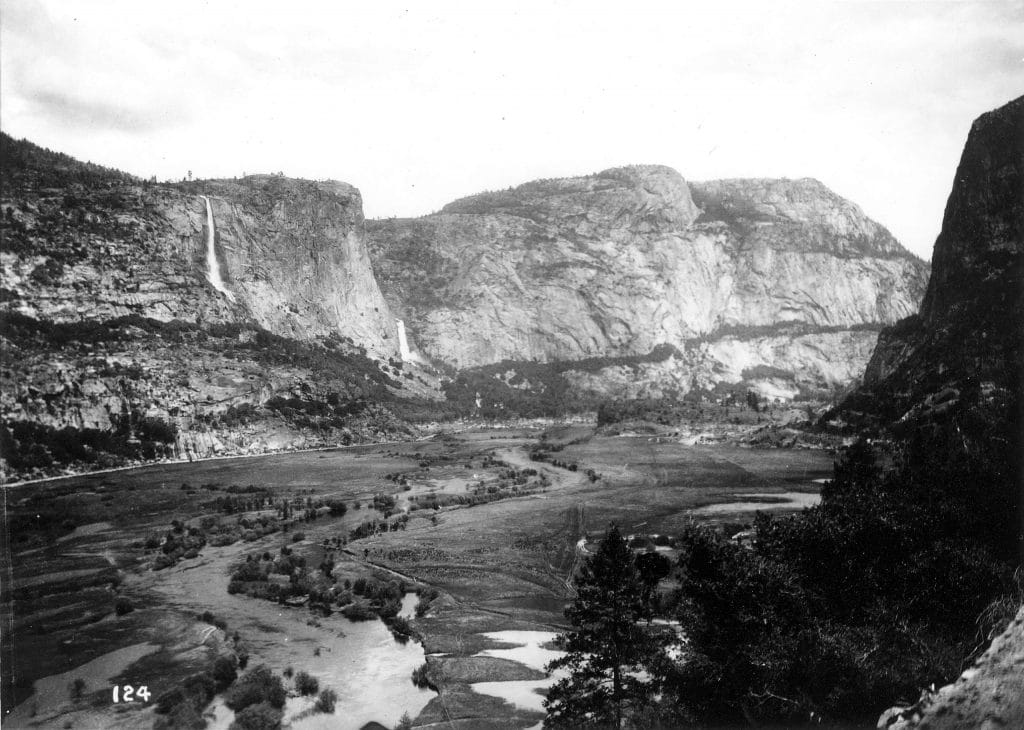
There was once a valley in Yosemite that John Muir believed was the equal of Yosemite Valley itself. He called it a mountain temple. Glaciers had carved it, the Tuolumne River ran through it, waterfalls poured down its granite walls, and in spring its meadows filled with wildflowers. Its name was Hetch Hetchy. Today it lies at the bottom of a reservoir, drowned under more than two hundred feet of water, and the fight over whether to flood it became the first great battle of the American conservation movement.
The story of Hetch Hetchy matters far beyond the loss of one valley. It was the moment the young movement split in two, pitting preservation against use, John Muir against Gifford Pinchot, and it ended in a defeat so bitter that it arguably helped create the modern fight to protect wild places. To lose Hetch Hetchy, in the end, was to teach the country exactly what it stood to lose everywhere else.
A Valley Inside a National Park
The crucial fact about Hetch Hetchy is that it was not unprotected wilderness. It lay inside Yosemite National Park, established in 1890, land Congress had already set aside as belonging to all Americans forever. That is what made the proposal to dam it so explosive. If a city could reach inside a national park and flood a valley for its own convenience, then no national park anywhere was truly safe. The principle was on trial, not just the place.
The city in question was San Francisco, which had long eyed the Tuolumne River as a clean, reliable water and power supply. The campaign to dam Hetch Hetchy was led most forcefully by Mayor James Phelan and other city officials, who argued that the valley could serve a far greater number of people as a reservoir than as a remote park few would ever visit. After the catastrophic 1906 earthquake and the fires that followed, San Francisco’s case for a secure municipal water supply gained powerful momentum and public sympathy.
117 public lands destinations are under threat. Get the free briefing that 27,000+ people use to stay informed and take action.
Muir and Pinchot, Friends Turned Foes
The battle came to be personified by two giants of conservation who had once been friends. On one side stood John Muir, founder of the Sierra Club and the nation’s most eloquent voice for wilderness, who saw the valley as sacred ground that no engineering benefit could justify destroying. On the other stood Gifford Pinchot, chief of the U.S. Forest Service and apostle of what he called wise use, who believed natural resources existed to serve the greatest good for the greatest number. To Pinchot, supplying water to a great city was exactly that.
This was not a clash of good against evil. It was a clash of two sincere philosophies of conservation, and both have shaped American land policy ever since. You can read the fuller story of each man in our profiles of John Muir and Gifford Pinchot. Their split over Hetch Hetchy hardened into the central divide of the movement, the question of whether nature is something to be managed or something to be left alone.

The Fight Goes National
What made Hetch Hetchy historic was that the argument did not stay local. Muir and the Sierra Club turned it into a national cause, flooding magazines and newspapers with appeals to Americans who would never set foot in the valley but who might be moved to defend the idea of a national park. It was one of the first times a conservation fight was waged in the court of national public opinion, and the tactics, the letter-writing, the press campaigns, the appeals to a shared natural heritage, became a template the movement would use for the next century.
Muir’s words from this fight are among the most quoted in conservation. Defending the valley against those who treated it as mere real estate to be improved, he wrote that these temple destroyers seemed to have a perfect contempt for nature, and that instead of lifting their eyes to the God of the mountains, they lifted them to the Almighty Dollar. The line still lands because the conflict it describes never went away.
Defeat at the Hands of Congress
In the end, the dam builders won. After years of debate, Congress passed the Raker Act, which authorized San Francisco to build a dam and reservoir in Hetch Hetchy, and President Woodrow Wilson signed it into law on December 19, 1913. Construction of the O’Shaughnessy Dam followed, and by the early 1920s the valley Muir had fought to save was disappearing beneath the rising water of a reservoir.
John Muir did not long survive the loss. He died in December 1914, and many who knew him believed the defeat had broken his heart. It is a brutal coda to a brilliant life, the prophet of wilderness watching his greatest cause go under, literally, before he died.

Why a Lost Valley Changed Everything
Here is the paradox of Hetch Hetchy. Muir lost the valley, but the movement may have won the war. The shock of watching a valley inside a national park get dammed galvanized the public in a way no victory could have. Just three years after the Raker Act, in 1916, Congress created the National Park Service, in part to provide the unified protection that Yosemite had so plainly lacked when San Francisco came calling. The agency charged with defending the parks was born, at least partly, out of the failure to defend this one.
The fight also drew a permanent line. Ever since, Americans arguing over a proposed mine, dam, pipeline, or road on public land have been re-fighting Hetch Hetchy in miniature, use against preservation, the greatest economic good against the things that cannot be replaced once they are gone. There are still people who dream of draining the reservoir and restoring the valley, and every so often the proposal resurfaces.
Whether or not Hetch Hetchy is ever brought back, its lesson endures. A national park is only as safe as the public’s willingness to defend it. John Muir lost the valley, but he taught a nation why it should never want to lose another, and that may be the most important thing any conservationist ever did.


