

On June 30, 1864, with the Civil War still raging, Abraham Lincoln signed a law protecting a valley he would never see. The Yosemite Grant Act was the first time the federal government set aside scenic land simply so the public could enjoy it, and every national park that followed stands on that signature. Yosemite did not just join the national park system. Yosemite invented the idea.
What follows are 13 facts about Yosemite’s people, its history, and the granite landscape that started it all. For trip planning, trails, and lodging, start with our full Yosemite National Park guide.
Tony Pattiz taught American history for more than 25 years before he began writing it for this site. The Tunnel View and Half Dome photographs in this article are our own. Every date, number, and name below has been checked against the National Park Service and the primary sources listed at the end of this article. Last verified July 2026.
Yosemite National Park Basics
- Location: The western slope of California’s Sierra Nevada, four to five hours east of San Francisco
- Size: 759,620 acres, about 93 percent of it designated wilderness, per the NPS park statistics
- Visitation: 4,278,413 recreation visits in 2025, per NPS Stats
- Highest point: Mount Lyell, 13,114 feet
- Established: October 1, 1890, though the Yosemite Grant protected the valley and the Mariposa Grove beginning in 1864
- Designations: UNESCO World Heritage Site (1984)
- Wildlife: More than 400 vertebrate species, from foothill chaparral to alpine rock
1. People Have Lived In Yosemite For As Long As 8,000 Years
Who saw Yosemite Valley first? Not John Muir, and not any gold miner. According to the National Park Service, people have lived in the Yosemite area for as long as 8,000 years. Archeological evidence shows the earliest residents grinding seeds on flat stones and hunting with spears and atlatls.
Love Yosemite? It's one of 117 threatened public lands destinations we're tracking. Get the free briefing.
The valley came to be called Ahwahnee, a gaping mouth-like place, and the people who lived there called themselves the Ahwahneechee. By the late 18th century, most of Yosemite was home to Southern Miwok people, with Central Miwok people using the northern quarter of the park. During the 19th century, Mono Lake Kootzaduka’a people from east of the Sierra crest, Chukchansi Yokuts, and Western Mono people came to live with the Southern Miwok of the Yosemite region, and their descendants remain connected to the park today.
2. An Armed Militia Was The First Group Of Outsiders To Enter Yosemite Valley
The first documented entry of non-Native people into Yosemite Valley was not an expedition of discovery. It was a military campaign. In March 1851, during the conflict that followed the Gold Rush into the Sierra foothills, the Mariposa Battalion, a state militia led by trader James D. Savage, rode into the valley pursuing the Ahwahneechee, whose homeland it was.
The battalion’s young doctor, Lafayette Bunnell, was so struck by the scenery that he proposed naming the valley Yosemite, a word he took from the Miwok language, and he later wrote the whole story in Discovery of the Yosemite, and the Indian War of 1851. The beauty of the name should not soften what happened. The campaign burned villages and food stores and forced the Ahwahneechee from their land, a removal from which their communities suffered terribly. The valley’s modern history begins with that loss.

3. Lincoln Protected Yosemite Eight Years Before Yellowstone Existed
Word of the valley spread fast. New York Tribune editor Horace Greeley saw it in 1859 and urged California to safeguard the Mariposa Grove. Five years later, conservation advocates got something far bigger. On June 30, 1864, President Abraham Lincoln signed the Yosemite Grant Act, granting Yosemite Valley and the Mariposa Big Tree Grove to the State of California on the express condition that they “be held for public use, resort, and recreation” and remain “inalienable for all time.”
It was the first time the federal government had ever set aside land purely for its scenery and for the public who would come to see it. Yellowstone, established in 1872, became the first true national park, but the men who wrote the Yellowstone act were following a pattern drawn at Yosemite eight years earlier.
4. Galen Clark Was Guarding Yosemite Decades Before Park Rangers Existed
The 1864 grant needed a protector, and it found an unlikely one. Galen Clark, born in 1814 in what is now Quebec, first visited the area in 1855 with a pioneer tourist party. After a lung hemorrhage, he moved to the meadows of Wawona in 1857 to either recover in the mountain air or die in it. He recovered, spectacularly. He spent the remaining 50 years of his life protecting Yosemite, and though he was not the first to see the Mariposa Grove, he is believed to be the first to count and measure its giant sequoias.
In 1866, the grant’s first board of commissioners chose Clark as the Guardian of Yosemite, decades before the job title “park ranger” existed. He served from 1866 to 1880 and again from 1889 to 1897, patrolling, building trails, and hosting travelers. John Muir called him the best mountaineer he ever met. Clark chose his own gravesite near Yosemite Falls, dug the grave himself, and planted sequoia seedlings from the Mariposa Grove around it. They grow there still.
5. John Muir’s Campaign Made Yosemite A National Park In 1890
John Muir first reached Yosemite in 1868, a visit of about a week that changed the direction of his life. He came back the next June as a shepherd, driving a flock of 2,000 sheep to Tuolumne Meadows, a summer he turned into one of his finest books, My First Summer in the Sierra. He then went to work at James Mason Hutchings’ new sawmill near the base of Yosemite Falls and built himself a cabin beside Yosemite Creek so he could hear the water as he slept.
Muir saw what state management could not stop. Sheep, which he called hoofed locusts, were stripping the high meadows. Writing with editor Robert Underwood Johnson of Century Magazine, he campaigned for federal protection of the high country, and on October 1, 1890, Congress created Yosemite National Park around the state grant. The valley itself stayed under state control for another 16 years. Two years later, in 1892, Muir became the first president of the newly founded Sierra Club. We tell his whole improbable story in our John Muir facts article.
6. Buffalo Soldiers Protected The Early Park
Yosemite’s first federal protectors did not wear ranger green. They wore Army blue. From 1891 to 1913, before the National Park Service existed, the U.S. Army administered Yosemite, evicting poachers and timber thieves, ending illegal grazing, fighting wildfires, and building the infrastructure early visitors relied on. In doing so, the cavalry wrote much of the playbook that park rangers still use.
In 1899, 1903, and 1904, those duties fell to the 9th Cavalry and 24th Infantry, the African American regiments known as the Buffalo Soldiers. Their service in Yosemite and Sequoia went largely untold for a century, until Yosemite ranger Shelton Johnson began bringing their story back to life, sometimes in the persona of a 9th Cavalry sergeant, for park visitors and national audiences.

7. A 1903 Camping Trip Changed The Park’s Future
In May 1903, President Theodore Roosevelt slipped away from his official party and disappeared into Yosemite for three nights with John Muir. They slept the first night beneath the Grizzly Giant in the Mariposa Grove, woke near Sentinel Dome under five inches of new snow the second, and camped the last night at the edge of Bridalveil Meadow, where Muir pressed his case that Yosemite Valley belonged inside the national park. The Library of Congress retells the story through a book whose title stuck, The Camping Trip that Changed America.
The majestic trunks, beautiful in color and in symmetry, rose round us like the pillars of a mightier cathedral than ever was conceived even by the fervor of the Middle Ages.
Theodore Roosevelt on his night in the Mariposa Grove, An Autobiography, 1913
The payoff took three years, not three days. In June 1906, Roosevelt signed the recession bill returning Yosemite Valley and the Mariposa Grove from California to the federal government, finally uniting the park. Over his presidency he protected five national parks, 18 national monuments, 51 federal bird reserves, four national game preserves, and 150 national forests.
8. Losing Hetch Hetchy Helped Create The National Park Service
Ask a historian for the most consequential chapter in Yosemite’s story and you will hear one name. Hetch Hetchy. San Francisco, desperate for a secure water supply, wanted to dam the Tuolumne River and flood Hetch Hetchy Valley, a valley inside the park that Muir called a wonderfully exact counterpart of Yosemite Valley. He fought the plan for years and published his book The Yosemite in 1912 to rally the public.
Dam Hetch Hetchy! As well dam for water-tanks the people’s cathedrals and churches, for no holier temple has ever been consecrated by the heart of man.
John Muir, The Yosemite, 1912
Muir lost. On December 19, 1913, President Woodrow Wilson signed the Raker Act, and the O’Shaughnessy Dam, finished in 1923, drowned the valley. But the shock of watching a national park flooded galvanized the country, and in 1916 Congress created the National Park Service in part to guarantee unified protection the parks had plainly lacked. We tell the full story in our Hetch Hetchy article.

9. Yosemite Hired One Of The Nation’s First Women Rangers In 1918
Clare Marie Hodges first saw Yosemite at age 14, in 1904, at the end of a four-day horseback ride with her family. She never shook the place. In 1916 she returned to teach at the Yosemite Valley School, and in 1918, with World War I draining the supply of male applicants, she asked Superintendent W. B. Lewis for a ranger job. Lewis replied that he already had it in mind to hire a woman ranger and had simply not found the right one. He hired her on May 22, 1918, at a salary of $900 a year.
Hodges rode horse patrols through the park’s remote country, registered tourists, issued auto permits, and sealed firearms to keep them from being used in the park. For a century she was celebrated as the National Park Service’s first woman ranger. Park Service historians have since documented two women hired earlier elsewhere, which makes Hodges the third in the Service and the first at Yosemite, as well as the first to be publicly celebrated for the job in her own lifetime. The correction does not shrink the achievement.

10. Glaciers Carved Yosemite Valley, And The Park’s Last Two Are Nearly Gone
Yosemite Valley is a textbook glacial valley, ground into its U shape by rivers of Ice Age ice that mostly melted away about 10,000 years ago. Two small glaciers survived into modern times high in the park, the Lyell Glacier below 13,114-foot Mount Lyell and the Maclure Glacier beside it.
In 1872, John Muir drove wooden stakes into the Maclure ice to prove that it moved, with Galen Clark helping him set the line. Park scientists repeated the experiment 140 years later. Maclure still creeps, about three quarters of an inch a day in 2022 against Muir’s measured inch, but the Lyell ice has stopped moving entirely, and since glaciers by definition move, the Park Service says the word may no longer apply to it. Both bodies of ice have retreated steadily since they were first mapped in 1883. The ice that carved the world’s most famous valley is, in this park, almost finished.
11. Yosemite Falls Drops 2,425 Feet In Three Stages
Few places on Earth concentrate waterfalls like Yosemite Valley. Yosemite Falls, one of the tallest waterfalls in North America, drops 2,425 feet in three stages, a 1,430-foot upper fall, 675 feet of middle cascades, and a 320-foot lower fall. Ribbon Fall, across the valley, plunges 1,612 feet in a single leap. Sentinel Falls stacks about 2,000 feet of cascades. Bridalveil Fall, the first one most visitors see, drops 620 feet and flows all year.
Timing is everything. The falls run on snowmelt and peak in May, and some, including Yosemite Falls itself, are down to a trickle or completely dry by August. And each February, for about two weeks, the setting sun can light Horsetail Fall on the eastern edge of El Capitan until it glows like lava, a natural event photographers call the Firefall. It borrows its name from the manmade spectacle in which burning embers were pushed off Glacier Point on summer nights until the Park Service ended the practice in 1968. Our Yosemite Firefall guide covers both, and how to see the real one.

12. More Than 500 Mature Giant Sequoias Grow In The Mariposa Grove
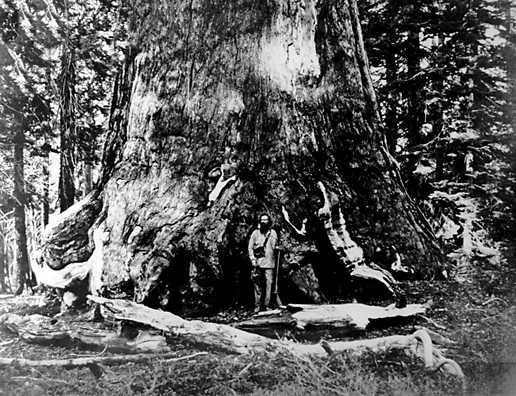
The Mariposa Grove, the very grove Lincoln protected in 1864, is the largest sequoia grove in Yosemite and holds more than 500 mature giant sequoias. Its patriarch is the Grizzly Giant, roughly 3,000 years old, the same tree Galen Clark posed beside in the photograph above. A single lower branch on the Grizzly Giant is six feet, seven inches in diameter, as thick as the base of almost any tree trunk in New England.
Walk the two-mile Grizzly Giant Loop and you pass the Bachelor and Three Graces and the California Tunnel Tree before reaching the patriarch itself. Standing under these trees rearranges your sense of time. The Grizzly Giant was a sapling before Rome was an empire.
13. El Capitan Made Yosemite The Center Of The Climbing World
El Capitan rises about 3,000 feet of sheer granite from the valley floor, and for climbers there is no more famous wall anywhere. The modern benchmark came on January 14, 2015, when Tommy Caldwell and Kevin Jorgeson topped out the Dawn Wall after 19 straight days living on the rock, the first free climb of what many call the hardest big-wall route on Earth. They used ropes only to catch falls, never to make upward progress.
Hollywood got there first, in its own way. Star Trek V, released in 1989, opens with Captain Kirk free climbing El Capitan on his shore leave, and the filmmakers made no attempt to disguise the park. Why would they? For those of us without a starship or a portaledge, the classic walk-up challenge is the cable route on Half Dome, and honest hikers should read our case for climbing Clouds Rest instead.
How To See This History For Yourself
We will say this plainly. This section is built on the park’s named viewpoints and its own records, not on a trip diary. The good news is that almost every chapter above is still standing where it happened. From the Tunnel View pullout, where we made the photograph at the top of this article, the whole 1864 grant story spreads out in one frame, El Capitan on the left, Bridalveil Fall on the right, Half Dome in the distance. The Lower Yosemite Fall trail passes the site where John Muir ran Hutchings’ sawmill. Galen Clark’s grave sits in the Valley Cemetery, ringed by the sequoias he planted himself, and the park’s ranger programs are where stories like the Buffalo Soldiers’ live on. Check the park calendar when you go.
When you are ready to plan, our guide to the best things to do in Yosemite ranks the viewpoints, walks, and big hikes in the order we would do them.

Where These Facts Come From
Every claim in this article was checked against the sources below in July 2026. Numbers that change over time, like annual visitation and glacier measurements, are stated with the year they were reported.
- NPS, Yosemite Park Statistics, for acreage and wilderness percentage
- NPS, Yosemite Indians, Their Lifeways and Destruction and Disruption, for the 8,000-year human history, Ahwahnee, the valley’s peoples, and the Mariposa Battalion’s campaign, with the Library of Congress record of Bunnell’s Discovery of the Yosemite for the 1851 entry and the naming of the valley
- NPS, Yosemite Grant Act of 1864, for the act’s language, and NPS, Yosemite Celebrates 120 Years, for the June 30, 1864 signing, the October 1, 1890 establishment, and the 1984 World Heritage listing
- Horace Greeley, An Overland Journey (1860), for his 1859 visit and his plea for the safety of the big trees
- NPS, Galen Clark, for Clark’s life, guardianship, gravesite, and the Grizzly Giant’s branch
- NPS, John Muir, for Muir’s 1868 arrival, shepherd summer, sawmill work, cabin, the 1890 campaign, and the Sierra Club presidency
- NPS, Buffalo Soldiers in Yosemite, for the Army years, the 9th Cavalry and 24th Infantry service dates, and Shelton Johnson’s work
- Library of Congress, Roosevelt, Muir, and the Camping Trip, the Sierra Club John Muir Exhibit, Theodore Roosevelt, An Autobiography (1913), and NPS, Theodore Roosevelt and Conservation, for the May 1903 trip and campsites, Roosevelt’s own words, the June 1906 recession, and his conservation record
- NPS, Remember Hetch Hetchy, for the Raker Act and the road to the 1916 Organic Act, and John Muir, The Yosemite, chapter 16, for his Hetch Hetchy words
- NPS, Clare Marie Hodges, for her 1918 hiring, duties, and her corrected place in ranger history
- NPS, Glaciers, NPS, Waterfalls, NPS, Horsetail Fall, and NPS, Mariposa Grove, for glacier status, waterfall heights, the February glow, and the sequoia counts
- UNESCO World Heritage Centre, Yosemite National Park, for the inscription, National Geographic, for the 2015 Dawn Wall free climb, and StarTrek.com, for the 1989 El Capitan opening scene
Keep Exploring Yosemite
- Yosemite National Park Guide, our full trip planning hub
- Yosemite Reservations in 2026, what you need to book and what you don’t
- Best Hikes in Yosemite National Park
- California National Parks Worth Visiting
- Yellowstone National Park Facts, the history of the first national park
- Before you go, check live alerts and air quality on our national park conditions dashboard
What to Bring to Yosemite
Gear we recommend for Yosemite. Affiliate links support our work at no cost to you.
More Than Just Parks may earn a small commission from purchases made through these links, at no extra cost to you. We only recommend gear we would actually use.
Affiliate disclosure: Some links on this page earn us a small commission at no extra cost to you. We only recommend gear we actually use.


