

July is the busiest month of the year in the national parks. Great Smoky Mountains alone logged 11.5 million visits in 2025, and the big western parks each absorbed somewhere between 3 and 5 million. If you’ve ever idled in the entrance line at Yellowstone in mid-July, you know exactly what those numbers feel like.
Here’s the part most folks never hear. While a few famous parks soak up the crowds, dozens of parks sit nearly empty in the very same month. Some of them are at their absolute best in July. A few others are empty for reasons you should respect, and we’ll be honest about which is which.
We recently rebuilt our guide to the least visited national parks using the official 2025 visitation data from the National Park Service, and that data is the backbone of this article. Every number you see here comes from the NPS calendar-year 2025 figures.
So if your July trip is still up in the air, consider this your permission slip to skip the famous entrance lines entirely. Let’s get into it.
117 public lands destinations are under threat. Get the free briefing that 27,000+ people use to stay informed and take action.

The Quiet July Parks at a Glance
Before we go park by park, here’s the lay of the land. These are full-year 2025 visitation totals, so remember that July is the busy season at most of these places. The difference is that “busy” at North Cascades means a full trailhead lot, not a 90-minute entrance line.
| Park | 2025 Visits | Typical July High / Low |
|---|---|---|
| Isle Royale | 29,091 | 69 / 50 |
| North Cascades | 46,925 | 78 / 54 |
| Great Basin | 161,210 | 85 / 58 |
| Voyageurs | 206,326 | 78 / 52 |
| Black Canyon of the Gunnison | 250,086 | 82 / 52 |
| Lassen Volcanic | 504,777 | 79 / 46 |
| Theodore Roosevelt | 729,893 | 86 / 56 |
| Canyonlands (Needles and Maze) | 796,057 parkwide | 91 / 68 |
For comparison, Yellowstone saw 4,762,988 visits in 2025, Yosemite saw 4,278,413, and Rocky Mountain saw 4,171,431. And here’s the number that really tells the story. Yellowstone logged 975,109 visits in July 2025 alone, which is more than the entire year of visitation at every single park in the table above.
1. North Cascades National Park (Washington)
North Cascades recorded just 46,925 visits in all of 2025, and it sits three hours from Seattle. We’ve called it the American Alps for years, and we stand by that. Glaciers, jagged spires, turquoise lakes, and a wilderness interior with no roads at all.
Here’s why July matters. This park spends most of the year buried in snow. The high trails like Cascade Pass and Maple Pass typically melt out in July, which makes it one of the few parks on this list where July is genuinely the smartest month to show up. The wildflower meadows along Maple Pass in late July are as good as anything we’ve filmed in the Rockies.
One honest caveat. The low number is partly a paperwork quirk. Highway 20 runs through Ross Lake National Recreation Area rather than the park proper, so drive-through traffic doesn’t count toward the park’s total. You won’t have Diablo Lake overlook to yourself. Step onto a trail that leaves the highway, though, and the crowds vanish within a mile.
Start with our guide to the best things to do in North Cascades, then check out the North Cascades park hub for maps and trip planning resources.
2. Great Basin National Park (Nevada)
Great Basin logged 161,210 visits in 2025, which made it the fourth least visited park in the lower 48. It’s also the easiest park on this list to actually reach, with a paved road that climbs from the desert floor to 10,000 feet on Wheeler Peak.
July here is a two-climates-in-one-day situation. The valley runs hot, with normal highs around 85, but the Wheeler Peak Scenic Drive lifts you into cool alpine air where the bristlecone pines grow. Some of those trees were already thousands of years old when Rome was founded. Walking among them in July, with snow still patching the cirque below Wheeler Peak, is one of the most underrated experiences in the entire park system.
Then the sun goes down and the real show starts. Great Basin is an International Dark Sky Park with some of the darkest night skies in the country, and the July Milky Way here is something folks drive across two states for. Lehman Caves tours run year-round and hold a steady cave temperature no matter what the desert is doing.
Our Great Basin itinerary covers the full park, and the Great Basin hub has everything else you need.
3. Isle Royale National Park (Michigan)
Isle Royale saw 29,091 visits in 2025, making it the least visited park in the lower 48. It’s also the only national park that closes completely for winter, so its entire year of visitation gets squeezed into about five months. July sits right in the heart of that window.
And what a window it is. Normal July highs around 69 degrees while the rest of the country swelters. Moose feeding in the inland lakes. Loons calling across the water at dusk. A roadless island wilderness in Lake Superior where the loudest thing you’ll hear all day is your own paddle.
The catch is commitment. You get here by ferry, seaplane, or private boat, and the shortest ferry crossing still takes a couple hours. That crossing is exactly what keeps the numbers low, and it’s also why Isle Royale has one of the highest repeat visitation rates in the park system. The folks who make it once keep coming back.
Two pieces of honesty before you book. First, the bugs. July on Isle Royale means mosquitoes and black flies, sometimes in numbers that test your sense of humor, especially on calm days in the interior. Bring a head net and real repellent, camp where the breeze reaches you, and you’ll be fine. Pretend they don’t exist and the island will correct you.
Second, the ferry decision is the actual trip planning, so here it is. From Michigan, the NPS-operated Ranger III sails from Houghton to Rock Harbor in about six hours, and the Isle Royale Queen IV makes a faster run from Copper Harbor to Rock Harbor. From Minnesota, the Voyageur II departs Grand Portage and serves Windigo on the island’s west end. There’s also a seaplane out of the Houghton area if the budget allows. July departures are the first to fill, so book your crossing before you book anything else. Our guide to things to do at Isle Royale will help you decide between a day trip and a multi-day backpacking route, and the Isle Royale hub covers logistics.
4. Lassen Volcanic National Park (California)
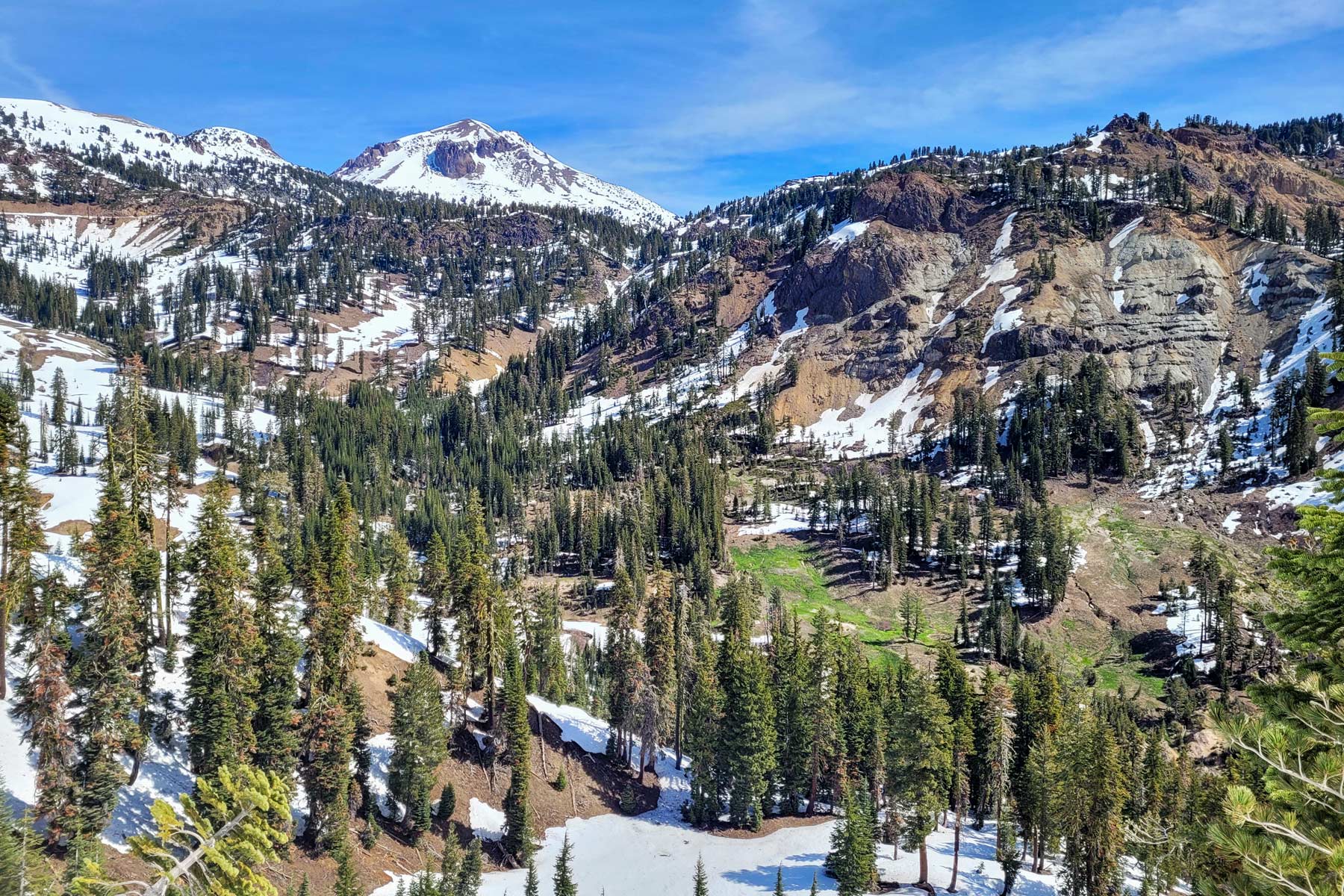
Lassen recorded 504,777 visits in 2025. Yosemite, its fellow California park a few hours south, recorded 4,278,413. Read those two numbers again and tell us why anyone fights for a Yosemite campsite in July.
Lassen is essentially a sampler platter of Yellowstone’s geology without Yellowstone’s traffic. Boiling mudpots and steaming fumaroles at Bumpass Hell. An honest-to-goodness volcano you can summit in a half-day hike. Alpine lakes that hold ice into early summer.
July is prime time here for a simple reason. Lassen gets crushed with snow most years, and the full park highway often doesn’t melt open until late June or July. Normal July days run around 79 degrees with cool nights in the 40s, the hydrothermal areas are fully accessible, and the Manzanita Lake campground actually has space midweek.
Here’s our full guide to things to do at Lassen Volcanic, plus the Lassen hub.
5. Black Canyon of the Gunnison National Park (Colorado)
Black Canyon saw 250,086 visits in 2025, while Rocky Mountain, its neighbor to the northeast, saw 4,171,431. Same state, same month, two completely different experiences at the entrance station.
The canyon itself is one of the most dramatic sights in the country. It’s so deep and narrow that parts of the inner gorge receive only minutes of sunlight a day. The Painted Wall, at 2,250 feet, is the tallest sheer cliff in Colorado. In July you can stand at Chasm View at midday, watch swifts dive into the void, and share the railing with a handful of people.
July honesty for this one. Rim elevations sit around 8,000 feet, so normal highs near 82 feel manageable, but afternoon thunderstorms are a near-daily ritual in a Colorado July. See the views in the morning, then retreat to the town of Montrose for lunch like a local would.
Our guide to things to do at Black Canyon of the Gunnison covers both rims, and the Black Canyon hub has the rest.
6. Voyageurs National Park (Minnesota)
Voyageurs logged 206,326 visits in 2025, and it might be the most purely pleasant July park in America. Normal highs around 78, water everywhere you look, and long northern evenings where the light hangs on past 9 pm.
This is a water park in the original sense. More than a third of Voyageurs is water, and the best campsites are reachable only by boat, which is exactly the filter that keeps the numbers down. Rent a boat or book a tour out of International Falls, find a houseboat, or paddle the interior lakes. Walleye dinner is strongly encouraged.
The night sky here deserves its own mention. Voyageurs has certified dark skies, and on a clear July night the Milky Way over the water is worth staying up for. The northern lights are real here too, but July nights this far north barely get fully dark, so treat the aurora as a late August through winter game rather than a July promise.
And the same bug honesty we gave Isle Royale applies on this border lake. July brings mosquitoes and black flies, worst at dusk and in the woods, much better out on open water with a breeze. Repellent and a head net take the issue from miserable to manageable, and evenings on a houseboat deck beat evenings in the trees.
Start with our guide to the best things to do at Voyageurs and the Voyageurs hub.
7. Theodore Roosevelt National Park (North Dakota)
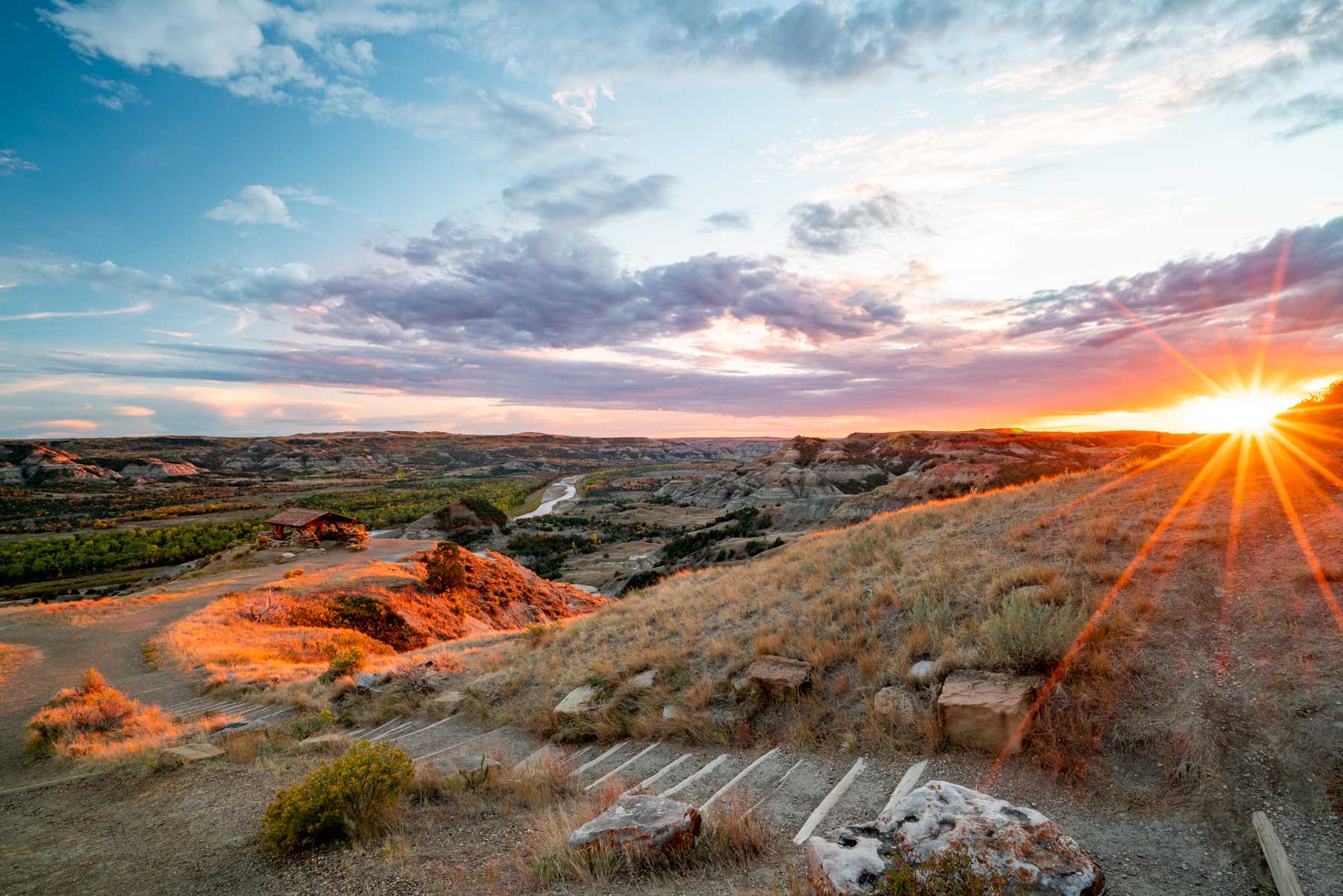
Theodore Roosevelt saw 729,893 visits in 2025, which sounds like a lot until you remember it’s spread across two units 70 miles apart and an entire summer of long daylight. We filmed here for weeks and came away convinced it’s one of the most underrated parks in the system.
July is peak wildlife season in the badlands. Bison herds with new calves, wild horses in the South Unit, prairie dog towns in full chaos, and golden light on the buttes that lasts until nearly 10 pm this far north. Normal highs around 86 are real but honest, with dry air and cool mornings in the 50s.
Our move is the North Unit. It gets a fraction of the South Unit’s traffic, and River Bend Overlook might be the single best view in either Dakota. If you’re driving I-94 across the country anyway, there is no excuse to skip this place.
Here’s our full list of things to do at Theodore Roosevelt, plus the Theodore Roosevelt hub.
8. Canyonlands National Park, the Needles and the Maze (Utah)
This one comes with an asterisk the size of a canyon. Canyonlands logged 796,057 visits in 2025, and most of those folks went to one place, the Island in the Sky district near Moab. The Needles district sees a fraction of that, and the Maze is one of the most remote spots in the lower 48, period.
Now the honesty. July in Canyonlands is hot, with normal highs around 91 and exposed terrain that makes it feel hotter. We are not telling you to backpack the Needles in July. We are telling you that sunrise and evening hours in the Needles in July are workable, spectacular, and almost completely empty while Arches up the road runs at full capacity. Hike early, carry more water than feels reasonable, and be done with anything strenuous by 11 am.
If your July plans already include Utah, this is how you save the trip from the crowds. Our guide to things to do in Canyonlands breaks down all the districts, and the Canyonlands hub has maps and logistics.
The Alaska Option. Wrangell-St. Elias National Park and Preserve
We’d be cheating you if we left Alaska off a July list, because July is exactly when the truly empty parks are at their best. And the one we’d send most folks to first is Wrangell-St. Elias, which saw 108,840 visits in 2025. That’s the largest national park in America, 13.2 million acres, roughly six Yellowstones, drawing a full year of visitation that Yellowstone tops in about four days of a typical July.
Here’s the part that surprises folks. You can drive there. The McCarthy Road runs 60 miles of old railbed gravel to the footbridge at McCarthy, and from there it’s a shuttle or a walk up to Kennecott, the historic copper mill town perched below glaciated peaks. Day hikes onto Root Glacier leave right from town. July gives you long daylight, the mildest weather of the year, and a scale of country that resets your sense of what big means.
If you’re set on the fly-in parks instead, Lake Clark saw 19,778 visits in 2025 and Katmai saw 34,479, and both are bucket-list trips in their own right. Start with our Wrangell-St. Elias guide and the Wrangell-St. Elias hub.
The July Question Nobody Answers. Wildfire Smoke
Before you book any western park in July, we need to talk about smoke, because it’s the one variable that can rearrange a summer trip and almost no planning guide mentions it. Several parks on this list sit in smoke-prone country. North Cascades lost much of its 2024 season to fire closures, which is part of why its 2025 number jumped 185 percent as folks came back. Lassen is still recovering from the 2021 Dixie Fire. And Black Canyon closed entirely for the first time in its history in July 2025, when the lightning-sparked South Rim Fire burned through campgrounds and overlooks. The park has since reopened, though a couple of rim trails now pass through burned ground.
None of that is a reason to cancel. It’s a reason to check conditions a few days before you go and have a flexible plan. We built two free tools for exactly this. Our national park wildfire tracker shows you active fires and closures near every park in real time, and our public lands air quality map shows current smoke and air quality conditions across all of them. Check both the week of your trip, and if your first choice is smoked in, this list just handed you seven backups.
Quiet for a Reason. Please Skip These in July
Some parks are empty in July because July is trying to hurt you. We love these places dearly, in the right month. This is not that month.
Death Valley National Park. The average July high at Furnace Creek is around 116 degrees, and this is the place that holds the hottest air temperature ever reliably recorded on Earth. People do drive through in summer. Rangers spend their summer responding to the ones who underestimated it. Go between November and March and it’s one of the best parks in the country. Read up at our Death Valley hub.
Big Bend National Park. The Chisos Basin sits high enough to stay tolerable, but the desert floor and the river corridor where most of the park’s best ground lives run well past 100 degrees in July. Big Bend logged 568,104 visits in 2025, and almost none of them were in summer, for good reason. It’s a November through April park. Save it for then and see our Big Bend hub when you do.
Everglades National Park. July is the wet season. That means afternoon downpours, heat indexes past 100, wildlife dispersed across flooded terrain so it’s harder to see, and mosquitoes that locals describe with words we can’t print. The dry season, roughly December through April, is when the Everglades earns its reputation. Details at our Everglades hub.
And one near miss worth explaining. Great Sand Dunes almost made our quiet list, but by July the famous Medano Creek has usually dwindled to a trickle and the sand surface can hit 150 degrees on a summer afternoon, hot enough to burn paws and bare feet. Go in late May or early June instead, when the creek is flowing and the dunes are kind.
Practical Pivots from the Crowded Parks
If you already had your heart set on one of the giants, here’s how we’d translate that trip into a quieter July without losing the thing you wanted in the first place.
| If You Wanted | Go Instead To | What You Keep |
|---|---|---|
| Yellowstone (4.76M visits) | Lassen Volcanic (504K) | Mudpots, fumaroles, volcanic peaks |
| Glacier (3.14M) | North Cascades (47K) | Glaciers, alpine passes, wildflowers |
| Rocky Mountain (4.17M) | Black Canyon of the Gunnison (250K) | Colorado drama, big vertical, cool rims |
| Arches (1.51M) | Canyonlands Needles district | Red rock, sandstone spires, solitude |
| Yosemite (4.28M) | Great Basin (161K) | Granite high country, ancient trees, dark skies |
| Grand Teton (3.80M) | Theodore Roosevelt (730K) | Big wildlife, big light, room to breathe |
And if you simply must do a famous park in July, the playbook is the same one we always preach. Enter before 7 am, hike past the first mile where most folks turn around, and plan your midday around the busy hours instead of fighting them.
One More Trick. The National Forest Next Door
Nearly every crowded park shares a boundary with national forest land that offers similar scenery, free dispersed camping, and a tiny fraction of the people. The Shoshone next to Yellowstone, the Flathead next to Glacier, the Arapaho next to Rocky Mountain. We put together a whole guide to the national forests for exactly this reason. It’s the best-kept non-secret in public lands.
That’s a Wrap, Folks
The parks above prove the point we keep coming back to. Low visitation almost never means low quality. It usually just means a ferry, a gravel road, a long drive, or a famous neighbor hogging the spotlight.
For the complete countdown with all 63 parks ranked by 2025 visitation, head over to our full guide to the least visited national parks in America. Pick one, go in July, and enjoy having the place mostly to yourself.


