

September. The best time to visit Grand Teton National Park is September, and it isn’t particularly close. Golden aspens, bugling elk, moose in full rut, alpenglow that lingers, and a park that empties out a little more every day after Labor Day. I’ll make the full case below, but I want my answer on the record up top.
The longer answer depends on what you’re chasing, because Grand Teton runs on three overlapping calendars. There’s a weather calendar, which is short and brutal at 6,500 feet. There’s a wildlife calendar, which is the best in the lower 48 alongside Yellowstone’s. And there’s a light calendar, which is the one photographers actually plan around. Let’s take them in order.
One thing to clear up before the calendars, because it’s the question I get most. Grand Teton has no timed entry and no vehicle reservation system in 2026. None. While Rocky Mountain, Glacier, Yosemite, and Arches all make you race strangers on Recreation.gov at 8 a.m., here you can roll up to the gate on a July Saturday at noon with nothing but an entrance pass. What the park does have in 2026 is construction, a lot of it, which earns its own section below because it rearranges some of the standard advice.
Grand Teton Month by Month
These are NOAA 30 year normals from the Moose station on the valley floor, which is where you’ll actually be standing. The Tetons rise 7,000 feet straight off this valley, so subtract aggressively for anything you plan to climb.
Love Grand Teton? It's one of 117 threatened public lands destinations we're tracking. Get the free briefing.
| Month | High / Low (F) | What’s actually happening |
|---|---|---|
| January | 27 / 1 | Deep winter. Teton Park Road closed, groomed for skiing. |
| February | 32 / 6 | Cold, clear stretches. Frosted cottonwoods at dawn. |
| March | 42 / 15 | Snowpack peaks. Bears start emerging late in the month. |
| April | 50 / 24 | Mud and melt. Quietest month. Road still closed to cars through April 30. |
| May | 62 / 33 | Teton Park Road reopens May 1. Baby animals everywhere. Jenny Lake shuttle starts May 15. |
| June | 71 / 39 | Wildflowers, snow still on high trails, crowds arriving. |
| July | 82 / 44 | Peak season. High trails finally open. Afternoon thunderstorms. |
| August | 81 / 42 | Peak season continues. Occasional wildfire smoke. |
| September | 71 / 34 | Aspens turn, elk bugle, moose rut, crowds thin. The month. |
| October | 56 / 25 | Late color early on, first real snows by Halloween. |
| November | 39 / 15 | Teton Park Road closes November 1. The valley goes quiet. |
| December | 28 / 4 | Winter proper. Skiers and almost nobody else. |
Note those lows. Even in July the valley floor drops to 44 at night, and a 34 degree September dawn is normal. I’ve watched people step out at Mormon Row in shorts in late September with expressions I can only describe as betrayed. Bring layers in every month with no exceptions.
The 2026 Construction Reality Check
Now the asterisk on everything below. Grand Teton is running its biggest construction season in decades in 2026, and it touches several of the park’s marquee spots. Every recommendation in this article has been reconciled against the closures, but here’s the full picture so your itinerary doesn’t write checks the roads can’t cash. All of it is from the park’s official road construction page, which is worth a check before you drive.
| Where | When | What it means in 2026 |
|---|---|---|
| Moose-Wilson Road | May 1 to Nov 15 | Closed between the Rockefeller Preserve and Moose May 1 to June 19, 45 minute delays June 20 to Sept 7, then closed again Sept 8 to Nov 15. |
| Death Canyon Road and Trailhead | May 2026 to June 2027 | Fully closed. All of it, all season. |
| Teton Park Road at Moose | Through the 2026 season | 20 minute delays at the new roundabout site, on top of the entrance station line. |
| Taggart Lake Trail | All season | The short northern route is closed. The southern route still reaches the lake at 4.24 miles one way with 711 feet of gain. |
| Mormon Row | June to November | Open, but construction equipment is visible and audible at the historic district. |
| North Park Road | Summer 2026 | 15 minute delays by day, up to an hour overnight (9 p.m. to 6 a.m.), which matters if you drive to sunrise spots in the dark. |
The practical translation shows up in the sections below, but the headline is this. The Moose-Wilson corridor is a bad bet for most of 2026, Death Canyon is off the menu entirely, and dawn shooters should budget extra time for the delays. The mountains themselves remain under no construction whatsoever.
The Wildlife Calendar
Grand Teton compresses an absurd amount of wildlife into a narrow valley, which means timing matters more here than almost anywhere.
- Late March through May. Grizzlies emerge from dens, and mothers with cubs work the area around Willow Flats and Pilgrim Creek. This was the kingdom of Grizzly 399, the most famous bear in the world, who raised 18 known cubs in view of the road before a driver killed her south of Jackson in October 2024. Her descendants still work this same country, and spring is when you’ll see them. Give bears the legally required distance of 100 yards, which the people parked on the shoulder with phones out routinely do not.
- Late May through June. Calving season. Elk calves, bison calves, moose calves, pronghorn fawns. Also the season predators pay closest attention, which is exactly why the watching is good.
- Mid September through October. The rut. Bull moose spar in the willows along the Gros Ventre River, which is the corridor to watch in 2026 because Moose-Wilson Road closes for construction on September 8, right as the rut gets good. Elk bugle at dawn and dusk through the sagebrush flats. Hearing a bugle echo off the Tetons in cold morning air is a top five national park experience, full stop.
- Winter. Thousands of elk concentrate on the National Elk Refuge just south of the park, with bighorn sheep on Miller Butte and moose browsing the river bottoms.
The Light, Because That’s Why You’re Really Here
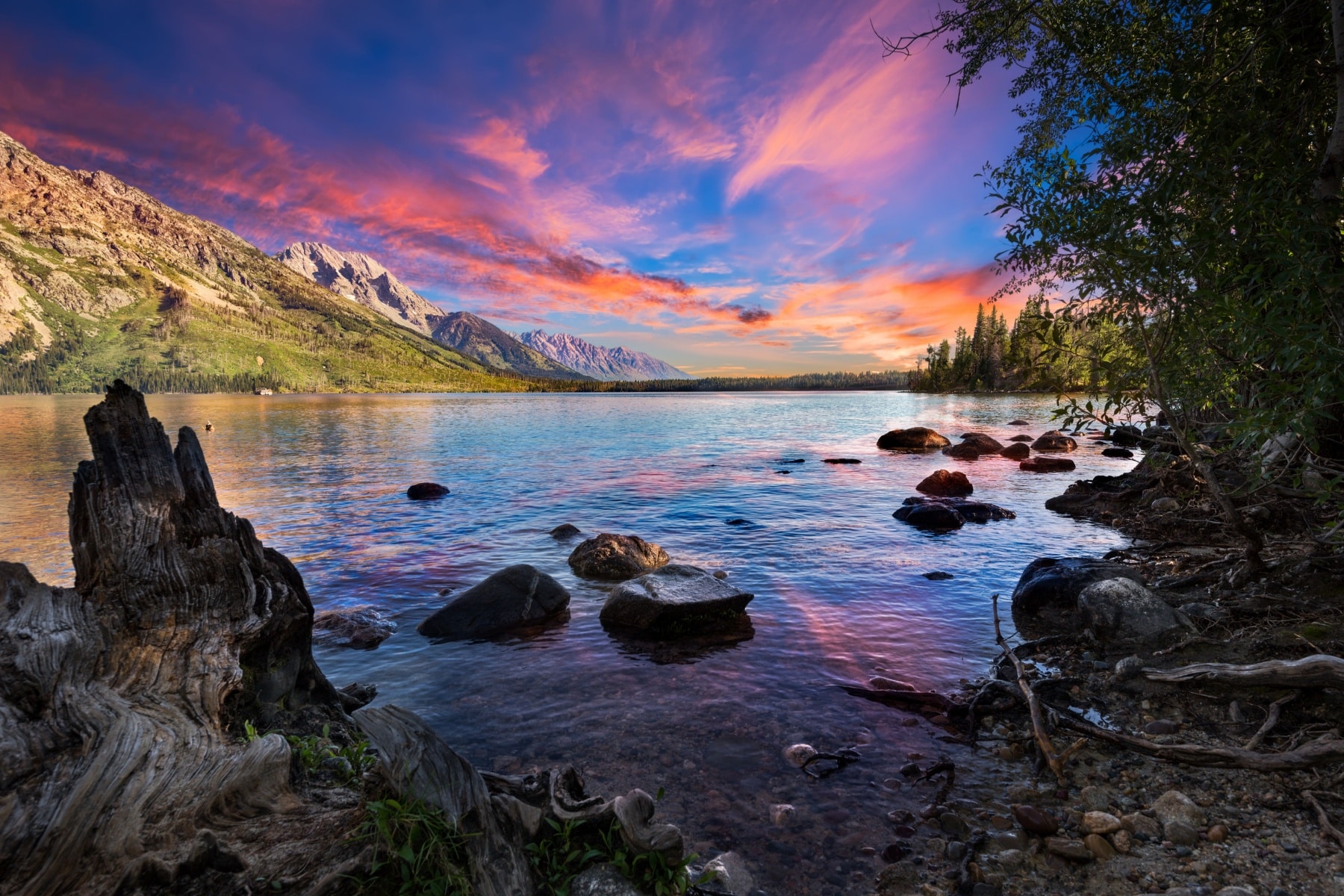
The Teton range faces east over a flat valley with nothing to block first light, which is why photographers treat this park like a pilgrimage site. Alpenglow hits the Grand before sunrise and turns the whole range pink for about ten minutes. The classic spots earn their reputations. Mormon Row for the Moulton barns with the range behind them, Schwabacher Landing for reflections on still beaver ponds, Oxbow Bend for Mount Moran doubled in the Snake River.
Seasonally, here’s how I’d rank it. Late September is first, when the cottonwoods at Oxbow Bend go gold in the last week of the month and you can put fall color, river, and mountain in one frame. Winter is a sleeper second, with the range plastered white and frost on the cottonwoods, though you’ll work for it at 1 degree. June gives you wildflowers in the sagebrush for foregrounds. Midsummer is the weakest light, with haze and the occasional smoke (our live air quality map will tell you whether the murk over the valley is weather or wildfire before you spend a 4:30 a.m. wakeup on it). At Mormon Row in peak season, expect 30 tripods at dawn (the barns have a fan club), and in 2026 expect construction equipment within earshot and sometimes within frame from June through November. Walk 200 yards north along the row and you’ll have a comparable composition alone, though this year you may be cropping out a front loader either way.
Summer and the Yellowstone Pipeline
July and August are the months everything is open, every trail is snow-free, and every parking lot is full by 9 a.m. Grand Teton’s summer crowds have a particular flavor because the park sits directly on the road to Yellowstone, connected to the South Entrance by the John D. Rockefeller Jr. Memorial Parkway. A huge share of summer traffic is passing through on the grand loop of both parks, which we’ve broken down in our Grand Teton to Yellowstone driving guide and our honest comparison of Yellowstone vs Grand Teton. (Short version of that one, Teton has better mountains, Yellowstone has better weirdness, September solves both.)
The pass-through traffic concentrates brutally at Jenny Lake, the park’s most loved spot. The Jenny Lake shuttle boat runs across to the Cascade Canyon side from May 15 through September 30 in 2026, every 10 to 15 minutes, $20 round trip for adults, no reservations taken. It saves you 4 miles of round trip walking on the way to Hidden Falls and Inspiration Point, which is exactly why the boat dock line gets long by mid morning in August. Take the first boats of the day (7 a.m. in midsummer) or hike the lake trail while everyone else queues.
Summer strategy in one paragraph. Hike at dawn, and I mean trailhead at 6 a.m., not breakfast at 6 a.m. Save Jenny Lake and String Lake for weekdays. Spend afternoons on the quieter east side roads, Antelope Flats and the Gros Ventre, where the bison are anyway. And if you want big hikes without the circus, our guide to the best hikes in Grand Teton points you up Paintbrush or Granite Canyon, where crowds dissolve a mile past the trailhead. Death Canyon, the usual answer here, is off the table in 2026, with its road and trailhead closed for construction through June 2027. Reach Granite Canyon from the Teton Village end of Moose-Wilson Road, since the Moose end spends most of 2026 closed or delayed.
The Snow Asterisk on June and July
Every June, people look at a 71 degree forecast and assume the whole park is open for hiking. The valley is. The mountains are not. Snow lingers on the high trails far later than first-time planners expect, and the marquee routes through the canyons hold steep snowfields into July. Paintbrush Divide, the high point of the park’s most famous loop, regularly carries snow that demands an ice axe until late July. Lake Solitude and the upper reaches of Cascade Canyon clear earlier but not by much.
So if your trip is built around big alpine days, the real hiking season runs from mid July through mid September, a window of about nine weeks. June travelers should plan valley hikes, lower Cascade Canyon, String Lake, and wildflower walks through the sagebrush, then check current trail conditions with the rangers at Moose before pointing uphill. Taggart and Bradley Lakes still work in 2026 with an asterisk. The short northern route to Taggart is closed all season for rehabilitation, so the lake comes via the southern route at 4.24 miles one way with 711 feet of gain, which turns a quick leg stretcher into a half day. The mountains will still be there in August. The snowbridge over the creek might not be.
The other thing nobody puts in the June brochure is mosquitoes. They hatch with the melt and stay thick in the willows and around the lakes from roughly mid June into August, and on a still July evening at String Lake they are the dominant wildlife encounter. Bring repellent, or visit in September, when the first frosts have settled the argument. (You may be noticing a theme.)
The Case for September, Spelled Out
Here’s why September wins. The average high is still 71, which is perfect hiking weather. The aspens and cottonwoods turn gold from roughly the third week of September into early October, and our fall foliage tracker follows the color down the valley with daily updates once the season turns. The elk rut and the moose rut both run through the month, so the valley sounds alive at dawn. The summer families are gone after Labor Day, and the crowd curve drops from peak to manageable in about two weeks. The Jenny Lake boats run through September 30 and most facilities hold on through the month, though 2026 takes one bite out of the calendar. Moose-Wilson Road closes for construction on September 8 and stays closed into November, so build your moose watching around the Gros Ventre instead. And the light gets that low, clean autumn angle that makes the range look carved.
The trade-offs are real but small. Nights are cold, with normal lows around 34 and frost common. The first dustings hit the high peaks, so shoulder-season gear applies above 9,000 feet. And the secret is out enough that late September weekends at Oxbow Bend feel like a photo workshop convention. Go midweek, go anyway.
Winter and the Long Closure
Grand Teton doesn’t close in winter, but it transforms. The Teton Park Road, the inner road that runs along the base of the range past Jenny Lake, closes to vehicles from November 1 through April 30 each year and is scheduled to reopen May 1. From the Taggart Lake Trailhead to Signal Mountain Lodge it becomes a groomed corridor for skiing, snowshoeing, and walking, which means in winter you can stand in the middle of the park’s most scenic road in total silence. Highway 26/89/191 along the east side stays open all year, so Mormon Row country, the Gros Ventre, and the airport (yes, this park has a commercial airport in it, the only one in the system) remain reachable.
Winter here is for self-sufficient travelers. Services inside the park drop to nearly nothing, temperatures sit below freezing for months, and the valley holds some of the coldest air in the lower 48 on clear January nights. The reward is the range at its most dramatic, wildlife pushed down to the valley floor, and Jackson’s full restaurant scene 20 minutes away when you’re done pretending to enjoy minus 10.
Quick Picks by Trip Type
- Photographers. Last week of September. Gold cottonwoods at Oxbow Bend, frost at Schwabacher, alpenglow with bite.
- Wildlife watchers. Mid May for bears and babies, or mid September for the rut (the Gros Ventre, not Moose-Wilson, in 2026). Dawn and dusk in both cases, binoculars always.
- Big-mile hikers. Mid July through mid September, once the divides melt out.
- Budget and quiet. May or October. Shoulder-season rates in Jackson, empty pullouts, weather roulette.
- Skiers and snowshoers. January through March on the closed Teton Park Road, with the range doing its best impression of the Alps.
One logistical note that shapes all of this. Most lodging inside the park operates only from roughly mid May through early October, and Jenny Lake campsites in summer are some of the hardest reservations in the park system. Outside that window, and honestly even inside it, Jackson is your base. Book it early for September, and I mean early. The park lodges open reservations roughly a year ahead, and September in Jackson now books many months out, because the month has quietly become the town’s second high season for exactly the reasons in this article.
The Verdict
Go in September, the earlier half for warmth or the later half for gold. June is the runner-up for wildflowers and baby animals, with the caveat that high trails are still under snow. July and August deliver everything except solitude. May is the value month, with the Teton Park Road newly open and bears out with cubs. Winter is its own discipline. April is for locals and the deeply committed.
However you time it, get up for at least one sunrise. The Tetons at midday are impressive. The Tetons at first light are the reason the parking lots at Schwabacher Landing have a sunrise rush hour. For the rest of your planning, start with our full Grand Teton National Park guide, and if Yellowstone is on the itinerary too, read our comparison before you decide how to split your days.
What to Bring to Grand Teton
Gear we recommend for Grand Teton. Affiliate links support our work at no cost to you.
More Than Just Parks may earn a small commission from purchases made through these links, at no extra cost to you. We only recommend gear we would actually use.
Affiliate disclosure: Some links on this page earn us a small commission at no extra cost to you. We only recommend gear we actually use.
More Than Just Parks Film Watch our 8K film of Grand Teton We spent weeks in Grand Teton, one of our favorite public lands destinations, capturing it the way it deserves. Take a few minutes and see it for yourself.


