


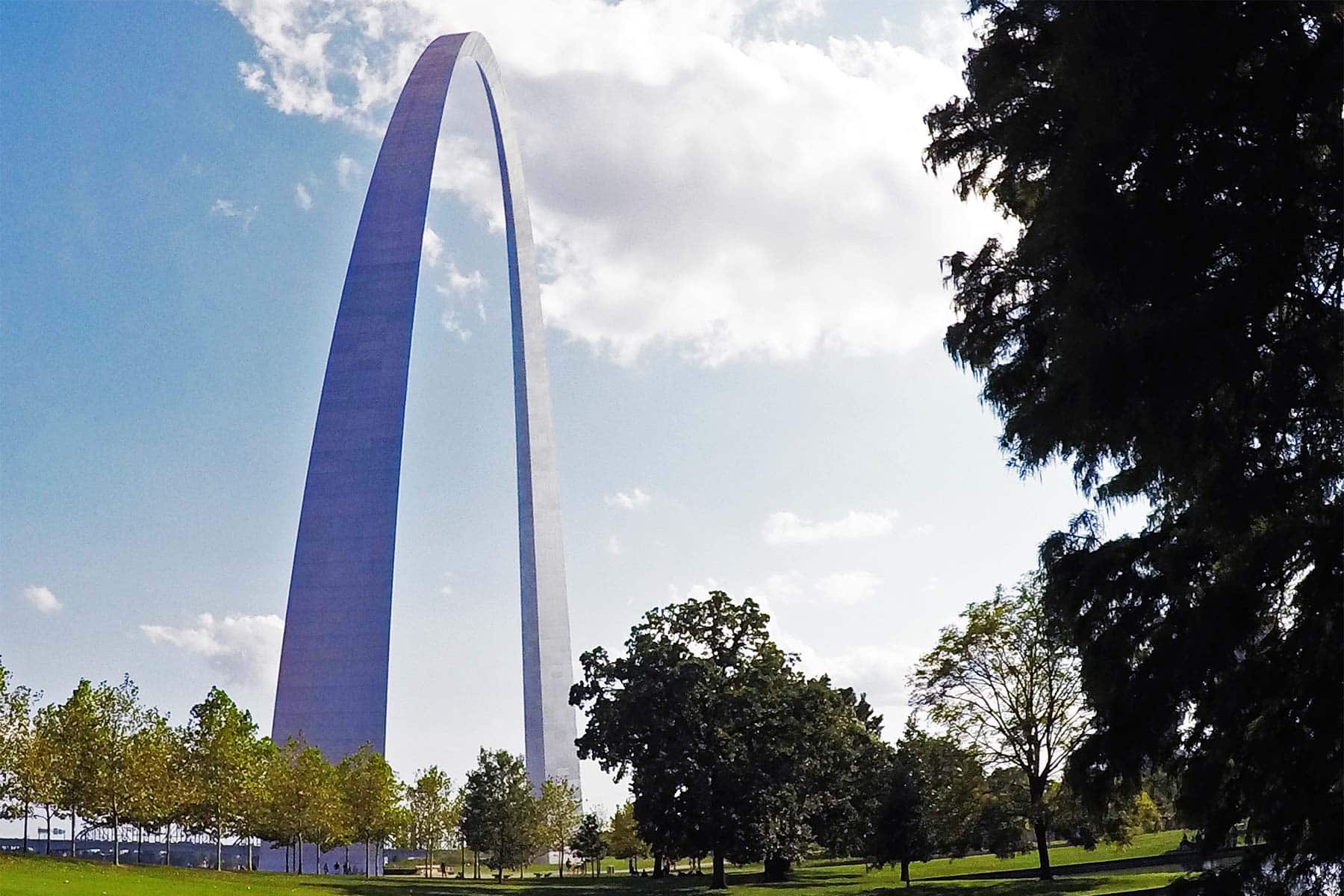
The tallest man-made monument in the United States does not stand over a canyon or a mountain valley. It rises out of 91 acres of downtown St. Louis, a stainless steel curve 630 feet high above the Mississippi River, and it crowns the smallest national park in the country.
What follows are 10 facts about Gateway Arch National Park, the architect who designed its monument, the workers who built it, and the courthouse where an enslaved man and woman sued for their freedom. For trip planning, start with our full Gateway Arch National Park guide.
Tony Pattiz taught American history for more than 25 years before he began writing it for this site, and the ground this park covers, Jefferson’s purchase, the road west, the Dred Scott case, is the ground he taught longest. More Than Just Parks has not filmed at Gateway Arch, so this piece leans on the historical record rather than our cameras. Every date, number, and name below has been checked against the National Park Service and the primary sources listed at the end of this article. Last verified July 2026.
Gateway Arch National Park Basics
- Location: Downtown St. Louis, Missouri, on the west bank of the Mississippi River
- Size: 91 acres, the smallest national park in the United States
- The Arch: 630 feet tall and 630 feet wide from leg to leg
- Visitation: 2,209,028 recreation visits in 2025, per NPS Stats
- First protected: December 21, 1935, as the Jefferson National Expansion Memorial
- Redesignated: February 22, 2018, as Gateway Arch National Park
- Designations: The Gateway Arch became a National Historic Landmark in 1987
1. It Is The Smallest National Park In The United States
Start with the fact that makes this park an outlier. The National Park Service puts it plainly: Gateway Arch National Park contains only 91 acres, which makes it the smallest national park in the United States. The next smallest, Arkansas’s Hot Springs, covers about 5,550 acres, room enough to hold this park’s entire footprint dozens of times over. We told that park’s strange story in our Hot Springs National Park facts.
Love Gateway Arch? It's one of 117 threatened public lands destinations we're tracking. Get the free briefing.
Gateway Arch protects no wilderness and no natural wonder. Its grounds are a landscaped urban green space in the middle of a major city. What it protects instead is a story, told through a monument and two of the most consequential courtrooms in American history, and that unusual mission is a large part of why its promotion to national park status stirred debate, which we will get to below.
2. A St. Louis Lawyer Proposed It And Franklin Roosevelt Signed It Into Being
Why put a national memorial on the St. Louis riverfront at all? Because this is where the West began. Thomas Jefferson’s Louisiana Purchase of 1803 doubled the size of the young country, and the Lewis and Clark expedition pushed off from the St. Louis area in 1804 and returned to the city’s levee in 1806. For the wagon trains that followed, St. Louis was the doorway to the frontier.
The idea of memorializing that history came from Luther Ely Smith, a St. Louis attorney and civic booster who proposed a riverfront memorial to Jefferson and westward expansion in 1933 and then chaired the association that fought for it. His persistence paid off on December 21, 1935, when President Franklin D. Roosevelt signed Executive Order 7253, creating the Jefferson National Expansion Memorial under the brand-new Historic Sites Act. The green square connecting the Old Courthouse to the Arch grounds is named for Smith today.

3. The Winning Telegram Went To The Wrong Saarinen
In 1947 the memorial association launched a nationwide design competition, and by the deadline 172 entries had arrived, judged anonymously by number so the jury saw plans rather than names. Five entries advanced to the final round. When the association wired congratulations, the telegram was addressed simply to “Mr. E. Saarinen,” and it landed with Eliel Saarinen, the celebrated Finnish architect, who broke out the champagne.
The celebration lasted about three days before the correction came through. The winner was his son and studio partner Eero, whose entry was a 630-foot stainless steel arch. The mix-up was almost forgivable. Father and son shared a last name, a first initial, an office, and, remarkably, an August 20 birthday. Eero won the final judging in 1948, and the family reportedly toasted him all over again.
Neither an obelisk nor a rectangular box nor a dome seemed right on this site or for this purpose. But here, at the edge of the Mississippi River, a great arch did seem right.
Eero Saarinen, on his design for the Jefferson National Expansion Memorial

4. Eero Saarinen Never Saw His Arch Rise
Here is the sad twist in the story. Eero Saarinen died of a brain tumor on September 1, 1961, at age 51, before a single section of his monument existed. Construction of the Arch began on February 12, 1963, and the final section was set in place on October 28, 1965. The total building cost came to about 13 million dollars, tram system included.
Saarinen spent the years between the competition and his death designing some of the most recognizable modern buildings in America, including the General Motors Technical Center near Detroit, the swooping TWA terminal in New York, and the main terminal at Washington Dulles International Airport. The Arch became his memorial as much as Jefferson’s.
5. The Arch Is Exactly As Wide As It Is Tall
The detail that surprises most first-time visitors is hiding in plain sight. The Arch stands 630 feet tall, and the distance between the outside edges of its two legs at ground level is also exactly 630 feet. Because the legs curve away from you, the eye insists the monument is taller than it is wide. It is not.
The shape is a weighted catenary curve, the form a hanging chain takes when held at both ends, flipped upside down. It was assembled from 142 prefabricated sections, each a triangle in cross section, and its skin required 886 tons of stainless steel, which is how it earned its standing as America’s tallest man-made monument, higher than the Washington Monument and the Statue of Liberty.

6. It Was Built To Sway, And Nobody Died Building It
A 630-foot steel ribbon has to bend or it will break. According to the National Park Service, the Arch was engineered to sway as much as 18 inches in 150 mile per hour winds. On an ordinary blustery day it barely moves; a 50 mile per hour wind shifts the top about an inch and a half to each side of center.
The human record is more remarkable than the engineering one. The men who built the Arch worked on open steel hundreds of feet above the ground, and the builders themselves recalled the grim prediction that thirteen workers would be killed before it was finished. Not one died. The construction crews topped out the monument in 1965 with a perfect safety record that nobody in the industry had expected.
7. A Tram Part Elevator And Part Ferris Wheel Climbs Each Leg
How do you move people up the inside of a curve? No existing elevator could do it. Dick Bowser, an elevator man who never finished his engineering degree, was given just two weeks to produce a concept, and he delivered a one-of-a-kind tram system whose barrel-shaped cars rotate to stay level, part elevator and part Ferris wheel, as they travel 748 feet up through each hollow leg. The north tram opened to the public on July 24, 1967, and the south tram followed in 1968. Both still run on Bowser’s design.
Tram tickets are timed and sell out on busy days, and prices and hours change, so we do not publish them here. Get the current details from the official Gateway Arch site, and see our Gateway Arch guide for how to fit the ride into a visit.

8. The Dred Scott Case Began In The Park’s Old Courthouse
Two blocks west of the Arch stands the building I would argue is the most important thing in this park. The Old Courthouse was the site of more than 300 suits for freedom, cases in which enslaved people sued for their liberty. One of them changed the country.
On April 6, 1846, Dred Scott and his wife Harriet filed suit here against Irene Emerson, arguing that their years of residence in free territory made them free. They lost their first trial in 1847 on a hearsay technicality, won their freedom outright at a second trial in 1850, and then watched the Missouri Supreme Court strip it away on appeal in 1852. The case ended at the United States Supreme Court in 1857, where Chief Justice Roger Taney’s majority ruled that African Americans were not citizens and that the Missouri Compromise was void. The decision inflamed the divide that soon broke into civil war.
The Scotts’ own story has a bittersweet coda. Returned to the Blow family, who had known Dred since childhood, they were freed in May 1857, just months after the ruling. Dred Scott died of tuberculosis in September 1858. Harriet lived nearly twenty years more, and their descendants still live in St. Louis.

9. The Old Courthouse Reopened In 2025 After A Sweeping Renovation
The courthouse itself is older than the state’s Civil War scars. Construction began in 1839, and in the 1870s its courtrooms heard another landmark fight when Virginia Minor challenged Missouri’s refusal to let women vote, a case that carried her name to the Supreme Court.
After a two-year closure, the building reopened on May 3, 2025, with the first elevator in its history, restored courtrooms, and new galleries, including an exhibit devoted to Dred and Harriet Scott and one tracing African American life in St. Louis. If you make time for only one indoor stop in this park, a retired history teacher’s advice is to make it this one.
10. It Has Been A National Park Only Since 2018
For most of its life this place was the Jefferson National Expansion Memorial. That changed on February 22, 2018, when the Gateway Arch National Park Designation Act became law. The new title drew grumbling from purists who reserve the words national park for vast natural places, and the argument has never fully died down. Whatever you call it, the site earned its promotion in style.
The redesignation capped the CityArchRiver project, a 380 million dollar overhaul that stands as the largest public-private partnership in National Park Service history. It added eleven acres of parkland, more than five miles of paved paths, a land bridge over the interstate that once cut the Arch off from downtown, and a reimagined underground museum, which opened on July 3, 2018. The Museum at the Gateway Arch traces the story from the Louisiana Purchase to the last section of steel, and it is honest about the cost of that story: the same expansion the Arch celebrates displaced and devastated the Native nations already living on the land.

How To See This Yourself
We have not filmed at Gateway Arch, and we will not invent a memory of it for you. Here is how to see the park’s story with your own eyes instead. Start on the steps of the Old Courthouse, where the Scotts filed their suit, and look east down the axis of Luther Ely Smith Square to the Arch framed between the buildings. Walk that line to the museum’s west entrance, spend real time in the galleries, then ride Dick Bowser’s tram to the observation windows at the top, where the Mississippi bends below you and the whole city of St. Louis spreads west, the direction all of this history was facing. Ranger-led talks at the Old Courthouse and the museum run regularly, and they are the closest thing to sitting in on a very good history class.
If you are building a bigger trip around it, our Missouri national parks guide maps everything else the National Park Service protects in the state.
Where These Facts Come From
Every claim in this article was checked against the sources below in July 2026. Numbers that change over time, like annual visitation, are stated with the year they were reported.
- NPS, Gateway Arch Frequently Asked Questions, for the Arch’s dimensions, sway, construction dates and cost, tram opening dates, park acreage, and the 2018 renaming
- NPS, Gateway Arch Fact Sheet, for the 142 sections, 886 tons of stainless steel, and tram travel distance
- NPS, Nature at Gateway Arch, for the park’s standing as the smallest national park at 91 acres
- NPS Stats (IRMA), for 2025 recreation visits
- Executive Order 7253, full text at the American Presidency Project, and the National Archives Prologue history of the Arch, for Luther Ely Smith, the 1933 proposal, and the December 21, 1935 designation
- NPS, Eero Saarinen, for the architect’s biography, his death, his other buildings, and his words on the design
- History.com, on the 1947-48 design competition, with PBS American Masters and Smithsonian Magazine, for the 172 entries, the misdirected telegram, the three days of celebration, and the second champagne toast
- St. Louis Public Radio, interviews with the Arch’s builders, for the builders’ recollection of the thirteen-deaths prediction and the perfect safety record
- NPS, The Dred Scott Case, NPS, Dred Scott, and NPS, Old Courthouse, for the case chronology, the 300 freedom suits, Virginia Minor, and the Scotts’ later lives
- NPS, Old Courthouse Renovation, and the NPS Gateway Arch history pages, for the 1839 construction start and the May 3, 2025 reopening
- Public Law 115-128, Gateway Arch National Park Designation Act, for the February 22, 2018 redesignation
- Gateway Arch official fact sheet, and the Gateway Arch Park Foundation, for the tallest man-made monument standing and the CityArchRiver project figures
- NPS, Lewis and Clark Expedition by Date, and the National Archives, Louisiana Purchase Treaty, for the 1803 purchase and the 1804 to 1806 expedition
Keep Exploring Gateway Arch
- Gateway Arch National Park hub, our trip planning home base
- Gateway Arch National Park Guide, the full visit walkthrough
- Missouri National Parks Worth Visiting
- Mammoth Cave National Park Facts, more verified park history
- All 63 US National Parks Ranked
- Before you go, check live alerts and air quality on our national park conditions dashboard
What to Bring to Gateway Arch
Gear we recommend for Gateway Arch. Affiliate links support our work at no cost to you.
More Than Just Parks may earn a small commission from purchases made through these links, at no extra cost to you. We only recommend gear we would actually use.
Affiliate disclosure: Some links on this page earn us a small commission at no extra cost to you. We only recommend gear we actually use.


