

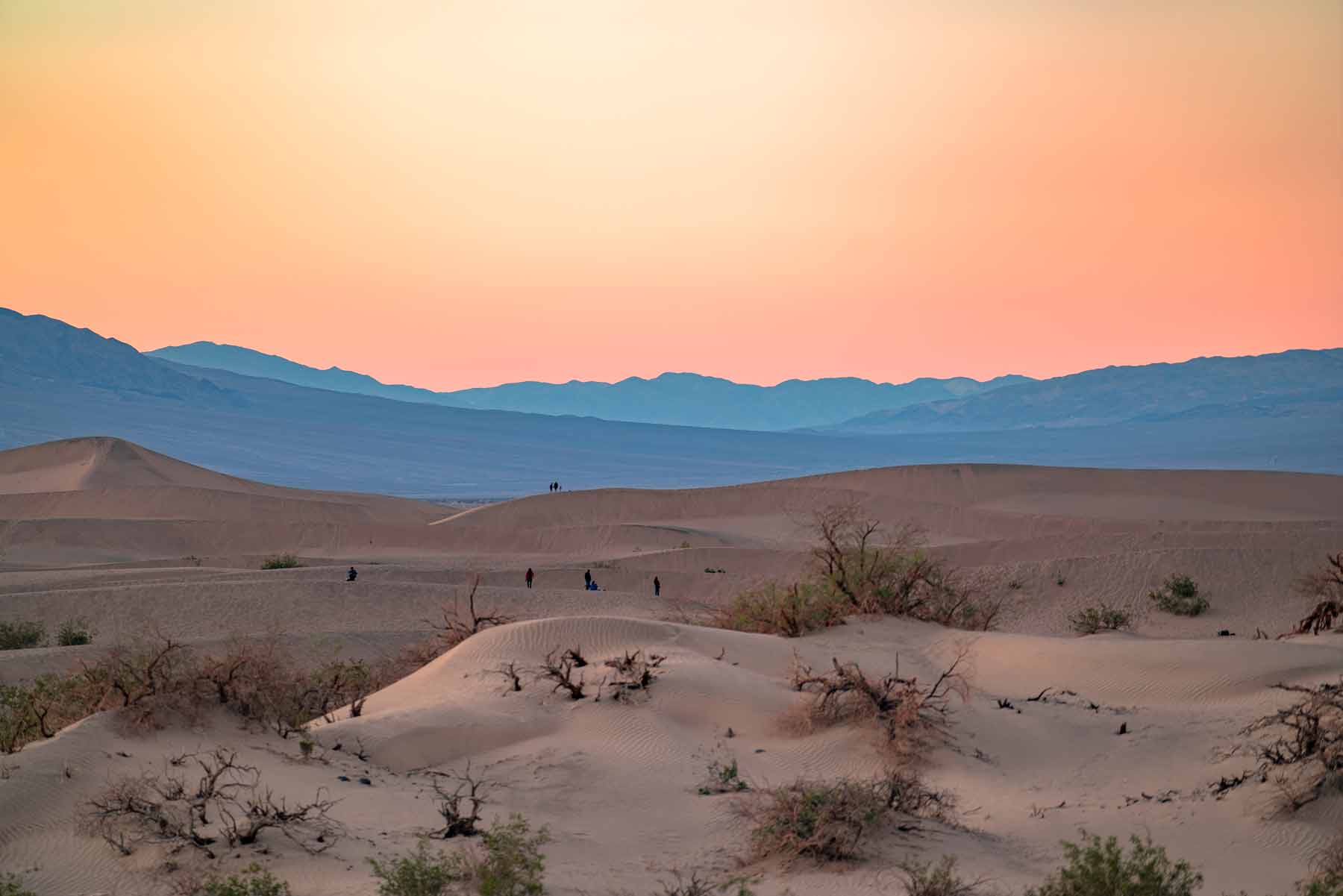
The hottest air temperature ever recorded on Earth was measured here. So was the lowest point in North America, 282 feet below sea level, in a park that sprawls across about 3.4 million acres, more ground than any other national park in the contiguous United States. Death Valley is where the continent goes to extremes, and the closer you look, the stranger and better the stories get.
What follows are 13 verified facts about Death Valley National Park, its people, its records, and its beautiful oddities. For trip planning, roads, and tours, start with our full Death Valley National Park guide.
Tony Pattiz taught American history for more than 25 years before he began writing it for this site. Will and Jim filmed in Death Valley in winter, when the desert lets you work, and hiked most of the park’s trails doing it. Every date, number, and name below has been checked against the National Park Service and the other primary sources listed at the end of this article. Last verified July 2026.
Death Valley National Park Basics
- Location: Eastern California and a slice of western Nevada, in the northern Mojave Desert
- Size: About 3.4 million acres, the largest national park in the contiguous United States
- Lowest point: Badwater Basin, 282 feet below sea level, the lowest in North America
- Highest point: Telescope Peak, 11,049 feet
- Visitation: More than 1.32 million recreation visits in 2025, per the NPS visitation report
- Established: Protected as a national monument in 1933, redesignated a national park on October 31, 1994
- Night skies: The third International Dark Sky Park certified in the U.S. National Park System
1. Death Valley Is The Homeland Of The Timbisha Shoshone
Long before anyone attached the word “death” to this valley, it was home. The Timbisha Shoshone lived here for centuries before the first outsiders arrived, moving with the seasons to harvest pinyon pine nuts and mesquite beans, and the name Timbisha refers to the red ochre found in the Black Mountains, a material the tribe’s elders used for spiritual purposes.
Love Death Valley? It's one of 117 threatened public lands destinations we're tracking. Get the free briefing.
The creation of the national monument in 1933 treated the valley as an empty wilderness, and for decades the tribe was pushed to the margins of its own homeland. The Timbisha Shoshone won federal recognition in 1983, but without a land base. That finally changed when the Timbisha Shoshone Homeland Act of 2000 returned nearly 7,800 acres to the tribe, including more than 300 acres at Furnace Creek. Death Valley became the first national park in the country to return land and create a tribal reservation within its boundaries, and the Timbisha community lives at Furnace Creek today.
2. Lost Gold Rush Emigrants Gave The Valley Its Name
The name was a parting curse from people who barely made it out alive. After gold was found in California in 1848, wagon trains poured west, and in the autumn of 1849 a group of emigrants left the Old Spanish Trail on the strength of a hand-sketched map promising a shortcut to Walker Pass that would supposedly save 500 miles. The Lost ’49ers reached the valley floor on Christmas Eve 1849, short on food, their oxen giving out, and walled in by mountains their wagons could not cross.
While the stranded Bennett-Arcan party waited by a spring, two young men, William Lewis Manly and John Rogers, walked more than 300 miles to Mission San Fernando for supplies and then walked back. As far as the record shows, only one member of the group died in the valley during that long wait, but the survivors assumed the place would be their grave. Climbing out over the Panamint Mountains, someone is said to have turned and proclaimed “goodbye, Death Valley.” The name stuck.
3. Twenty Mule Teams Hauled Borax 165 Miles To The Nearest Railroad
The valley’s first big business was not gold. It was a white mineral used in soap. William T. Coleman built the Harmony Borax Works near Furnace Creek, and beginning in late 1883 or early 1884 its 40 workers produced three tons of borax a day.
Getting it to market created an American icon. Teams of 18 mules and 2 horses pulled double wagons loaded with borax, plus the animals’ own drinking water, on a 165 mile, ten day haul across the desert to the railhead at Mojave. The twenty mule teams ran from 1883 to 1889, moved nearly 10,000 tons of borax, and by the drivers’ own boast never had a wagon break down on the route. The ruins of the Harmony works still stand a short walk off the road near Furnace Creek.
4. A Borax Radio Show Became One Of The Longest Running Westerns On Television
Few national parks can claim a hit show named after them. Death Valley Days was created in 1930 by writer Ruth Woodman as a radio anthology dramatizing true stories of the Old West, sponsored by the Pacific Coast Borax Company, makers of 20 Mule Team Borax. It jumped to television in 1952 and ran until 1970, some 452 episodes in all, one of the longest runs any western ever managed.
The borax connection runs deeper than sponsorship. The man who helped make 20 Mule Team Borax a household name was a young marketing talent named Stephen Mather, who went on to become the first director of the National Park Service. We tell his story in our piece on Stephen Mather and Horace Albright. And the show’s host for two seasons in the mid 1960s was Ronald Reagan, in his last job as an actor. He left Death Valley Days in 1966 to run for governor of California.
5. A Suffragist Helped Introduce America To Death Valley
In 1920, fresh from the fight for the 19th Amendment, Cleveland suffrage leader Edna Brush Perkins and her friend Charlotte Hannahs Jordan spent about a month exploring Death Valley in a wagon drawn by a horse and a mule. Perkins had chaired the Woman’s Suffrage Party of greater Cleveland and lectured for the cause from 1912 until the amendment passed. Then she went looking for empty country.
Her 1922 book about the journey, The White Heart of Mojave, is one of the earliest great travel accounts of the valley, and her words are displayed on the wall of the Furnace Creek Visitor Center today.
Our real craving was not for a play hour, but for the wild and lonely place and a different kind of freedom from that about which we had been preaching.
Edna Brush Perkins, The White Heart of Mojave, 1922
6. Scotty’s Castle Is Named For A Con Man Who Never Owned It
One of the park’s odder landmarks is a Spanish-style mansion in Grapevine Canyon, and the man whose name is on it never paid for a single brick. Walter Scott, a onetime rider in Buffalo Bill Cody’s Wild West Show better known as Death Valley Scotty, spent years selling shares in a fabulously rich gold mine that did not exist. One of his investors was a Chicago insurance millionaire named Albert Johnson.
Here is the twist. When Johnson came west to see the mine for himself, he fell for the desert instead, and for Scotty. The two men struck up a genuine, lifelong friendship. Johnson began building his vacation home in Grapevine Canyon in 1922, and Scotty told everyone the castle was his, bought with mine money. Johnson played along. Scotty lived out his years there and died in 1954, buried on the hill above the house. The National Park Service bought the property in 1970. A flash flood tore through the canyon in 2015 and repairs are still underway, so check the tour situation in our guide to the best things to do in Death Valley National Park before you go.

7. It Became The Largest National Park In The Contiguous United States In 1994
Death Valley was first protected as a national monument in 1933, in the final weeks of Herbert Hoover’s presidency. It stayed a monument for six decades. Then, on October 31, 1994, President Bill Clinton signed the California Desert Protection Act, which added 1.3 million acres, redesignated Death Valley a national park, and designated more than 90 percent of it as wilderness.
At about 3.4 million acres, Death Valley is the largest national park in the contiguous United States. Only a handful of Alaska parks, including Wrangell-St. Elias, Gates of the Arctic, and Denali, are bigger. We ranked all the national parks by size if you want to see where the rest land.
8. Badwater Basin Is The Lowest Point In North America
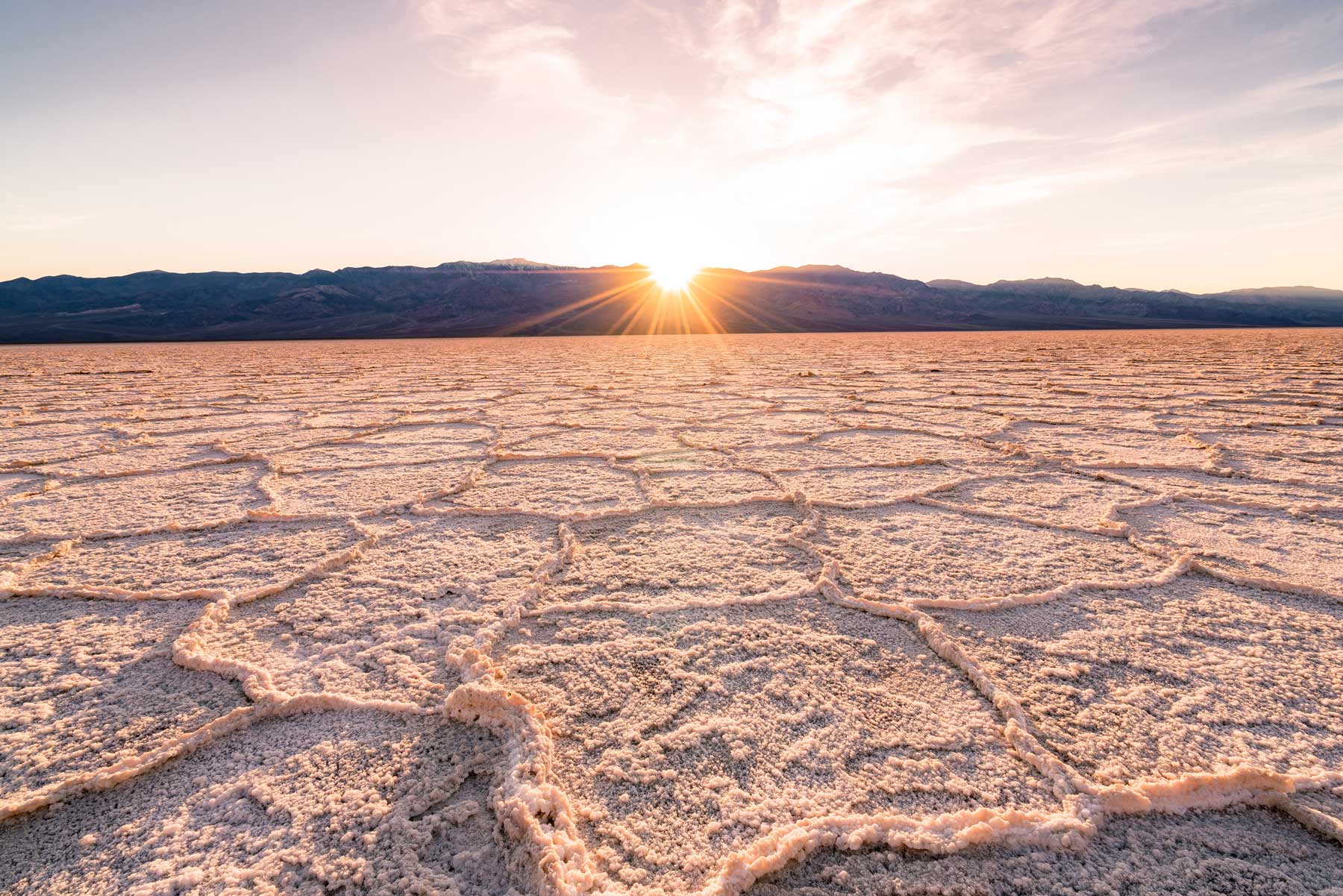
Badwater Basin sits 282 feet below sea level, the lowest point not just in the United States but on the whole continent. The name comes from a story about an early surveyor whose mule refused to drink from the spring-fed pool there. The water is not poisonous, just intensely salty.
The vast salt flats are the floor of ancient Lake Manly, which had no outlet, so every mineral that washed in stayed. When the lake dried up tens of thousands of years ago it left the salt behind, including the jagged crystal spires of the nearby Devil’s Golf Course, so rough that an old park guidebook joked only the devil could play golf there. Stand on the flats and look west and the effect is dizzying. Telescope Peak rises 11,049 feet above sea level almost directly overhead, more than two vertical miles of relief, a drop the Park Service says you cannot match anywhere else in America over such a short distance.
9. Furnace Creek Holds The World Heat Record, And Scientists Still Argue About It
On July 10, 1913, the weather station at Furnace Creek recorded an air temperature of 134 degrees Fahrenheit. That reading stands today as the official world record for the hottest air temperature ever measured on Earth. Remarkably, the same station hit the park’s record low of 15 degrees on January 8 of that same year.
The record comes with an asterisk that keeps growing. Death Valley only became the official champion in 2012, when a World Meteorological Organization panel invalidated a 1922 reading of 136 degrees from El Azizia, Libya, blaming an inexperienced observer and a misread instrument. Weather historians have since argued the 1913 figure deserves the same scrutiny, and a peer-reviewed 2026 study in the same journal concluded the reading was likely about 14 degrees too hot and recommended the record be rescinded. The WMO, which rules on weather extremes, has not acted on that recommendation, so the 1913 mark still stands. What nobody disputes is the modern benchmark. Furnace Creek reached about 130 degrees in August 2020 and again in July 2021, among the highest temperatures ever reliably measured on this planet, and summer highs here routinely top 120.

10. It Is Also The Driest Place In North America
Hottest and lowest get the headlines, but Death Valley holds a third title. It is the driest place in North America. The NPS climate records for Furnace Creek show average rainfall of less than 2 inches a year, and in 1929 and again in 1953 the station recorded no rain at all. During one stretch from 1931 to 1934, only 0.64 inches fell in 40 months.
The dryness is not an accident of latitude. Storms rolling in from the Pacific must clear range after range of mountains before they reach the valley, and each ridge wrings more moisture out of the air. By the time the clouds arrive, there is usually nothing left to fall.

11. Scientists Finally Caught The Racetrack’s Sailing Stones In The Act
For decades, one of the great mysteries in any national park sat on a dry lakebed called the Racetrack. Rocks, some far too heavy for any person to shove, slide across the playa on their own, leaving long trails in the mud. Nobody had ever seen one move, and the theories ranged from hurricane-force winds to magnetism to pranksters.
Then science staked out the crime scene. A research team led by Richard Norris fitted rocks with GPS units and set up a weather station, and in December 2013 they watched it happen. Their study, published in the journal PLOS ONE in 2014, showed that a rare winter pond freezes overnight into windowpane ice just a few millimeters thick. When morning sun breaks the sheet apart, light winds of about 10 miles per hour push the floating ice panels into the rocks, shoving them along at a stately 2 to 5 meters per minute. Some of the instrumented rocks traveled as far as 224 meters in a single winter. The mystery was never monsters or magnets. It was ice, wind, and patience.
12. Death Valley Played The Desert Planet Tatooine In Star Wars
When George Lucas needed an alien desert for the 1977 film that became Star Wars Episode IV, A New Hope, he found it here. Death Valley stood in for Tatooine, Luke Skywalker’s home planet, and the crew returned to shoot scenes for Return of the Jedi. The park’s own filming tour points fans to Mesquite Flat Sand Dunes, where R2-D2 and C-3PO wandered after their escape pod crashed, along with Golden Canyon, Desolation Canyon, Artists Palette, and Dante’s View.
Star Wars is only the most famous entry in the park’s long filming history. If you like tracking down familiar backdrops, our roundup of classic movies filmed in the national parks is full of them.
13. Devils Hole Shelters One Of The Rarest Fish On Earth
East of the valley, across the Nevada line, the park includes a detached 40-acre unit protecting a single water-filled cavern called Devils Hole, added to the monument by presidential proclamation in 1952. The cavern is more than 500 feet deep, holds steady at 92 degrees, and is the only natural home of the Devils Hole pupfish, Cyprinodon diabolis, a tiny blue fish that feeds and spawns on one shallow rock shelf near the surface. The entire wild population of the species lives in this one pool.
The species has been fighting for its life in real time. The spring 2025 count found just 38 fish after earthquakes sloshed the water and disrupted the shelf. Biologists responded by releasing pupfish raised in a captive backup population, and the spring 2026 count rebounded to 77, with new juveniles spotted in the hole. Every one of those fish lives inside a national park boundary line drawn around a single desert spring.
What It Feels Like To Stand In Death Valley
Facts only carry you so far, so here is what filming there taught us. Winter dawn on the Mesquite Flat dunes starts cold enough for gloves, and within an hour of sunrise you are peeling off layers while the sand squeaks under your boots. At Badwater, if you walk far enough out on the salt to lose the parking lot, the silence gets so complete you notice your own pulse. The washboard road to the Racetrack rattled our teeth and our tripods for hours each way, and it was worth every mile. And the nights are the secret. The valley is one of the best places in the country to see the Milky Way from horizon to horizon, which is why it made our list of the best dark sky national parks.

Watch Our Death Valley Film

This is our Death Valley film, shot in 8K. Because this is the hottest place on Earth, we filmed in winter and hiked most of the park’s trails to earn these frames.
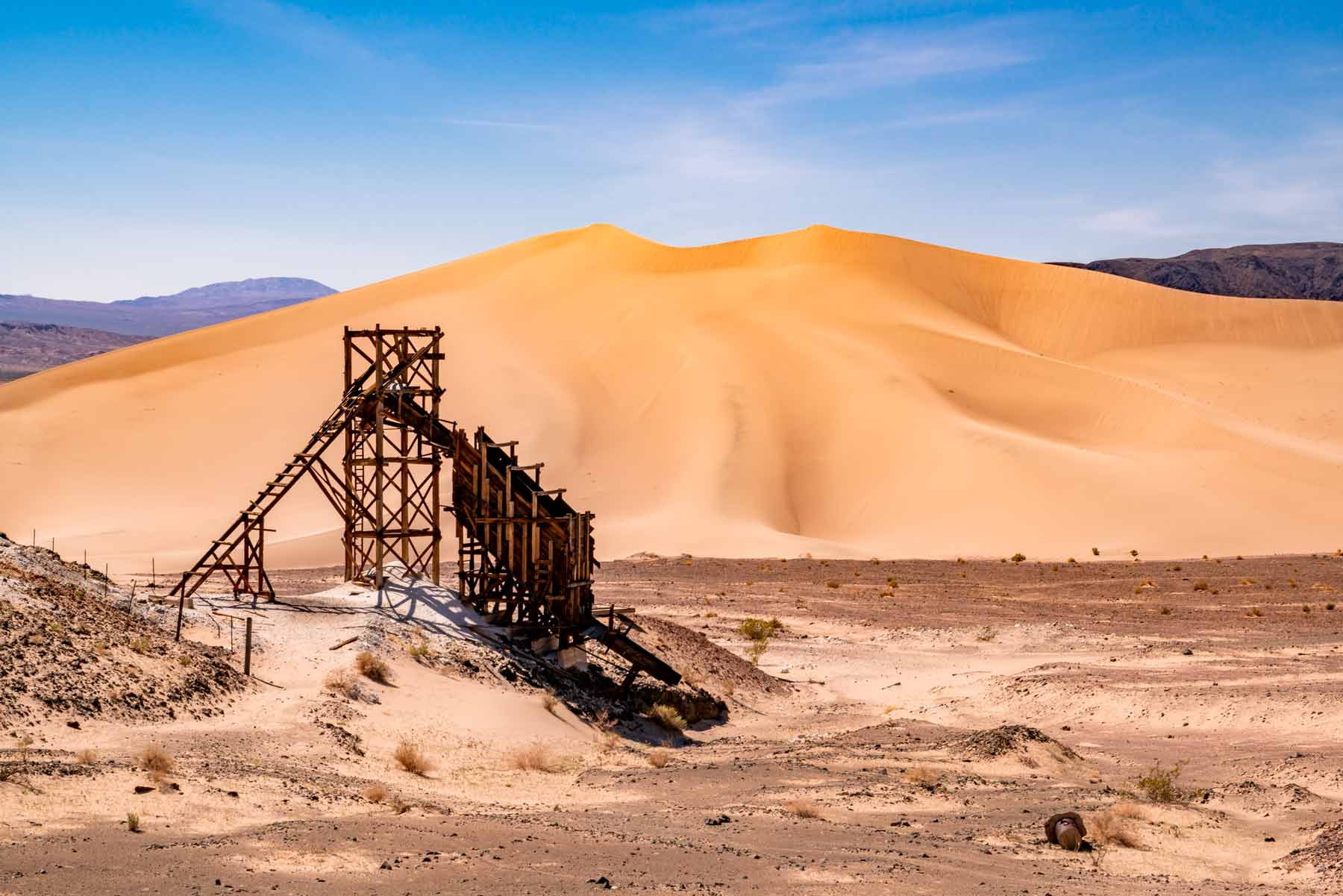
You will see many of the places in this article, including the Eureka Dunes, the Racetrack, the Mesquite Flat dunes, Zabriskie Point, the Wildrose charcoal kilns, Aguereberry Point, Badwater Basin, and Darwin Falls. If a place this brutal can be this beautiful, that is the whole point.
Where These Facts Come From
Every claim in this article was checked against the sources below in July 2026. Numbers that change over time, like annual visitation and pupfish counts, are stated with the year they were reported.
- NPS, Death Valley Frequently Asked Questions, for the 1913 heat record, Badwater Basin, and the origin of the park’s name
- NPS, Death Valley Weather and Climate, for rainfall records, the 1913 low, and the driest-place figures
- NPS, Home, the Timbisha Shoshone story, and NPS, People of Death Valley, for the Timbisha Shoshone history, recognition, and the Homeland Act
- NPS, The Lost ’49ers, for the naming story, the Bennett-Arcan party, and the Manly and Rogers rescue
- NPS, Harmony Borax Works, NPS Places, Harmony Borax Works, and NPS, Twenty Mule Teams, for the borax operation and the 165 mile haul
- NPS, Guide to the Papers Related to Stephen T. Mather, for Mather’s borax marketing career and his NPS directorship
- NPS, Edna Brush Perkins, and the 1922 text of The White Heart of Mojave, for the Perkins story and quotation
- NPS, Scotty’s Castle, and the Death Valley Conservancy, for the Scott and Johnson story and the castle’s dates
- NPS news release, 25th Park Anniversary, for the 1994 California Desert Protection Act figures
- NPS Places, Badwater Basin, for the elevation, Lake Manly, and Telescope Peak relief
- Bulletin of the American Meteorological Society, for the WMO invalidation of the El Azizia record, with NOAA NESDIS on the 2020 reading, Christopher Burt’s Weather Underground analysis on the dispute, and Spencer, Christy, and Reid, BAMS, 2026, the peer-reviewed challenge to the 1913 reading
- Norris et al., PLOS ONE, 2014, and NPS, The Racetrack, for the sailing stones explanation
- NPS, Star Wars in Death Valley, for the filming history and locations
- NPS, Devils Hole, the NPS spring 2025 pupfish count, and NPR, May 2026, for the pupfish facts and counts
- NPS news release, March 2026, for 2025 visitation
Keep Exploring Death Valley
- Death Valley National Park Guide, our full trip planning hub
- Best Things To Do In Death Valley National Park, every stop ranked
- California National Parks Worth Visiting
- Joshua Tree National Park Facts, more desert history next door
- All 63 US National Parks Ranked
- Before you go, check live alerts, extreme heat warnings, and air quality on our national park conditions dashboard
What to Bring to Death Valley
Gear we recommend for Death Valley. Affiliate links support our work at no cost to you.
More Than Just Parks may earn a small commission from purchases made through these links, at no extra cost to you. We only recommend gear we would actually use.
Affiliate disclosure: Some links on this page earn us a small commission at no extra cost to you. We only recommend gear we actually use.
More Than Just Parks Film Watch our 8K film of Death Valley We spent weeks in Death Valley, one of our favorite public lands destinations, capturing it the way it deserves. Take a few minutes and see it for yourself.


