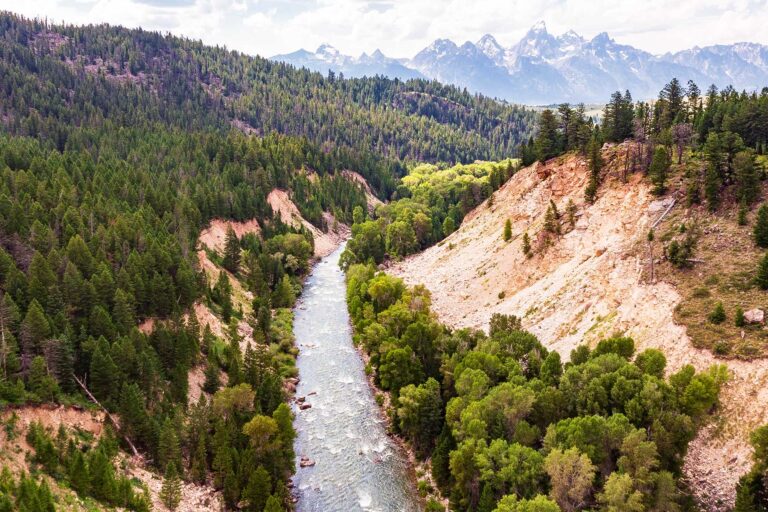


Follow the Rio Grande through far west Texas and the river does something strange. After running southeast for hundreds of miles it swings hard to the northeast, a giant elbow of green water in brown desert country. Inside that elbow sits Big Bend National Park, 801,163 acres of Chihuahuan Desert, river canyon, and mountain, with the darkest night skies of any national park in the lower 48 states hanging overhead.
What follows are 12 verified facts about Big Bend, the people who fought for it, and the discoveries made inside it. For trip planning, lodging, and itineraries, start with our full Big Bend National Park guide.
Tony Pattiz taught American history for more than 25 years before he began writing it for this site. More Than Just Parks has not yet filmed in Big Bend, so this piece was built the way a historian builds anything, from the National Park Service’s own records, the park’s archives, and the primary sources listed at the end of this article. Every date, number, and name below has been checked against them. Last verified July 2026.
Big Bend National Park Basics
- Location: Far west Texas, in Brewster County, where the Rio Grande forms the border with Mexico
- Size: 801,163 acres, or 1,252 square miles, per the NPS park statistics
- Visitation: 568,104 recreation visits in 2025, per NPS Stats
- Highest point: Emory Peak in the Chisos Mountains, 7,832 feet
- Lowest point: Rio Grande Village, 1,850 feet
- Established: June 12, 1944, the first national park in Texas
- Designations: International Dark Sky Park (2012); 118 miles of the park run along the United States border with Mexico
1. The Park Is Named For A Giant Turn In The Rio Grande
The name is not a boast about size, though it could be. It is a piece of geography. The Rio Grande flows southeast along the Texas border until it meets the uplifted rock of the Chihuahuan Desert, where it bends sharply northeast. Texans have called that elbow of river country the Big Bend for generations, and the park takes its name from it.
Love Big Bend? It's one of 117 threatened public lands destinations we're tracking. Get the free briefing.
The river is the park’s southern boundary for 118 miles, and 196 miles of the Rio Grande here carry a federal Wild and Scenic designation. Along the way it has cut three great canyons, Santa Elena, Mariscal, and Boquillas, with walls that rise as much as 1,500 feet above the water.
Go south from Fort Davis until you come to the place where rainbows wait for rain, and the big river is kept in a stone box, and water runs uphill. And the mountains float in the air, except at night when they go away to play with other mountains.
Directions to the Big Bend in local folklore, as recorded by John Jameson in The Story of Big Bend
2. People Have Lived In The Big Bend For Nearly 10,000 Years
Long before anyone drew a border down the middle of the river, this desert was home. The National Park Service records evidence of Paleo-Indian presence in the park dating to roughly 8000 to 6500 BCE, followed by the long Archaic period, the Late Prehistoric, and the Historic era that began when Spanish expeditions reached the region in the 1500s. That is nearly 10,000 years of continuous human story in one of the harshest corners of North America.
How much of that story has been studied? Remarkably little. Between 1995 and 2013, archeologists from the Center for Big Bend Studies surveyed more than 60,000 acres of the park, less than a tenth of it, and recorded more than 1,500 archeological sites. Most of Big Bend has never been formally surveyed at all. The Park Service puts it plainly. The sites and artifacts you pass in this desert may never have been recorded or studied by anyone.
3. A Geologist Mapped The Canyons In 1899 And Called It The Bloody Bend
An official boundary survey pronounced the canyons of the Rio Grande impassable in the 1850s, and for half a century almost nobody proved otherwise. Then, in October 1899, U.S. Geological Survey geologist Robert T. Hill led a six man party in three boats down the river from Presidio to Langtry, Texas. The trip took nearly a month.
Hill packed photographic equipment into the boats, and his pictures and the published account that followed introduced the American public to a place few of them knew existed. He did not romanticize it. Hill called the region “the Bloody Bend,” and John Jameson’s history of the park records why. At a small store near Presidio, a shopkeeper showed Hill the bloodstains where the previous shopkeeper had been murdered by an outlaw. Before the year was out, that shopkeeper was dead too.

4. A Former Texas Ranger Is Remembered As The Father Of The Park
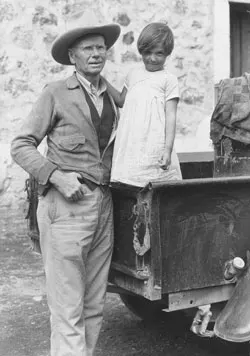
Every park has its champions. Big Bend had Everett Ewing Townsend, and it is hard to imagine the park existing without him. In 1891 Townsend lied about his age to join Company E, Frontier Battalion of the Texas Rangers. He became a Deputy U.S. Marshal in 1893, and one year later came to the Big Bend country as a mounted inspector for U.S. Customs in Presidio County.
On August 31, 1894, the young lawman rode up to the panoramic view from the South Rim of the Chisos Mountains. Decades later he recalled that the sight made him “see God as he had never seen Him before,” and it planted an idea he refused to let go of. When the bill establishing Texas Canyons State Park passed the Texas legislature in March 1933, Townsend, by then a state representative, was its co-author.
He spent the next decade pushing for full national park status. At the 1943 ceremony handing the land deeds to the Department of the Interior, Townsend was the one individual singled out for recognition, and after the park was established he was appointed its U.S. Commissioner. He died in 1948 at the age of seventy-seven. In 1954, on the park’s tenth anniversary, Superintendent Lon Garrison presented his family with a posthumous honorary park ranger commission for the man remembered as the father of Big Bend National Park.
5. Big Bend Was The First National Park In Texas, And It Is Still The Largest
The state park of 1933 was only a down payment. In 1942 the State of Texas allocated $1.5 million to purchase roughly 600,000 acres from private owners, and in September 1943 Texas delivered the deed to the federal government as a gift to the nation. On June 12, 1944, six days after the D-Day landings in Normandy, Big Bend was established as a national park by a congressional act signed by President Franklin D. Roosevelt. It was the first national park in Texas.
It remains the largest of the state’s national parks by a wide margin, one of 18 National Park Service sites we cover in our guide to the Texas national parks. At 1,252 square miles, Big Bend is bigger than the state of Rhode Island, and the NPS ranks it the 8th largest national park in the lower 48 states. Much of its early infrastructure, including the seven mile road that climbs into the Chisos Basin, was built by Civilian Conservation Corps crews, most of them young Hispanic men, who worked in the Chisos Mountains between 1934 and 1942.
6. No Other National Park Has More Kinds Of Birds, Bats, Or Cacti
A desert is supposed to be empty. Big Bend never got the message. According to the National Park Service, the park has more types of birds, bats, butterflies, ants, scorpions, and cacti than any other national park in the United States.
The numbers behind that sentence are worth reading slowly. Some 450 species of birds have been reported in the park, only 56 of which live here year round; the rest ride the great migratory flyways that funnel through the river corridor. The park also holds more than 1,200 plant species, including about 60 kinds of cactus, along with 75 species of mammals, 56 reptiles, and roughly 3,600 kinds of insects. The secret is the spread of habitats, from a desert river floodplain at 1,850 feet to a cool mountain woodland nearly 6,000 feet higher, all inside one park boundary.
7. The Chisos Are The Only Mountain Range Entirely Inside One National Park
Rise from the desert floor toward the center of the park and you enter a different world. The Chisos Mountains are the only mountain range in the United States contained entirely within a single national park, a compact volcanic range crowned by Emory Peak at 7,832 feet.
The Chisos are what biologists call a sky island. Their upper slopes trap enough rain and shade to support woodlands of pinyon pine, juniper, and oak, an island of green stranded above a sea of desert when the climate dried after the last ice age. In the circular basin at the heart of the range, ringed by craggy peaks, visitors will find a campground, a ranger station, and the trailheads for some of the finest hiking in Texas.

8. The Largest Flying Creature Ever Found Was Discovered Here
In 1971, a University of Texas graduate student named Douglas Lawson was doing fieldwork in the park when he found the fossilized bones of an enormous wing. They belonged to Quetzalcoatlus northropi, a pterosaur with a wingspan of at least 36 feet, which the National Park Service describes as the largest flying creature of all time. No bird, bat, or other flying animal known to science has ever come close.
The giant pterosaur is the headliner of a fossil record that is astonishing in its own right. Big Bend preserves a largely intact 130 million year slice of geologic time, including the dinosaur extinction event, and more than 1,200 fossil species have been identified in the park, one of the most diverse fossil records in the National Park System. You can meet many of them at the Fossil Discovery Exhibit on the road between Panther Junction and Persimmon Gap, which opened in January 2017 as the park’s first new exhibit space in more than three decades.

9. Franklin Roosevelt Wanted Big Bend To Be Half Of One Great International Park
The idea arrived before the park did. On October 8, 1934, Albert W. Dorgan, a World War One naval aviator and landscape architect living at Castolon, wrote to Interior Secretary Harold Ickes proposing an international park spanning both banks of the Rio Grande, becoming the first person to formally ask the federal government for a park in the Big Bend.
President Roosevelt embraced the vision. Months after Big Bend was established, he wrote to Mexican President Manuel Avila Camacho, on October 24, 1944, and the Mexican president answered with instructions to his own government to pursue it.
I do not believe that this undertaking in the Big Bend will be complete until the entire park area in this region on both sides of the Rio Grande forms one great international park.
President Franklin D. Roosevelt, letter to President Manuel Avila Camacho, October 24, 1944
The single park never came to be, but the idea did not die. Mexico now manages the Maderas del Carmen, Ocampo, and Santa Elena Canyon protected areas directly across the river, and the two park systems share research and management experience across the border. Visitors can even cross legally into the village of Boquillas through the park’s official port of entry; schedules and document requirements change, so check the NPS Boquillas Crossing page before you go.
10. Lady Bird Johnson Floated Mariscal Canyon To Mark The Park Service’s 50th
In April 1966, First Lady Lady Bird Johnson came to Big Bend to promote the See America First campaign and celebrate the fiftieth anniversary of the National Park Service, trailing Interior Secretary Stewart Udall and more than seventy reporters and White House staffers into one of the most remote parks in the system.
She hiked the Lost Mine Trail, and the highlight of the visit was a six hour, eleven mile float through Mariscal Canyon in a flotilla of twenty-four rubber rafts, during which the First Lady took a paddle herself for twenty-five minutes. Standing on a ridge in the Chisos, she said the country looked like “the very edge of the world.” Writing to her friend Conrad Wirth, the former Park Service director, she remembered “that fabulous corner of the world” and watching the Sierra del Carmen mountains at sunset over barbecued steaks, glowing in “every hue of blue, lavender and mist color.”
11. Apollo Astronauts Trained For The Moon Here In 1964
Before NASA could send geologists to the Moon, it had to make geologists of its pilots. In April 1964, the first group of astronaut trainees, a roster that included Buzz Aldrin and Gene Cernan, flew into far west Texas for geology field training in the Big Bend, studying the park’s exposed folds, faults, lava flows, and ash beds. Apollo crews returned again and again, nine trips in all between 1964 and 1972.
Why here? Bill Muehlberger, the University of Texas geologist who led the training, chose the region because it packed a greater variety of geology into a smaller area than anywhere else in the country. NASA staff geologist Ted Foss put it more bluntly. “We can’t say what the moon is like, exactly, but it may be similar to the Big Bend area,” he said, a line preserved in the Journal of Big Bend Studies. The men who walked the Moon learned to read rocks in this desert first.
12. Big Bend Has The Darkest Night Skies In The Lower 48
When the Sun goes down, Big Bend shows you something almost no one in America has seen from home. The National Park Service’s Natural Sounds and Night Skies division has determined that Big Bend has the darkest night skies of any national park in the lower 48 states, with the least light pollution of any park unit in the contiguous United States. In 2012 the International Dark-Sky Association named it an International Dark Sky Park.
The protection keeps growing. In 2022 the region became the heart of the Greater Big Bend International Dark Sky Reserve, a certified dark sky area of more than 15,000 square miles reaching across the border into Mexico, the largest in the world. On a clear, moonless night here the Milky Way does not merely appear; it casts shadows on the desert. It is the reason Big Bend anchors our guide to the best dark sky national parks in America.
How To See Big Bend For Yourself
We will be straight with you. More Than Just Parks has not filmed in Big Bend yet, so rather than pretend otherwise, here is how the rangers and the record say to meet this park. Time your first evening for the Window View Trail in the Chisos Basin, where the sunset burns through the basin’s rock notch. Earn the South Rim on foot and stand where Everett Townsend stood in 1894. Soak in the 105 degree hot springs by the Rio Grande in the ruins of the old Langford bathhouse. And stay up late; the park’s ranger led night sky programs put telescopes under the darkest skies in the lower 48.
For trail by trail detail, from the Lost Mine Trail to Santa Elena Canyon, our guide to the best hikes in Big Bend National Park ranks them all.

Where These Facts Come From
Every claim in this article was checked against the sources below in July 2026. Numbers that change over time, like annual visitation, are stated with the year they were reported.
- NPS, Big Bend Park Statistics, for acreage, elevations, river miles, and visitation history
- NPS Stats (IRMA), for 2025 recreation visits
- NPS, Big Bend Nature and Science, and NPS, Birds of Big Bend, for species counts and the biodiversity superlatives
- NPS, Big Bend Archeology, and the Center for Big Bend Studies survey report, for the human timeline and site counts
- NPS, Robert T. Hill, for the 1899 expedition
- NPS, Everett Townsend, for the father of the park’s life and dates
- NPS, Texas’ Gift to the Nation, for the land purchase, the 1943 deed, the 1944 establishment, and the CCC
- NPS, Fossils of Big Bend, and NPS, Pterosaurs of Big Bend, for the fossil record and the 1971 Lawson discovery
- Texas State Historical Association, Albert W. Dorgan, and the Chihuahuan Desert Education Coalition, for the international park proposal and the Roosevelt letter
- NPS, Partners in Protection, for the Mexican protected areas across the river
- NPS, When Lady Bird Came to Big Bend, for the 1966 visit and quotations
- The Big Bend Sentinel on Apollo astronaut training, drawing on the Journal of Big Bend Studies
- NPS, Stargazing at Big Bend, and the Greater Big Bend International Dark Sky Reserve, for the dark sky findings and 2022 reserve certification
- NPS, Big Bend FAQs, for the hot springs temperature and park size rankings
Keep Exploring Big Bend
- Big Bend National Park Guide, our full trip planning hub
- Best Things To Do In Big Bend National Park
- Best Hikes In Big Bend National Park, every major trail ranked
- Texas National Parks Worth Visiting
- Guadalupe Mountains National Park Facts, more history from west Texas
- All 63 US National Parks Ranked
- Before you go, check live alerts and air quality on our national park conditions dashboard
What to Bring to Big Bend
Gear we recommend for Big Bend. Affiliate links support our work at no cost to you.
More Than Just Parks may earn a small commission from purchases made through these links, at no extra cost to you. We only recommend gear we would actually use.
Affiliate disclosure: Some links on this page earn us a small commission at no extra cost to you. We only recommend gear we actually use.