

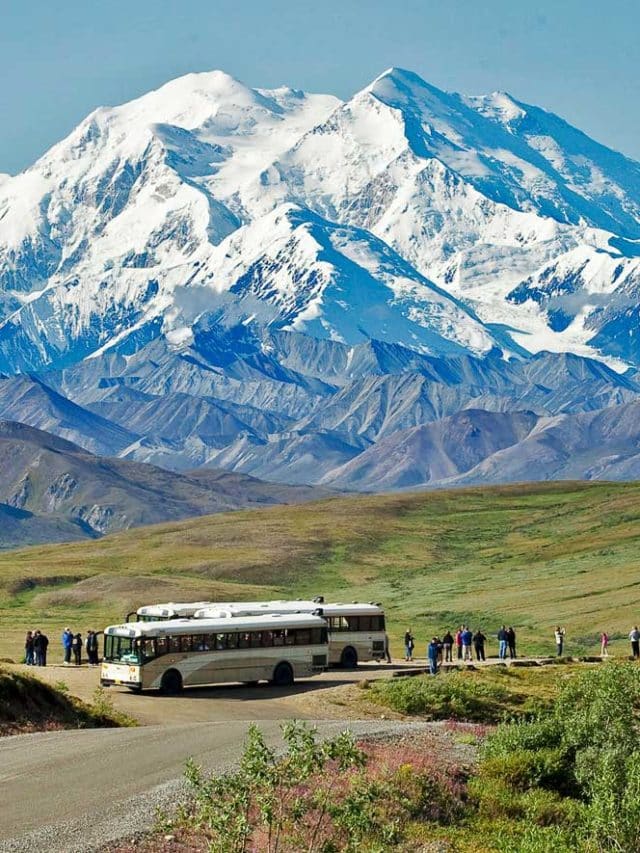
The summit of Denali stands 20,310 feet above sea level, and nothing in North America stands higher. Measured from its own base, the mountain rises about 18,000 feet, which makes it, base to summit, roughly a mile taller than Mount Everest. Around it spreads a park and preserve bigger than the state of New Hampshire, crossed by exactly one road.
What follows are 12 verified facts about Denali National Park and Preserve, the mountain at its heart, and the people whose stories run through both. For trip planning, bus tickets, and current road status, start with our full Denali National Park guide.
Tony Pattiz taught American history for more than 25 years before he began writing it for this site. This piece is built on the National Park Service record, the United States Geological Survey, and the primary sources listed at the end of this article, against which every date, number, and name below has been checked. Last verified July 2026.
Denali National Park Basics
- Location: Interior Alaska, on the crest of the Alaska Range
- Size: 6,075,030 acres in all, a 4,740,091 acre national park plus a 1,334,118 acre preserve, per the NPS park statistics
- Highest point: The summit of Denali, 20,310 feet, the highest in North America
- Visitation: 543,300 recreation visits in 2025, per NPS Stats
- Established: February 26, 1917, as Mount McKinley National Park; renamed and roughly tripled as Denali National Park and Preserve on December 2, 1980
- Road: One, the 92 mile Denali Park Road
1. Denali Is The Highest Peak In North America
Denali rises to 20,310 feet, the highest point on the continent. That figure is newer than you might think. For decades the official elevation was 20,320 feet, a number produced with 1950s era survey technology. In June 2015 a team carried modern GPS equipment to the summit, and that September the United States Geological Survey announced the new official height. The mountain had lost ten feet on paper without shrinking an inch.
Love Denali? It's one of 117 threatened public lands destinations we're tracking. Get the free briefing.
The name is far older than any survey. It comes from deenaalee in Koyukon, the Alaska Native language traditionally spoken north of the mountain, and translates as “the tall one.” People had been calling it that for generations before any prospector or surveyor arrived.

2. Measured Base To Summit, Denali Is Taller Than Everest
How can a 20,310 foot mountain out-tower a 29,000 foot one? It depends on where you start measuring. Everest rises from the Tibetan Plateau, a base that is already thousands of feet above sea level. Denali rises out of lowlands that sit only a few thousand feet high.
The result, in the National Park Service’s own words, is that Denali “towers three and one-half vertical miles above its base, making it a mile taller from base to summit than Mt. Everest.” Stand on the tundra north of the Alaska Range on a clear day and you take in around 18,000 feet of mountain in a single look.
3. A Gold Prospector Named The Mountain For A Presidential Candidate
We are used to mountains named for presidents. A presidential nominee is rarer. In the summer of 1896, a prospector named William Dickey emerged from the Alaska wilderness, learned that William McKinley of Ohio had won the Republican nomination, and attached the candidate’s name to the highest peak on the continent. Dickey wrote that the nomination “was the first news we received on our way out of that wonderful wilderness,” and his account ran in the New York Sun in 1897.
The choice was political. McKinley championed the gold standard, his opponent William Jennings Bryan championed free silver, and Dickey, a gold prospector, gave the gold standard’s champion the biggest monument on the continent. McKinley himself never visited Alaska and never saw the mountain.
The name held on for more than a century, and the argument over it is not finished. In 2015, President Barack Obama and Interior Secretary Sally Jewell restored the name Denali, returning the peak to what Alaska Native people had always called it. In 2025, President Donald Trump issued an executive order changing the mountain’s federal name back to Mount McKinley. The park’s name remains Denali National Park and Preserve.
4. Charles Sheldon Spent A Decade Campaigning For This Park
Charles Sheldon was a Yale educated engineer who made his fortune young, retired at 36, and gave the rest of his working life to wild country, above all to the wild sheep he loved to study. Beginning in 1906 he spent parts of two years in the Denali region, building a cabin, tracking Dall sheep, and writing down what he saw nearly every day.
What he saw worried him. He feared unchecked hunting would empty the country of the wildlife he had spent two years recording, and Sheldon, a member of the Boone and Crockett Club founded by Theodore Roosevelt, turned his alarm into a quest that lasted the better part of a decade. By his own account he interviewed more than 200 congressmen in a single month to push the park bill through. When it passed, Sheldon personally carried the bill from the Interior Department to the White House, where President Woodrow Wilson signed it on February 26, 1917 and handed him the pen. The park it created, then called Mount McKinley National Park, was established primarily to protect Dall sheep and the rest of the region’s wildlife.
5. The First Superintendent Helped Lead The First Ascent
Denali’s first superintendent, Harry Karstens, was no ordinary government hire. He came north in the Klondike gold rush of 1897, still a teenager, earned the nickname “the Seventymile Kid” on the Seventymile River, and made his name mushing mail by dog team across interior Alaska.
In 1913 Karstens was the climbing leader of the first expedition to reach Denali’s summit. On June 7, 1913, Walter Harper, the son of a Koyukon Athabascan mother, stepped onto the summit first, followed by Karstens, the expedition organizer Hudson Stuck, and Robert Tatum. An Alaska Native was the first person to stand on the roof of North America. The brutal ice ridge where Karstens and Harper chopped a staircase through earthquake shattered blocks is named Karstens Ridge today. When the park finally received funding in 1921, Charles Sheldon recommended Karstens for the job, and the Seventymile Kid ran the park until 1928.

6. Rangers Still Patrol The Park By Dog Team
Karstens left another legacy. In 1922, as superintendent, he bought the park’s first seven sled dogs, and rangers and dog teams have worked Denali’s winter backcountry together ever since. Denali’s dogs are the only sled dogs in the United States that help protect a national park, and the historic kennels building is the oldest building in the park still used for its original purpose.
These are working animals, not mascots. More than two million acres of Denali are federally designated wilderness where motorized vehicles are largely prohibited, so in winter the dogs haul rangers, supplies, and science gear where no snowmachine may go. The kennels raise their own pups, and in summer visitors can meet the dogs at the kennels near park headquarters.
7. Many Consider Denali The Coldest Mountain On Earth
Denali is one of the Seven Summits, the highest peaks of the seven continents, and at 63 degrees north latitude it is the northernmost of them all. Everest, by contrast, sits at 28 degrees north, the same latitude as central Florida.
That subarctic address has consequences. The National Park Service notes that many consider Denali the world’s coldest mountain, with temperatures of minus 93 degrees Fahrenheit and winds over 150 miles per hour recorded on its slopes. Even down at the park entrance, rangers tell visitors to expect sun, wind, rain, and clouds, all on the same day.

8. Glaciers Cover About One Sixth Of The Park
According to the National Park Service, glaciers cover about one million acres of Denali, roughly one sixth of the park. At least 40 named glaciers, and many more unnamed ones, pour off the high peaks of the Alaska Range, flowing from elevations as high as 19,000 feet down to as low as 800 feet above sea level.
The giant among them is the Kahiltna Glacier, about 45 miles long, the longest glacier in the entire Alaska Range. It is also the mountain’s front door, the glacier where expedition climbers land by ski plane each spring to begin the standard route. This is not the tidewater glacier country of coastal Alaska; Denali’s ice grinds out its existence far inland, high and dry and slow.
9. Climbing Denali Has Cost More Than One Hundred Lives
Mountaineering is one of Denali’s defining pursuits, and it keeps a grim ledger. The first climbers died on the mountain in 1932, and a study published in the journal Wilderness and Environmental Medicine counted 96 deaths from 1903 through the 2006 season. The park’s annual mountaineering summaries have recorded more nearly every year since. Falls are the leading killer, and most fatal accidents happen on the descent, when exhausted climbers run out of margin after the summit. On one steep section of the standard West Buttress route alone, at least fourteen climbers have died in falls since 1980.
The worst single disaster came in July 1967, when a storm with winds initially estimated at 100 to 150 miles per hour trapped the Wilcox Expedition high on the mountain. Seven climbers died. It remains the deadliest accident in the mountain’s history and one of the worst in American mountaineering.
10. People Have Hunted This Land For More Than 12,000 Years
How long have people known Denali? Longer than almost any place in the Americas. Charcoal from the Bull River II archaeological site in the park has been radiocarbon dated to between 12,180 and 12,460 years ago, and the Park Service says Bull River II may be the oldest site yet discovered in the park. The nearby Teklanika West site preserves evidence of hunters from the same late Pleistocene world.
The Athabascan peoples of interior Alaska carried that relationship into the historical era, following game across the region in spring, summer, and fall and gathering in winter villages for the long dark season. Their oral tradition explained the world through stories of raven, bear, fox, and porcupine, and their Koyukon language gave the mountain the name it carries today.
11. One Road Runs Into Six Million Acres
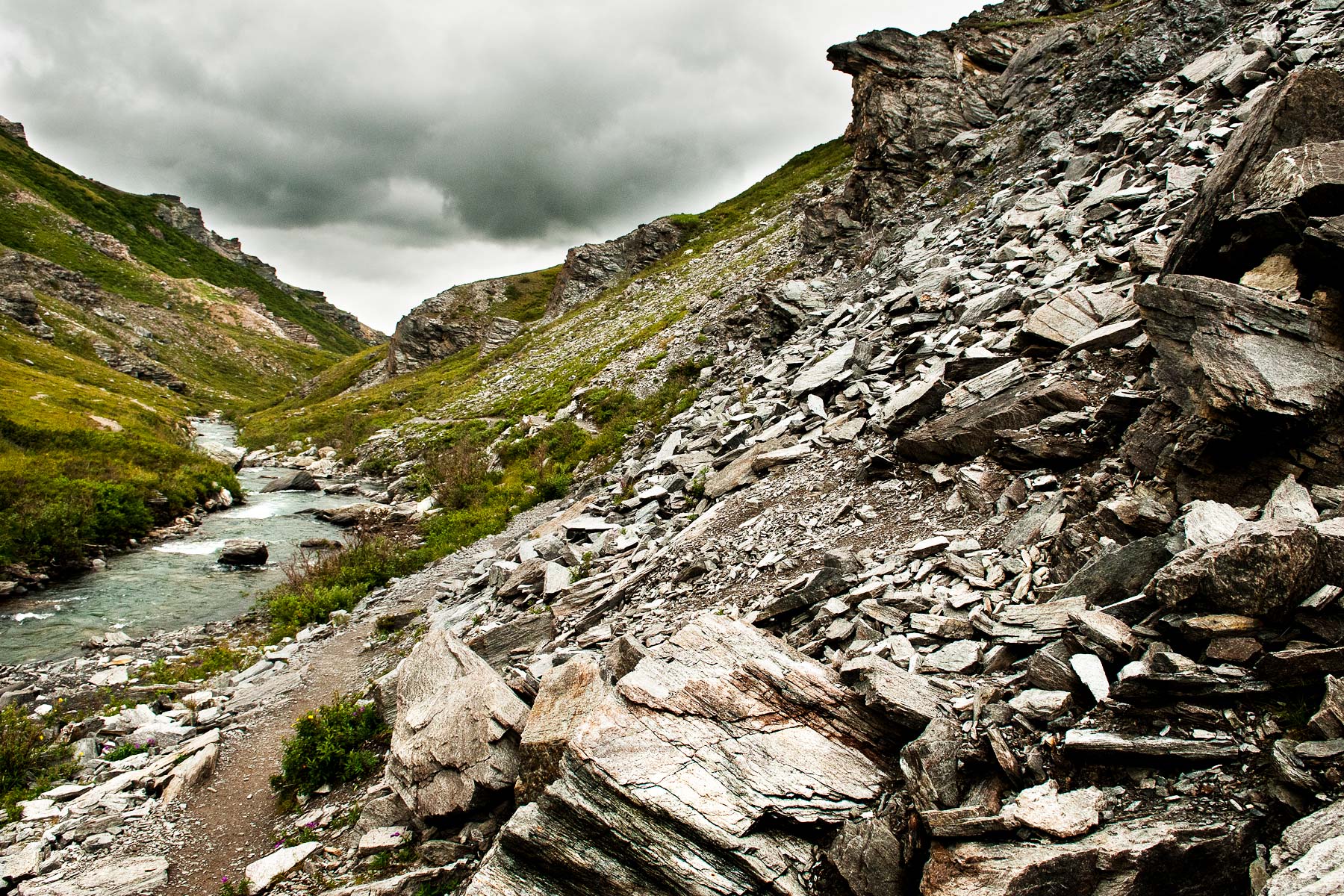
Denali National Park and Preserve covers 6,075,030 acres, and a single road serves all of it. The Denali Park Road runs 92 miles from the park entrance into the heart of the range, and only the first 15 are paved. Private vehicles may drive just those first 15 miles, to the Savage River; beyond that, summer travel means a bus, a bicycle, or your own two feet. Landslide repairs have changed how far vehicles can go in recent years, so check the park’s current road status before you plan around any milepost.
The park was not always this vast. On December 2, 1980, the Alaska National Interest Lands Conservation Act roughly tripled the old Mount McKinley National Park, added the surrounding preserve, and gave the whole thing the mountain’s Koyukon name. One signature from President Jimmy Carter, and the park grew by an area larger than some eastern states.
12. Alaska’s Big Five All Live Here
Wolves, grizzly bears, moose, caribou, and Dall sheep are so popular with Denali’s visitors that they are known here as the Big Five, and watching for them from a bus seat is one of the great wildlife experiences in North America. They headline a community of 38 mammal species in all, from shrews that weigh about as much as a penny to moose that can top 1,200 pounds.
The park’s bird list runs to 172 recorded species, most of them migrants that pour into the subarctic each spring to breed. Keep your distance from all of it. Nothing here is fenced, fed, or tame, and that is precisely the point of the place.
How To See Denali For Yourself
Here is the playbook. Ride a transit bus past the Savage River check station and give the day time to open up; the skies here are normally cloudy, the mountain hides more often than it shows itself, and the visitors who catch the full summit call themselves a lucky club for good reason. Build an extra day or two into your itinerary to raise your odds. Hike the Savage Alpine Trail for range views without a bus ticket, stop at the kennels for the free sled dog demonstrations, and scan every braided river bar for bears and caribou. Our guide to the best things to do in Denali National Park ranks all of it.

Where These Facts Come From
Every claim in this article was checked against the sources below in July 2026. Numbers that change over time, like annual visitation, glacier extent, and mountaineering fatalities, are stated with the year they were reported.
- NPS, Denali Park Statistics, for acreage, road mileage, and species counts
- NPS Stats (IRMA), for 2025 recreation visits
- USGS news release, September 2, 2015, for the 20,310 foot elevation and the survey history behind it
- NPS, The Alaska Range and Mount McKinley, for vertical relief, latitude, and the coldest mountain records
- NPS, Mountain Name Origins, for the Koyukon name, the Dickey story, and the naming decisions of 2015 and 2025
- Boone and Crockett Club, Charles Sheldon and the Creation of Denali National Park, for Sheldon’s campaign and the 1917 signing
- NPS, Remembering Walter Harper, for the 1913 first ascent
- NPS, Sledding for Science, NPS, Kennels, and NPS, Sled Dog Kennels, for the sled dog program since 1922 and the historic kennels building
- NPS, Glaciers of Denali, for glacier coverage and the Kahiltna Glacier
- McIntosh et al., Mountaineering Fatalities on Denali, the NPS annual mountaineering summaries, and an NPS news release of May 2024, for the fatality record
- NPS, Bull River Prehistoric Upland Hunting Site, for the 12,000 year archaeological record
- NPS, ANILCA and NPS, Denali Basic Information, for the 1980 expansion, the park road, and the park’s founding purpose
- History.com, Jordan Friedman, Why the Name of Alaska’s Peak Changed, for the Dickey account, his New York Sun article, and President Carter’s ANILCA signature
Keep Exploring Denali
- Denali National Park Guide, our full trip planning hub
- Alaska National Parks, A Guide For Visiting All Eight
- Wrangell St. Elias National Park Facts, America’s largest national park
- Kenai Fjords National Park Facts, more Alaska history
- All 63 US National Parks Ranked
- Before you go, check live alerts and air quality on our national park conditions dashboard
What to Bring to Denali
Gear we recommend for Denali. Affiliate links support our work at no cost to you.
More Than Just Parks may earn a small commission from purchases made through these links, at no extra cost to you. We only recommend gear we would actually use.
Affiliate disclosure: Some links on this page earn us a small commission at no extra cost to you. We only recommend gear we actually use.


