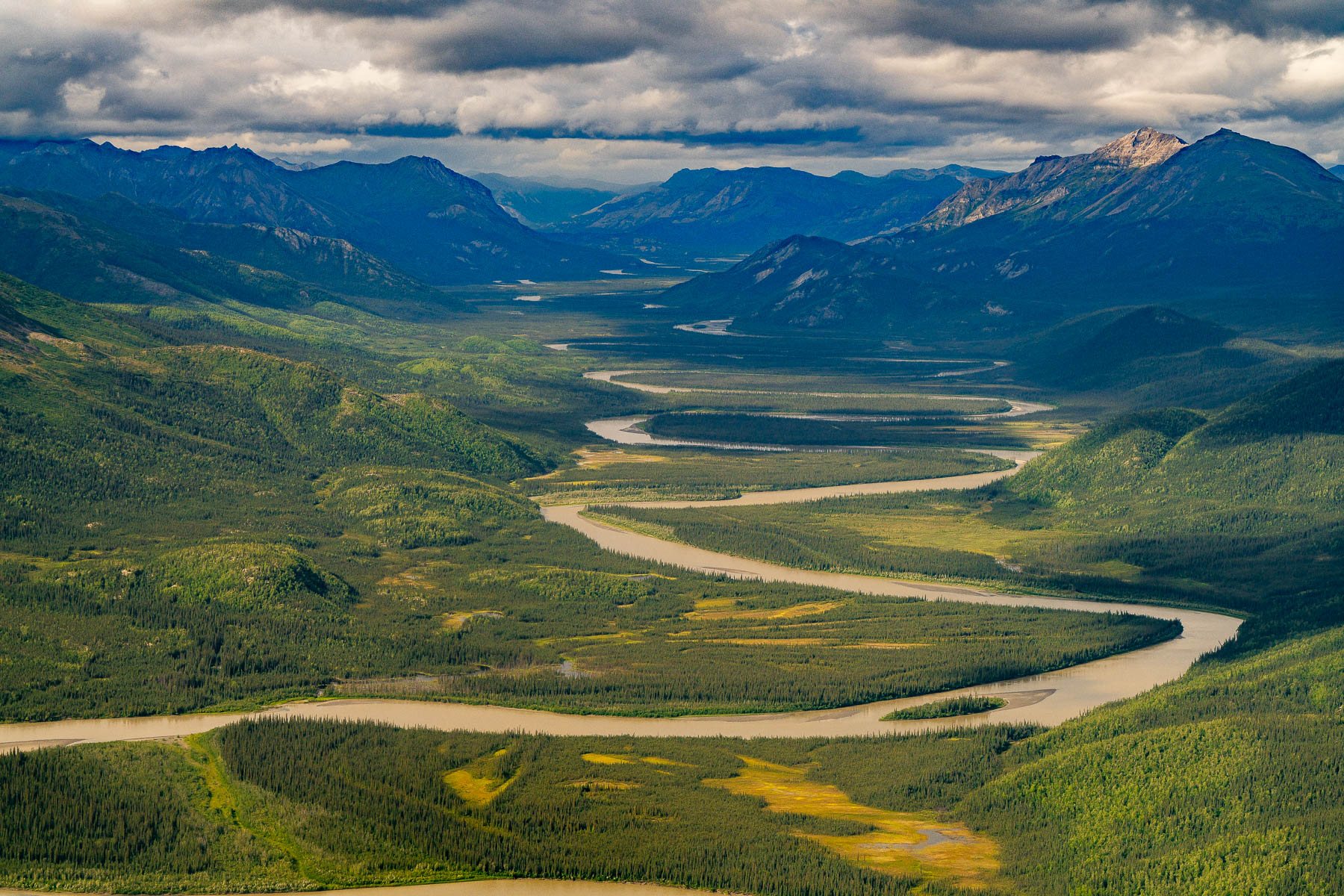
 BROOKS RANGE, ALASKA / MORE THAN JUST PARKS
BACK FROM THE BROOKS RANGE · EXPEDITION COMPLETE
Get an email when this fight moves.
Alaska's A state corporation, spending public money. AIDEA is a public corporation the Alaska Legislature created in 1967. Its own audited statements record $8.5 million appropriated to the road effective July 1, 2013 and another $8.5 million effective July 1, 2014: seventeen million dollars of direct appropriation. AIDEA has since committed up to $35 million to the project under funding agreements with Ambler Metals, and authorized another $50 million in October 2025 for permitting, construction and legal costs. Construction itself is meant to be financed with revenue bonds sold to private buyers, who would carry the risk if the road fails; the federal review says the bonds wouldn't be a liability of the State. AIDEA's board can't approve debt above $25 million on its own, and a 2024 push to raise that limit to $300 million failed. wants to build a 211-mile private mining road through some of the most magnificent country left on this continent so two foreign mining companies can haul their ore across our public lands. We went in to see the corridor for ourselves. Our readers get what we brought back first, and the fight isn't over.
Will and Jim Pattiz · More Than Just Parks
THREE WAYS IN
One investigation, three ways to take it. Read it as a story in our photographs, fly the road itself mile by mile, or open the full map and interrogate every crossing yourself.
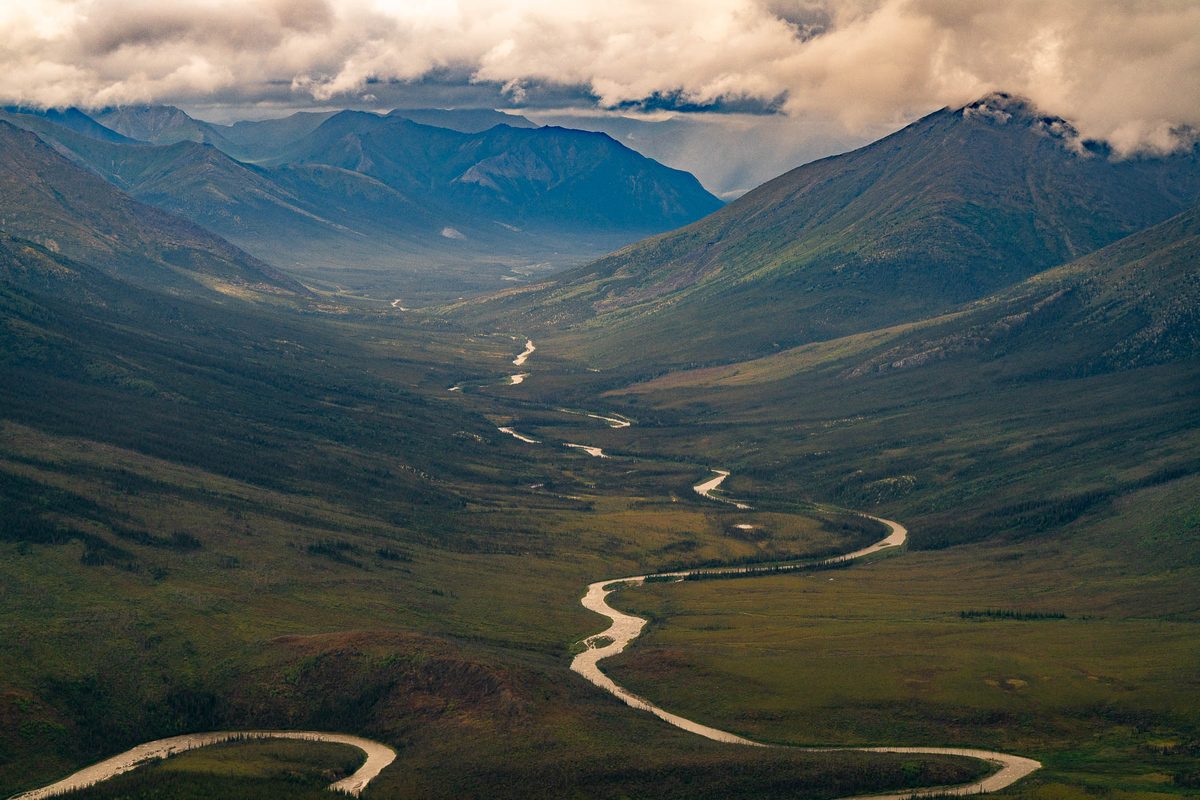 01 · The story
The Ambler Road, taken apart
Eighteen scenes. The quiet, the gravel, the frozen ground, the crossings, the herd and the money, in our photographs and the government's own numbers.
Read the story
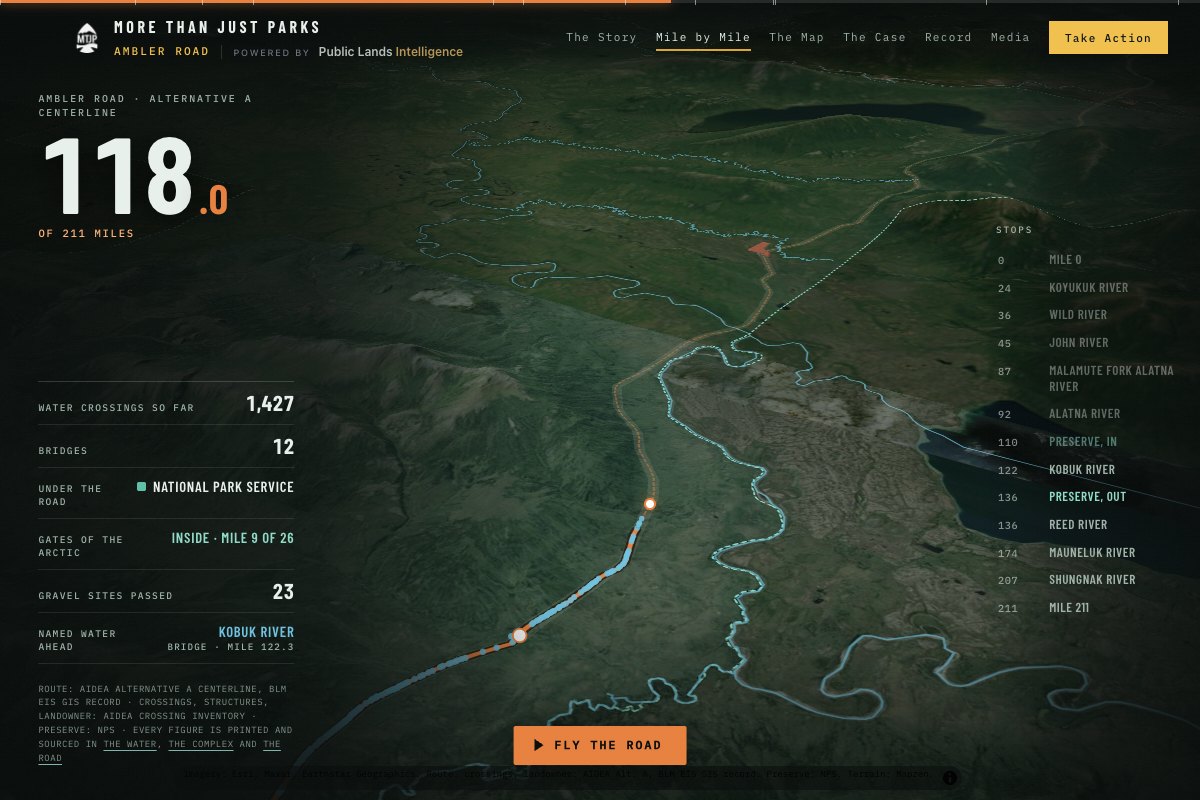 02 · Mile by mile
Fly all 211 miles
The road on the terrain it would cross, end to end, with what the record puts under every mile: the crossings, the owner, the preserve, the gravel.
Fly the road
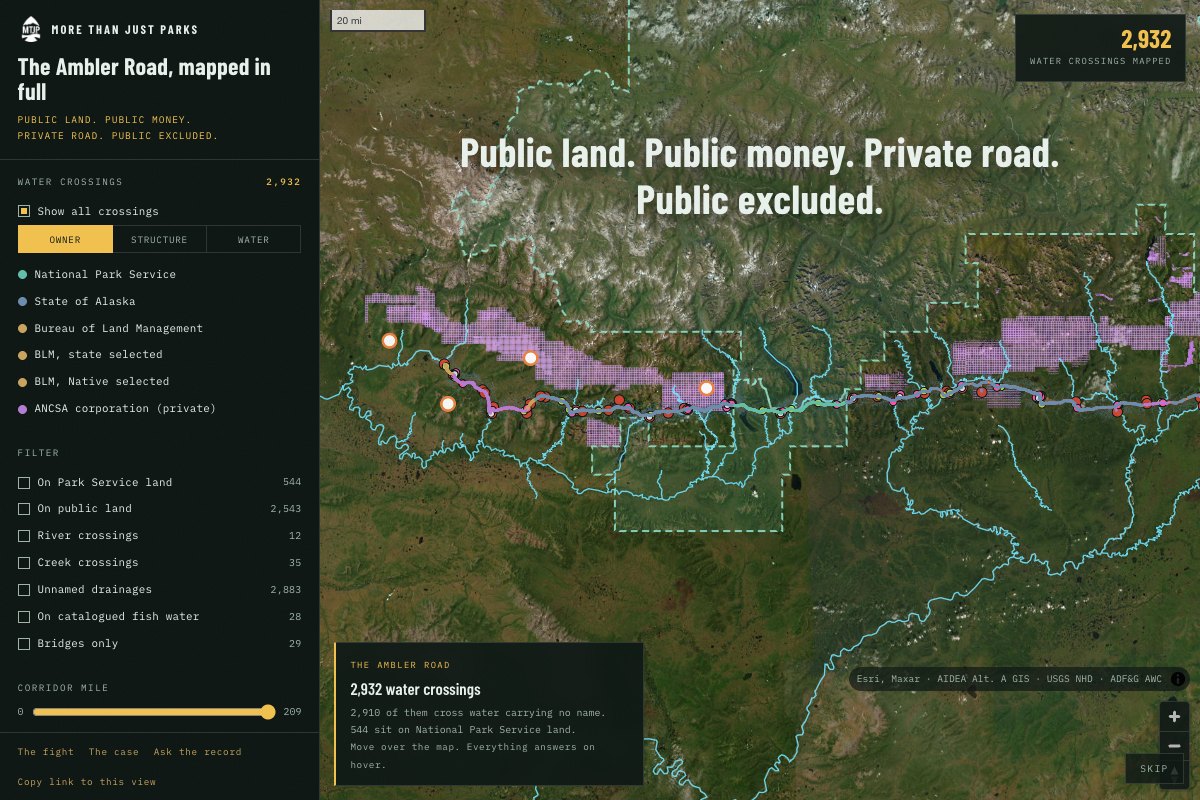 03 · The map
Every crossing, every acre
The full atlas. Filter 2,932 water crossings by owner, structure and water, switch every layer, copy a link to any view.
Open the map
Also: the case, the history, the lawsuit and the money in one read · the record, ask 104 primary documents · the photographs · the press kit · take action
THE INVESTIGATION
One chapter for each thing the road actually is. Every figure is cited to a page of the federal record, the applicant's own engineering file or a filing with the SEC. Read them in order, or start anywhere.
Who AIDEA is, what the record doesn't know, and the 189 voices from the hearings.
Each new chapter, permit decision and comment window, in your inbox. Get Ambler Road alerts →
THE WIRE
Every Ambler Road headline, Trilogy Metals filing, agency notice and court entry, newest first, with its source. The newest four are here; the whole year is on the wire.
The full wire, checked twice a day, with filters for the filings, the agencies, the courts and the trip's own reporting. New to this? The best reporting on the fight.
Ambler Road alerts
The Ambler Road gets decided in permits, court filings and comment windows that are easy to miss. Leave your email and we'll write when one of them moves, with the source and what you can do about it.
Free, from More Than Just Parks. One click in your inbox confirms it. Only when something happens, and it's separate from the newsletter. Leave any time.
WHO PAYS. WHO PROFITS.
That's the whole argument in eight words. Use it.
AIDEA is a public corporation of the State of Alaska, which means the money it spends is public money. It has committed up to $35 million to the project under funding agreements with Ambler Metals, and another $50 million in October 2025, authorized for permitting, construction and legal costs. What that buys is 211 miles of industrial road across public land, closed to the public, to move ore from a venture owned by a Vancouver junior and an Australian mining giant.
STRAIGHT ANSWERS
We went to the corridor and we read the federal record. Every answer below names the document it came from and the page it is on, including the answers that complicate our own position.
It has been permitted, then denied, then reinstated by the President personally.
After a supplemental review, the Bureau of Land Management denied the right-of-way in June 2024. In October 2025 the President approved AIDEA's appeal under section 1106(a) of the Alaska National Interest Lands Conservation Act and approved the application, and the permits were reissued. The President didn't dispute BLM's subsistence finding: he approved the road under that separate appeal provision, after making his own public-interest findings.
No mine has been permitted. Road construction hasn't begun.
Decision of the President, 2025 Ambler Road Appeal, p. 2. BLM Record of Decision, Ambler Road SEIS, June 2024.No. This is the single most misunderstood thing about the project.
Every federal document describes a private industrial road, closed to the public. AIDEA's own audited financial statements call it "a controlled, private industrial access road." It isn't a highway, it doesn't connect communities to each other, and the public couldn't drive it: the federal review says it would be open only to permitted industrial users and commercial transporters.
AIDEA Audited Financial Statements, FY2025, p. 74. Same language appears in the FY2024 statements, p. 80.We counted the crossings ourselves off AIDEA's own centerline data and got 2,932. Then we checked our number against the government's structure table for the selected route, and it lands in exactly the same place: 2,864 minor culverts, 7 moderate culverts, 12 major culverts, and 49 bridges. That is 2,932.
Our count from AIDEA's centerline file matches the structure table in the Record of Decision, which is also built from the applicant's engineering. That is roughly fourteen crossings for every mile of road.
Our count, from AIDEA centerline data. Structure table: BLM Record of Decision, p. 12, sourcing DOWL 2016 and USACE 2020.Fifteen million cubic yards of gravel to build it, and another 220,000 cubic yards every year to keep it there. The total project footprint is 4,524 acres, of which 332 acres sit on land managed by the National Park Service.
The gravel has to come from somewhere. It comes from material sites dug along the route, which is why the footprint is far wider than the roadbed.
BLM Record of Decision, p. 12, Alternative A figures.In places, asbestos. The federal record calls it naturally occurring asbestos, and gives it its own acronym, NOA, its own map and its own table in the environmental impact statement.
AIDEA committed to avoid, where feasible, material containing more than 0.1 percent asbestos by mass, which is a tighter threshold than the state transportation department's 0.25 percent. The environmental impact statement is candid about what that does and doesn't buy: the threshold "does not mean those materials have no asbestos and those materials are not capable of releasing asbestos to the air or presenting a risk to human health."
The 2024 Record of Decision also states that AIDEA's routes, including the one later reinstated, carry greater impacts from asbestos-bearing material than Alternative C.
Ambler Road Final EIS, Volume 1, p. 49 and p. 76. BLM Record of Decision, p. 12.The Western Arctic Caribou Herd peaked at more than 490,000 animals in 2003. The 2025 photocensus counted 121,000. Roughly three quarters of the herd is gone in two decades, and a fifth of it went between 2023 and 2025 alone.
In December 2025 the herd's technical committee recommended the management level "Critical, Declining." Under the management plan, if the population falls below 75,000 there is a proposed moratorium on all hunting until it recovers past 100,000.
The road would cross the herd's range. The federal review found it could cause further declines.
Peak: Ambler Road Final EIS, Volume 1, p. 155, citing Dau 2015. Census series and management level: Western Arctic Caribou Herd Working Group, 2025 Meeting Summary, pp. 2 and 5, and the 2025 Technical Committee Packet, p. 3.The federal subsistence evaluation found the road may significantly restrict subsistence uses for 30 communities, and for 34 once other projects are counted in the cumulative case. The Record of Decision lists the 34 by name:
Alatna, Allakaket, Ambler, Anaktuvuk Pass, Bettles, Buckland, Coldfoot, Deering, Elim, Evansville, Golovin, Hughes, Huslia, Kiana, Kivalina, Kobuk, Kotzebue, Koyuk, Noatak, Nome, Noorvik, Nuiqsut, Point Hope, Point Lay, Selawik, Shaktoolik, Shishmaref, Shungnak, Stevens Village, Unalakleet, Utqiagvik, Wainwright, White Mountain and Wiseman.
The broader study area covers 66 communities that harvest resources in, near, or migrating through the project area.
BLM Record of Decision, p. 21 for the 34-community finding, p. 16 for the 66-community study area, drawing on the Final Supplemental EIS, Appendix L.The public, through AIDEA, the Alaska Industrial Development and Export Authority. AIDEA is a public corporation of the State of Alaska, created by the Legislature in 1967 and reported as a component unit of the state, so the money it spends is public money.
It has committed up to $35 million to the project under funding agreements with Ambler Metals, and authorized another $50 million in October 2025 for permitting, construction and legal costs.
The ore the road would serve is held by Ambler Metals, owned equally by Trilogy Metals, a Vancouver company, and South32, an Australian mining company. NANA owns the land under the Bornite deposit and holds a back-in right or royalty on projects on its lands.
AIDEA Board Resolution G25-09, October 22 2025. AIDEA Audited Financial Statements, FY2022 through FY2025. Alaska Business, October 28 2024, on the bonding limit.Yes, and the terms are unusual. On October 6, 2025, the day the President ordered the permits reissued, the Department of War signed a binding letter of intent to take roughly ten percent of Trilogy Metals for about $35.6 million. On August 28, 2026 the two sides signed the definitive agreements, and on September 11, 2026 the investment closed. The government is now a shareholder of record.
The ten percent is the headline. The rest: every unit the government bought also carries three quarters of a ten-year warrant, and the government took a separate ten-year option on 6,161,678 more shares. Both are priced at one cent, roughly 12.3 million shares in all. Under the executed text the warrants become exercisable on the earliest of three events: completion of Phase 1 of the road as determined by the engineering firm or AIDEA, the first ten ore-concentrate trucks on the road in any ten-day period, or a change of control of the company. Trilogy describes the option as exercisable after Phase 1 or a change of control; its executed text isn't public.
The signed agreements also buy governance, which Trilogy listed in its August 28 filing. The government may name an independent director to Trilogy's board until October 2028 and keep a board observer. It gets an observer seat inside Ambler Metals, the joint venture itself, with the financials and the books. The joint venture's security plan requires the government's written approval. Until 2029, Trilogy can't borrow more than $1 billion without it, though that approval can't be unreasonably withheld. And the Department of War agreed to "work in good faith to help facilitate financing required for construction of the Ambler Access Project in coordination with the State of Alaska."
The money itself still goes to the mine, not the road: Trilogy and South32 both reinvest their proceeds in Ambler Metals for exploration and development. The road is what the penny shares are keyed to. The closing was reported to the SEC on September 14, 2026, with the full agreements attached as exhibits, and they define the warrants' trigger as the earliest of Phase 1 complete, ten trucks carrying ore concentrate on the road in any ten-day period, or a change of control of the company.
Trilogy Metals Form 8-K, filed October 7 2025, for the letter of intent. Form 8-K filed August 31 2026 and its Exhibit 99.1 news release dated August 28 2026 for the definitive agreements and the governance terms. Form 8-K filed September 14 2026 and its Exhibits 10.1 to 10.5 for the closing and the executed agreements, including the trigger definitions. Filing history checked directly against SEC EDGAR, CIK 1543418, on September 15 2026.This is the strongest argument for the road and it deserves a straight answer rather than a dismissal.
Copper is genuinely a critical mineral, it was added to the federal critical minerals list in November 2025, and the Ambler district is a real deposit. Nobody serious disputes that.
What the argument skips is that no mine has been permitted. Ambler Metals filed the first mine's Clean Water Act permit application on April 20, 2026 (the Corps dates the complete application May 19), its environmental review opened for public scoping on September 18, 2026, with comments due November 2, and the decision is targeted for September 2028. The tolls meant to repay the road would come from mines that don't yet exist, and the ore is owned by a Vancouver junior and an Australian mining giant. A road built now serves a mine that may or may not be approved, may or may not be financed, and would ship its concentrate to whoever buys it.
Final 2025 List of Critical Minerals, Federal Register, November 7 2025. Permitting status from Trilogy Metals News Release, July 16 2026, on the federal and state permitting schedule.The road itself is a small permanent employer. The federal review puts it at 81 jobs across an operating life of 44 to 46 years.
Construction is where the real employment is, and it is temporary: about 360 jobs during the four- to six-year build, with 292 of them estimated to go to local residents and other Alaskans. Those are real jobs and real wages in a part of the state that has few of either, and that shouldn't be waved away.
The much larger job numbers you may see quoted, in the thousands, are mine jobs, not road jobs. They depend on mines that haven't been permitted.
BLM Record of Decision, p. 27. AIDEA Ambler Access Project Development Plan Update, p. 8.They disagree with each other, and the record shows it.
Alaska Native regional corporations, village corporations and tribal governments are different institutions with different obligations, and on this project they don't speak with one voice. NANA Regional Corporation has a long-running agreement with the mine's owners covering exploration and development in the district; it withdrew from the road project in 2024, and in December 2025 it signed a nonbinding memorandum with AIDEA that it says isn't a final decision. Other communities and tribal governments have opposed the road outright, and the federal record finds the road may significantly restrict subsistence for 30 communities, 34 in the cumulative case.
We report the disagreement rather than averaging it. Where we quote a position, we name the specific entity holding it.
NANA agreement: Trilogy Metals Form 10-K, FY2025, pp. 14 and 15. NANA withdrawal: NANA release, May 8 2024. Memorandum: Northern Journal, February 6 2026. Subsistence findings: BLM Record of Decision, p. 21.No. The permits are reinstated and the legal challenges are pending. Construction of the road hasn't started.
That is exactly why the record matters now. Almost every decision that will determine whether this road exists is being made while there is nothing to photograph.
Status verified against agency records and company filings as of October 1, 2026.FOR READERS
The reporting from the ground, and a look at this country before any of it happens, goes to our readers first.
Free. Join 27,000+ readers. Prefer the Substack app? Follow there instead.
FOR NEWSROOMS AND ORGANIZATIONS
We mapped all 2,932 water crossings on the line from AIDEA's own engineering files, and indexed the environmental reviews, the court filings and the presidential decision into a record you can query. If you're reporting on this, we'll share it.

OPEN NOW · ARMY CORPS SCOPING · CLOSES NOVEMBER 2
Demand the Army Corps stop the first Ambler Road mine
The Ambler Road is meant to reach this mining district, and the Arctic mine is the first one to seek a federal permit. What you tell the Army Corps by November 2 goes on the record its decision has to answer.
About five minutes. You tell it why this matters to you, in your own words, and get a letter with the sources in it, ready to send to the Corps. You don't have to live on the Kobuk to comment.
Corps reference POA-2019-00081 · Scoping meetings in Shungnak Oct 6, Ambler Oct 7, Kobuk Oct 8, Fairbanks Oct 13 and online Oct 19 (register to speak) · Read the Corps' notice · Other ways to comment