


Seattle built the Space Needle in about a year for the 1962 World’s Fair, a fair themed around the space age and the world of the future. The crowds left, the future arrived, and the 605-foot tower stayed put as the symbol of the city. Much of Seattle works that way: a temporary idea that took root and refused to leave.
I spent a career teaching history before I joined my sons at More Than Just Parks, and the stories behind these places are the ones I most like to tell, from the Klondike gold rush that made the city rich overnight to the giant concrete troll that has clutched a real Volkswagen under the Aurora Bridge since 1990. These are the 15 I would send you to, counted down from number 15.
Seattle Landmarks At A Glance
Here is a quick comparison of all 15 landmarks before we dig into the stories behind each one.
| Landmark | Type | Year | Neighborhood |
|---|---|---|---|
| Space Needle | Observation tower | 1962 | Seattle Center |
| Pike Place Market | Public market | 1907 | Downtown |
| Original Starbucks Store | Historic storefront | 1971 (this site 1976) | Pike Place |
| Ballard Locks | Navigation locks | 1917 | Ballard |
| Museum of Pop Culture | Pop-culture museum | 2000 | Seattle Center |
| Chihuly Garden and Glass | Glass-art museum | 2012 | Seattle Center |
| Pacific Science Center | Science museum | 1962 | Seattle Center |
| Volunteer Park | Olmsted public park | 1904 to 1912 | Capitol Hill |
| Seattle Great Wheel | Ferris wheel | 2012 | Waterfront |
| Pioneer Square | Historic district | 1850s | Pioneer Square |
| Museum of Flight | Aviation museum | 1965 | Tukwila / Boeing Field |
| Kerry Park | Viewpoint park | 1927 | Queen Anne |
| Smith Tower | Historic skyscraper | 1914 | Pioneer Square |
| Seattle Art Museum | Art museum | 1933 / 1991 | Downtown |
| Fremont Troll | Public sculpture | 1990 | Fremont |
If you want to pair your city trip with the wild side of the state, take a look at the national parks in Washington and our guide to things to do at Mount Rainier.
117 public lands destinations are under threat. Get the free briefing that 27,000+ people use to stay informed and take action.

15. Fremont Troll
The Fremont Troll is an 18-foot concrete sculpture lurking under the north end of the Aurora Bridge, clutching a real Volkswagen Beetle in one giant hand. It is one of Seattle’s best-loved pieces of public art and a perfect symbol of Fremont’s self-declared status as the city’s quirkiest neighborhood.

The Fremont Arts Council ran a competition in 1989 to enliven the dead space under the bridge, which had become a magnet for dumping and crime. The winning team of artists, Steve Badanes, Will Martin, Donna Walter, and Ross Whitehead, built the troll from rebar, wire, and concrete, finishing it in 1990. The car in its grip is real. The troll has since hosted weddings, concerts, and an annual Halloween gathering, and it remains a fixture of Seattle’s playful streak.
14. Seattle Art Museum
The Seattle Art Museum, known to locals as SAM, has been the center of the visual arts in the Pacific Northwest since 1933. Its collection spans more than 25,000 objects from around the world.

SAM opened in 1933 in an Art Deco building in Volunteer Park designed by the firm Bebb and Gould. That original building now houses the Seattle Asian Art Museum. In 1991 the museum opened a much larger downtown home designed by architect Robert Venturi, marked outside by Jonathan Borofsky’s towering Hammering Man sculpture. SAM now operates three sites, the downtown museum, the Asian Art Museum, and the free Olympic Sculpture Park on the waterfront.
13. Smith Tower
Smith Tower is the elegant white skyscraper that ruled the Seattle skyline for decades. When it was completed in 1914 it was the tallest building west of the Mississippi River, and it remained the tallest on the West Coast until the Space Needle rose in 1962.

Typewriter and firearms magnate Lyman Cornelius Smith financed the tower, hiring the firm Gaggin and Gaggin to design it in the neoclassical style. Construction ran from 1910 to 1914, and the 38-story tower stood 484 feet tall. Its top floors include the ornate Chinese Room, and the open-air observatory on the 35th floor still offers one of the best views downtown. Smith Tower joined the National Register of Historic Places in 1984.
12. Kerry Park
Kerry Park is the small Queen Anne hillside viewpoint responsible for the postcard image of Seattle: the Space Needle front and center, downtown towers behind it, Elliott Bay to the side, and Mount Rainier floating on the horizon on a clear day.

Albert Sperry Kerry and his wife donated the land to the city in 1927 so the view could belong to everyone. The compact park has benches, a steel sculpture called Changing Form by Doris Totten Chase, and a small playground just below. It is busiest at sunset and after dark, when photographers line the railing for the city lights.
11. Museum of Flight
The Museum of Flight at Boeing Field is one of the largest air and space museums in the world, with more than 175 aircraft and spacecraft in its collection. It is a fitting tribute in the city where Boeing was born.

The collection ranges from a replica of the Wright brothers’ flyer to a former Air Force One presidential jet, the first jet-powered Boeing 747, a Concorde, and a full-fuselage Space Shuttle trainer used by NASA astronauts. Interactive galleries trace the story of flight from its earliest days through commercial aviation and spaceflight. The museum traces its roots to 1965 and has grown into a major center for aerospace education.
10. Pioneer Square
Pioneer Square is Seattle’s first neighborhood, a compact district of Richardsonian Romanesque brick buildings, art galleries, and underground tour entrances. It is where the city began and where its oldest surviving architecture stands.

The Denny Party settled the area in 1852, and Pioneer Square grew into the heart of early Seattle. The Great Seattle Fire of 1889 leveled roughly 25 city blocks of the wooden downtown, and the neighborhood was rebuilt in brick and stone, raising the street grade and leaving behind the buried passages now explored on the famous Underground Tour. After mid-century decline, preservationists won historic-district protection in 1970, and the area is again a lively mix of history, nightlife, and sports crowds bound for the nearby stadiums.
9. Seattle Great Wheel
The Seattle Great Wheel is the 175-foot Ferris wheel that juts out over Elliott Bay from the end of Pier 57. Its 42 climate-controlled gondolas carry riders out above the water for sweeping views of the waterfront and the Olympic Mountains.

Developer Hal Griffith spent years pushing for a wheel on the family’s pier, and after securing permits and financing he made it happen. The wheel was built in Germany, shipped to Seattle in sections, and opened to the public in June 2012. At night it lights up with a programmable LED display, and it has become one of the most photographed features of the rebuilt waterfront.
8. Volunteer Park
Volunteer Park is a 48-acre Olmsted-designed park on Capitol Hill, home to a glass conservatory, a brick water tower you can climb, and the Seattle Asian Art Museum. It is one of the city’s most graceful green spaces.

The land served as a cemetery before the city converted it to a park and brought in the Olmsted Brothers, the renowned firm founded by the sons of Central Park designer Frederick Law Olmsted, to design it. Their plan, built out between 1904 and 1912, included the conservatory, reservoir, and water tower. The park is also known for Isamu Noguchi’s ring-shaped Black Sun sculpture, which frames a view of the Space Needle and is widely cited as an inspiration for Soundgarden’s song “Black Hole Sun.”
7. Pacific Science Center
The Pacific Science Center sits at the foot of the Space Needle, its white arches and reflecting pools left over from the 1962 World’s Fair. It became the first U.S. museum founded as a science and technology center and remains a hands-on favorite for families.

The graceful arches were designed by architect Minoru Yamasaki, who later designed the original World Trade Center in New York. After the fair closed, the buildings reopened as the Pacific Science Center. Highlights today include the Tropical Butterfly House full of live butterflies, an IMAX dome theater, a planetarium, and rotating STEM exhibits, plus year-round classes and camps.
6. Chihuly Garden and Glass
Chihuly Garden and Glass, at the base of the Space Needle, showcases the work of Tacoma-born glass artist Dale Chihuly, who reshaped what glass could do as an art form. It opened in 2012 on the former site of the Fun Forest amusement park.

The centerpiece is the Glasshouse, a 40-foot-tall glass-and-steel pavilion holding a suspended 100-foot sculpture in reds, oranges, and yellows. Eight interior galleries trace Chihuly’s series, from sea forms to his Persians, and the outdoor garden weaves glass among living plants. With the Space Needle rising directly behind it, the garden is one of the most photographed corners of Seattle Center.
5. Museum of Pop Culture
The Museum of Pop Culture, or MoPOP, is the swooping, multicolored building at Seattle Center devoted to music, science fiction, and pop culture. Its collection includes one of the deepest holdings anywhere of Jimi Hendrix and Nirvana artifacts.

Microsoft co-founder Paul Allen funded the museum, which opened in 2000 as the Experience Music Project. Frank Gehry designed the building, its sheet-metal curves meant to evoke smashed electric guitars. Inside, visitors find the Sound Lab for hands-on music-making, a guitar gallery, and exhibits on science fiction, fantasy, horror, and video games, alongside rotating shows on everything from Nirvana to Star Wars costumes. The institution took its current name in 2016.
4. Ballard Locks
The Hiram M. Chittenden Locks, known to everyone as the Ballard Locks, carry boats between the saltwater of Puget Sound and the freshwater of Lake Union and Lake Washington. They are among the busiest locks in the country and a free, fascinating place to spend an afternoon.

Built between 1911 and 1917 as part of the Lake Washington Ship Canal, the locks were named for Hiram M. Chittenden, the Army Corps of Engineers officer who championed them. Two lock chambers raise and lower vessels between sea level and the lakes, while a separate fish ladder, with an underwater viewing room, lets salmon and steelhead climb upstream to spawn. The Carl S. English Jr. Botanical Garden surrounds the site. The U.S. Army Corps of Engineers still operates the locks today.
3. The Original Starbucks Store
The Starbucks storefront at Pike Place Market draws long lines of visitors paying their respects to the coffee giant’s roots. It is widely treated as the original Starbucks, and it carries the company’s older brown logo with the bare-breasted siren.

One detail worth knowing: the very first Starbucks opened in 1971 at a different address nearby on Western Avenue, and the company moved to the current Pike Place storefront at 1912 Pike Place in 1976 (some accounts say 1977). Starbucks was founded by three partners, Jerry Baldwin, Zev Siegl, and Gordon Bowker, and at first sold only roasted beans and brewing gear. Howard Schultz joined in 1982, bought the company in 1987, and turned it into the cafe chain known worldwide.
2. Pike Place Market
Pike Place Market is one of the oldest continuously operating public markets in the United States and the beating heart of downtown Seattle. Its neon clock and “Public Market Center” sign are as recognizable as anything in the city.
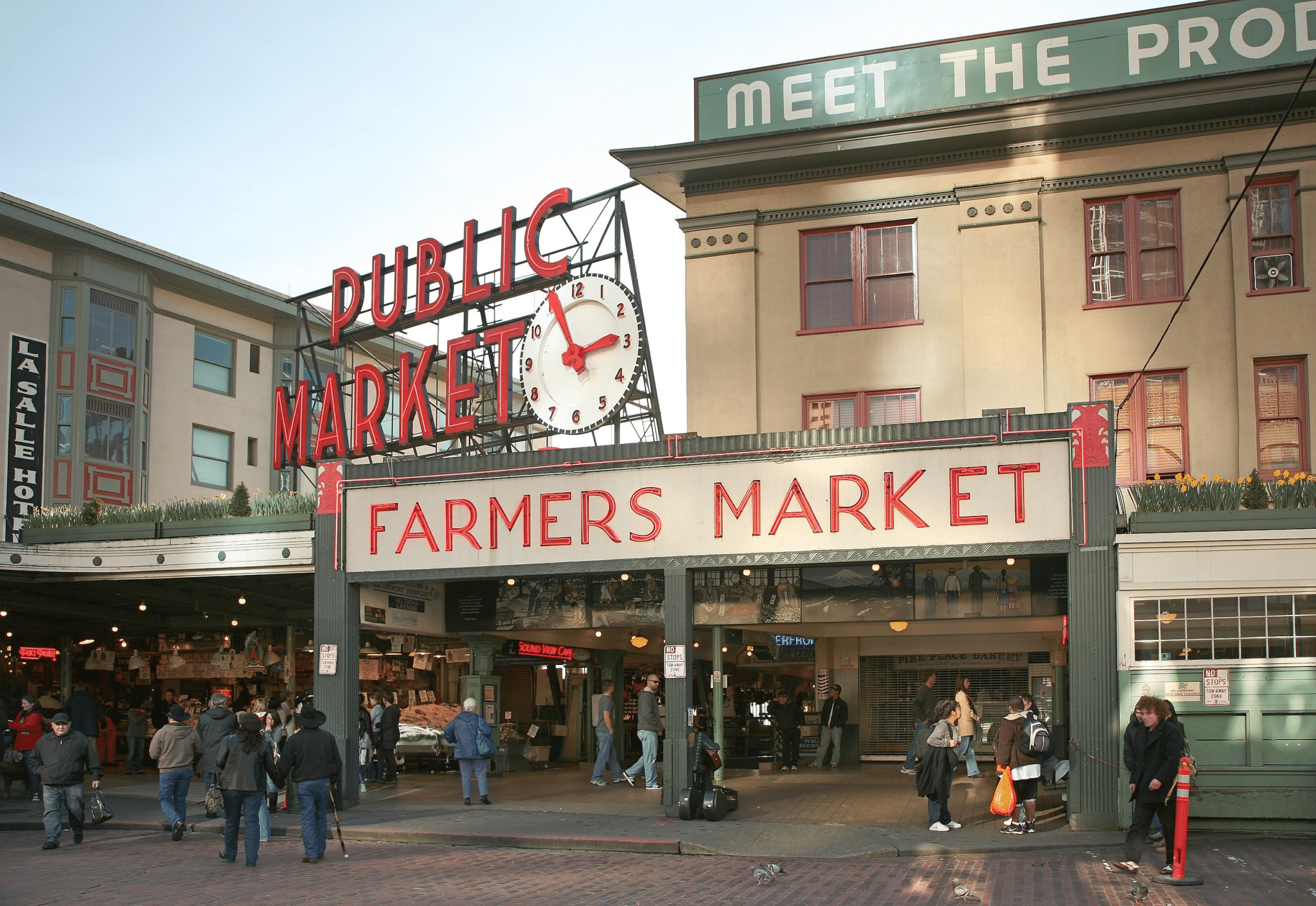
The market opened on August 17, 1907, after the city council set aside Pike Place so farmers could sell directly to the public and bypass the price-gouging commission houses. Crowds mobbed the first farmers, and a permanent arcade opened that November. The market survived the Great Depression, the forced removal of its many Japanese American farmers during World War II, and a 1960s plan to demolish it, which a citizen campaign led by architect Victor Steinbrueck defeated in 1971. Today more than 200 year-round businesses fill the market, including the fishmongers famous for tossing salmon to the crowd.
1. Space Needle
Our number one Seattle landmark is the Space Needle. Built for the 1962 World’s Fair, it has been the symbol of the city ever since, a 605-foot tower with a flying-saucer top that captured the optimism of the space age.

Western hotel executive Edward E. Carlson sketched the first idea for a tower on a napkin, reportedly inspired by a broadcast tower he had seen in Stuttgart, Germany, and architect John Graham Jr. shaped it into the saucer-topped design we know. Construction raced to finish in time for the fair, whose theme was the Age of Space, and the tower drew enormous crowds. A 2018 renovation added tilting glass walls and the world’s first rotating glass floor. The Space Needle remains the icon of Seattle and the Pacific Northwest.
The Full Ranking
- Space Needle
- Pike Place Market
- The Original Starbucks Store
- Ballard Locks
- Museum of Pop Culture
- Chihuly Garden and Glass
- Pacific Science Center
- Volunteer Park
- Seattle Great Wheel
- Pioneer Square
- Museum of Flight
- Kerry Park
- Smith Tower
- Seattle Art Museum
- Fremont Troll
You should know that this guide does not come out of thin air. More Than Just Parks is a family operation. My sons Will and Jim have spent their adult lives exploring America’s national parks and public lands destinations, working with the National Park Service, the Department of the Interior, the USDA, and the U.S. Forest Service along the way. In 2018, after a career teaching history, I joined them to help tell the stories behind these places.
Helpful Related Articles
Washington National Parks: National Parks in Washington
Things to Do at Mount Rainier: Things to Do at Mount Rainier National Park
Mount Rainier Facts: Interesting Mount Rainier Facts
North Cascades Facts: North Cascades National Park Facts
Things to Do at Olympic National Park: Things to Do at Olympic National Park
National Parks Ranked: All 63 US National Parks Ranked by Experts
Most Visited National Parks: The Most Visited National Parks
Least Visited National Parks: The Least Visited National Parks


