

The best time to visit Rocky Mountain National Park is the second half of September. Elk bugling in the meadows, aspens turning gold, Trail Ridge Road still open, and the summer crush thinning out by the day. That’s my answer, and I’ll defend it below.
But Rocky Mountain is really four different parks depending on when you show up, and the right month for you depends on whether you’re chasing wildflowers, elk, snowshoe trails, or an empty parking lot at Bear Lake (good luck with that last one).
Rocky Mountain sits 90 minutes from Denver, which means it absorbs Front Range day traffic on top of destination travelers, and that math shapes when you should go. In this guide I’ll walk through the park season by season and month by month, with real NOAA temperature normals, the 2026 timed entry dates, and the honest stuff most guides skip, like what March actually looks like up there.

The Quick Answer
| If You Want | Go In |
|---|---|
| The best overall experience | Mid September to early October |
| Alpine wildflowers | July |
| Elk rut and fall color | Mid September to mid October |
| Snowshoeing and solitude | January to March |
| Every trail and road open | Mid July to early September |
| The fewest people | November to April, midweek |
Rocky Mountain saw 4,171,431 visits in 2025, which made it the sixth busiest national park in the country. Most of those visits land between June and September, which is exactly why the timing of your trip matters more here than at almost any other park. More on the crowds, and the reservation system that manages them, below.
Love Rocky Mountain? It's one of 117 threatened public lands destinations we're tracking. Get the free briefing.
Rocky Mountain Weather by the Numbers
These are NOAA monthly normals for the Estes Park area on the east side of the park, elevation roughly 7,500 feet. Subtract 15 to 20 degrees for the alpine sections of Trail Ridge Road, and add wind. Always add wind.
| Month | Avg High (F) | Avg Low (F) |
|---|---|---|
| January | 37 | 16 |
| February | 38 | 16 |
| March | 45 | 21 |
| April | 52 | 26 |
| May | 61 | 35 |
| June | 74 | 43 |
| July | 80 | 48 |
| August | 78 | 46 |
| September | 70 | 39 |
| October | 57 | 30 |
| November | 44 | 24 |
| December | 36 | 16 |
Summer (June Through August). Everything Open, Everyone Here
Summer is when the whole park is on the table. Trail Ridge Road is open, the high trails melt out through July, and the alpine tundra puts on its brief, absurd wildflower show. If you’ve never stood at 12,000 feet surrounded by sky pilot and alpine sunflowers in mid-July, it belongs on your list.
The catch is that everyone else read the same forecast. June through August is peak season, Bear Lake Road is a managed-access corridor for a reason, and the popular trailheads fill before sunrise. Literally before sunrise. Pull into the Bear Lake lot at 5:15 am in July and you will have company.
The other summer reality is the afternoon thunderstorm. In July and August, storms build over the divide almost daily, usually popping between noon and 3 pm. Lightning above treeline is not a photography opportunity, it’s an emergency. Start early, summit early, and be headed down by midday. The classic hikes like Dream Lake, Emerald Lake, and Sky Pond are all best done at first light anyway, when the lakes are still and the light is doing its thing on Hallett Peak.
July normals run 80 for a high and 48 for a low in Estes Park, which is about as pleasant as mountain weather gets. Just respect the altitude. Folks coming from sea level feel 9,500 feet quickly.
One more late-summer reality the brochures skip. Wildfire smoke has defined stretches of several recent Augusts on the Front Range, sometimes from fires burning hundreds of miles away. Before any August trip, check our public lands air quality map a few days out and keep the plan flexible.
Fall (September and October). The Main Event
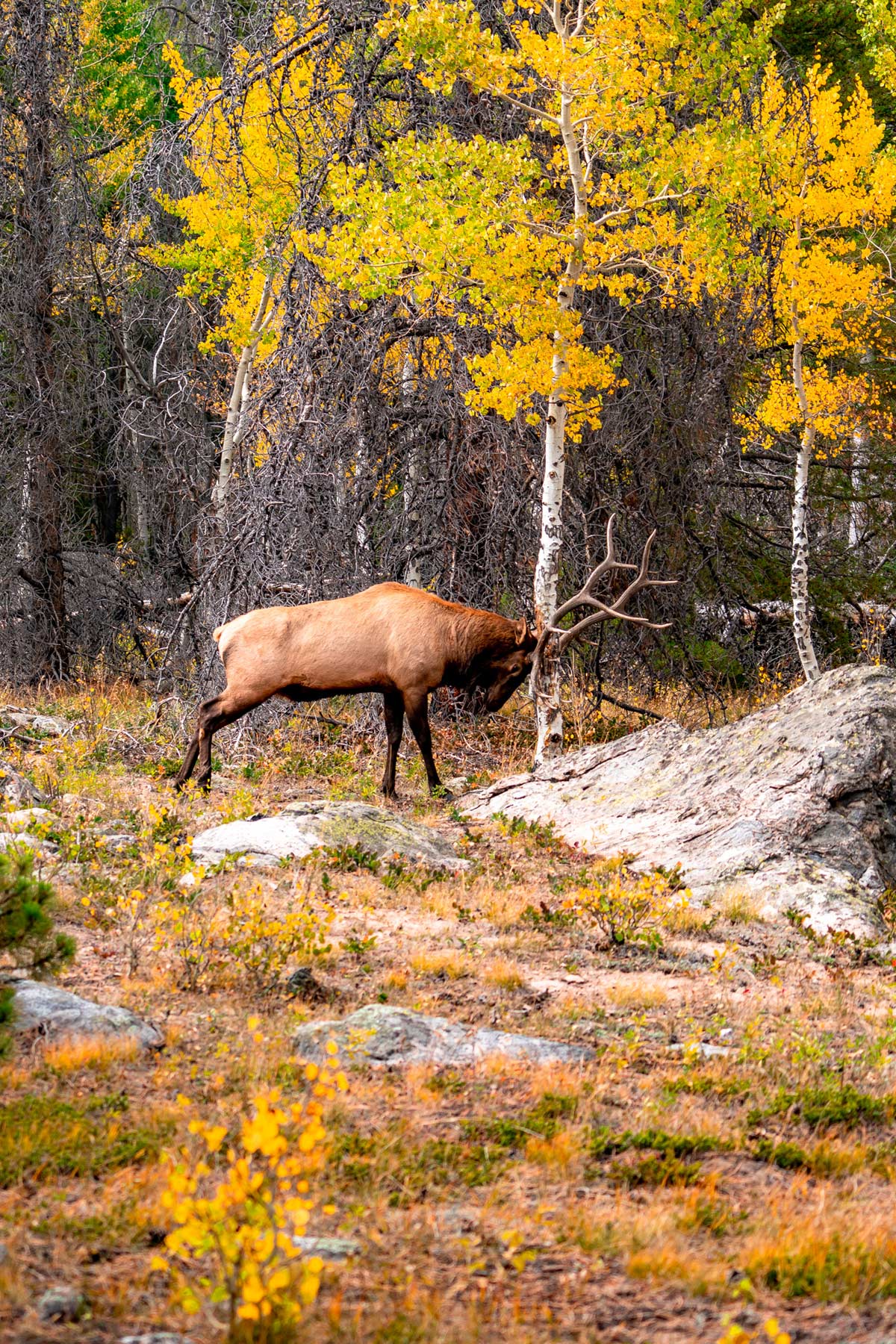
Here’s why September wins. From roughly mid-September through mid-October, hundreds of elk pour down into the meadows around Estes Park for the rut. Bulls bugle at dawn and dusk, an eerie, high-pitched scream that sounds like nothing else in North America. Moraine Park, Horseshoe Park, and Upper Beaver Meadows are the spots, and Upper Beaver Meadows is my favorite of the three because the crowds are thinner and the Longs Peak backdrop is better.
At the same time, the aspens turn. Bear Lake Road, Hidden Valley, and the Kawuneeche Valley on the west side all go gold, usually peaking in the last week of September. September normals are 70 and 39, the air goes clear in that specific autumn way, and the first dustings of snow show up on the peaks while the trails stay dry. For a photographer it’s the whole package, golden trees in the foreground, white summits behind, and a bull elk screaming somewhere off frame.
Two notes of honesty. First, September weekends are no longer a secret, and the elk viewing areas draw real crowds at sunset. Go at dawn instead (better light, fewer people, more active elk). Second, give the elk room. Rangers manage the meadows closely during the rut, and a bull in October has zero sense of humor.
Trail Ridge Road usually closes for the season in mid-October, weather depending, so early October is your last call for the full park experience until late May.
Winter (November Through March). The Underrated Season
Most folks write off Rocky Mountain in winter, which is exactly why I won’t. The east side trails out of Bear Lake become snowshoe routes through silent, frosted forest, and a trail that holds 200 people on a July morning might hold a dozen in January. Dream Lake frozen and wind-scoured under a clear winter sky is one of the best photographs in the park.
The numbers look mild on paper. January normals are 37 and 16 in Estes Park. The wind is what the table doesn’t show you. Gusts come over the divide and funnel through the east-side valleys hard enough to knock you off rhythm, and wind chill above treeline is genuinely dangerous. Dress like you mean it, rent snowshoes or microspikes in Estes Park, and stay below treeline.
What you get in exchange is the park to yourself, no timed entry reservations, and easy lodging in Estes Park at winter rates. Hidden Valley, the park’s old ski area, doubles as a family sledding hill. Trail Ridge Road is closed at the higher elevations all winter, so plan an east-side trip.
Spring (April and May). Mud Season, With Asterisks
I’ll be straight with you. April and early May are the park’s awkward months. The snowpack is rotting but not gone, lower trails alternate between mud and ice, and the high country is still buried. March and April are typically the snowiest months on this side of the divide, and the storms keep coming well into May, which surprises people every single spring. The 2026 season proved the point when a late May storm kept Trail Ridge Road closed through Memorial Day weekend.
The asterisks. Late May can be terrific if the melt cooperates. Elk and mule deer are in the valleys, waterfalls like Alberta Falls and Chasm Falls run at full volume, moose calving season starts in the Kawuneeche Valley, and the crowds haven’t fully arrived. Pack waterproof boots, check trail conditions before you commit to anything above 10,000 feet, and treat every spring forecast as a suggestion.
Trail Ridge Road. The Season Inside the Season
Trail Ridge Road is the highest continuous paved road in the country, topping out at 12,183 feet, and its opening and closing dates effectively define the park’s calendar. The park aims to open it around the Friday before Memorial Day, but the snowpack votes too. In 2026 it opened May 29 after that late storm. It typically closes to through traffic in mid-October, again weather depending.
If driving it is the centerpiece of your trip, aim for mid-June through September and check the park’s road status line before you go. And drive it early in the day. The light is better, the bighorn sheep and elk are out on the tundra, and the afternoon storms haven’t formed yet. Old Fall River Road, the one-way historic dirt route up to the Alpine Visitor Center, opens even later, usually in July.
Timed Entry in 2026. The Short Version
From May 22 through mid-October 2026, Rocky Mountain requires timed entry reservations during peak hours. There are two flavors. The Timed Entry Plus Bear Lake Road permit covers the whole park including the Bear Lake corridor and runs 5 am to 6 pm. The standard Timed Entry permit covers everything except Bear Lake Road and runs 9 am to 2 pm. Reservations release on the first of each month at 8 am Mountain on recreation.gov, and the park holds back 40 percent of each day’s permits for a next-day batch that drops at 7 pm the evening before.
The practical takeaway for timing your visit is this. Arrive before the reservation window starts or after it ends and you can enter without one, which is one more argument for the dawn starts I keep pushing. For the full breakdown of how the system works, my brother Jim wrote a complete explainer on Rocky Mountain’s 2026 timed entry system.
Now the fine print that actually catches people. If you slip in before 9 am without a permit, you’re set for the day, but leave the park and you can’t get back in until after 2 pm unless you’re holding a reservation. The Bear Lake corridor plays by an even stricter version. Once you enter the corridor and then exit it, you cannot re-enter Bear Lake Road until after 2 pm, even with the Bear Lake permit. And if you hold a Bear Lake permit and enter from the Grand Lake side, the rules require you to reach the Bear Lake corridor within your two-hour window, which means the entire Trail Ridge drive has to fit inside it. That one quietly wrecks west-side itineraries. Plan the drive first, then pick the window.
As for how fast these sell, the Bear Lake permits are the ones to take seriously. Summer weekend dates are the first to disappear, sometimes within hours of the 8 am monthly release, while rest-of-park permits usually linger for days. The 7 pm next-day drop is a genuine safety net, but it moves fast too. Be logged in and ready at 7:00, not 7:15.
Month by Month in One Table
| Month | The Short Version |
|---|---|
| January | Snowshoe season. Quiet, windy, beautiful below treeline. |
| February | Same as January with deeper snow. Best solitude of the year. |
| March | Snowiest stretch begins. Heavy, wet storms. Still winter up high. |
| April | Mud season. Lower trails melting, high country closed. |
| May | Late May can shine. Waterfalls, wildlife, watch for spring storms. Timed entry begins May 22. |
| June | Trail Ridge opens for the season. High trails still snowy early in the month. |
| July | Alpine wildflowers peak. Daily afternoon storms. Peak crowds. |
| August | Everything open. Monsoon storms continue. Crowds slightly thinner late. |
| September | The best month. Elk rut begins, aspens turn, weather holds. |
| October | Rut winds down, gold lingers early. Trail Ridge closes mid-month. |
| November | The in-between month. Quiet park, thin snow, good wildlife. |
| December | Winter settles in. Holiday Estes Park is genuinely charming. |
A Note for Photographers
Since I know some of you are here for the light. Dream Lake at sunrise is the classic for a reason, with first light hitting Hallett Peak and Flattop across still water, and in September you can shoot it and still make the elk in Moraine Park by mid-morning. Sprague Lake gives you nearly the same alpenglow with a flat, stroller-friendly path. The Rock Cut pullout on Trail Ridge at sunset in July, with storm light moving across the tundra, is worth planning a whole day around. And Upper Beaver Meadows at dawn in late September is the most underrated frame in the park.
Beating the Crowds in Any Month
Whatever month you pick, a few moves separate a good trip from a frustrating one. First, the west side. The Grand Lake entrance gets a fraction of the Estes Park traffic, the Kawuneeche Valley is the best moose habitat in the park, and the drive over Trail Ridge connects both sides in summer anyway. Second, Wild Basin. This southeast corner of the park has its own entrance, a string of waterfalls along one trail (Copeland Falls, Calypso Cascades, Ouzel Falls), and crowds that feel a decade behind Bear Lake’s. Third, weekdays. Rocky Mountain sits an hour and a half from Denver’s millions, so the Saturday and Sunday surge is real in every season. A Tuesday in July can feel quieter than a Saturday in October.
And if the park still feels too full for your taste, the surrounding Arapaho and Roosevelt national forests deliver similar high country without the reservation system. We make that case across the whole park system in our guide to the national forests.
The Bottom Line
Go in the second half of September if you can. Go in July if you want every trail open and don’t mind company at dawn. Go in January if you want the park to yourself and own real gloves. Skip early April unless you enjoy mud with your views.
For planning the rest of the trip, start with our Rocky Mountain National Park hub, then dig into the best things to do in the park and our full guide to the best hikes in Rocky Mountain.
More Rocky Mountain Resources
- Rocky Mountain Timed Entry in 2026, Explained
- Upper Beaver Meadows, the Park’s Most Underrated Spot
- Hiking the Sky Pond Trail
- Rocky Mountain National Park Facts
What to Bring to Rocky Mountain
Gear we recommend for Rocky Mountain. Affiliate links support our work at no cost to you.
More Than Just Parks may earn a small commission from purchases made through these links, at no extra cost to you. We only recommend gear we would actually use.
Affiliate disclosure: Some links on this page earn us a small commission at no extra cost to you. We only recommend gear we actually use.
More Than Just Parks Film Watch our 8K film of Rocky Mountain We spent weeks in Rocky Mountain, one of our favorite public lands destinations, capturing it the way it deserves. Take a few minutes and see it for yourself.


