


Fall is the one that sticks with us. The summer crowds thin out, the bison are putting on a spectacular show during rutting season, and the mixed-grass prairie turns this extraordinary gold that plays against those striped formations in ways that make you stop the car every 200 yards.
Most visitors pack Badlands into a summer road trip and call it done. That’s a sensational park being reduced to a pit stop. But in fall, the Badlands slow down just enough to let you actually experience them. We’ve put together everything we know about visiting between September and November so you can make the most of it.
Why Fall Is the Best-Kept Secret Season
Here’s the honest truth about Badlands National Park. Summer is blazing hot, winter is brutal, and spring is unpredictable. Fall threads the needle perfectly. You get comfortable temperatures, manageable crowds, and a landscape doing something genuinely strange with the light.

The park saw over 1.1 million visitors in recent years, with the vast majority coming between June and August. September drops noticeably, October is quieter still, and November is nearly empty. But unlike winter, everything is still accessible. The roads are open, the trails are clear, and the wildlife is more active than it’s been all summer.
Love Badlands? It's one of 117 threatened public lands destinations we're tracking. Get the free briefing.
We’re not saying summer is bad. We’re saying fall is better. And we’ll explain exactly why.
Fall Weather Month by Month
Weather is the single biggest factor that shapes your experience at Badlands in fall. The good news is that it shifts gradually, giving you options depending on what kind of trip you want.
September
September in the Badlands still feels like summer during the day. Expect highs in the mid-70s, sometimes pushing into the low 80s during the first week or two. Nights cool down to the mid-40s, which makes for spectacular sleeping weather if you’re camping. Precipitation is low. This is the sweet spot month for us because you get summer weather without the summer crowds.
October
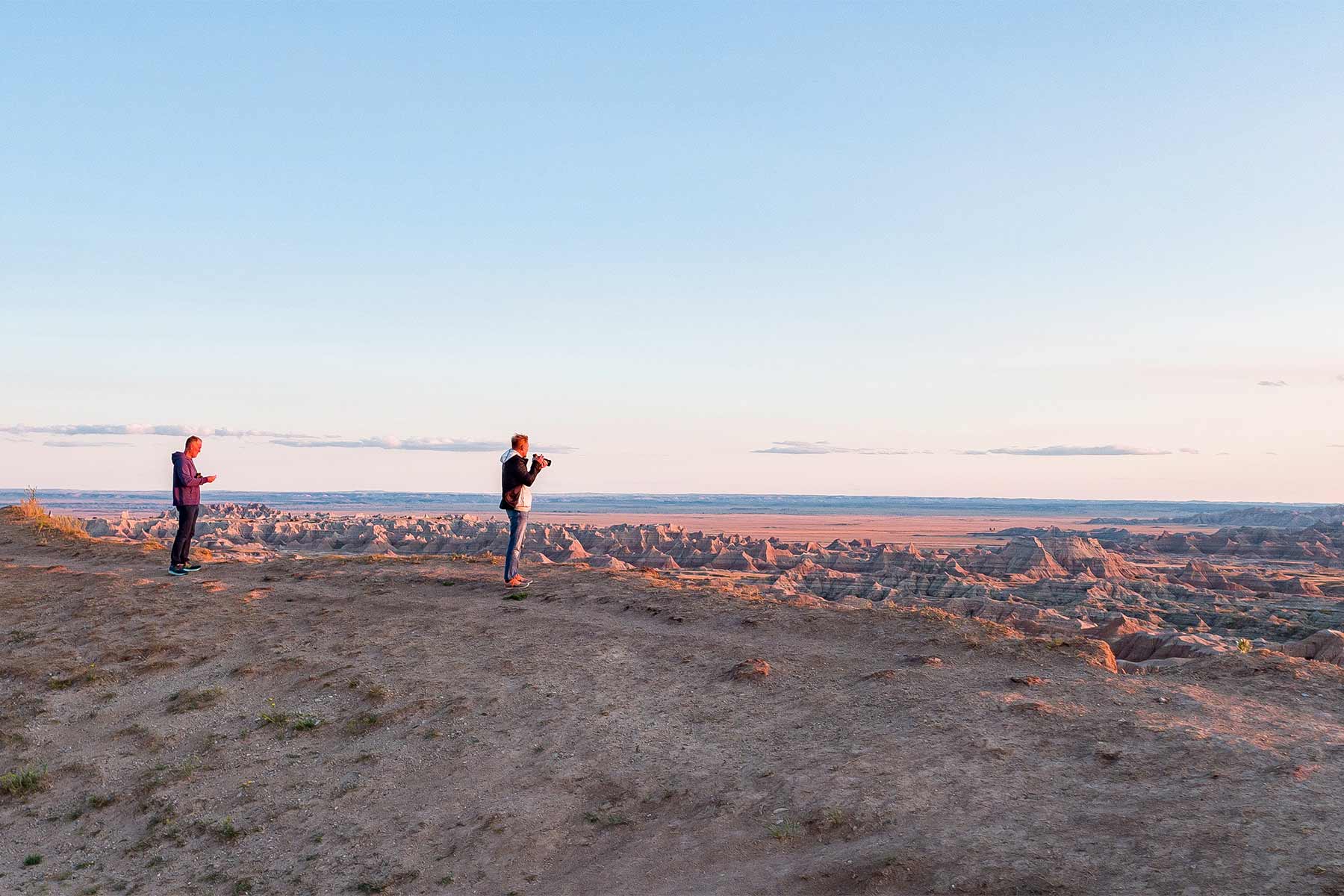
October is the transition month and arguably the most photogenic. Highs average 68 degrees, with lows near 39. The prairie grasses hit peak gold. The cottonwoods along the draws are the color here, and our Badlands fall color forecast says when they turn. The light at sunrise and sunset gets that low-angle quality that photographers travel thousands of miles for. Frost is common in the mornings, which adds an extraordinary layer of texture to the formations.
November
November is where fall starts giving way to winter. Highs average 50 degrees, with lows near 26. Snow is possible. Wind is more persistent. But if you’re prepared for it, a November visit to Badlands is an extraordinary experience. The park is nearly empty, the air is crystal clear, and there’s a starkness to the landscape that hits different when you have it all to yourself.
PRO TIP: Layer everything. Even in September, mornings can be 30 degrees colder than afternoons. We bring a base layer, a fleece, and a windbreaker on every fall visit. The wind out here is no joke.
The Golden Prairie and Why It Matters
Here’s something most people don’t think about when they picture the Badlands. Yes, the striped buttes and pinnacles are the headliners. But nearly half the park is mixed-grass prairie, and in fall, that prairie transforms into an ocean of gold, amber, and bronze that stretches to the horizon.

The contrast is sensational. You’ve got these warm golden grasses running right up against the cool grays, whites, and pale pinks of the eroded formations. It creates a color palette that doesn’t exist at any other time of year. Big bluestem, western wheatgrass, and green needlegrass all turn at slightly different rates, so the prairie isn’t one uniform color. It’s a patchwork.
If you’ve read our facts about Badlands National Park, you already know this landscape is roughly 75 million years old. In fall, with that golden light and those ancient formations, you really feel the weight of that number.
Wildlife in Fall. Bison, Bighorn, and More
Fall wildlife viewing at Badlands is, in a word, spectacular. Two of the park’s most iconic animals are at their most visible and most active during this season.
Bison Rutting Season
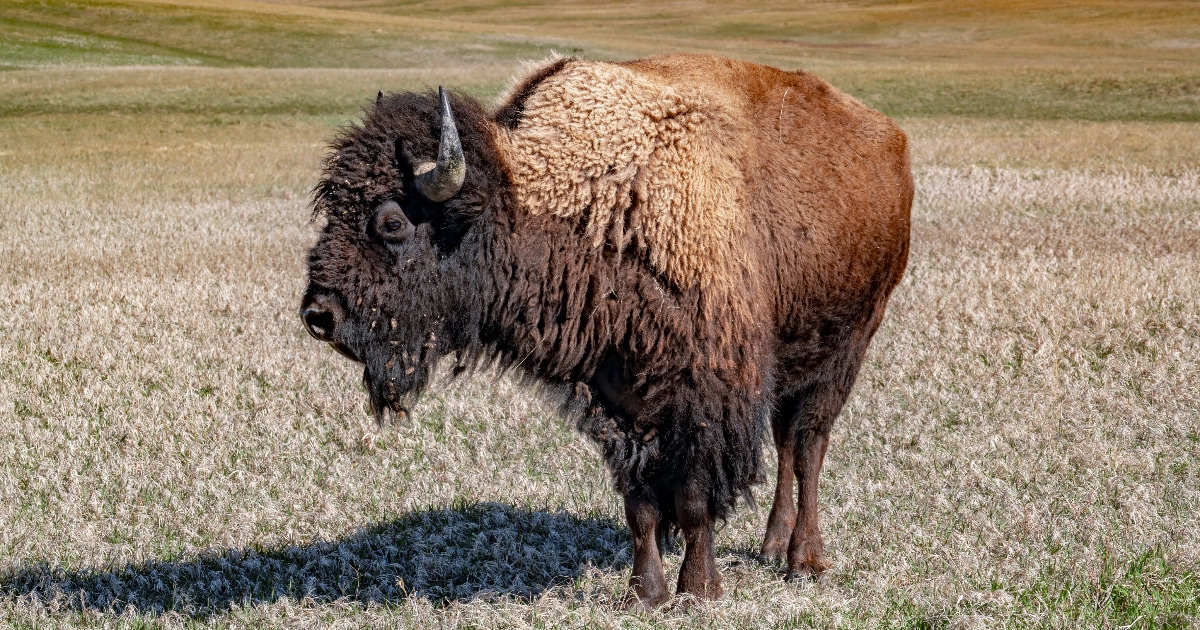
Bison rutting season runs from late July through September, and early fall catches the tail end of it. This is when the bulls are at their most dramatic. We’re talking 2,000-pound animals charging, bellowing, and kicking up dust across the Sage Creek Wilderness area. It is raw power, and you feel it in your chest.
The Sage Creek Rim Road is your best bet for bison encounters. We’ve sat at pulloffs along this road and watched entire herds move across the prairie. In fall, the golden grass makes them even more photogenic. Just remember that bison are dangerous. The NPS recommends staying at least 100 yards away. We’ve seen too many people push that boundary.
Bighorn Sheep
As temperatures drop in fall, bighorn sheep move to lower elevations, making them much easier to spot. The Pinnacles area and along the formations near Cedar Pass are prime viewing spots. Badlands reintroduced bighorn sheep in 1964 after they’d been completely eliminated from the area, and the herd has been growing steadily since. Seeing them navigate those impossibly steep formations is extraordinary.
You’ll also see pronghorn more frequently in fall, along with mule deer, prairie dogs (always entertaining at Roberts Prairie Dog Town), and if you’re lucky, a swift fox darting across the road at dusk.
Best Drives and Overlooks
The Badlands Loop Road (Highway 240) is the main artery of the park, running 31 miles with more overlooks than you can count. In fall, this drive becomes something truly special.
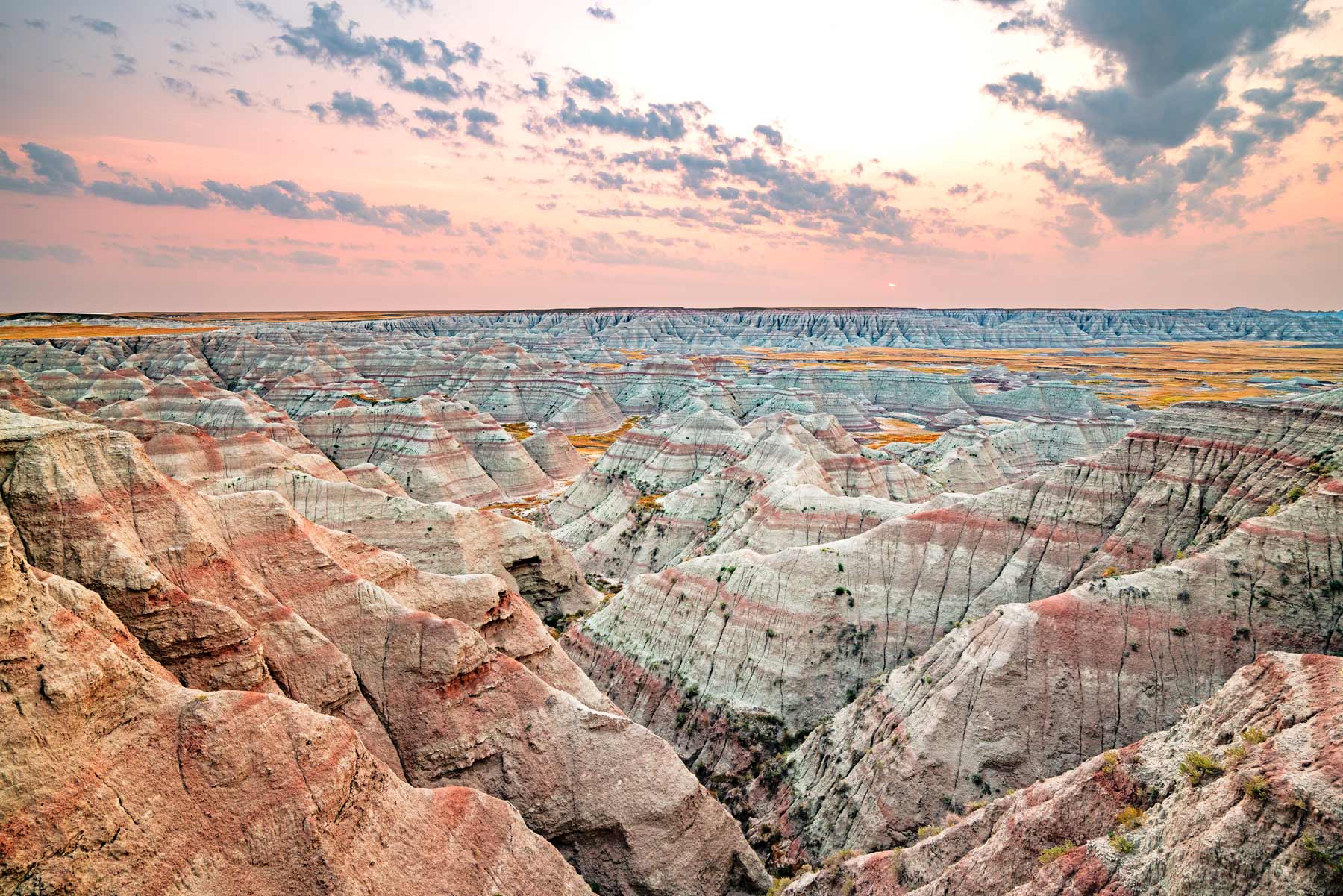
Here are the overlooks we always stop at, and we’ve driven this road more times than we can count.
- Big Badlands Overlook is the first major viewpoint from the northeast entrance and one of the most sensational in the entire park. In fall, the morning light hits the Wall here and turns everything pink and gold. Get here for sunrise if you can. You won’t regret it.
- Yellow Mounds Overlook is where the geology gets wild. These mounds are ancient sea bed deposits that have oxidized into brilliant yellows and reds. The fall light intensifies those colors in ways summer sun just washes out.
- Pinnacles Overlook gives you a panoramic view of the park’s most dramatic formations with the prairie rolling out behind them. On a clear fall day, you can see for 100 miles.
- Panorama Point lives up to its name. This is a 360-degree view that takes in both the formations and the open grassland. Spectacular at sunset.

For our complete guide to things to do in Badlands, including every overlook and activity, check out that resource. It covers all of it.
Best Fall Hikes
Fall is the best hiking season at Badlands, full stop. Summer temperatures regularly push past 100 degrees with zero shade on most trails. In fall, you can actually enjoy the hikes without feeling like you’re melting. Here are the ones we recommend. For the full breakdown, see our guide to the best hikes in Badlands National Park.

Notch Trail
Notch Trail is 1.5 miles round trip and one of the most unique hikes we’ve done anywhere. You climb a wooden ladder, scramble along a narrow ledge, and end up at a notch in the Badlands Wall with views that are absolutely sensational. In fall, the cooler temperatures make the exposed ladder section much more comfortable, and the view from the top looks out over golden prairie that seems to go on forever.
Castle Trail
Castle Trail is the longest trail in the park at 10 miles round trip, and fall is the only season we’d recommend doing the full thing. You weave between formations and prairie in a way that really shows off the diversity of this landscape. The wildflower remnants and golden grasses along the trail in October are extraordinary.
Door Trail and Saddle Pass
Door Trail (0.75 miles round trip) is short, mostly boardwalk, and gives you an up-close look at the formations through a natural “doorway” in the Badlands Wall. Saddle Pass is steeper and more challenging at 0.3 miles, climbing straight up the wall with handholds in the rock. Both are better in fall when the surfaces aren’t scorching hot and the crowds have thinned. We’ve had Saddle Pass completely to ourselves in October.
Dark Skies. Fall Stargazing
Badlands National Park is a certified International Dark Sky Park, and fall is arguably the best season for stargazing here. The summer haze clears out, the humidity drops, and the atmosphere becomes extraordinarily transparent.

On a clear fall night, the Milky Way stretches across the sky in a band so bright it casts shadows on the formations below. We’ve seen it here and we’ve seen it in some of the darkest places in the country, and Badlands holds its own with any of them.
The best stargazing spots are away from the Cedar Pass Lodge area. Pinnacles Overlook and the pulloffs along Sage Creek Rim Road are our go-to locations. September and October offer front-row seats to the Milky Way core before it dips below the horizon for the winter. The park sometimes hosts night sky programs through early fall, so check the ranger schedule when you arrive.
Practical Information for Fall Visits
Entrance Fees
- $30 per vehicle (valid for 7 days)
- $15 per person for walk-ins and cyclists, or $25 for a motorcycle
- The America the Beautiful Pass ($80/year) covers entrance to all 2,000+ federal recreation sites and pays for itself in three visits
Camping
Cedar Pass Campground is the park’s main developed campground with 96 sites. It’s open through mid-October in most years, though the exact closing date varies. Sites have access to flush toilets, running water, and a dump station. After Cedar Pass closes, those amenities are gone for the season.
Sage Creek Campground is the one we prefer in fall. It’s primitive (no water, pit toilets only), it’s free, and it’s first-come, first-served year-round. The trade-off is that you’re camping right in the middle of bison country. We’ve woken up with bison grazing 50 feet from our tent. That’s not an exaggeration. It’s an extraordinary experience.

Lodging and Services
Cedar Pass Lodge is the only lodging inside the park, and it typically closes in mid-October. The town of Interior (population around 70) has limited options. Wall, South Dakota, about 30 minutes from the Pinnacles entrance, has more hotels and restaurants. Book ahead for September weekends. October and November, you’ll have your pick.
The Ben Reifel Visitor Center stays open into fall but shifts to limited hours. Check the NPS website for current schedules before you go.
Nearby Attractions Worth Combining
One of the best things about a fall Badlands trip is what’s nearby. This corner of South Dakota punches way above its weight.
- Wall Drug is a tourist trap and it knows it. But it’s been doing its thing since 1931, and the five-cent coffee is still five cents. It’s worth 45 minutes of your time, especially if you have kids.
- Minuteman Missile National Historic Site sits right along I-90 between the two Badlands entrances. Cold War history preserved underground on the South Dakota prairie. The tours are free but limited, so reserve ahead on recreation.gov.
- The Black Hills are about an hour west and deserve at least two or three days on their own. Mount Rushmore, Custer State Park (their bison roundup happens every fall), Wind Cave, and Jewel Cave are all there. We’ve spent weeks in the Black Hills and still haven’t seen everything.
Our Recommended Fall Itinerary
If you have two days (which we recommend as a minimum), here’s what we’d do.
Day 1 starts at Big Badlands Overlook for sunrise. Drive the full Badlands Loop Road, stopping at every overlook that catches your eye. Hike Notch Trail and Door Trail in the morning while it’s cool. Spend the afternoon at Roberts Prairie Dog Town and cruising Sage Creek Rim Road for bison. Stay for sunset at Pinnacles Overlook.
Day 2 begins with a sunrise from Yellow Mounds (the colors are sensational in early light). Tackle Castle Trail or Saddle Pass. Drive out to the Sage Creek area for one more pass at wildlife. If skies are clear, stay after dark for stargazing at Pinnacles Overlook.

Final Thoughts
We’ve been to a lot of national parks in fall. It’s our favorite season across the board. But there’s something about the Badlands that hits differently when the prairie goes gold and the crowds disappear. The formations look ancient all year long, but in fall, when the low sun rakes across them and the only sound is wind through the grass, you feel like you’ve stepped into deep time.
September is the easiest month for planning. October is the most beautiful. November is for the adventurous. All three are better than summer, and we’ll stand by that.
That’s a wrap folks!
What to Bring to Badlands
Gear we recommend for Badlands. Affiliate links support our work at no cost to you.
More Than Just Parks may earn a small commission from purchases made through these links, at no extra cost to you. We only recommend gear we would actually use.
Affiliate disclosure: Some links on this page earn us a small commission at no extra cost to you. We only recommend gear we actually use.
More Than Just Parks Film Watch our film of Badlands We spent weeks in Badlands, one of our favorite public lands destinations, capturing it the way it deserves. Take a few minutes and see it for yourself.


