
Badlands National Park Map
15 trails mapped — click a pin to learn more
Badlands National Park at a Glance
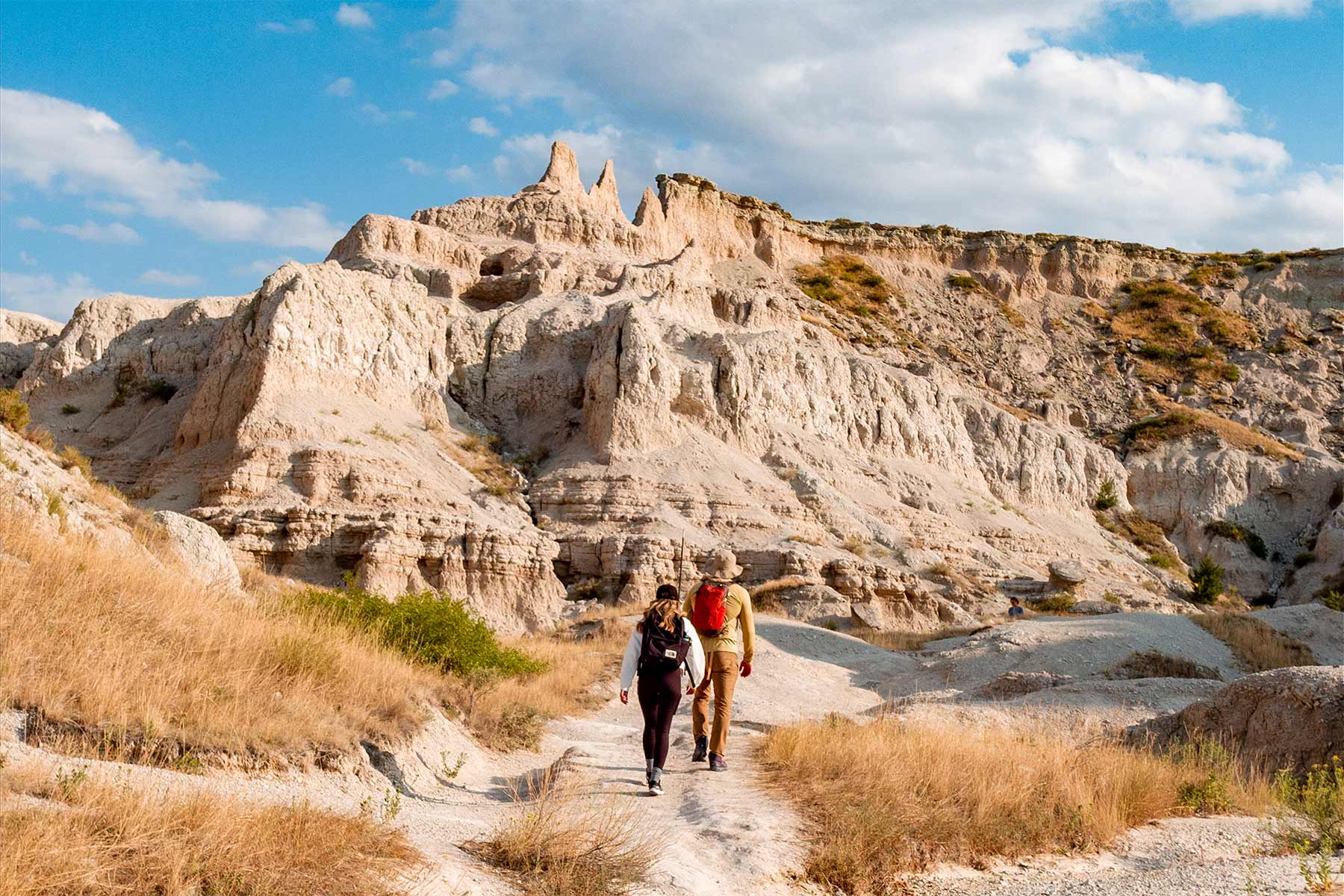
1 alertBadlands National Park has roughly 244,000 acres of eroded buttes, pinnacles, and spires sitting on top of one of the world’s richest fossil beds. The trail system here is surprisingly modest for a park this size. Most of the maintained trails are under a mile long. A few are measured in tenths of a mile. You could technically hike every single official trail in the park in a single day and still make your dinner reservation in Wall.
But that would be missing the point.
The best hiking in Badlands is not about distance. It is about what happens to your brain when you step off the boardwalk and into formations that look like they belong on another planet. I have been to this park five times now, and I still find new angles, new light, new reasons to walk back out on the same half-mile trail I walked yesterday.
Here are the 15 best hikes in Badlands National Park, ranked by the ones I think are actually worth your time.
1. Notch Trail
Distance: 1.5 miles round trip | Elevation Gain: 130 feet | Difficulty: Moderate | Time: 1 to 1.5 hours
This is the best hike in the park. I would not say that lightly about a trail that is less than a mile each way, but Notch Trail earns it. You start on a boardwalk through a canyon, then climb a wooden ladder bolted into the side of a cliff, and end up on a narrow ledge overlooking the White River Valley with the Badlands Wall stretched out beneath you.
The ladder section makes some folks nervous. It is about 20 feet of open rungs set against the rock. If heights bother you, this one might not be your trail. But if you can handle it, the payoff is one of the best views in South Dakota’s national parks.
For photographers, late afternoon light turns the formations below you into layered gold and pink. I have shot this spot four separate times and the light is different every visit. If you want a deeper look at this trail, I wrote a full guide to hiking the Notch Trail.
2. Castle Trail
Distance: 10 miles round trip (or 5 miles one way with a shuttle) | Elevation Gain: 350 feet | Difficulty: Moderate to Strenuous | Time: 4 to 6 hours
Castle Trail is the longest marked trail in Badlands and the only one that genuinely feels like a real hike rather than a nature walk. It connects the Door/Window parking area with the Fossil Exhibit trailhead, winding through grasslands, past eroded castles of sediment, and along the base of the Badlands Wall.
Most folks do this as a one-way hike with a car shuttle. Smart move. The 10-mile out-and-back version is exposed and repetitive on the return. But that one-way walk, especially in morning light, is the best way to understand the scale of this landscape. You are walking through 75 million years of geologic history, layer by visible layer.
Bring at least 2 liters of water per person. There is zero shade on this trail. I have a more detailed breakdown in my Castle Trail guide.
3. Door Trail
Distance: 0.75 miles round trip | Elevation Gain: Minimal | Difficulty: Easy (boardwalk), Moderate (off-trail extension) | Time: 20 to 45 minutes
Door Trail starts on a flat boardwalk that takes you to the edge of the Badlands Wall, where a natural “door” opens up into the formations. Most folks stop at the end of the boardwalk, take a photo, and turn around. That is the easy version and it is perfectly fine.
The better version is to keep going. Past the boardwalk, the trail becomes an unmarked route through eroded clay and silt formations. There are no signs, no maintained path. Just you and the landscape. The NPS allows it, and the exploring is some of the most fun you will have in any national park. Just watch your footing on the clay when it is wet. It becomes ice-slick.
4. Window Trail
Distance: 0.25 miles round trip | Elevation Gain: 50 feet | Difficulty: Easy | Time: 10 to 15 minutes
Window Trail shares the same parking lot as Door and Notch, and most folks walk all three before moving on. The trail is a short boardwalk that leads to a natural opening in the Badlands Wall. You look down through the “window” into a deep erosion channel that frames the prairie beyond.
This is the shortest trail on this list and probably the park, but it works because the framing is genuinely dramatic. Sunset here is particularly good. The light comes through the gap and paints the canyon walls in shades of rust and copper. Ten minutes, and you have got one of the best photos in the park.
5. Saddle Pass Trail
Distance: 0.25 miles round trip | Elevation Gain: 200 feet | Difficulty: Strenuous | Time: 15 to 25 minutes
A quarter mile long and rated strenuous. That should tell you something. Saddle Pass is a short, steep scramble straight up the side of the Badlands Wall. The trail is loose gravel and clay, and it gains 200 feet in roughly 500 horizontal feet. It feels like climbing a sand dune that someone tilted to 45 degrees.
The reward is a view from the top of the Wall looking out over the upper prairie grasslands. From up here, you can also connect to the Medicine Root Trail or the Castle Trail if you want to keep going. Most folks use Saddle Pass as a quick leg-burner to see the view and then head back down. Going down is the hard part.
6. Cliff Shelf Nature Trail
Distance: 0.5 miles round trip | Elevation Gain: 100 feet | Difficulty: Easy to Moderate | Time: 20 to 30 minutes
Cliff Shelf is a loop trail that climbs through a juniper forest perched on a shelf of rock partway up the Badlands Wall. It is one of the few trails in the park with actual trees, which makes it feel completely different from everything else. The shade is a genuine relief on hot summer days when the rest of the park is radiating heat off bare clay.
The trail has interpretive signs explaining how this shelf formed and why vegetation can survive here when the surrounding formations are barren. From the high point, you get a nice view of the formations below and the prairie stretching out to the east. This is a good one for families or anyone who wants a quick walk without the full sun exposure.
7. Fossil Exhibit Trail
Distance: 0.25 miles round trip | Elevation Gain: Flat | Difficulty: Easy (fully accessible) | Time: 15 to 20 minutes
This is a paved, wheelchair-accessible trail with replica fossil casts displayed along the path. The Badlands contain one of the world’s richest deposits of Oligocene-era mammal fossils, dating back 23 to 35 million years. The replicas along this trail show ancient horses the size of dogs, saber-toothed cats, and three-toed ancestors of the modern rhinoceros.
Is this a “hike”? Barely. But I am including it because the fossil story is genuinely fascinating, and most folks blow right past it on their way to the more photogenic trails. The interpretive panels are well done. Budget 15 minutes here. You will learn more about what is under your feet than anywhere else in the park.
8. Medicine Root Trail
Distance: 4 miles round trip | Elevation Gain: 150 feet | Difficulty: Moderate | Time: 1.5 to 2.5 hours
Medicine Root is an out-and-back trail that takes you through mixed-grass prairie along the base of the Badlands Wall. This is one of the quieter trails in the park because most folks gravitate to the shorter, more dramatic options near the Door/Window area. Their loss.
The prairie here is alive with wildflowers in late spring and early summer. I have seen pronghorn on this trail more than any other in the park. The landscape is not as visually intense as the formations along Notch or Door, but it shows you a completely different side of the Badlands. This is what 90% of the park actually looks like when you are not standing at an overlook.
9. Deer Haven Trail
Distance: 3 miles round trip | Elevation Gain: 100 feet | Difficulty: Easy to Moderate | Time: 1 to 1.5 hours
Deer Haven connects the Panorama Point area to the upper prairie and is one of the least-walked maintained trails in the park. The trail meanders through grasslands with scattered views of the Wall formations in the distance. You are unlikely to see more than a handful of other folks here, even on a busy summer weekend.
The name is apt. This is prime mule deer habitat, and early morning or late evening walks here regularly produce wildlife sightings. If you are looking for solitude in a park that gets over a million visitors a year, this is where you find it.
10. Sage Creek Rim Trail
Distance: Variable, up to 8 miles | Elevation Gain: Minimal | Difficulty: Easy to Moderate | Time: 1 to 4 hours depending on distance
This trail follows the rim above the Sage Creek Wilderness, the only designated wilderness area in the park. It is not a formal maintained trail so much as a social path along the canyon edge, but it is well-worn and easy to follow. The views down into the Sage Creek basin are excellent, and you will almost certainly see bison. The Sage Creek area is where the park’s herd of roughly 1,200 bison spends most of its time.
I like starting from the Sage Creek Campground (free, first-come, first-served, no water) and walking east along the rim for as far as I feel like going. There is no set turnaround point. Just walk until the light gets good and then set up your tripod.
11. Sage Creek Wilderness (Backcountry)
Distance: Variable | Elevation Gain: Variable | Difficulty: Moderate to Strenuous | Time: Half day to multi-day
The 64,144-acre Sage Creek Wilderness has no trails. None. You pick a direction, check your topo map, and walk. This is backcountry hiking in its purest form. No permits required, no quotas, no designated campsites. Just you, the bison, and 100 square miles of eroded grassland.
A few things to know before you go. First, the bison are wild and they are everywhere. Maintain at least 100 yards of distance. Second, there is no water source in the wilderness that you should trust without treatment. Bring everything you need. Third, rattlesnakes are common in summer. Watch where you step and where you put your hands.
If you have backcountry experience and want to see a side of Badlands that 99% of the park’s visitors never see, this is it.
12. Badlands Wall Off-Trail Exploration
Distance: Variable | Elevation Gain: Variable | Difficulty: Moderate | Time: 1 to 3 hours
Here is something most folks do not realize about Badlands. The NPS allows off-trail hiking almost everywhere in the park. You can walk directly into the formations from almost any pullout along the Badlands Loop Road. No permit needed. No trail to follow. Just pick a direction and go explore.
The formations near the Door/Window area and along the stretch between Pinnacles Overlook and Yellow Mounds are particularly good for scrambling. The clay and silt layers create natural staircases, ledges, and canyons that are endlessly interesting to explore. Just be careful on steep slopes, especially when wet, and always keep landmarks in sight so you can find your way back to the road.
This kind of unstructured exploring is genuinely my favorite thing to do in the park. Forget the trail. Grab your camera and go find something.
13. Sheep Mountain Table
Distance: Variable, typically 2 to 4 miles round trip | Elevation Gain: 100 feet | Difficulty: Easy to Moderate | Time: 1 to 3 hours
Sheep Mountain Table sits in the South Unit of the park, which is part of the Pine Ridge Indian Reservation and is managed in partnership with the Oglala Lakota. Getting there requires a 7-mile drive on a dirt road that can become impassable when wet. If it has rained recently, do not attempt it.
The table itself is a flat-topped mesa surrounded by dramatic drops on all sides. There is no maintained trail. You drive to the top and then walk to the edges for 360-degree views of the South Unit formations. The colors here are different from the North Unit, with deeper reds and oranges mixed into the sediment layers. I shot some of my favorite Badlands photographs from this spot.
Check conditions at the Ben Reifel Visitor Center before driving out. Cell service is nonexistent.
14. Palmer’s Creek Trail
Distance: 3 miles round trip | Elevation Gain: 100 feet | Difficulty: Easy to Moderate | Time: 1 to 1.5 hours
Palmer’s Creek is a backcountry trail accessible from the Conata Picnic Area, and it is one of the least-visited trails in the park. The route follows a dry creek bed through grasslands and past some of the park’s lesser-known formation clusters. You are walking through prime black-footed ferret habitat here. Badlands is one of the few places in the country where reintroduction efforts for this critically endangered species have succeeded.
Will you actually see a black-footed ferret? Probably not. They are nocturnal. But knowing they are out there is part of what makes this corner of the park feel special. If you want to read more about the wildlife and science side of this park, check out our Badlands facts page.
15. Big Badlands Overlook to Yellow Mounds Walk
Distance: Variable, typically 1 to 2 miles | Elevation Gain: Minimal | Difficulty: Easy | Time: 30 to 60 minutes
This is not a formal trail. It is more of a walking tour along the pullouts and overlooks on the eastern end of the Badlands Loop Road. Big Badlands Overlook is usually the first stop for folks entering from the northeast entrance, and it is a legitimate jaw-dropper. The panorama stretches for miles across eroded formations that glow in early morning light.
From there, you can drive west and stop at Yellow Mounds, where the formations shift to vivid yellows and golds caused by ancient soil layers being exposed by erosion. Walking between the pullouts and spending time at each viewpoint is one of the best ways to experience the park if you are not up for longer hikes. For more ideas beyond hiking, check out 20 things to do in Badlands National Park.
Tips for Hiking in Badlands
Water is everything. There is no potable water on any trail in the park. Carry at least 1 liter per hour of hiking in summer, more for Castle Trail or backcountry trips. The nearest water fill stations are at the Ben Reifel Visitor Center and Cedar Pass Lodge.
Watch the weather. Summer temperatures regularly hit 100 degrees F, and there is virtually no shade on any trail except Cliff Shelf. Thunderstorms roll in fast and can make clay surfaces dangerously slippery within minutes. If you see storms building, get off exposed formations immediately.
Best times to hike. Early morning and late afternoon. The light is better for photography, the temperatures are more manageable, and the wildlife is more active. Midday in July is brutal.
Rattlesnakes. Prairie rattlesnakes are common throughout the park, especially in summer. Stay on trails where possible, watch your step on rocky ground, and never reach into spaces you cannot see.
Bison safety. The park’s bison herd is wild. They can weigh 2,000 pounds and run 35 mph. Stay at least 100 yards away. This is not a suggestion. They will charge if they feel threatened, and they are faster than you.
When to Go
September and early October are my favorite. The summer crowds thin out, temperatures drop into the 70s and 80s, the light turns golden, and the grasslands take on warm autumn tones. Late May through June is also good if you can handle the heat, with wildflowers adding color to the prairie.
Winter is underrated. The park stays open year-round, and fresh snow on the formations is one of the most photogenic things I have ever shot. Just know that some roads may close temporarily after heavy snowfall. I wrote more about that in our Badlands in winter guide.
Frequently Asked Questions
Badlands has about 10 maintained trails totaling roughly 15 miles. Most are short, between 0.25 and 1.5 miles. Castle Trail is the longest at 10 miles round trip. The park also allows off-trail hiking in most areas, which opens up essentially unlimited exploration.
No. Dogs are not allowed on any hiking trail in Badlands National Park. They are allowed in parking lots, along roads, and in campgrounds, but must be on a leash no longer than 6 feet at all times.
Saddle Pass is the steepest maintained trail, gaining 200 feet in just 0.25 miles. But for overall difficulty, Castle Trail’s 10-mile round trip with full sun exposure and no shade is the most demanding day hike. Backcountry routes in the Sage Creek Wilderness can be as challenging as you make them.
For the short boardwalk trails like Door, Window, and Fossil Exhibit, any closed-toe shoe works. For Notch Trail, Saddle Pass, Castle Trail, or off-trail exploring, wear hiking boots or sturdy trail shoes with good traction. The clay surfaces get extremely slippery when wet.
What to Bring to Badlands
Gear we recommend for Badlands. Affiliate links support our work at no cost to you.
Affiliate disclosure: Some links on this page earn us a small commission at no extra cost to you. We only recommend gear we actually use.