Is there a city in America that packs more history into every square block than our nation’s capital? We don’t think so.
Washington D.C. is one of those places where you can feel the weight of history all around you. From the towering Washington Monument to the solemn reflection of the Lincoln Memorial, from the grandeur of the Capitol to the sensational Smithsonian museums (all free, by the way), this city delivers an experience that’s hard to match anywhere in the world.
As a retired history teacher who spent a lifetime teaching about the events and people who shaped this nation, visiting these sites in person has been nothing short of incredible. And now we’re sharing the stories of these extraordinary places with you.
To be clear, this list focuses on National Park Service sites and other major landmarks in Washington D.C. If you want the full picture, we’ve put together a comprehensive guide to all 40 National Parks in Washington D.C. that’s well worth your time.
The Top 10 Things to See in Washington D.C.
10. Smithsonian National Museum of Natural History
We kick off our top 10 at number ten with the Smithsonian National Museum of Natural History, and what a place to start.

Located on the National Mall and part of the Smithsonian Institution, this museum holds the world’s most extensive collection of natural history specimens and human artifacts. We’re talking about everything from dinosaur remains to tools used by early humans to the legendary Hope Diamond.
Established in 1910, this place is larger than 18 football fields and is home to more than 148 million specimens. You could spend days here and still not see everything.
The best part? Like all Smithsonian museums, admission is completely free. The museum is open daily from 10 AM to 5:30 PM (with extended summer hours). You can reach it easily via the Smithsonian Metro station on the Blue, Orange, and Silver lines.
So Many Museums, So Little Time
And if you have all the time in the world, why stop with just one Smithsonian museum? Here are all of the Smithsonian museums located in Washington D.C.:
- National Air and Space Museum
- National Museum of African American History and Culture
- National Museum of American History
- National Museum of the American Indian
- National Museum of Natural History
- National Portrait Gallery
- National Postal Museum
- Smithsonian American Art Museum
- Renwick Gallery
- Freer Gallery of Art
- Arthur M. Sackler Gallery
- Hirshhorn Museum and Sculpture Garden
- Anacostia Community Museum
- National Museum of African Art
- Arts and Industries Building
Every single one of them is free. That’s 15 world-class museums at zero cost to you.

READ MORE: 25 Famous Landmarks in America You Must See
9. Vietnam Veterans Memorial
At number nine on our list of the top things to see in Washington D.C. is the Vietnam Veterans Memorial, and we challenge you to visit this place without being deeply moved.
The Vietnam War was a long, costly, and divisive conflict. More than 3 million people were killed, including over 58,000 Americans. More than half of the dead were Vietnamese civilians.
Visiting the Vietnam Veterans Memorial Wall on the National Mall can be one of the most powerful and emotional experiences you’ll have in Washington D.C. The Wall, which officially opened in November 1982, bears the names of every American who gave their life in the conflict. Since then, visitors have left tributes in honor of veterans, including dog tags, medals, and other deeply personal remembrances.

Visitor tip: The memorial is open 24 hours a day, 7 days a week. Rangers are typically on duty from 9:30 AM to 10 PM to help you locate names on the Wall. An evening visit is particularly moving, as the Wall is beautifully illuminated.
READ MORE: All 63 US National Parks Ranked
8. National Mall and Memorial Parks
At number eight, we don’t want to overlook the stunning green spaces that tie all of these incredible sites together. The National Mall and Memorial Parks is actually one of the older parklands in the National Park System, officially established in 1965.
Stretching roughly two miles from the Capitol Building to the Lincoln Memorial, the Mall provides visitors with the chance to commemorate presidential legacies, honor the courage and sacrifice of war veterans, and celebrate the United States’ commitment to freedom and equality.
We love walking the Mall early in the morning before the crowds arrive. The Reflecting Pool at sunrise is sensational, and you can cover a surprising amount of ground before lunch. Comfortable shoes are essential, as you’ll be walking 4 to 6 miles if you’re seeing everything along the way.

READ MORE: All 130 US National Monuments Ranked
7. World War II Memorial
At number seven is a memorial dedicated to the brave men and women who participated in the most destructive war in human history. The World War II Memorial is one of the most powerful things to see in Washington D.C.
I taught World History for over a quarter of a century, and I used to tell my students that World War II was the most significant and influential event of the twentieth century. The devastation is almost incalculable. Total military and civilian deaths are estimated at 70 to 85 million, about 3% of the global population at the time.

The Story Behind the World War II Memorial
Designed by Austrian-American architect Friedrich St. Florian, the memorial sits at the eastern end of the Reflecting Pool between the Lincoln Memorial and the Washington Monument. The site was long considered fitting for a memorial, going back to the 1901 McMillan Commission Plan for the city.
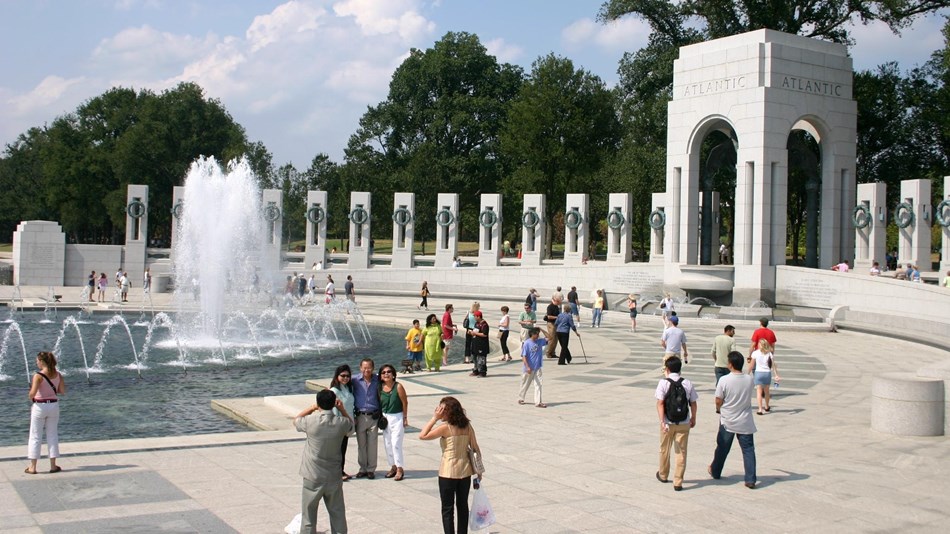
Fifty-six granite pillars, each standing 17 feet high, ring the outer plaza. One pillar represents each U.S. state and territory that existed in 1945. Two granite pavilions anchor the north and south ends, dedicated to the Atlantic and Pacific theaters of war.
On the west end stands the Freedom Wall, lined with 4,048 gold stars. Each star represents 100 Americans who died in the war. At night, the wall is lit from below, and the pool glows gold with their reflection. It’s an incredibly moving sight.
Visitor tip: The memorial is open 24 hours and free to visit. Rangers are on duty from 9:30 AM to 10 PM. Ground was broken in September 2001, and the memorial opened on April 29, 2004.
6. Martin Luther King, Jr. Memorial
Rounding out the first half of our list at number six is the Martin Luther King, Jr. Memorial, and this one hits close to the heart for any former history teacher.
Described as the “conscience of the nation,” Martin Luther King, Jr. was a Baptist minister who became the leading spokesperson of the Civil Rights Movement in the 1960s. Dr. King advanced the cause of civil rights through nonviolence, and his marches and protests built pressure that led to landmark civil rights and voting rights legislation.
On October 14, 1964, Dr. King was awarded the Nobel Peace Prize for his pioneering work in combating racial discrimination and injustice. He was just 35 years old.

“Injustice anywhere is a threat to justice everywhere.”
Dr. Martin Luther King, Jr.
As you explore the memorial, you’ll find powerful quotes from throughout King’s lifetime carved into the granite walls, along with a striking 30-foot sculpture of the civil rights leader emerging from a stone of hope. The memorial sits along the Tidal Basin, and a visit during cherry blossom season in late March and early April is especially memorable.
Visitor tip: The memorial is free and open 24 hours. Rangers are on duty from 9:30 AM to 10 PM. There is a bookstore nearby with products to commemorate your visit.
READ MORE: 10 Best Civil Rights Sites in America
The Top 5 Things to See in Washington D.C.
5. Thomas Jefferson Memorial
We begin the final countdown with the top five. At number five is the Thomas Jefferson Memorial, a beautiful neoclassical tribute to the principal author of the Declaration of Independence.
Thomas Jefferson will always be celebrated for articulating the American national creed and the fundamental principles of self-government that he set forth in the Declaration of Independence.
On the verge of death, Jefferson designed his own gravestone and epitaph: “Author of the Declaration of Independence [and] of the Statute of Virginia for religious freedom and Father of the University of Virginia.” That he chose not to mention serving as the third President of the United States tells you something about the man.
Within the circular colonnade, a 19-foot-tall bronze statue of Thomas Jefferson stands holding the Declaration of Independence and gazing out toward the Tidal Basin. Construction began on November 17, 1938, and President Roosevelt laid the cornerstone a year later.
We hold these truths to be self-evident, that all men are created equal, that they are endowed by their Creator with certain unalienable Rights, that among these are Life, Liberty and the pursuit of Happiness.
Thomas Jefferson, The Declaration of Independence

Visitor tip: The Jefferson Memorial is free and open 24 hours. During cherry blossom season (typically late March through mid-April), this is one of the most photographed spots in all of Washington D.C., so plan to arrive early if you’re visiting then.
READ MORE: 10 Best Revolutionary War Sites in America
4. United States Capitol
We’re on to the final four! At number four we have the United States Capitol, arguably the most recognized symbol of democratic government in the world.
The Capitol has housed Congress since 1800. This is where our elected representatives meet to write the laws of our nation, where presidents are inaugurated, and where they deliver their annual State of the Union addresses.
An Architectural Achievement
Beyond its role in government, the Capitol also houses an important collection of American art, and it is an architectural achievement in its own right. The building attracts millions of visitors every year.
The U.S. Capitol Visitor Center is the newest addition to the complex. At nearly 580,000 square feet, it’s approximately three-quarters the size of the Capitol itself. The entire facility is located underground on the east side so as not to detract from the appearance of the Capitol and the grounds designed by Frederick Law Olmsted in 1874.
Visitor tip: Free tours of the Capitol are available Monday through Saturday and can be booked online through the Capitol Visitor Center website. We strongly recommend booking well in advance, especially during peak season (March through July).
3. Washington Monument
At number three on our list of the top things to see in Washington D.C. is the Washington Monument, the towering tribute to the man who made it all possible.
The consensus among historians is that George Washington’s presidency set the nation on a path that has endured for nearly 250 years, longer than any other republic in history. He established precedents that would last for generations and did more to flesh out the office of the presidency than anyone could have expected.
Like Dwight Eisenhower, who served as the Supreme Allied Commander during World War II, Washington had an enormous impact on history before ever becoming President. He was the man who led the colonies in their successful bid for independence.

A Memorial to America’s First President
Designed by Robert Mills and completed by Thomas Casey and the U.S. Army Corps of Engineers, the Washington Monument honors and memorializes George Washington at the center of the nation’s capital.
The structure was completed in two phases, one private (1848 to 1854) and one public (1876 to 1884). Built in the shape of an Egyptian obelisk, evoking the timelessness of ancient civilizations, it embodies the awe, respect, and gratitude the nation felt for its most essential Founding Father.
When completed, the Washington Monument was the tallest building in the world at 555 feet, 5 and 1/8 inches. Today visitors can take the elevator to the 500-foot observation deck for a spectacular 360-degree view of the capital.
Visitor tip: Free timed-entry tickets are required and are distributed on a first-come, first-served basis through recreation.gov. They go fast, especially during peak season. The monument is open daily from 9 AM to 5 PM.

READ MORE: 30 Must-See Washington D.C. Landmarks
2. The White House (President’s Park)
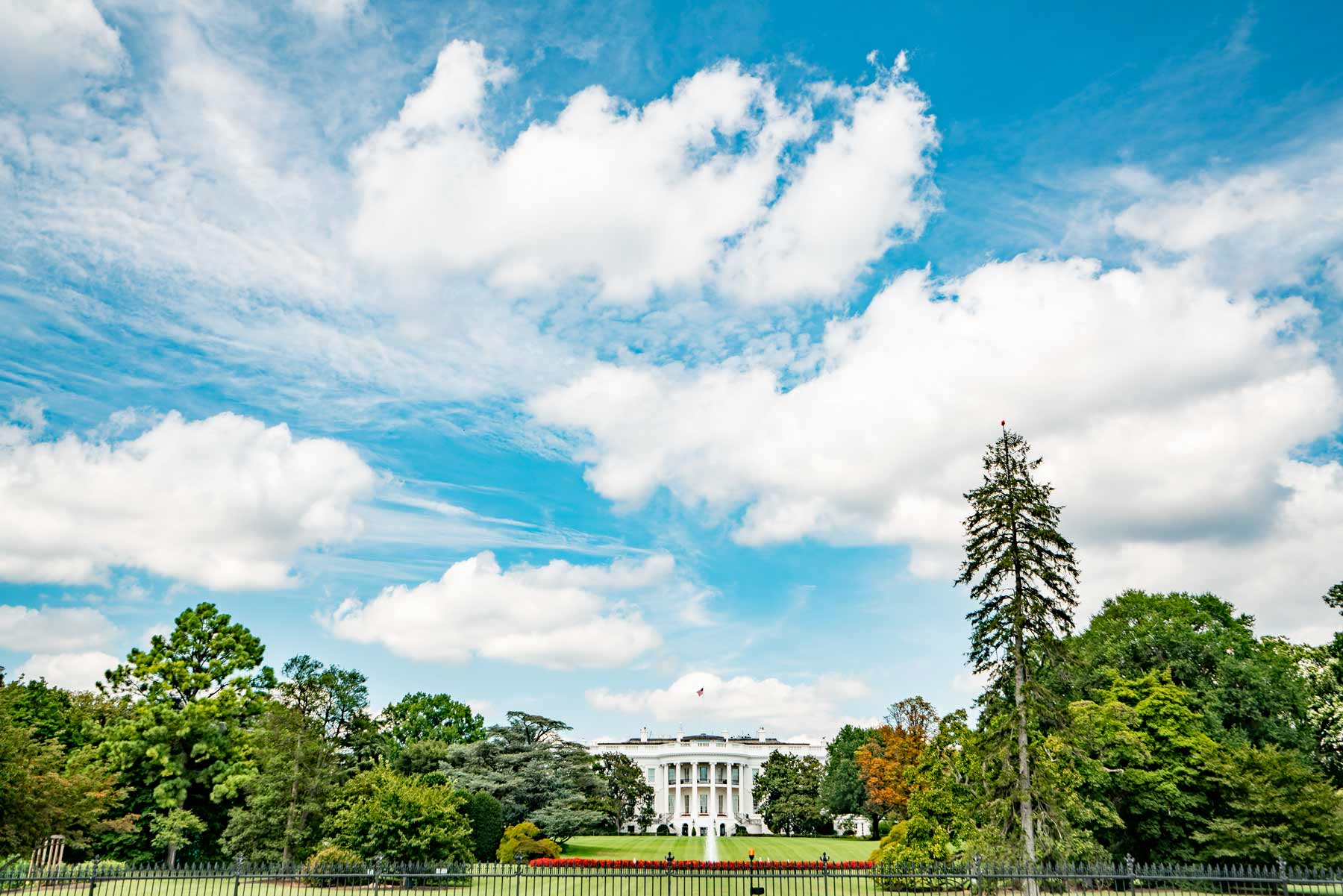
In the runner-up spot at number two is what many consider to be the most recognizable building in the world. The White House is not just the president’s home. It’s a National Park.
Our first president, George Washington, selected the site for the White House in 1791. The following year, the cornerstone was laid and a design submitted by Irish-born architect James Hoban was chosen. After eight years of construction, President John Adams and his wife Abigail moved into the still-unfinished residence.
In 1902, President Theodore Roosevelt began a major renovation, including the relocation of the president’s offices from the second floor to the newly constructed Executive Office Building, now known as the West Wing.
Visitor tip: Public tours of the White House are free but must be requested through your member of Congress. Requests should be submitted at least 21 days in advance (and preferably much earlier). Tours are available Tuesday through Saturday from 7:30 AM to 11:30 AM, though schedules can change. Foreign nationals should contact their country’s embassy in Washington D.C. for information.
The Number One Thing to See in Washington D.C.
1. Lincoln Memorial
At number one on our list, and for good reason, is the Lincoln Memorial. If you visit only one site in Washington D.C., make it this one.
In C-SPAN’s most recent survey of presidential historians, Abraham Lincoln topped the rankings as the greatest president of all time. George Washington and Franklin Roosevelt came in second and third. Why does Lincoln hold that position? Simply put, he saved the Union. In the process, he defined the creation of a more perfect Union in terms of liberty and economic equality that rallied the citizenry behind him.
“His great achievement, historians tell us, was his ability to energize and mobilize the nation by appealing to its best ideals while acting ‘with malice towards none’ in the pursuit of a more perfect, more just, and more enduring Union. No President in American history ever faced a greater crisis and no President ever accomplished as much.”
Michael Burlingame, Professor Emeritus of History, Connecticut College

READ MORE: 10 Best Civil War Sites in America
Visiting the Lincoln Memorial
No trip to Washington D.C. is complete without a visit to the Lincoln Memorial. The interior is divided into three chambers. The north and south chambers contain carved inscriptions of Lincoln’s Second Inaugural Address and his Gettysburg Address.
It took nearly 60 years to erect the Lincoln Memorial. In 1867, Congress passed the first bill to create a commission overseeing a memorial to America’s 16th President. Construction began in 1914 on Lincoln’s birthday, February 12th, and slowed during World War I. It was finally completed in 1922.
The original plans called for something more like an Egyptian pyramid. While that would have complemented the Washington Monument (an Egyptian-style obelisk), the idea lost out to Henry Bacon, who designed the neoclassical monument we know and love today.
Visitor tip: The Lincoln Memorial is free and open 24 hours a day. Rangers are on duty from 9:30 AM to 10 PM. A visit at night, when the memorial is illuminated and the crowds have thinned, is an experience we cannot recommend highly enough.
For a deeper dive into D.C., check out our guide to all 40 National Parks in Washington D.C.
Map of the Top 10 Things to See in Washington D.C.
Complete List of the Top 10 Things to See in Washington D.C.
- Lincoln Memorial
- The White House (President’s Park)
- Washington Monument
- United States Capitol
- Thomas Jefferson Memorial
- Martin Luther King, Jr. Memorial
- World War II Memorial
- National Mall and Memorial Parks
- Vietnam Veterans Memorial
- Smithsonian National Museum of Natural History
More Washington D.C. Resources
If you’re planning a trip to the nation’s capital, these guides will help you make the most of it.
- 40 National Parks in Washington D.C.
- 30 Must-See Washington D.C. Landmarks
- 20 Must-See Historic Sites in Washington D.C.
- 20 Best Black History Sites in America
- 10 Best East Coast National Parks, Ranked
About the People Behind More Than Just Parks

You should probably know that we don’t just make this stuff up out of thin air. My sons have spent their entire adult lives exploring and filming America’s national parks and public lands.
As for me, I’m a retired lifelong educator and proud dad of these two guys hopelessly obsessed with the national parks.
We’ve worked with the National Park Service, the Department of Interior, and the U.S. Forest Service for years creating films on important places and issues. Our work has been featured in leading publications all over the world and even some people outside of our immediate family call us experts on the national parks.
Meet the Parks Brothers
We’re Jim Pattiz and Will Pattiz, collectively known as the Pattiz Brothers (and sometimes the Parks Brothers) and we absolutely love the national parks.
Our goal here at More Than Just Parks is to share the beauty of America’s national parks and public lands through stunning short films in an effort to get Americans and the world to see the true value in land conservation.
We hope you’ll follow our journey through the parks and help us to keep them the incredible places that they are. If you’re interested in joining the adventure, sign up below!