


I’ve spent more time in old-growth forests than most people spend at the gym. Hundreds of hours across dozens of groves in California and the Pacific Northwest. And I can say without hesitation that Stout Grove in Redwood National Park is the single most impressive stand of trees I’ve ever walked through.
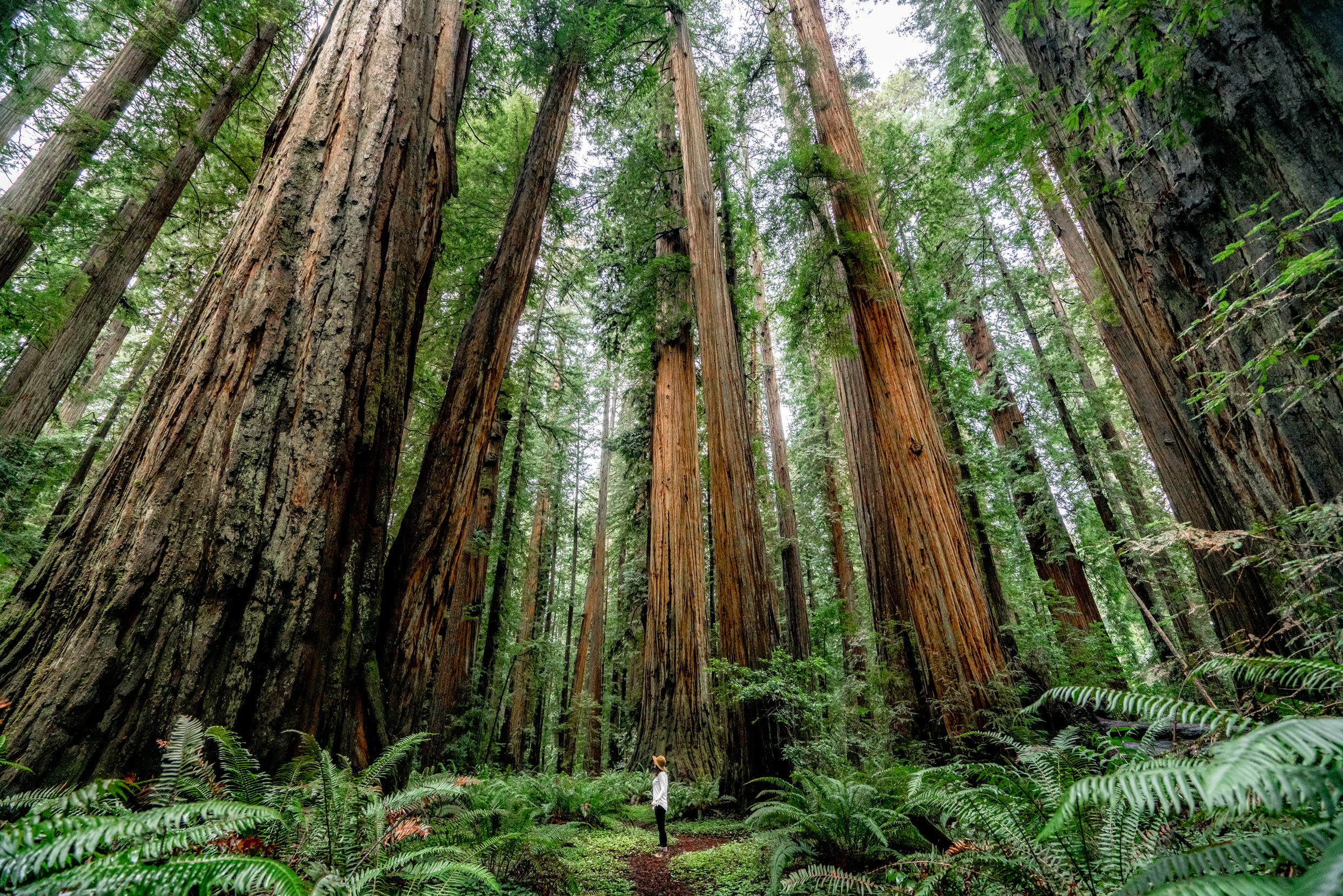
That’s not a statement I make lightly. I’ve been to Muir Woods, the Hoh Rainforest, the Mariposa Grove in Yosemite, and half a dozen other famous redwood and sequoia groves. Stout Grove beats them all. The trees here top 300 feet, the undergrowth is unusually low, which lets you actually see the full height of the trunks, and on a foggy morning the light filtering through the canopy looks like something out of a cathedral.
This grove sits inside Jedediah Smith Redwoods State Park, the northernmost section of the Redwood park system near Crescent City. It takes a little effort to get here, but the payoff is enormous. Here’s everything you need to know.
The History of Stout Grove
Stout Grove exists today because of a lumberman’s widow. In 1929, Clara Stout donated this grove to the Save the Redwoods League in memory of her husband, Frank D. Stout, who made his fortune in the lumber industry. There’s an irony there that isn’t lost on anyone.
Love Redwood? It's one of 117 threatened public lands destinations we're tracking. Get the free briefing.
The grove became one of the early protected stands in what would eventually become Jedediah Smith Redwoods State Park. That matters. It set a precedent that led to more acquisitions, more protections, and eventually a state park that now protects thousands of acres of old-growth forest. Much of that protection traces back, in some way, to Clara Stout’s decision to save these particular trees.
Over the following decades, the park expanded around Stout Grove, absorbing land that logging companies had been eyeing for years. The state formally established Jedediah Smith Redwoods State Park, and in time the broader region was folded into the Redwood National and State Parks system, giving it federal protection on top of the state layer. Stout Grove remains the heart of the entire complex.
Today, the grove is considered one of the most significant stands of coast redwoods (Sequoia sempervirens) in existence. Many of the trees here are estimated to be well over 1,000 years old. To walk among them is to stand in the presence of living things that were saplings during the Crusades.
The Stout Tree
The centerpiece of the grove is the Stout Tree itself, and it’s worth singling out. This coast redwood stands roughly 325 feet tall with a circumference of about 54 feet near its base, which works out to more than 16 feet across. To put that in perspective, you could park three cars bumper to bumper across the base of this tree and still have room left over.
The Stout Tree is the largest individual tree in the grove and one of the larger trees in all of Jedediah Smith Redwoods State Park. There’s a viewing platform at its base that lets you stand close without compacting the root zone, and I’d encourage you to use it. Spend a minute there. Look straight up. Your neck will hurt and your brain won’t quite believe what it’s processing.
I’ve stood at the base of thousands of big trees. General Sherman, the Grizzly Giant, the general vicinity of Hyperion. The Stout Tree doesn’t win any world records, but it has a presence that the famous trees sometimes lack, because you can actually be alone with it. No ropes, no crowds of 200, no shuttle bus. Just you and a tree that was already ancient when Columbus sailed.
The Stout Grove Trail
The trail itself is short. Just 0.6 miles as a loop with roughly 50 feet of elevation change. You could technically walk it in 15 minutes.
Don’t do that.
This is a place that rewards slow exploration. I’ve spent two hours or more in this grove on each of my visits, and every time I notice something new. A fern-covered nurse log I missed before. A burned-out hollow in a massive trunk that you can step inside of and look straight up through. Light hitting the canopy at an angle I hadn’t seen.
From the parking lot, you descend gradually into the grove on a paved walkway. Within 30 seconds, you’re surrounded by trees that are wider than your car and taller than most buildings you’ve ever been in. The canopy blocks most of the sky, and the forest floor is covered in a thick carpet of redwood sorrel.
The main loop has several smaller footpaths that branch off into the grove. These are worth exploring. Some lead to particularly large individual trees, and others take you to spots where ancient redwoods were burned out by fire centuries ago. The hollows left behind are large enough for an adult to stand inside comfortably. My brother Jim and I both fit inside one with room to spare.
At the back of the loop, a spur trail descends about 20 feet to the confluence of Mill Creek and the Smith River. The Smith is one of the last undammed rivers in California, and standing at its edge with 1,000-year-old redwoods towering behind you is one of those moments that sticks with you. Bring a wide-angle lens.
The trail also connects to longer routes if you want to extend your hike. The Hiouchi Trail heads along the Smith River, and the Mill Creek Trail branches south into more old-growth habitat. Neither is required to appreciate Stout Grove, but both are solid additions if you have the time.
Distance – 0.6 miles round trip (loop)
Elevation Gain – Roughly 50 feet
Time – 1 to 2 hours, if you’re doing it right
Difficulty – Easy. Mostly flat, paved descent, well-maintained trail. The main path is wheelchair accessible.

Best Time to Visit Stout Grove
The magic hour at Stout Grove is early morning, right around sunrise, when fog rolls through the trees and shafts of light pierce the canopy. I’ve photographed a lot of forests, and this is one of the most photogenic lighting conditions I’ve encountered in the natural world. Summer and early fall produce the most consistent fog, so if that’s what you’re after, plan for July through September.
Get there early for another reason, too. The parking lot at the Stout Grove trailhead is small, maybe 10 to 12 cars, and it fills up by mid-morning on summer weekends. I’ve seen folks circling the lot at 10 a.m. with nowhere to park. If you arrive before 8 a.m., you’ll have the grove practically to yourself.
Sunset is the next best option. The western light filters through the grove at a low angle and turns everything gold. Late afternoon visitors often have the grove nearly to themselves, which adds to the experience.
Midday works too. The canopy is so thick that the forest floor stays relatively dim regardless of the time, which gives the grove that ancient, timeless quality even at high noon. You lose the dramatic light rays, but the atmosphere holds up.
Rain is one of my favorite conditions here. The moisture brings out the color in the redwood bark and the understory vegetation, and the sound of rain on the canopy 300 feet above your head is something else entirely. Just bring a rain jacket.
Seasonally, summer (June through September) is peak season. The road access is easiest, the weather is warmest, and the fog is at its most dramatic. Spring offers fewer crowds and wildflowers on the forest floor. Fall is quieter still, with occasional rain adding mood. Winter is the least visited season, and Howland Hill Road can become muddy after heavy storms, so check conditions before driving in from November through March.
How to Get to Stout Grove
Stout Grove is in the northernmost section of the Redwood park system, in Jedediah Smith Redwoods State Park. There are two ways to reach the grove.
Option 1 – Drive Howland Hill Road to the Stout Grove Parking Lot
From Highway 199, cross the bridge over the Smith River and drive about 1.5 miles down Douglas Park Drive until it becomes Howland Hill Road. This is where the pavement ends and the gravel begins.
Howland Hill Road is an unpaved, single-lane road that runs roughly 6 miles through old-growth forest. It has some bumps, tight turns, and occasional potholes, but it’s passable in a standard passenger car. I’ve driven it in a Prius with zero issues. Continue about a mile down Howland Hill Road until you see a turnoff on the right for Stout Grove. Follow that turnoff a quarter mile to the parking lot.
A few important notes about the road. Buses, RVs, and vehicles towing trailers are prohibited. The road is too narrow and winding for anything bigger than a van, and there is no parking for oversized vehicles at the trailhead. In winter and spring, the road surface can get muddy, and all-wheel drive is a good idea during those months. In summer, expect dust. Keep your windows up or you’ll be wearing a layer of it by the time you park.
The drive itself is an experience. Howland Hill Road passes through dense old-growth forest, and in places the road is so narrow that the ferns brush the sides of your car. It feels like driving through a tunnel of green. Don’t rush it. This is one of the best scenic drives in the entire park system.
Option 2 – Walk from the Jedediah Smith Day Use Area
If you’d rather skip the gravel road, you can park at the Jedediah Smith Redwoods Day Use Area (there’s a state-park day-use fee) and walk to the grove. The trail is about 0.8 miles and crosses a footbridge over the Smith River, which is beautiful in its own right. This is actually the approach I’d recommend if you have the time, because the bridge crossing adds to the experience and gives you views of the river that you can’t get from the road.
This is also the better choice if you’re driving an RV or towing a trailer, since the day-use area can handle larger vehicles.
Photography Tips for Stout Grove
I’ve taken thousands of photos in Redwood National Park across multiple trips. Stout Grove is by far my most-photographed spot. Here’s what I’ve learned.
Go wide. A 16-35mm lens or equivalent is essential here. The trees are so tall and so close together that you need the widest focal length you have to capture the scale. I shot most of my best images at 16mm or 24mm.
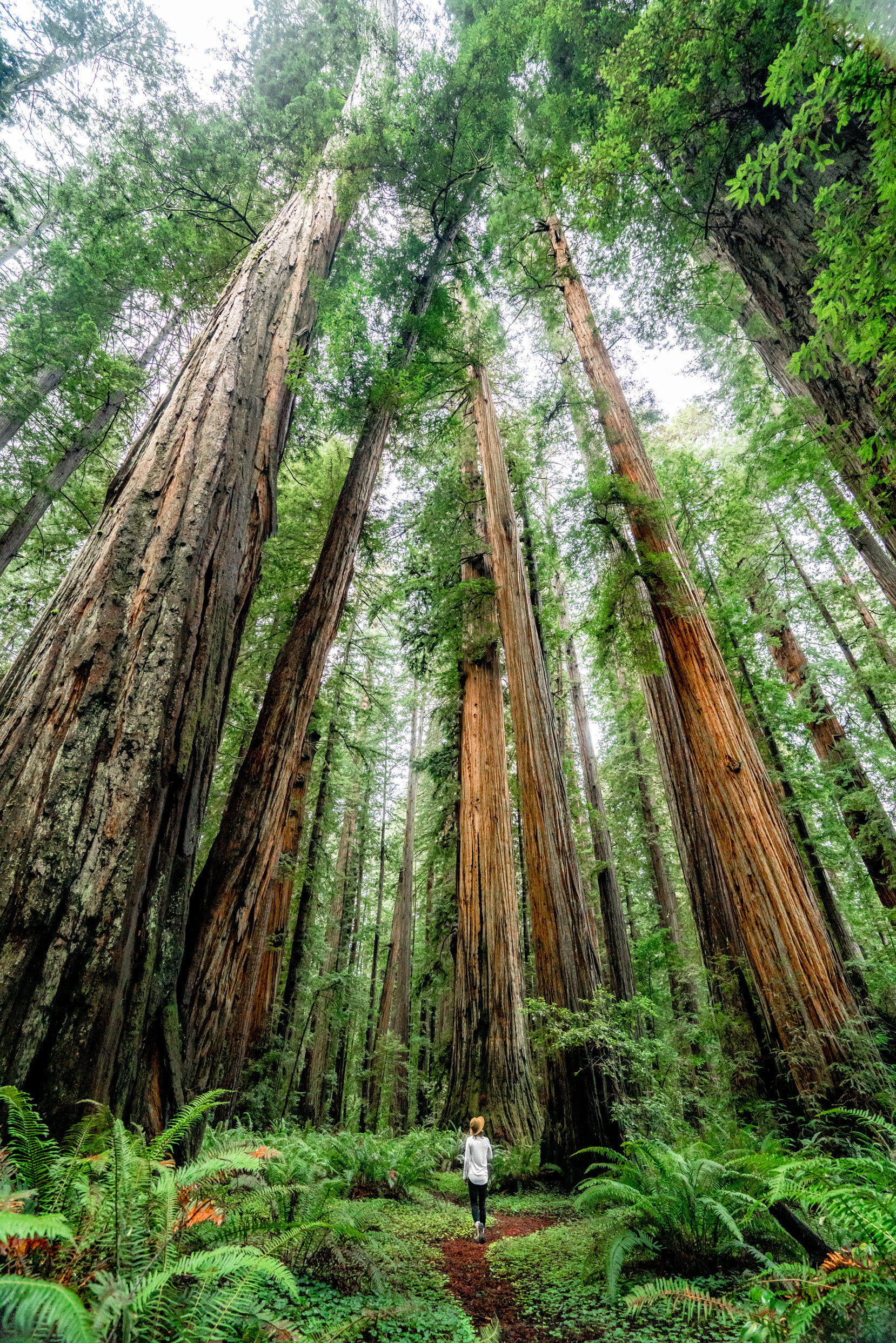
Shoot up. The classic Redwoods shot is looking straight up from the base of a tree into the canopy. In Stout Grove, this is particularly effective because the low undergrowth gives you clean sightlines straight up the trunks. Find a spot where three or four massive trunks converge overhead and point your camera straight at the sky.
Include a person for scale. Photos of big trees can look flat without a reference point. Put a person in the frame and suddenly the viewer understands that these trees are 20 feet wide at the base. Position someone 30 to 40 feet ahead on the trail and shoot with a wide lens.
Use fog to your advantage. Fog diffuses the light and creates depth in the forest. The shafts of light that appear when the sun breaks through fog are the holy grail of forest photography. I’ve waited hours for those moments, and they’re always worth it. The best fog conditions tend to happen in the first 90 minutes after sunrise, especially from July through October.
Bring a tripod. The forest floor is dim even on bright days, and long exposures can reveal details in the shadows that handheld shots miss. I typically shoot at ISO 400 to 800 with a 1 to 2 second exposure for the moodiest results.
Don’t ignore the forest floor. The redwood sorrel, sword ferns, and fallen logs are photogenic subjects on their own. A macro lens can capture the intricate patterns of the clover-like sorrel leaves, and the contrast between the tiny plants and the enormous trunks behind them tells the story of this ecosystem better than any wide shot.

Why Stout Grove Stands Out from Other Redwood Groves
There are dozens of redwood groves you can visit across Northern California. Most of them are beautiful. A handful are extraordinary. Stout Grove is in a category of its own, and it comes down to three things.
First, the undergrowth. Most redwood groves have thick underbrush, huckleberry bushes, and fallen logs that partially obscure the bases of the trees. Stout Grove is different. The forest floor here is unusually open, covered mostly in redwood sorrel and ferns. This means you can see the full trunk of these trees from root to canopy, and the sense of scale is staggering. When you can see the entire 300-foot column of a redwood without obstruction, your brain struggles to process it.
Second, the density. The trees in Stout Grove are packed tightly together, which creates a cathedral-like canopy effect. Light filters through the gaps in ways that feel almost intentional. On a foggy morning, the shafts of light piercing the canopy look like something out of a painting. I’ve photographed hundreds of groves and never seen light behave quite like it does here.
Third, the size of the individual trees. Stout Grove contains some of the largest coast redwoods in existence. Several of the trees here exceed 300 feet in height and 15 feet in diameter. The Stout Tree itself, the grove’s namesake, stands at roughly 325 feet with about a 16-foot diameter, making it one of the larger trees in Jedediah Smith Redwoods. Standing at its base and looking up is the closest I’ve come to a religious experience in the outdoors.
Things to Know Before Visiting
Entrance fees. Redwood National Park itself has no entrance fee. The state parks within the Redwood system, including Jedediah Smith Redwoods where Stout Grove is located, charge a day-use fee if you park in the designated day-use area. Parking at the Stout Grove trailhead off Howland Hill Road is free. Confirm current fees on the official park page before you go.
Mosquitoes. During the summer months (June through August), mosquitoes can be intense in the Redwoods. Stout Grove, being in a low-lying area near the river, can be particularly buggy. Bring environmentally friendly bug spray, and wear long sleeves if you’re sensitive. I’ve had visits where the mosquitoes were barely noticeable and visits where they were relentless. Mornings tend to be better than afternoons.
Stay on the trails and platforms. The root systems of old-growth redwoods are surprisingly shallow, spreading laterally rather than going deep. Soil compaction from foot traffic can damage these roots over time. The viewing platform around the Stout Tree exists for this reason. Please use it and stay on marked paths throughout the grove.
Cell service. Reception is decent in much of the park. There are a few dead zones near Orick, but in the Jedediah Smith area you should have reasonable coverage.
No reservations required. Unlike many popular national parks that now require timed entry permits, Redwood National Park has no reservation system. Just show up and go.
Pets. Dogs are not allowed on the Stout Grove Trail or most other trails in the Redwood park system. Leave them at camp or consider a dog-friendly beach stop instead.
Getting to Redwood National Park
Redwood National and State Parks stretch along the Northern California coast for about 40 miles. Stout Grove is in the northernmost section, near Crescent City.
By air. The closest airport is Del Norte County Airport (CEC) in Crescent City, about 30 minutes from the grove. It has limited commercial service, so most folks fly into a larger hub. Arcata-Eureka Airport (ACV) is about 90 minutes south. Medford, Oregon (MFR) is roughly 2 hours northeast and tends to have the best combination of flight options and proximity.
By car. Most folks drive. From San Francisco, take US-101 North for approximately 330 miles (about 6 hours). The drive itself is spectacular, especially the last stretch through the Redwoods. From Portland, it’s about 380 miles south (roughly 6.5 hours). From Medford, Oregon, take US-199 West for about 80 miles (2 hours), which is the route I’d recommend if you’re flying in from out of state.
A rental car is essential for exploring the park. There’s no shuttle system, and the various groves and beaches are spread across a large area. Pick up a car at whatever airport you fly into.
Where to Stay in the Redwoods
Visiting Redwood National Park? Check out our full guide to the park for tips on where to stay and what to see. Short on time? Here’s our favorite hotel in the Redwoods.
Other Sites Worth Visiting Nearby
Stout Grove is in the Jedediah Smith section of the park, which is loaded with great spots. Here’s what I’d add to the itinerary.
Grove of the Titans is just down Howland Hill Road and contains some of the largest coast redwoods ever measured. An elevated boardwalk trail opened in recent years to protect the root systems. If you’re already at Stout Grove, this is a 5-minute drive and well worth the addition. The two groves together make for a perfect morning.
Jedediah Smith Redwoods State Park encompasses the entire area surrounding Stout Grove and offers additional trails through old-growth forest. The campground here is one of the best in the park system, set right along the Smith River with sites shaded by massive redwoods.
Boy Scout Tree Trail is one of the best hikes in Redwood National Park. It’s a roughly 5.6-mile round trip through dense old-growth that ends at a hidden waterfall. The trailhead is also on Howland Hill Road, so you can combine it with Stout Grove in a single day.
Howland Hill Road deserves a slow drive even if you’ve already been to Stout Grove. The entire road passes through dense old-growth, and there are several pullouts where you can stop and wander into the forest. Budget 30 to 45 minutes for the full stretch.
The Smith River is worth a stop on its own. It’s one of the last major undammed rivers in California, and the water runs an almost unreal shade of blue-green. Swimming holes are plentiful in summer, and the river is popular with anglers and kayakers.
Crescent Beach Overlook offers sweeping views of the Pacific coastline. It’s a completely different landscape from the forest interior and worth the short detour.
For the full scope of what the park offers, check out our guide to the top things to do in Redwood National Park.
Watch the Award-Winning Redwoods Film
We spent weeks in the park to produce this film, which covers all the different regions and areas of Redwood National Park. It was featured by National Geographic, and it remains one of the pieces of work I’m most proud of.

Photos of Stout Grove
I’ve taken thousands of photos across multiple trips to Redwood National Park. Here are a few favorites from Stout Grove.

What to Bring to Redwood
Gear we recommend for Redwood. Affiliate links support our work at no cost to you.
More Than Just Parks may earn a small commission from purchases made through these links, at no extra cost to you. We only recommend gear we would actually use.
Affiliate disclosure: Some links on this page earn us a small commission at no extra cost to you. We only recommend gear we actually use.
More Than Just Parks Film Watch our 4K film of Redwood We spent weeks in Redwood, one of our favorite public lands destinations, capturing it the way it deserves. Take a few minutes and see it for yourself.


