

The Short Version: Mount Storm King is a steep, rope-assisted scramble above Lake Crescent. The maintained trail ends at a railed viewpoint with a fine view; the famous photo perch beyond it requires pulling yourself up unmaintained ropes on an exposed ridge. Climb it dry, turn around if you are uneasy with heights, and people have died here, so treat the ropes seriously.
Distance 4.0-5.5 mi RT (depending on how far up the climber’s path you go) Elevation Gain ~2,065 ft Difficulty Strenuous, with exposed rope scrambling Time 3-5 hrs Trailhead Storm King Ranger Station, Lake Crescent
Mount Storm King looms over Lake Crescent with more presence than its modest height suggests. It is a craggy peak of seafloor basalt, and the climb to its best viewpoint is one of the more demanding day hikes in Olympic National Park, not because of distance but because of how steep and exposed the final stretch gets.
The maintained trail climbs partway up and ends at a good overlook. Hikers who want the much-photographed view from higher on the ridge follow an unofficial, rope-assisted scramble that has earned a reputation online. In this guide we cover the route, the hazards, when to go, and who should and should not attempt the ropes. For broader trip planning, see our full Olympic National Park guide.
Love Olympic? It's one of 117 threatened public lands destinations we're tracking. Get the free briefing.
Many people call Mount Storm King the best hike in Olympic. We do not, and we will say why at the end. It is still very much worth doing.
Where Storm King Sits in the Olympics
The Olympic Peninsula of northwestern Washington is one of the country’s most remote corners, a Pacific Northwest landscape that rises from the outer ocean coast through some of the finest temperate rain forest on the planet to a core of high, ice-bound peaks. No roads cross the heart of it, and nearly a million acres are protected within Olympic National Park.
Much of the park is roadless backcountry, but there is plenty in the front country too, and Lake Crescent in the northern foothills is the standout. The deep, blue-green lake lies cradled in forested ridges along Highway 101, just south of the Strait of Juan de Fuca. Mount Storm King is the peak that guards its eastern end.
Things to Know Before Hiking Mount Storm King

Entrance Fees
Olympic National Park charges $30 per private vehicle, valid for seven days. An America the Beautiful annual pass covers entry here and at every other federal recreation site. There is no separate reservation required for the Storm King or Lake Crescent area, though parking at the Storm King Ranger Station fills early on summer weekends.
Sun, Bugs, and Footwear
Carry reef-safe sunscreen for the exposed upper ridge and an eco-friendly insect repellent (or this DEET option) for the forested lower trail. Most important: wear shoes with real grip. The ropes and the descent are where people slip, and worn-out soles are a genuine hazard here.

Guide Book and Map
Our preferred guide book for the area is Moon Olympic Peninsula, and we carry the National Geographic Trails Illustrated map for Olympic National Park.

Where to Stay Near Lake Crescent
Visiting Olympic National Park? If you haven’t decided where to stay yet, here’s our favorite hotel in the area.

The Lay of the Land
Mount Storm King is one of the landmark peaks of the northern front of the Olympic Mountains. It rises steeply from the Lake Crescent and Barnes Creek lowlands to 4,525 feet, forming the western end of a divide that runs east toward the Elwha River and continues along Baldy Ridge to 4,680-foot Mount Baldy.
The mountain is a hulk of seafloor basalt, part of the Crescent Formation that wraps the northern, eastern, and southern margins of the peninsula. Its summit marks the boundary between Olympic National Park to the south and Olympic National Forest to the north, but the entire hiking route stays inside the national park.
One important point of honesty: most hikers never reach the true 4,525-foot summit, which is a technical objective. The “Storm King summit” people photograph is a viewpoint reached partway up the climber’s path, several hundred feet above where the maintained trail ends. That viewpoint is the goal of this guide.
Lake Crescent’s Guardian Peak
A little history can spice up the grind. As geologist Rowland W. Tabor recounts in Geology of Olympic National Park, Mount Storm King figures in a Native legend about the origin of 650-foot-deep Lake Crescent.

As the story goes, the Quileute and Klallam fought a fierce battle in the valley now holding the lake. The fighting so enraged Mount Storm King that he hurled an enormous boulder down from his summit, killing the warriors and damming the valley to form the lake. A Lower Elwha Klallam member relayed a version in a 2014 Seattle Times story in which the hurled rock split a single large lake, Tsulh-mut, into Lake Crescent to the west and Lake Sutherland to the east.
The geology backs up the spirit of the tale. An ancient landslide slumped off the valley walls and separated the two lakes, backing up Lake Crescent until it found a new north-flowing outlet through the Lyre River. Either way, there is no finer view of the lake than the one from high on Mount Storm King, and you have to work for it.
The Trail: Ranger Station to the Maintained Endpoint
The hike starts at Olympic National Park’s Storm King Ranger Station on Barnes Point, midway along Lake Crescent’s south shore. Use the trailhead signed for the Barnes Creek Trail and Marymere Falls. The first half-mile is flat and easy, then a sign points you eastward and up onto the Storm King Trail. From here it is switchbacks the rest of the way.
It is a relentless climb up the western spur of the mountain, but the views open quickly and the forest is a pleasure. You start in deep, lush riverside forest of western hemlock, western redcedar, and bigleaf maple, then move into drier, more open slopes dotted with manzanita and the smooth-barked, almost tropical-looking Pacific madrone. These sun-loving broadleaf species add some welcome variety to a region otherwise ruled by conifers.
Just shy of a mile past the turnoff you reach the first real viewpoint, around the 2,000-foot mark, with a top-down look at narrow Lake Crescent and the Strait of Juan de Fuca beyond. A half-mile farther and a few hundred feet higher, at roughly 2,400 feet, the officially maintained trail ends. A sign warns of the hazardous terrain ahead.
For many hikers, this is the right turnaround, about 1.7 miles from the trailhead. The two viewpoints you have already reached are excellent and give a real taste of the summit panorama. If you are fit, sure-footed, and not running short on daylight, you can continue up the climber’s path. If you are not, there is no shame in stopping here, and the descent is the same switchbacks back down.
The Climber’s Path and the Ropes
Beyond the maintained trail, the route turns into a rough, unmaintained, often badly exposed scramble along a sharp ridgecrest. Expect steep pitches, loose gravel, and real drop-offs. This is the part of the hike that has built Storm King’s reputation.
Several of the steeper grades have ropes to help you up, starting just past the end of the official trail. These ropes are not installed or maintained by the National Park Service, so do not blindly trust them. Test each one before you commit your weight, and stay alert. Conditions and the ropes themselves change from year to year.
Online reviews have made the rope sections borderline infamous, and plenty of hikers turn back on reputation alone. Here is the honest read: you should proceed with caution, know your limits, and trust your gut, but in dry conditions an experienced, careful hiker who tests the ropes will usually find the route doable. If you have a real fear of heights, this is not the scramble for you. Stop at the maintained trail’s end and enjoy the view from there.
The Viewpoint at the Top
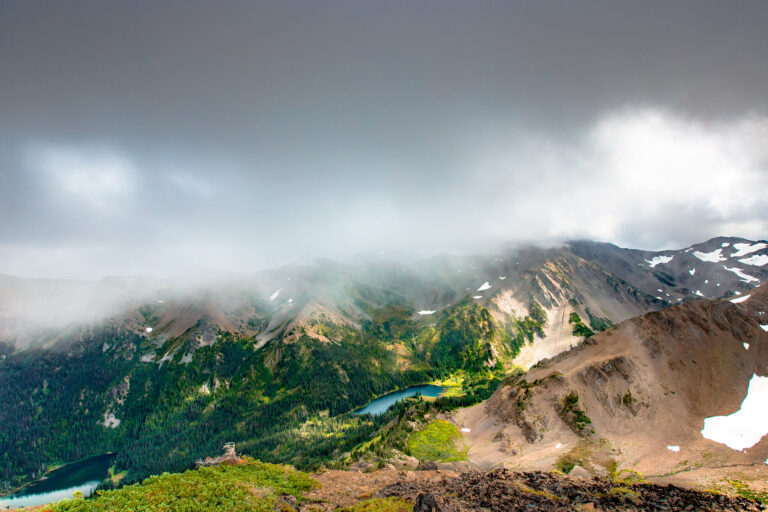
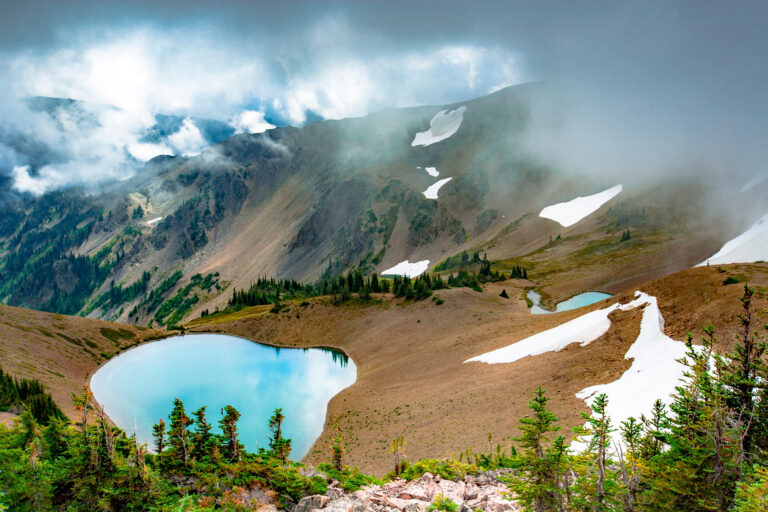
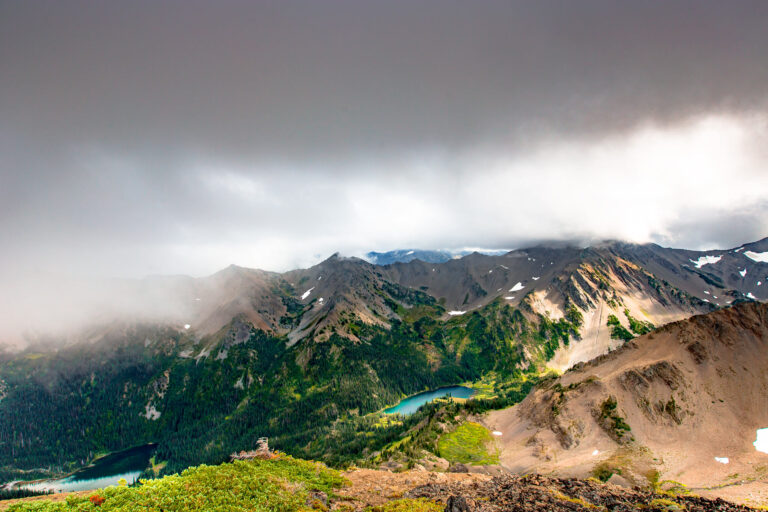
The much-photographed outcrop high on Storm King is a remarkable perch, with Lake Crescent glinting far below. It is one of the defining views in Olympic National Park, and arguably in all of Washington. On a clear day the panorama reaches north past the Strait of Juan de Fuca to Vancouver Island, east to the wall of the North Cascades, and south into the heart of the Olympics, with Happy Lake Ridge rising across the Barnes Creek valley.
This being the Olympic Peninsula, clouds may be swirling around you instead. Either way, expect company of the feathered kind: gray jays, the bold “whiskeyjacks,” routinely flit over to inspect hikers. Do not feed them.

When to Go, and Staying Safe
Check the forecast before you commit. Storm King is technically a year-round destination, but snow and ice make winter ascents a job for experienced mountaineers, and short winter days can leave you in tricky terrain after dark, since the climb often takes longer than the low mileage suggests.
Do not go beyond the end of the maintained trail in wet conditions or on ice unless you genuinely know what you are doing. People have died on Mount Storm King. It is easy to slip when the rock is wet or when you are moving carelessly. And take the name seriously: you do not want to be on this ridge during a real Olympic storm, when gale-force winds, most common from fall through spring, would make the ropes far too dangerous.
Start early. This is a popular route despite its difficulty, and the rope sections can bottleneck when hikers are going up and down at once. Yield to people descending: the way down is the harder, riskier direction, and most will want to ease backward down the ropes.
Add-On: Marymere Falls
Unless you are completely wiped on the way down, consider tacking on Marymere Falls. Turn left at the trail junction, hike a short way, then turn left again for the falls access trail, which crosses Barnes Creek and heads up the ravine of Falls Creek.

Falls Creek tumbles over a tall mossy rock face at Marymere Falls, fanning out into a ribbon somewhere between 90 and 119 feet tall depending on who is measuring. A short loop reaches both a lower and an upper viewpoint. The falls run hardest in winter and spring but are lovely year-round, and it is an easy 0.9-mile walk back to the ranger station from here, a gentle finish after the climb.
Olympic National Park Film

Is Mount Storm King Olympic’s Best Hike?
No. It is a great hike, but it is not the best in the park. Olympic is enormous and varied, and trails in the high country and along the coast deliver more for less risk. What Storm King offers that the others do not is a single concentrated payoff: a short, brutal climb to one of the great lake views in the Pacific Northwest.

Do not underestimate the effort or the exposure, but if you go prepared and pick a dry day, it is worth it. There is real satisfaction, on every future visit to Lake Crescent, in looking up at that peak on the skyline and knowing you stood up there.
Mount Storm King FAQ
Depending on how far up the climber’s path you go, the Mount Storm King hike is between 4 and 5.5 miles round trip.
It is strenuous. The Mount Storm King climb gains about 2,065 feet, and the upper section is an exposed, rope-assisted scramble that is not for anyone uneasy with heights. Set aside at least 4 hours; some hikers need 6 or more.
Helpful Related Links
Olympic National Park Guide: Our full guide to planning a trip to Olympic.
North Cascades Hikes: The best hikes in nearby North Cascades National Park.
Mount Rainier: The best hikes at Mount Rainier National Park.
All 63 National Parks Ranked: Every US national park, ranked by our team.
Most Visited National Parks: The 10 most visited national parks in the country.
What to Bring to Olympic
Gear we recommend for Olympic. Affiliate links support our work at no cost to you.
More Than Just Parks may earn a small commission from purchases made through these links, at no extra cost to you. We only recommend gear we would actually use.
Affiliate disclosure: Some links on this page earn us a small commission at no extra cost to you. We only recommend gear we actually use.
More Than Just Parks Film Watch our film of Olympic We spent weeks in Olympic, one of our favorite public lands destinations, capturing it the way it deserves. Take a few minutes and see it for yourself.