In the spring of 1933, the United States was on its knees. A quarter of the workforce was unemployed, the soil of the Great Plains was literally blowing away in black clouds, and millions of young men had no work, no prospects, and no reason for hope. Within weeks of taking office, Franklin Roosevelt proposed a single program meant to attack two crises at once. It would put hundreds of thousands of idle young men to work, and it would send them to heal an exhausted American landscape. It was called the Civilian Conservation Corps, and it is the closest thing the United States has ever built to a Green New Deal.
That phrase, Green New Deal, is usually associated with twenty-first century climate politics. But the basic idea, that the government can fight economic and environmental crises with the same paycheck, is not new at all. It was tried, at enormous scale, nearly a century ago, and it worked. Understanding what the CCC actually did, and what it could not do, is essential to any honest argument about whether such a thing could be done again.
Two Disasters at Once
To understand the CCC, you have to understand how desperate 1933 was. The Great Depression had thrown the economy into freefall, and the human cost fell heaviest on the young, who came of age into a country with no jobs to give them. At the same time, the nation faced an environmental catastrophe of its own making. Decades of clear-cutting had stripped the forests, and reckless plowing of the southern plains, combined with severe drought, had triggered the Dust Bowl, in which the topsoil of an entire region rose into the sky and buried farms.
Roosevelt, who had a genuine personal passion for forestry and land restoration, saw the two crises as one opportunity. The country had an army of unemployed young men and a continent of damaged land. Why not send the first to repair the second?
109 public lands destinations are under threat. Get the free weekly briefing that 25,000+ people use to stay informed and take action.
How the Corps Worked
Congress moved with startling speed. The Emergency Conservation Work Act was passed and signed at the end of March 1933, part of the legendary first hundred days, and within months the first camps were operating. The Civilian Conservation Corps enrolled young, unmarried men, initially those roughly eighteen to twenty-five years old, from families on relief. They were paid thirty dollars a month, and a condition of the work was that most of that wage, twenty-five dollars, was sent directly home to their families. The program fed, clothed, housed, and employed them while putting money into struggling households across the country.
The logistics were staggering, and they were handled largely by the U.S. Army, which had the only organization in the country capable of housing and feeding hundreds of thousands of men in remote camps on short notice. Over its nine-year life, from 1933 to 1942, the CCC enrolled roughly three million men. At its peak it ran more than two thousand camps spread across every state.

What They Actually Built
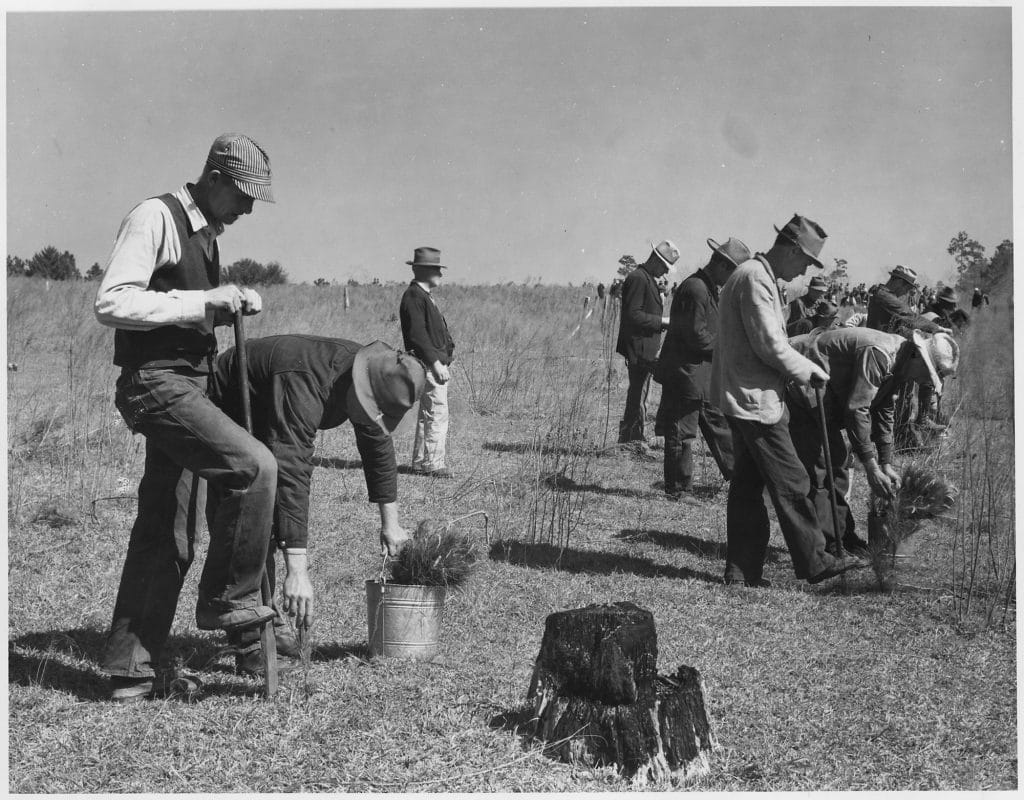
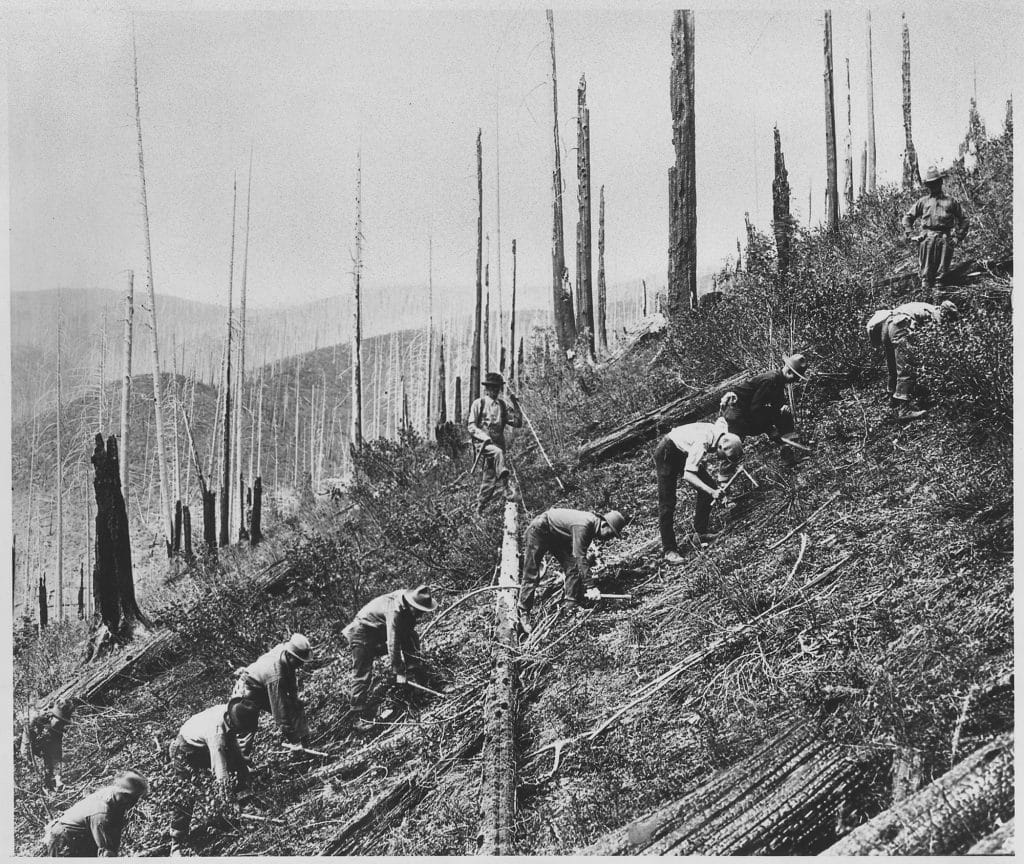
The work the CCC accomplished is visible in American parks and forests to this day. The corps is credited with planting on the order of three billion trees, an effort that earned its members the affectionate nickname Roosevelt’s Tree Army. They fought the erosion that had caused the Dust Bowl, terracing hillsides and restoring damaged farmland. They strung telephone lines, cut firebreaks, and built the fire lookout towers that protected the national forests for decades.
If you have ever hiked a classic trail, stayed in a rustic stone-and-timber park lodge, or driven a scenic park road built in that distinctive 1930s style, there is a good chance you have used the work of the CCC. The corps developed campgrounds, picnic areas, and trail systems in hundreds of national and state parks, building much of the basic infrastructure that still welcomes visitors today. Their handiwork is part of the foundation of the modern park experience, the public face of the conservation tradition that runs from Gifford Pinchot’s wise-use forestry through the New Deal and beyond.
The Parts We Should Not Romanticize
The CCC deserves its reputation, but it was a product of its time, and honesty requires noting its limits. The camps were racially segregated, with Black enrollees largely confined to separate units, a reflection of the entrenched discrimination of 1930s America. The program was also restricted to young men. Women were almost entirely excluded from the conservation corps, with only a small, separate set of camps ever created for them.
It is also worth being precise about what the CCC was fighting. The Dust Bowl was a disaster of drought, deforestation, and destructive farming practices, an environmental crisis, but not the same thing as the modern, carbon-driven warming of the planet. The CCC restored soil and forests. It did not, and could not, address greenhouse gases, a problem the science of the day did not yet understand. The honest parallel to today is not the specific threat but the strategy, the idea of marrying employment to environmental repair.
Why It Ended
The CCC did not fail. It was, in a sense, made obsolete by a far larger crisis. As the United States moved toward entry into World War II, the economy roared back to life on war production, unemployment vanished, and the same young men the corps had employed were needed for the military. Congress ended funding for the CCC in 1942. The discipline and outdoor experience many veterans had gained in the camps, ironically, helped prepare a generation for the war that followed.
Could We Do It Again?
The legacy of the Civilian Conservation Corps is why the program keeps coming back into political conversation. Every time the country faces high unemployment and mounting environmental damage at the same time, someone looks back at the 1930s and asks whether a modern version could work. The proposals carry different names, but the DNA is identical: pay people to do the urgent work of repairing the land.
The CCC proves that the basic concept is not a fantasy. A nation in crisis once chose to put millions of its young people to work restoring forests, soil, and parks, and the results are still standing nearly a century later. Whether the country has the will to attempt something on that scale again is a political question, not a practical one. The Civilian Conservation Corps already answered the practical question. It can be done, because it was. To understand how environmental action once commanded broad national support, it helps to read about the bipartisan era of environmental activism that followed.