

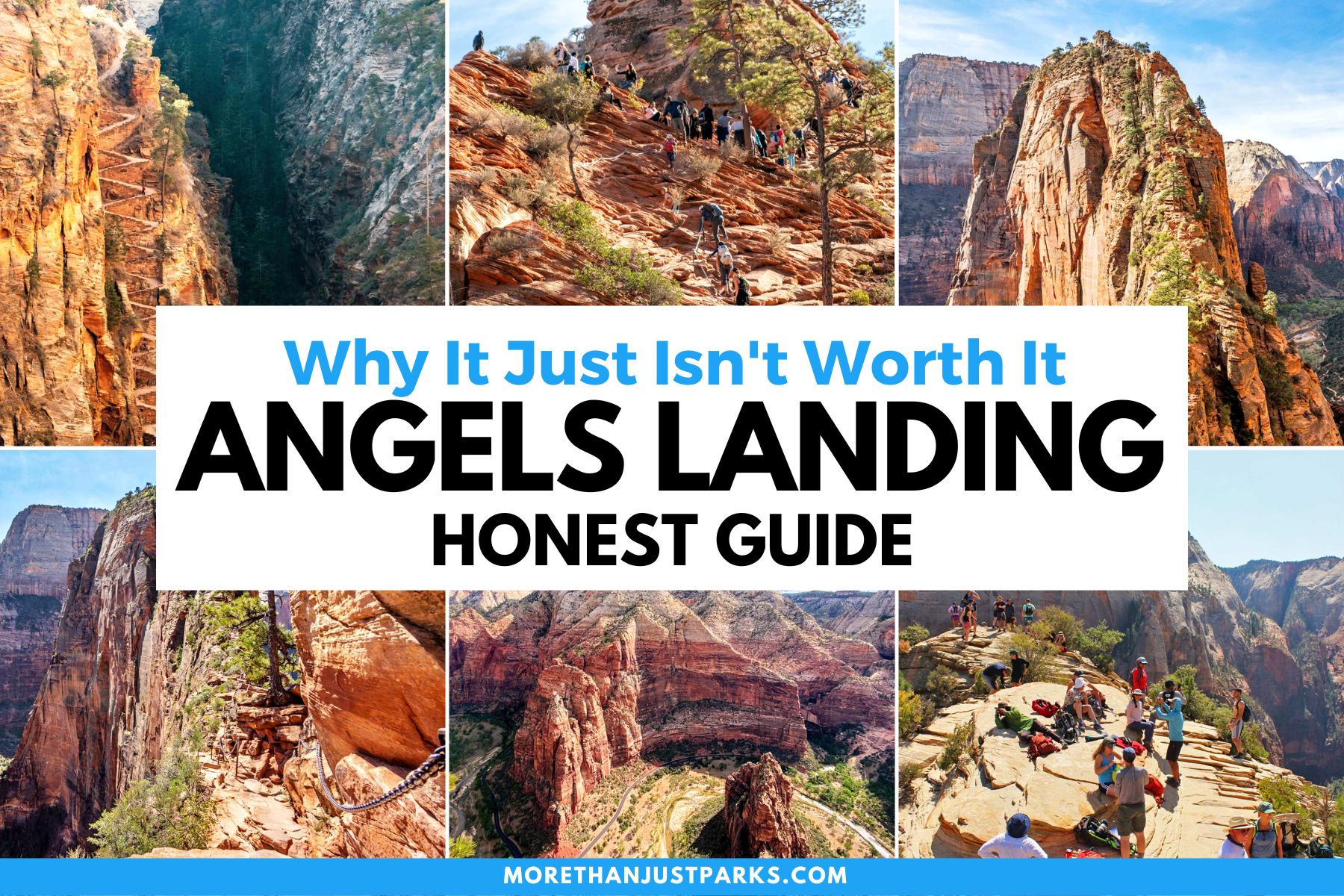
We’re going to be honest with you about Angels Landing, and you might not like what we have to say. Angels Landing is one of the most hyped hikes in America, and the hype has become the problem.
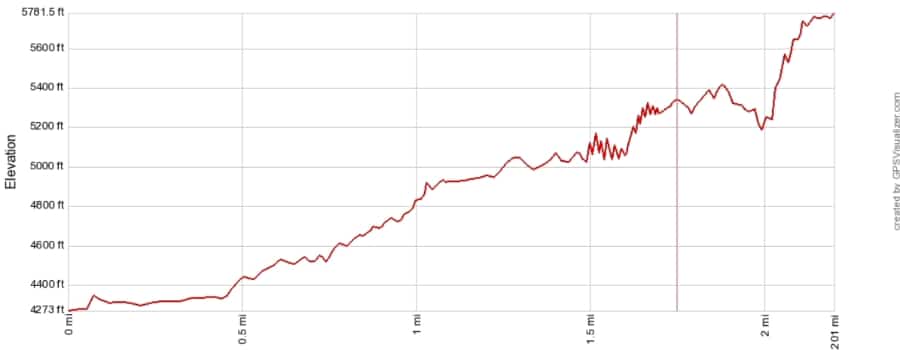
The trail itself is remarkable. A 5.4-mile round trip, 1,488 feet of climbing, and a final half mile along a sandstone fin with thousand-foot drops on both sides and a chain to hold onto. There’s nothing else like it in the park system.
The problem is everything around the trail. Zion logged 4,984,525 visits in 2025, second most of any national park, and it sometimes feels like every one of them is in line for the chains. This guide covers the permit lottery, the route section by section, and why we’d point most folks toward a different Zion hike entirely.
Angels Landing at a Glance
| Distance | 5.4 miles round trip |
| Elevation Gain | 1,488 feet |
| Time Required | 4 to 5 hours |
| Difficulty | Strenuous, with serious exposure on the chain section |
| Permit | Required beyond Scout Lookout, lottery only |
| Trailhead | The Grotto, Zion Canyon shuttle stop #6 |
Is Hiking Angels Landing Worth It?
Honestly, we don’t think the Angels Landing hike is worth it for most folks. Not because of the height, the difficulty, or the fear-mongering around the chains. The hike isn’t worth it because of the crowds. They are horrendous. The trail has been loved to death.
Love Zion? It's one of 117 threatened public lands destinations we're tracking. Get the free briefing.
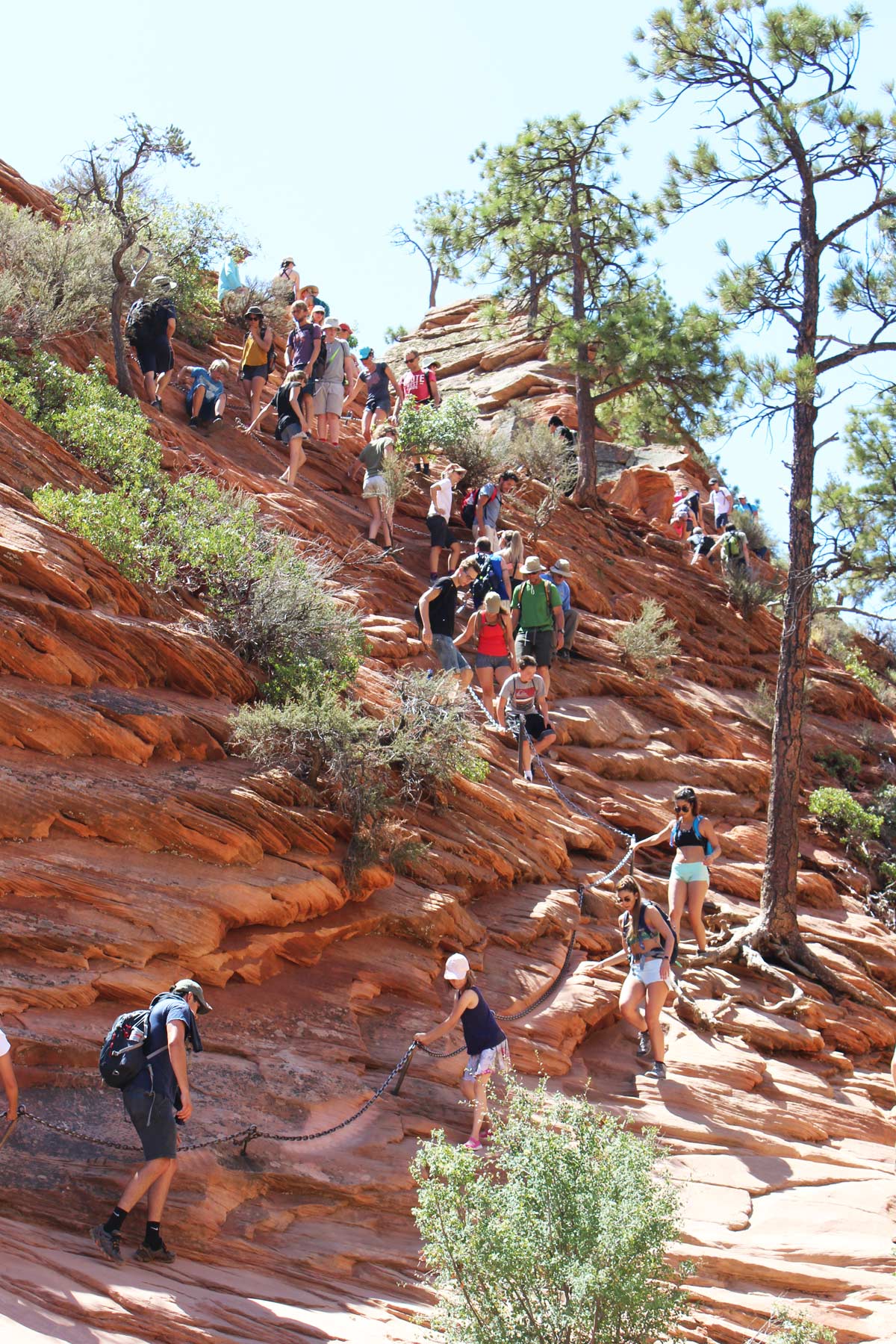
For much of the year the route is packed with folks who value the profile selfie more than the place. You’ll wait in line at the shuttle, wait in line at the switchbacks, and wait in line at the chains. A hike that should feel wild ends up feeling like a theme park queue with a fatal fall on either side.
The permit system has helped. It capped the worst of the congestion on the fin itself. But the trail below Scout Lookout requires no permit, and that’s where the crush now lives.
With that said, if you can look past all of that, the summit is genuinely one of the great viewpoints in America. Go at dawn, go in winter, or don’t go at all. And if you want the same caliber of reward without the circus, check our Zion National Park guide for alternatives. Observation Point stands 700 feet higher than Angels Landing and looks down on it.
Always check park alerts before you head to Zion to see if any closures or safety risks impact your hike.
Angels Landing Permit System
Zion drew about 2.7 million folks in 2010. By 2021 it was over five million, and the line for the chains looked like the queue photos from Everest. For safety and sanity, the park launched a permit pilot program in April 2022. You now need a permit to hike beyond Scout Lookout, and the only way to get one is a lottery on Recreation.gov.
“When we did have higher levels of crowding and congestion, people were so focused on making their way up the trail that they didn’t have those moments just to stop, enjoy the scenery, take it all in and really see the wonder that makes this hike one of the reasons people seek it out so much.”
Susan McPartland, Zion National Park Visitor Use Manager

How to Get an Angels Landing Permit in 2026
You have two shots at a permit. The seasonal lottery for planners and the day-before lottery for everyone else. Both run through Recreation.gov, and all deadlines are Mountain Time.
FRAUD ALERT: Permits are only sold through Recreation.gov. Any other website selling Angels Landing permits is scamming you.
Here are the 2026 seasonal lottery windows announced by the park.
| Hiking Dates | Lottery Application Window |
|---|---|
| March 1 to May 31, 2026 | February 13 to February 25, 2026 |
| June 1 to August 31, 2026 | April 1 to April 20, 2026 |
| September 1 to November 30, 2026 | July 1 to July 20, 2026 |
| December 1, 2026 to February 28, 2027 | October 1 to October 20, 2026 |
The lottery is a random drawing. Applying in the first hour gets you nothing extra, so don’t set a 5 am alarm for it.

Day-Before Lottery
Missed the seasonal window? The day-before lottery opens at 12:01 am and closes at 3:00 pm Mountain Time, with results around 4:00 pm for next-day hikes. Same process, shorter fuse.
Lottery Fast Facts
- Each application covers up to six people and costs $6, win or lose.
- If you’re drawn, you pay $3 per person on the permit.
- Seasonal applications let you rank seven date and time choices. Pick before 9 am, 9 am to noon, or after noon.
- You can name an alternate permit holder, and that person can also enter their own application.
- Carry proof of your permit, paper or digital. Rangers check at the start of the chain section.
Entrance Fees and Getting to the Trailhead
Zion costs $35 per vehicle, $30 per motorcycle, or $20 per person on foot or bike, good for seven days. The $80 America the Beautiful pass covers it. New for 2026, non-US residents age 16 and up pay a $100 surcharge on top of the entrance fee, and fee-free days now apply to US residents only. None of this covers the Angels Landing permit.
For most of the year, you can’t drive Zion Canyon Scenic Drive. You ride the free shuttle, no reservation needed, which runs roughly March through late November plus the late-December holidays. Shuttles come every 7 to 15 minutes and hold about 70 people. Get off at stop #6, The Grotto.
Parking inside the park fills before 9 am most of the season. Park in Springdale instead and take the Springdale Line shuttle to the pedestrian entrance at Zion Canyon Village. You have enough to think about on this hike without circling a full lot.
One more thing. Don’t gamble on the last shuttle of the day. If it’s full, it doesn’t stop, and you’ve got a five-mile walk back in the dark. Rangers will not drive you.

The Trail, Section by Section
As you cross the pedestrian bridge from the Grotto, a sign tells you how many people have died on this trail. The park is not being dramatic. It’s being accurate. Here’s what’s between you and the summit.
West Rim Trail
The first stretch lulls you. A flat, paved walk along the Virgin River, then the switchbacks start climbing a sheer rock face and don’t let up. Look straight up from the bottom and you’ll see exactly what you signed up for.
TRUTH MOMENT: You can turn around at any point on this trail, and plenty of smart folks do. Nobody is forcing you to summit, and the view from Scout Lookout is already better than most full hikes deliver. Don’t let your group pressure you past your limit. Set a meeting point and let them tag the top without you.
Refrigerator Canyon
Around the back side of the formation, the trail ducks into Refrigerator Canyon, the last shade you’ll see. It runs noticeably cooler than the canyon floor, which matters in a park that regularly tops 100°F.
Keep your voice down through here. Refrigerator Canyon is a designated quiet zone to protect the Mexican spotted owls that nest in the walls.
Walter’s Wiggles
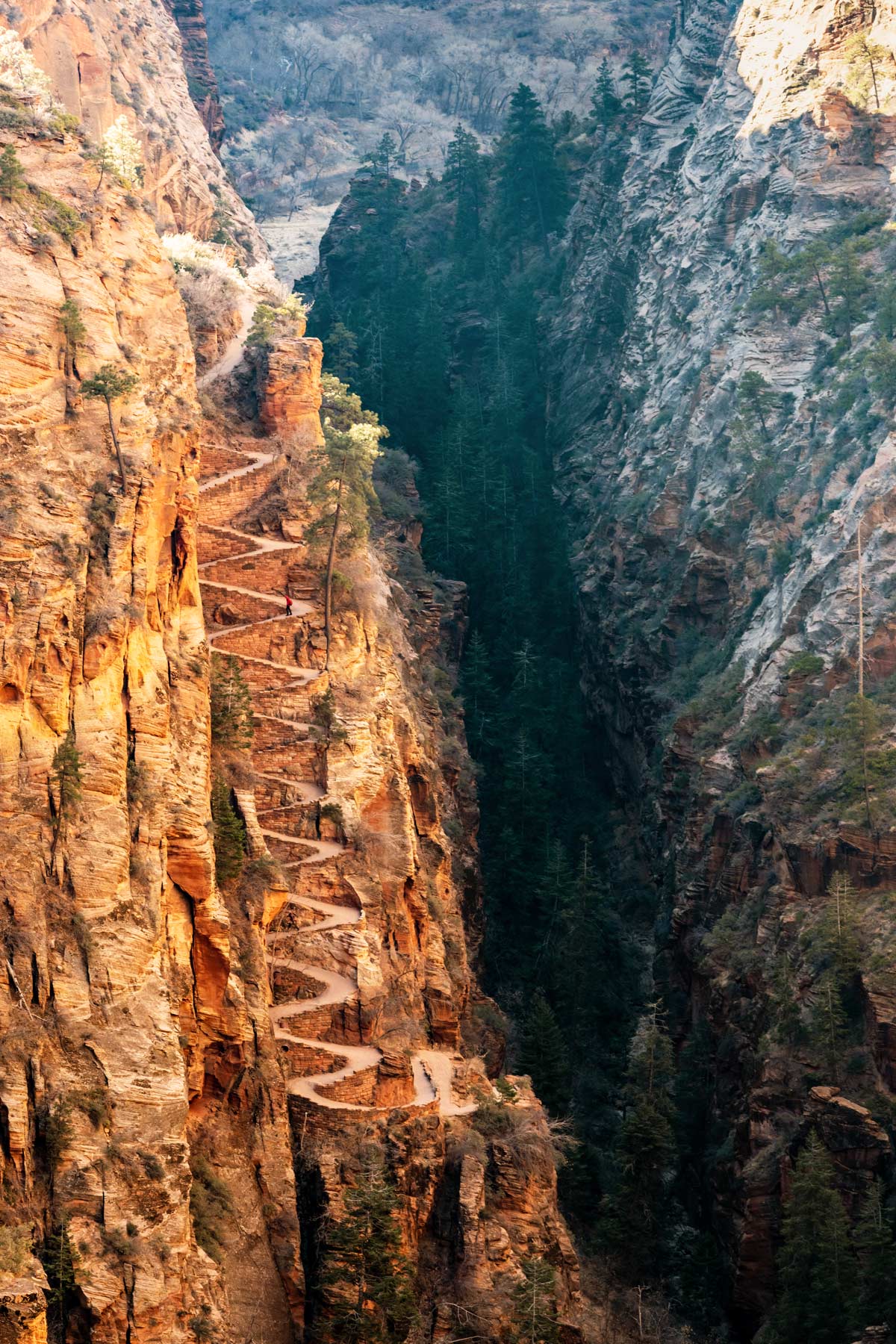
Then come the Wiggles, 21 tight, steep switchbacks stacked on top of each other, engineered into the cliff in 1926 under Walter Ruesch, Zion’s first superintendent. They gain about 250 feet and they will cook your legs. Without them, this hike wouldn’t exist for anyone but climbers.
Scout Lookout
The Wiggles top out at Scout Lookout, a broad sandstone shelf at 5,350 feet with a head-on view of the final fin. This is the turnaround point for anyone without a permit, and frankly a worthy destination on its own.
There are pit toilets up here. They are heavily used, the waste gets helicoptered out, and on a hot afternoon you will smell them before you see them. Plan accordingly.
PERMIT CHECK: Scout Lookout is the last place you can be on the trail without a permit. Rangers check everyone at the entrance to the chain section.
The Chain Section
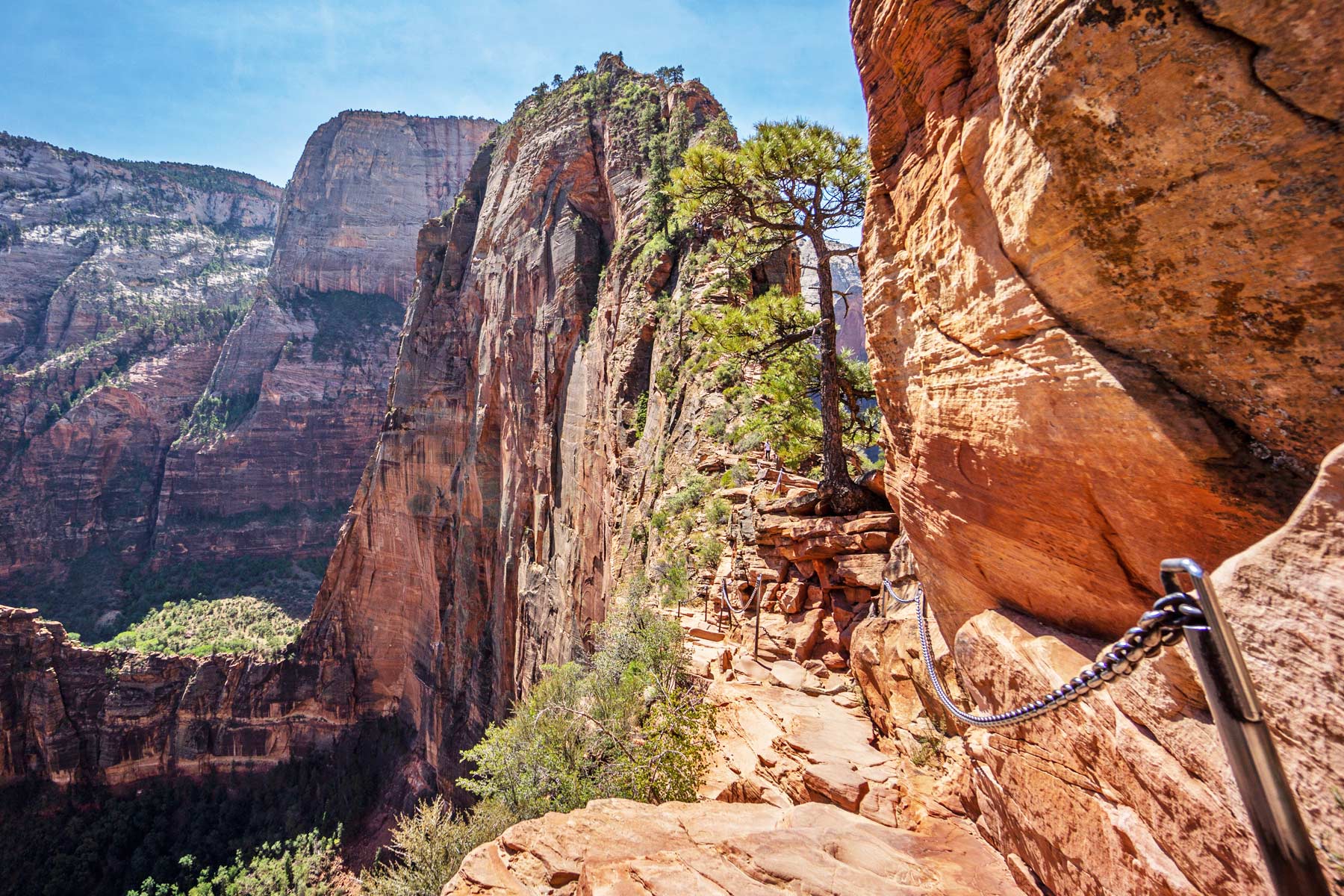
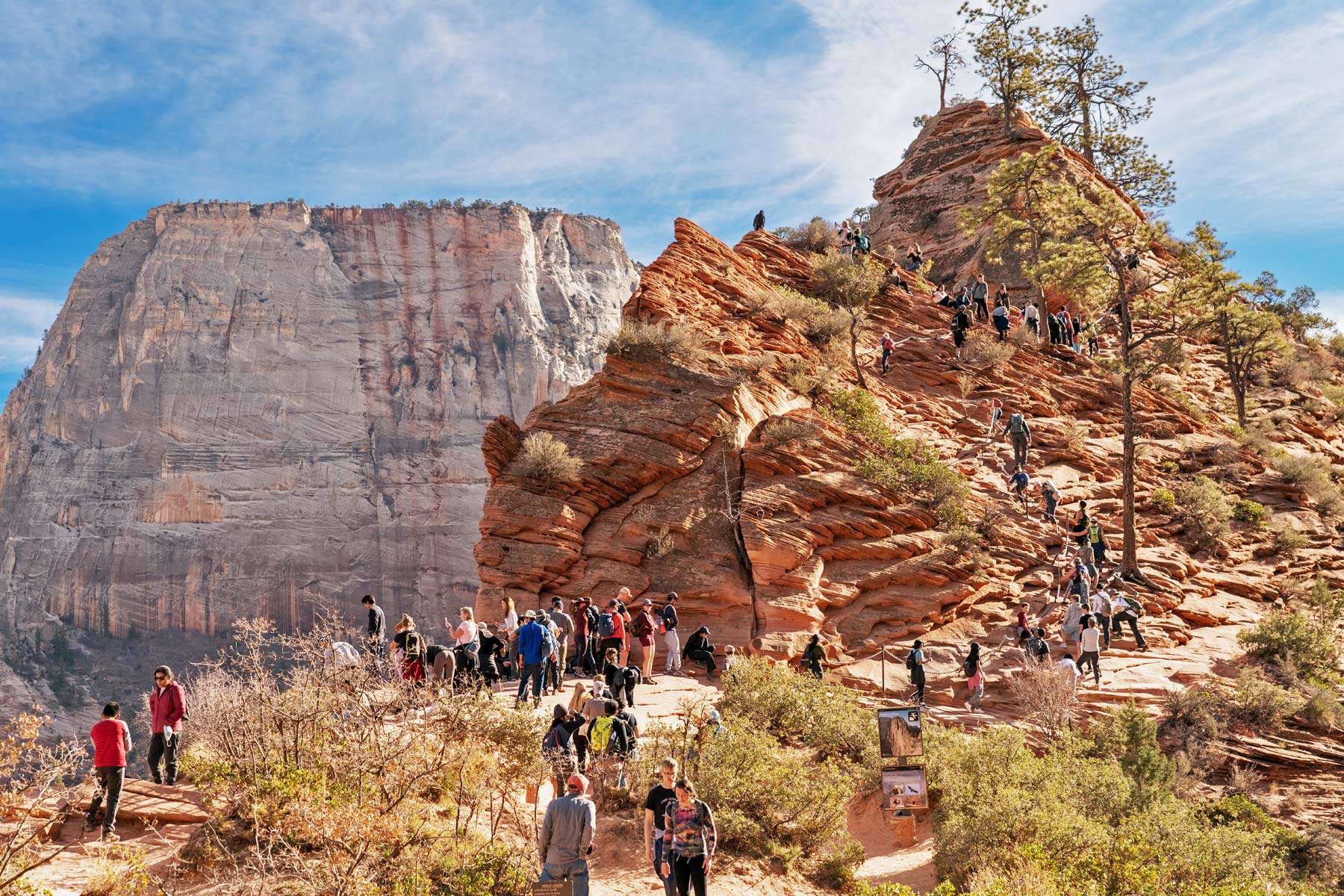
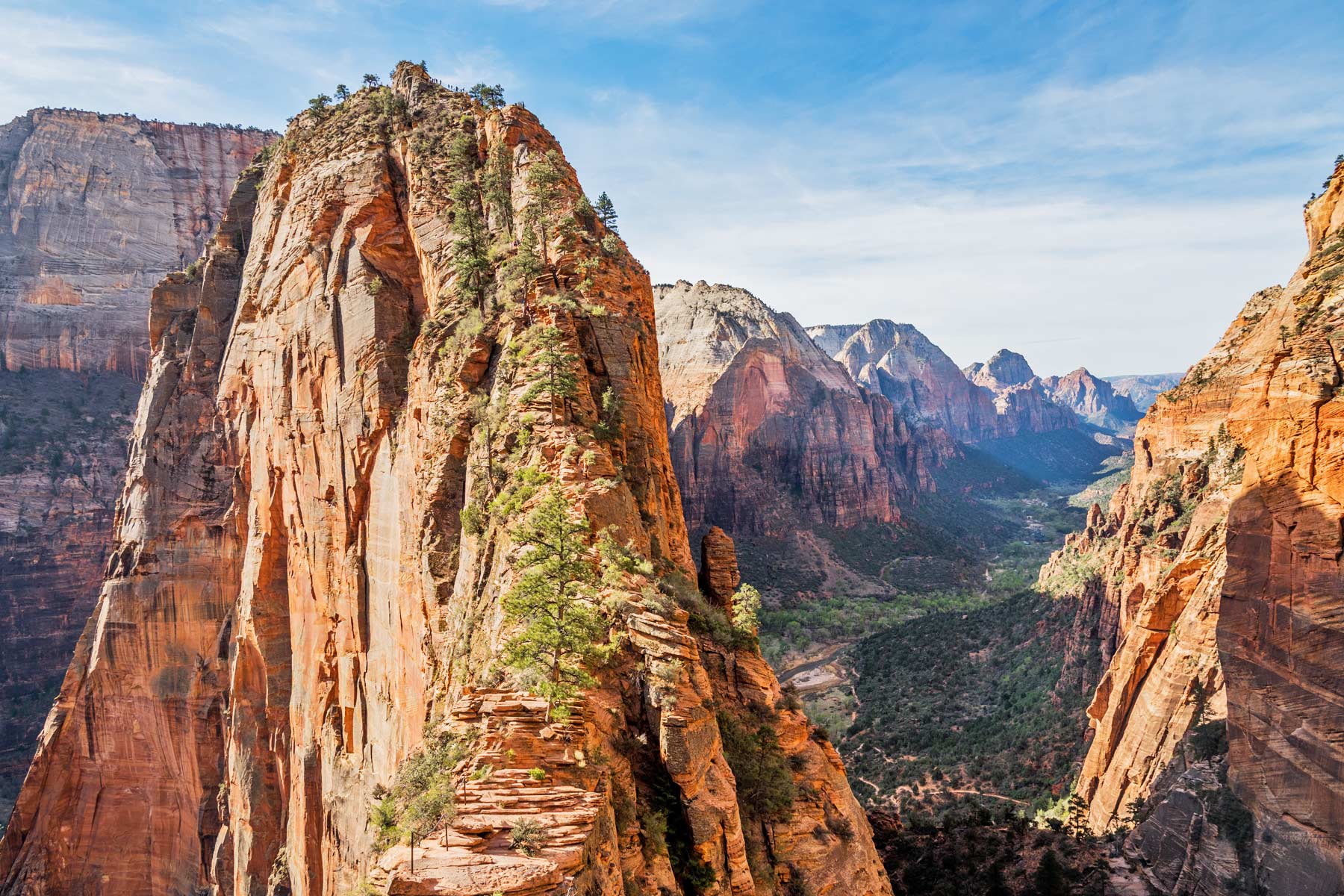
The final half mile follows the spine of the fin, with chains bolted into the rock and drops of roughly 1,000 feet on both sides. In places the walkway narrows to a few feet of sandstone. Scrambling is required. So is patience, because there will be a line, and uphill hikers have the right of way.
Bring gloves. The chain gets slick with sweat by mid-morning and hot enough to be unpleasant by afternoon. If storms are anywhere in the forecast, do not get on the fin. Wet sandstone and lightning have both killed people here.
The Summit
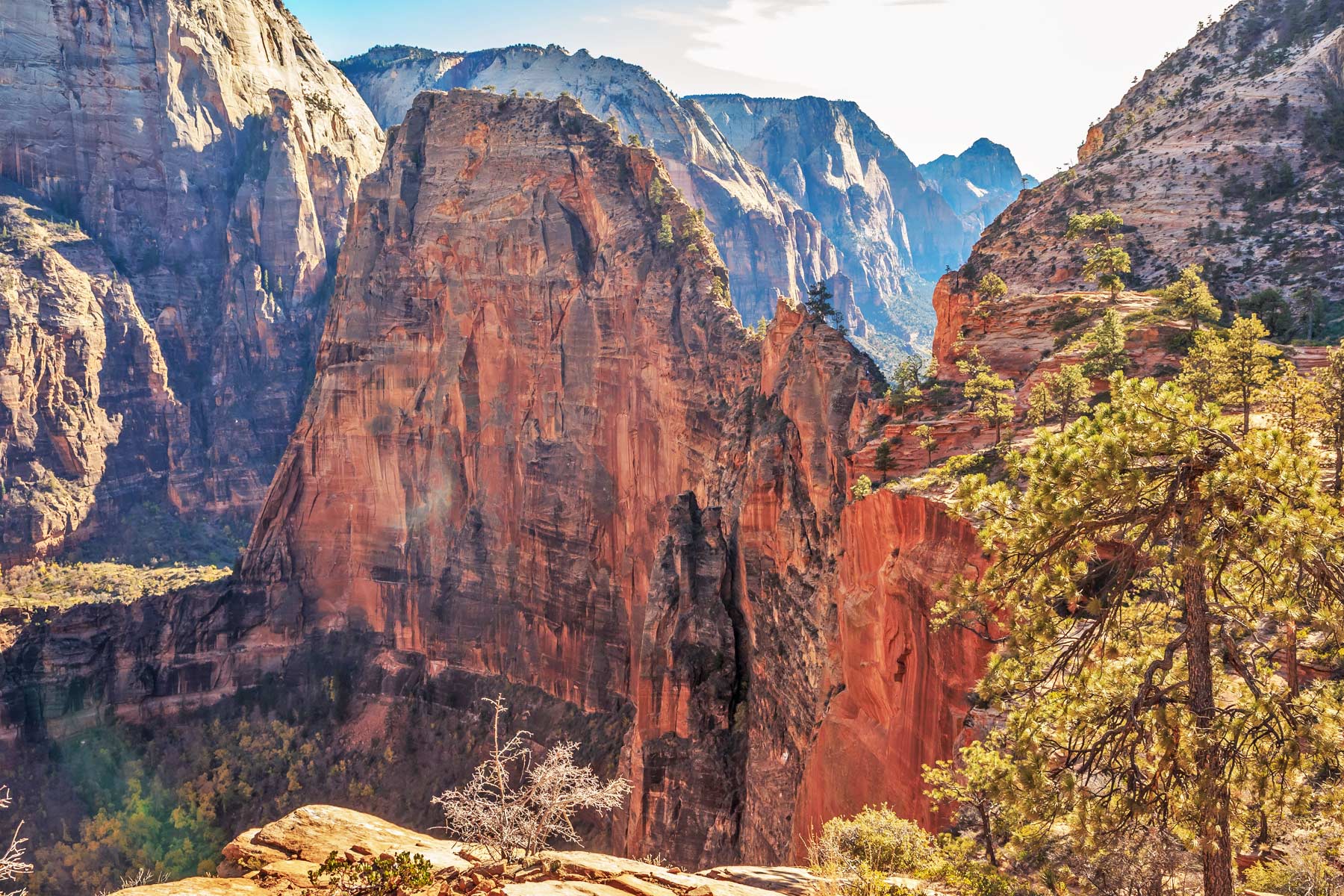
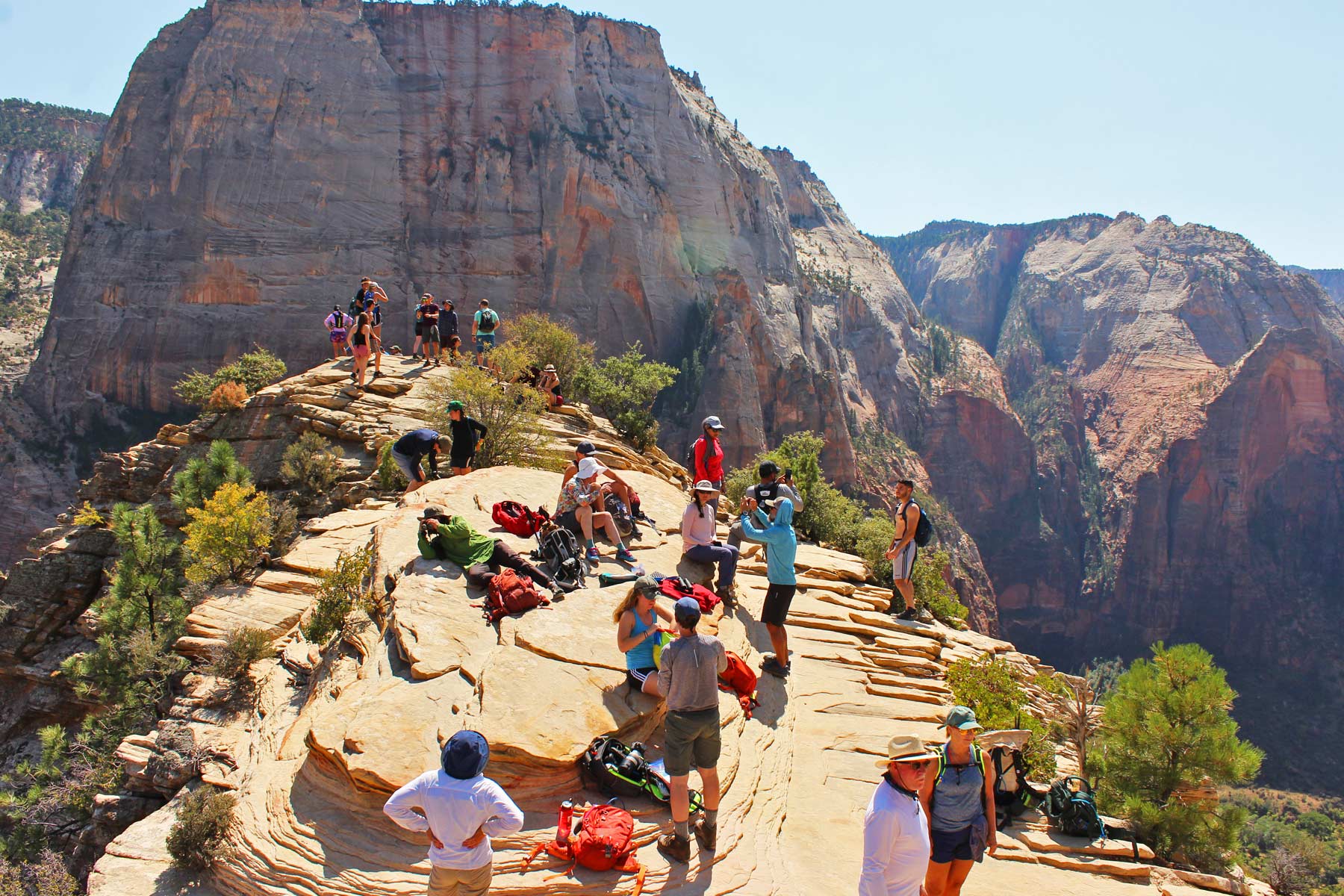
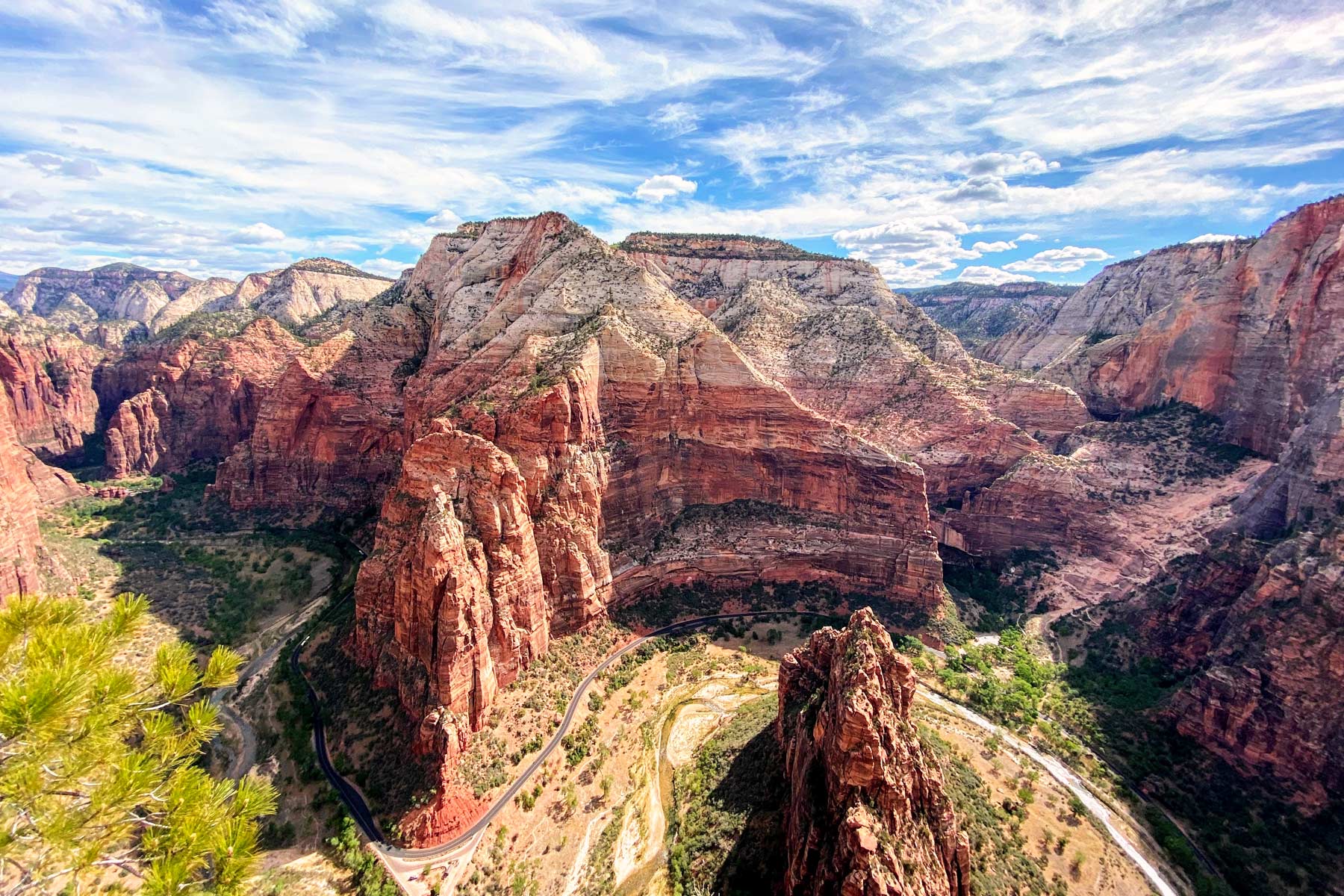
At the top, 1,488 feet above the canyon floor, there’s no fence, no barrier, and a 270-degree sweep of Zion Canyon that explains the entire phenomenon. Methodist minister Frederick Vining Fisher looked up at this formation in 1916 and declared only an angel could land on it. He was off by a few million hikers.
Save some focus for the descent. Going down the chains forces you to look at the exposure you ignored on the way up, and most accidents happen when legs are tired. The hike is not over at the summit. It’s half over.
When is the Best Time to Hike Angels Landing?
Fall. October gives you stable weather, bearable temperatures, and cottonwoods going gold along the Virgin River. Spring works too, though snow and ice can linger on the chains into March and runoff sometimes closes other marquee hikes like The Narrows.
Summer is the worst of both worlds. Temperatures regularly top 100°F, the exposed fin offers zero shade, and the crowds peak. If summer is your only window, take the first shuttle of the morning and be done by noon.
How Much Water Should You Bring?
A gallon per person in warm weather, plus electrolytes. There is no water source anywhere on the trail, and the only toilets past the trailhead are at Scout Lookout.
Do not drink from the Virgin River or its streams without proper filtration. Zion’s waterways carry cyanotoxin risks that can make you seriously ill.

Angels Landing vs Half Dome
The internet’s favorite question about these two hikes is “which one is scarier?” Wrong question. Here’s the honest comparison, and our standing advice on Yosemite’s version is the same as our advice here. Read our case for reconsidering Half Dome too.
| Details | Angels Landing | Half Dome |
| Length | 5.4 miles | 15 miles (approx.) |
| Starting Elevation | 4,300 feet | 4,000 feet |
| Peak Elevation | 5,790 feet | 8,839 feet |
| Round Trip Time | 4 to 5 hours | 10 to 12 hours |
| Permit | Lottery, year-round | Lottery, cables season |
Half Dome is the bigger physical test, three times the distance with a cable climb up bare granite at the end. Angels Landing is the bigger psychological test, a sidewalk-width spine with air on both sides. Both have claimed lives, 19 on Angels Landing and at least 25 on the Half Dome cables and summit. Neither is a casual outing, no matter what the person who “did it in tennis shoes” tells you.
Where is Zion National Park?
Southern Utah, about 40 miles off I-15 and an hour from St. George. Springdale sits at the park’s south entrance, and Bryce Canyon is under two hours away. Three deserts collide here, the Colorado Plateau, the Great Basin, and the Mojave, which is why the drive in on Utah Route 9 keeps changing colors on you.
Do not navigate to the Kolob Canyons Visitor Center for this hike. That’s the far side of a 229-square-mile park.

What Makes Zion So Special?
The geology. Zion started 240 million years ago as sediment filling a flat basin. Mineral-loaded water cemented the layers, uplift and the Virgin River carved them, and the result is a 2,000-foot-deep canyon painted in every shade of red, pink, and cream. Add 12,000 years of human history along the river and you have a place that earns the crowds, even when we wish it had fewer of them.

Angels Landing FAQs
We want to hear from you. Do you agree that the crowds have ruined Angels Landing, or do you think the permit system has fixed the problem? We get passionate responses on both sides of this debate, and we read every single one. Drop your take in the comments below.
Yes. The final half mile follows a narrow sandstone fin with drops of roughly 1,000 feet on both sides, and chains are the only protection. Natural hazards include high winds, winter ice, extreme heat, rockfall, and lightning. In summer 2022 the chain section closed over an anchor rock issue, and storm damage has closed Refrigerator Canyon before. The other hazard is human error. Dehydration, exhaustion, and showboating near the edges cause most of the close calls.
Yes. As of 2026, 19 people have died on Angels Landing and the trails leading to it, 17 of them in falls. In April 2026 a 68-year-old man became the first fatality since the permit system began in 2022. The sign at the trailhead bridge is not a scare tactic. Treat the chain section with the respect you would give a climbing route.
The Angels Landing Trail is 5.4 miles round trip. The distance is not the challenge. The 1,488 feet of elevation gain and the exposure on the final fin are.
Plan for four to five hours. Trail traffic adds real time, especially in the afternoon when the line for the chains backs up at Scout Lookout.
Yes, since April 2022. Permits are issued only through lotteries on Recreation.gov. Seasonal lotteries open quarterly, applications cost $6 for up to six people, and awarded permits cost $3 per person. A day-before lottery runs from 12:01 am to 3 pm Mountain Time. No permit is needed to hike as far as Scout Lookout.
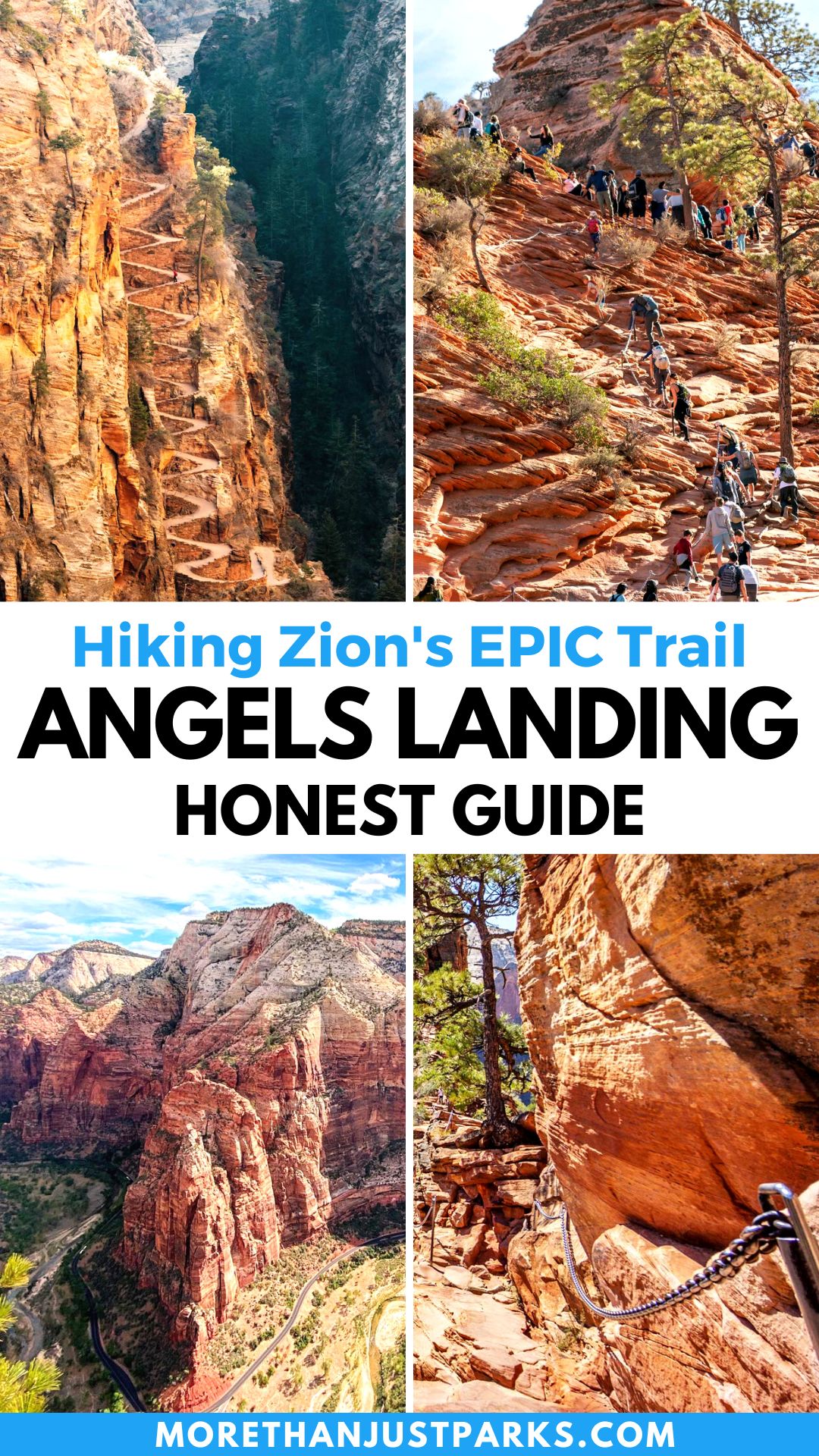
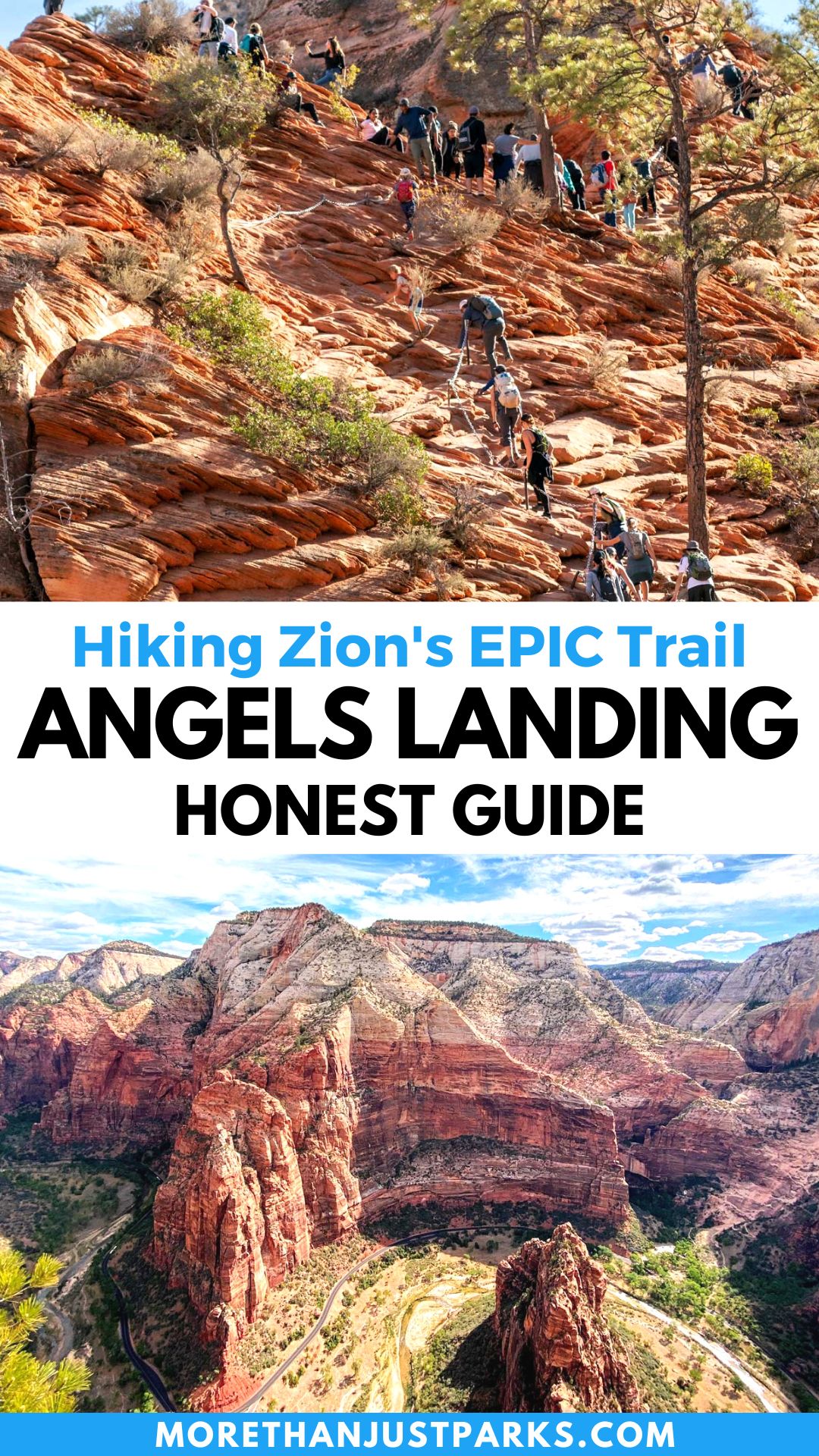
Pin the Angels Landing Hike
Helpful Related Articles
Plan your whole trip: Our complete guide to Zion National Park covers the shuttle, permits, fees, and where to stay in Springdale.
The other hike we steer people away from: Read why the Narrows takes real preparation, and our case for reconsidering Half Dome.
Nearby Utah parks: Things to Do in Canyonlands, Bryce Canyon, and Capitol Reef.
More planning: The most visited national parks and the least visited national parks if you want to dodge crowds entirely.
More Than Just Parks Film Watch our 8K film of Zion We spent weeks in Zion, one of our favorite public lands destinations, capturing it the way it deserves. Take a few minutes and see it for yourself.