


In 1913 Henry Ford put a moving assembly line into his plant outside Detroit and cut the time to build a Model T from twelve hours to about ninety minutes. The car became affordable, the country put itself on wheels, and Michigan has been bound up with motion ever since, from the auto plants to the Motown records cut in a small Detroit house to the Great Lakes freighters that still move ore.
I spent a career teaching history before joining my sons at More Than Just Parks, and Michigan, where industry and wilderness sit so close together, is a wonderful state to explore: two peninsulas wrapped in four of the five Great Lakes, with towering dunes, painted cliffs, and an island wilderness national park. These are the 20 Michigan landmarks I would send you to, counted down from number 20.
Michigan Landmarks At A Glance
Here is a quick comparison of all 20 landmarks before we dig into the stories behind each one.
| Landmark | Type | Region |
|---|---|---|
| Automotive Hall of Fame | Museum | Dearborn |
| Isle Royale National Park | National Park (NPS) | Lake Superior |
| Henry Ford Museum | Museum | Dearborn |
| Motown Museum | Music history museum | Detroit |
| Sleeping Bear Dunes National Lakeshore | National Lakeshore (NPS) | NW Lower Peninsula |
| Fort Mackinac | Historic fort | Mackinac Island |
| River Raisin National Battlefield Park | National Battlefield Park (NPS) | Monroe |
| Pictured Rocks National Lakeshore | National Lakeshore (NPS) | Upper Peninsula |
| Soo Locks | Navigation locks | Sault Ste. Marie |
| Tahquamenon Falls | State park waterfall | Upper Peninsula |
| Detroit Zoo | Zoo | Royal Oak |
| Shrine of the Pines | Folk-art museum | Baldwin |
| Norton Mound Group | Hopewell mounds (NHL) | Grand Rapids |
| Alden B. Dow Home & Studio | Historic house (NHL) | Midland |
| Mackinac Bridge | Suspension bridge | Straits of Mackinac |
| Windemere (Hemingway Cottage) | Historic cottage (NHL) | Walloon Lake |
| Detroit Institute of Arts | Art museum | Detroit |
| Bond Falls | Waterfall | Upper Peninsula |
| Air Zoo | Aerospace museum | Portage |
| Belle Isle Park | Island park | Detroit |
For more, see our guide to the national parks in Michigan and the best historic sites in Michigan.
117 public lands destinations are under threat. Get the free briefing that 27,000+ people use to stay informed and take action.

20. Belle Isle Park
Belle Isle is a 982-acre island park in the Detroit River, the largest city-island park in the country, designed in part by Frederick Law Olmsted of Central Park fame.

The island holds the James Scott Memorial Fountain, the oldest aquarium in the country, the Belle Isle Conservatory, a maritime museum, and a beach with skyline views of both Detroit and Windsor, Ontario. Once a private retreat, the city bought the island in 1879 and turned it into a public park. It is now managed as a Michigan state park, and it remains the green heart of Detroit’s riverfront.
19. Air Zoo Aerospace & Science Museum
The Air Zoo in Portage, near Kalamazoo, is a Smithsonian-affiliated aerospace museum where indoor amusement-park rides share the floor with rare aircraft and spacecraft.
Founded in 1979, the Air Zoo holds more than 100 aircraft, including a rare SR-71 Blackbird and a recovered World War II fighter pulled from the bottom of Lake Michigan and restored on site. Flight simulators and full-motion rides make it a hit with kids, while the restoration shop and historic planes draw aviation buffs. Its Smithsonian affiliation brings traveling exhibits to southwest Michigan.
18. Bond Falls
Bond Falls is one of the most beautiful waterfalls in the Upper Peninsula, a broad cascade where the Middle Branch of the Ontonagon River tumbles over a rocky ledge in a fan of white water.
The falls drop about 50 feet across a wide span, and a boardwalk and accessible viewing area make them easy to reach. Michigan is famous for its waterfalls, with hundreds scattered across the Upper Peninsula, and Bond Falls is widely considered one of the finest. It is a state scenic site, lovely in summer green and again when fall color frames the water.
17. Detroit Institute of Arts
The Detroit Institute of Arts holds one of the great art collections in the country, anchored by Diego Rivera’s monumental Detroit Industry Murals, a fresco cycle that celebrates the city’s auto workers.
Founded in 1885, the DIA holds more than 65,000 works spanning the world, from ancient Egypt to Van Gogh’s self-portrait, the first Van Gogh to enter a U.S. public collection. Rivera painted the Detroit Industry Murals in the early 1930s, and he considered them his finest work. During the city’s 2013 bankruptcy, a “grand bargain” of philanthropic and state money saved the collection from being sold, keeping the museum public.
16. Windemere (The Ernest Hemingway Cottage)
Windemere is the modest summer cottage on Walloon Lake, near Petoskey, where Ernest Hemingway spent the boyhood summers that shaped him as a writer. It is a National Historic Landmark.

Hemingway’s father, Dr. Clarence Hemingway, built the cottage in 1899, and young Ernest summered here until he was in his early twenties. The northern Michigan woods and waters fed his love of hunting and fishing and inspired his early Nick Adams stories, including “Big Two-Hearted River.” He and his first wife, Hadley, honeymooned nearby in 1921. Windemere was named a National Historic Landmark in 1968. It is still owned by Hemingway descendants and is not open for public tours, but its place in American letters is secure.
15. Mackinac Bridge
The Mackinac Bridge, “Mighty Mac,” spans the Straits of Mackinac to join Michigan’s two peninsulas. When it opened in 1957 it was the longest suspension bridge in the world between anchorages.
The bridge stretches about five miles between Mackinaw City and St. Ignace, carrying Interstate 75 high above the meeting point of Lakes Michigan and Huron. Engineer David B. Steinman designed it, and it ended generations of slow ferry crossings when it opened. Each Labor Day, the bridge hosts the Mackinac Bridge Walk, when thousands cross on foot. It remains an engineering landmark and the gateway to the Upper Peninsula.
14. Alden B. Dow Home & Studio
The Alden B. Dow Home and Studio in Midland is the masterwork of architect Alden B. Dow, who apprenticed with Frank Lloyd Wright and brought organic modernism home to Michigan. It is a National Historic Landmark.
Dow, son of the founder of Dow Chemical, designed the home and studio in 1934 and 1935 around a pond, with low copper-green rooflines and a famous “submarine” conference room whose windows sit at water level. He went on to design hundreds of buildings, mostly in Michigan, and served as the state’s first architect laureate. The home is open for guided tours and offers a rare, intact look at a single architect’s vision for living and working.
13. Norton Mound Group
The Norton Mound Group along the Grand River in Grand Rapids is one of the best-preserved Hopewell burial mound complexes in the western Great Lakes, built by Native peoples about 2,000 years ago. It is a National Historic Landmark.
The people known to archaeologists as the Hopewell were a far-reaching culture whose communities traded for materials across half the continent. The Norton group once held more than 40 mounds, of which around a dozen survive. Excavations have yielded grave offerings that reveal their long-distance trade and ceremonial life. The mounds are a sacred and fragile site, protected and not generally open for casual visitation, but their significance to Michigan’s deep human history is profound.
12. Shrine of the Pines
The Shrine of the Pines near Baldwin is a one-of-a-kind museum of rustic furniture, all handcrafted by a single man, Raymond Overholzer, from the stumps and roots of white pines left behind by Michigan’s logging boom.
Overholzer, a hunting and fishing guide, spent decades from the 1930s onward shaping tables, chairs, and a massive 700-pound table from single pine stumps, polished smooth without nails or glue. The lodge that holds his work sits on the Pere Marquette River. It is a quirky, deeply personal tribute to the great white pines that built Michigan and were nearly logged to extinction.
11. Detroit Zoo
The Detroit Zoo in Royal Oak was a pioneer of the cageless, naturalistic exhibit, letting animals roam in open habitats separated from visitors by moats rather than bars.
Opened in 1928, the zoo spans 125 acres and is home to animals from around the world. Its Polk Penguin Conservation Center is among the largest penguin facilities anywhere, and the Great Apes of Harambee and the Arctic Ring of Life are visitor favorites. The zoo is known for its conservation and animal-welfare work, including being one of the first to retire its elephants to a sanctuary.
10. Tahquamenon Falls
Tahquamenon Falls in the eastern Upper Peninsula is one of the largest waterfalls east of the Mississippi, its amber water, stained by cedar tannins, thundering over a 50-foot drop nearly 200 feet wide.
The Upper Falls is the showstopper, but the Lower Falls a few miles downstream offers a series of smaller cascades you can reach by a short rowboat trip to an island in the middle. The falls anchor Tahquamenon Falls State Park, one of the largest in Michigan, with miles of trails through old hemlock forest. Henry Wadsworth Longfellow set part of “The Song of Hiawatha” along this river.
9. Soo Locks
The Soo Locks at Sault Ste. Marie lift and lower ships 21 feet between Lake Superior and the lower Great Lakes, bypassing the rapids of the St. Marys River. They are among the busiest locks in the world by tonnage.
The first lock opened here in 1855, opening Lake Superior’s vast iron and copper country to the rest of the nation and helping fuel American industry. The U.S. Army Corps of Engineers operates the locks today, and giant lake freighters more than 1,000 feet long pass through. A free visitor center and viewing platform let you watch the great ships rise and fall just feet away.
8. Pictured Rocks National Lakeshore
Pictured Rocks National Lakeshore runs for more than 40 miles along Lake Superior, named for the mineral-stained sandstone cliffs that glow in bands of red, orange, and green above the deep blue water.

Established in 1966 as the first national lakeshore in the country, Pictured Rocks protects cliffs that rise up to 200 feet, along with waterfalls, dunes, beaches, and forest. The best views of the painted cliffs come from the water, by boat tour or kayak, while overland the lakeshore offers miles of the North Country Trail and overlooks like Miners Castle. It is managed by the National Park Service.
7. River Raisin National Battlefield Park
River Raisin National Battlefield Park in Monroe preserves the ground of the January 1813 Battle of Frenchtown and the events afterward, the deadliest single engagement for Americans in the War of 1812.
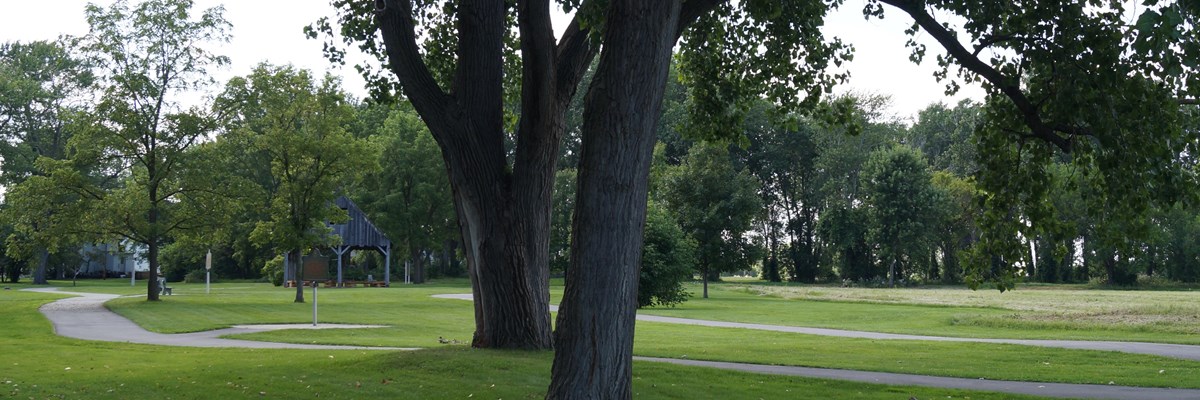
A force of Kentucky militia and U.S. soldiers was defeated here by British troops and their Native American allies, and in the aftermath dozens of wounded American prisoners were killed, an event that became known as the River Raisin Massacre. “Remember the Raisin” became a rallying cry for the rest of the war. The site interprets the battle with care for all who fought, including the Native nations defending their homelands. Congress made it a unit of the National Park Service in 2009, and it became a National Battlefield Park, one of only a handful in the system.
6. Fort Mackinac
Fort Mackinac looks down on the harbor from the bluffs of car-free Mackinac Island, a limestone-and-wood fort that the British built during the American Revolution and that changed hands in the War of 1812.
The British built the fort in the late 1770s, and American forces took it after the Revolution. In July 1812 the British seized it in the first U.S. land engagement of the War of 1812, and an American attempt to retake it in 1814 failed. The fort sits within Mackinac Island State Park, on land that was briefly the second national park in the country before being handed to Michigan in 1895. Today costumed interpreters fire cannons and muskets, and the island around it stays gloriously free of cars.
Top 5 Michigan Landmarks
5. Sleeping Bear Dunes National Lakeshore
Sleeping Bear Dunes National Lakeshore on the northwest Lower Peninsula protects towering sand dunes that rise as much as 450 feet above Lake Michigan, a landscape so striking it was once voted the most beautiful place in America.

Established in 1970, the lakeshore takes its name from an Ojibwe legend of a mother bear who swam Lake Michigan ahead of her cubs. The Pierce Stocking Scenic Drive, the thigh-burning Dune Climb, and the Empire Bluff Trail give visitors the big views, while the offshore Manitou Islands offer wilderness camping and historic lighthouses. The lakeshore appears on the back of the Michigan quarter. It is run by the National Park Service.
4. Motown Museum
The Motown Museum, “Hitsville U.S.A.,” is the little Detroit house where Berry Gordy launched Motown Records and changed the sound of American music. Inside is the original Studio A, where the Supremes, Stevie Wonder, Marvin Gaye, and the Temptations recorded their hits.
Gordy founded the label in 1959 with an $800 loan from his family and built it in this house on West Grand Boulevard, where a hand-painted sign declared it Hitsville U.S.A. The “Motown Sound” he created crossed racial lines on the pop charts at the height of the civil rights era. The museum opened in 1985, and visitors can stand in Studio A, where so many classics were cut, and see Michael Jackson’s glove among the artifacts. A major expansion is extending the campus around the original house.
3. Henry Ford Museum of American Innovation
The Henry Ford Museum in Dearborn is one of the great history museums in the country, a vast hall of American innovation that holds objects most museums could only dream of: the bus where Rosa Parks refused to give up her seat, the chair Lincoln was sitting in when he was shot, and the limousine in which President Kennedy was assassinated.
Henry Ford opened the museum in 1929 to preserve the tools, machines, and everyday objects of American life. It anchors a larger complex that includes Greenfield Village, an outdoor museum of relocated historic buildings, among them Thomas Edison’s Menlo Park laboratory and the Wright brothers’ bicycle shop. The collections trace the country’s industrial story, with a special focus on the automobile that Ford himself put within reach of ordinary Americans.
2. Isle Royale National Park
Isle Royale is a remote wilderness island in Lake Superior, the least-visited national park in the contiguous United States and one of the wildest. Reaching it takes a ferry or seaplane, and there are no roads or cars once you arrive. See our guide to Isle Royale National Park facts.

Established as a national park in 1940, Isle Royale spans more than 570,000 acres of land and surrounding water, a roadless backcountry of forest, inland lakes, and rocky shore. It is the site of the longest-running predator-prey study in the world, tracking its famous wolves and moose for more than six decades. The park closes entirely each winter, the only U.S. national park to do so. Backpackers, paddlers, and divers exploring its shipwrecks have it almost to themselves.
1. Automotive Hall of Fame
Our number one Michigan landmark is the Automotive Hall of Fame in Dearborn, the industry’s shrine in the city where the modern auto business was born. It honors the people who built the cars, and the company, that reshaped the world.
Founded in 1939, the Automotive Hall of Fame honors innovators from around the world, from Henry Ford and the Dodge brothers to engineers and designers whose names most people never learned. Its inductees span more than a century of automotive history. The hall sits beside the Henry Ford complex in Dearborn, making the area a natural pilgrimage for anyone who loves cars or wants to understand how the automobile remade American life. Interactive exhibits trace the people and ideas behind the machines.
The Full Ranking
- Automotive Hall of Fame
- Isle Royale National Park
- Henry Ford Museum of American Innovation
- Motown Museum
- Sleeping Bear Dunes National Lakeshore
- Fort Mackinac
- River Raisin National Battlefield Park
- Pictured Rocks National Lakeshore
- Soo Locks
- Tahquamenon Falls
- Detroit Zoo
- Shrine of the Pines
- Norton Mound Group
- Alden B. Dow Home & Studio
- Mackinac Bridge
- Windemere (The Ernest Hemingway Cottage)
- Detroit Institute of Arts
- Bond Falls
- Air Zoo Aerospace & Science Museum
- Belle Isle Park
You should know that this guide does not come out of thin air. More Than Just Parks is a family operation. My sons Will and Jim have spent their adult lives exploring America’s national parks and public lands destinations, working with the National Park Service, the Department of the Interior, the USDA, and the U.S. Forest Service along the way. In 2018, after a career teaching history, I joined them to help tell the stories behind these places.
Helpful Related Articles
Michigan National Parks: National Parks in Michigan
Historic Sites in Michigan: The Best Historic Sites in Michigan
Isle Royale Facts: Isle Royale National Park Facts


