


From 1983 to 2018, Kilauea erupted almost without pause for 35 years, one of the longest eruptions in recorded history. It shares a single national park with Mauna Loa, the largest active volcano on the planet. Nowhere else in America can you stand on ground that did not exist when you were born and watch the island that made it still under construction.
What follows are 12 verified facts about Hawaii Volcanoes National Park, its two restless volcanoes, and the people who have lived with them for centuries. For trip planning, start with our full Hawaii Volcanoes National Park guide.
Tony Pattiz taught American history for more than 25 years before he began writing it for this site. Will and Jim spent weeks on the Big Island filming our Hawaii Volcanoes film, and some of the places they shot have since been reshaped by eruptions. Every date, number, and name below has been checked against the National Park Service, the U.S. Geological Survey, and the primary sources listed at the end of this article. Last verified July 2026.
Hawaii Volcanoes National Park Basics
- Location: The southeastern side of the Island of Hawaii, the Big Island
- Size: 354,461 acres, including 123,100 acres of designated wilderness, per the NPS park fact sheet
- Established: August 1, 1916, as Hawaii National Park, the 15th park in the system; split and renamed Hawaii Volcanoes National Park in 1961
- Visitation: 1,877,854 recreation visits in 2025, per NPS Stats
- Elevation: Sea level to 13,681 feet at the summit of Mauna Loa
- Designations: International Biosphere Reserve (1980) and UNESCO World Heritage Site (1987)
1. Kilauea Is One Of The Most Active Volcanoes On Earth
The heart of this park is a volcano that rarely rests. The U.S. Geological Survey calls Kilauea one of the world’s most active volcanoes, and its recent record backs that up. From 1983 to 2018 it erupted almost continuously along its East Rift Zone, and since December 2020 a series of eruptions has been refilling the collapsed summit crater at Halemaumau, which Hawaiian tradition holds as the home of Pele, the volcano deity.
Love Hawaii Volcanoes? It's one of 117 threatened public lands destinations we're tracking. Get the free briefing.
Why here? The Hawaiian Islands sit over a hot spot in the Earth’s mantle. As the Pacific plate drifts across it, the hot spot builds islands one eruption at a time. The Big Island is the youngest in the chain, and Kilauea is its newest and busiest builder. Eruption activity starts and stops on its own schedule, so check current conditions before any visit.

2. Mauna Loa Is The Largest Active Volcano On The Planet
The park’s other giant earns its name, which means “long mountain” in Hawaiian. Mauna Loa is the largest active volcano on Earth. It covers half of the Big Island, and by itself it amounts to about 85 percent of the area of all the other Hawaiian Islands combined.
Its summit stands 13,681 feet above the sea, but that is the smallest way to measure it. The volcano’s flanks run another three miles down to the seafloor, and the mountain is so heavy that the seafloor itself sags roughly five miles beneath its mass. Measured from that depressed base, USGS puts the summit about 55,700 feet up, nearly twice the height of Everest above sea level.
After 38 quiet years, Mauna Loa reminded everyone it was only resting. On November 27, 2022, lava broke the surface in its summit caldera for the first time since 1984, then the eruption shifted to the Northeast Rift Zone, sending flows within 1.7 miles of the Daniel K. Inouye Highway before it ended on December 10.

3. Polynesian Voyagers Crossed 2,400 Miles Of Open Ocean To Settle Hawaii
The human story here is as remarkable as the geology. According to the National Park Service, Polynesians from the Marquesas Islands reached Hawaii more than 1,600 years ago, crossing some 2,400 miles of open Pacific in great double hulled canoes. They navigated by the sun and stars and read the winds, the currents, and the flight of seabirds to find the most geographically isolated island chain on Earth.
They were long established when a second wave of Polynesian voyagers arrived from the Society Islands about 800 years ago. To Native Hawaiians, the volcanic summits of this park are sacred ground, the chosen home of Pele. That relationship between people and volcano is not a museum exhibit. It continues today, and it is part of what the park was created to protect.
4. Buffalo Soldiers Built The 1915 Trail To The Summit Of Mauna Loa
Here is a piece of history many visitors miss. After the Civil War, Congress created all Black Army regiments whose troops became known as the Buffalo Soldiers. The 25th Infantry arrived in Honolulu on January 14, 1913, and marched to Schofield Barracks, where the National Park Service notes they found far less of the racial hatred they faced on the mainland.
Their mark on this park is literal. Between October 18 and November 25 of 1915, Company E of the 25th Infantry built a 30 mile trail connecting Kilauea to the summit of Mauna Loa, working with 12 pound hammers and gunny sacks at the request of Thomas Jaggar, founder of the Hawaiian Volcano Observatory, so scientists could reach eruptions at the top.
The soldiers became local favorites off duty too. Their baseball team, the Wreckers, made the Honolulu papers, and one player, Wilber “Bullet” Rogan, went on to the Baseball Hall of Fame.
5. Mark Twain Reported From An Erupting Kilauea In 1866
Fifty years before the park existed, one of America’s greatest writers rode up to the rim of an erupting Kilauea. In 1866, Mark Twain covered the islands as a correspondent for the Sacramento Daily Union, and his dispatches were later collected as Letters from Hawaii.
The volcano gave him plenty of material. The lava lake, he wrote, made “a rushing, a hissing, and a coughing or puffing sound,” like a steamboat working a river. Watching the fire pit from the rim, he reported that “the place looked a little larger and a little deeper every five minutes, by the watch.” And then there is the line every ranger still quotes.
The smell of sulfur is strong, but not unpleasant to a sinner.
Mark Twain, Letters from Hawaii, 1866
6. A Hotel Has Stood At The Edge Of Kilauea Since 1846
The inn Twain slept in has deep roots. Benjamin Pitman built the first shelter on the rim in 1846, a thatched structure with a dirt floor that charged a dollar a head per night, food extra. A thatched inn followed in 1866, and in 1877 a carpenter named William Lentz raised the first permanent western style Volcano House from native timber and imported redwood shingles.
The hotel’s later history reads like a novel. George Lycurgus bought it for 300 dollars at a sheriff’s auction in 1932 and ran it through decades of celebrities and presidents. A kitchen fire destroyed the building on February 7, 1940, and its replacement, designed by architect Charles W. Dickey, reopened on November 8, 1941. It still perches on the caldera’s edge today, which may make it the only hotel in America with a front porch over an active volcano.

7. Five Volcanoes Built The Big Island
Kilauea and Mauna Loa get the headlines, but the whole island is the work of five volcanoes. From oldest to youngest they are Kohala, Mauna Kea, Hualalai, Mauna Loa, and Kilauea.
Each is at a different stage of life. Kohala, the oldest, last erupted about 120,000 years ago and is considered extinct. Mauna Kea, the island’s tallest peak and a sacred summit in its own right, last erupted about 4,500 years ago and is expected to erupt again someday. Hualalai last erupted in 1801 and looms over Kailua-Kona. The two youngest, both protected in this park, do most of the island’s ongoing construction.
8. UNESCO Named It A World Heritage Site In 1987
The world has formally recognized what Hawaiians have always known. In 1987, UNESCO inscribed Hawaii Volcanoes as a World Heritage Site, citing the park as an outstanding example of island building through volcanic processes. Seven years earlier, in 1980, it had been designated an International Biosphere Reserve.
The designations capped a long protective history. Congress created Hawaii National Park on August 1, 1916, taking in Kilauea and Mauna Loa on the Big Island along with Haleakala on Maui. In 1961 the two island units were separated, and the Big Island half took its modern name. The Maui half became its own park, whose story we tell in our Haleakala National Park facts article.

9. Puuloa Holds More Than 23,000 Petroglyphs
Along the park’s coastal lava fields lies Puuloa, the largest petroglyph field in Hawaii, with more than 23,000 images carved into flows that hardened between AD 1200 and 1450. The name translates as “long hill,” with a hidden meaning of “hill of long life.”
Most of the carvings are poho, small cup shaped holes. For more than 500 years, Native Hawaiian families have placed the piko, a newborn’s umbilical cord stub, into these holes as a prayer that the child would live a long life rooted to the land. A roughly 1.5 mile round trip trail crosses the old pahoehoe lava to a boardwalk above the carvings. Stay on the boardwalk. This is sacred ground, and families still come here.

10. Two Scenic Drives Reach Most Of The Park’s Highlights
You do not have to be a hardcore hiker to take this park in. Crater Rim Drive circles part of the Kilauea summit, stringing together the visitor center, the steam vents, the Sulphur Banks, and the crater overlooks.
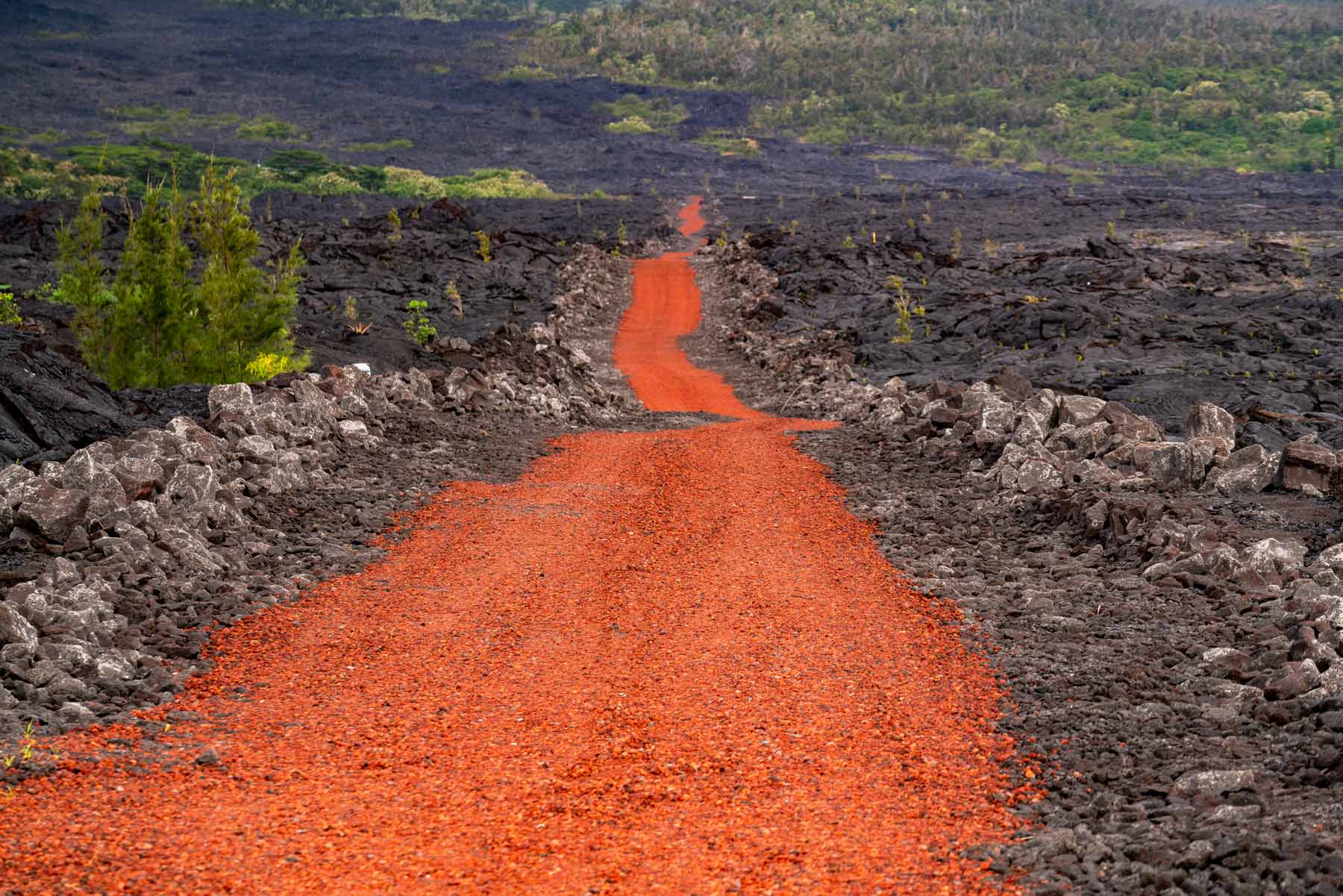
The second drive is the one people remember. Chain of Craters Road runs 18.8 miles from the summit area down to the sea, past a procession of old craters, decades of hardened lava flows, and the Puuloa petroglyph trailhead, ending where lava has repeatedly buried the road beyond. For a ranked list of stops on both drives, see our guide to the best things to do in Hawaii Volcanoes National Park.
11. You Can Walk Through A 500 Year Old Lava Tube
One of the park’s most popular stops is Nahuku, long known as the Thurston Lava Tube, near the Kilauea summit. A lava tube forms when the surface of a flow cools and hardens while molten rock keeps draining through underneath, leaving a hollow tunnel behind. Through this one, about 500 years ago, ran a river of lava at some 2,000 degrees Fahrenheit.
USGS surveyors came across the tube in 1912, and newspaper publisher Lorrin Thurston publicized it so energetically that his name stuck for a century. The Hawaiian name Nahuku, “the protuberances,” refers to the lava drippings that once hung from its ceiling, most of them long since carried off by early souvenir hunters. Today the Park Service asks visitors not to touch the roots that reach through the ceiling, because entire ecosystems of small creatures live in these fragile dark environments.

12. Kilauea Keeps Adding New Land To The Island
Most national parks protect a landscape that already exists. This one protects a landscape that is still being made, and the numbers from a single recent eruption show what that means.
In four months in 2018, the lower East Rift Zone eruption of Kilauea covered more than 700 structures and 30 miles of road, partially drained the summit magma reservoir, collapsing much of the caldera floor at Halemaumau, and added 875 acres of brand new land to the Island of Hawaii where lava poured into the sea. The eruption that had run since 1983 ended, and a new chapter of summit activity began in the collapsed crater in December 2020.
That is the essential fact of Hawaii Volcanoes National Park. The map is a draft. Roads, overlooks, and whole coastlines here are written in pencil, and the volcano holds the eraser.

What It Feels Like At The Rim
Facts only carry you so far. We spent weeks filming on the Big Island, and the moment that stays with us is arriving at the caldera after dark and seeing red glow hanging in the air above the crater, volcanic light thrown up against the clouds like a second sunset that refuses to end. In the daytime the park keeps switching worlds on you. One minute you are in dripping rain forest at the mouth of a lava tube, ferns brushing your shoulders, and ten minutes later you are on a plain of bare black rock with nothing alive in sight and the wind smelling faintly of sulfur.
Some of the places we filmed have since been reshaped or erased by eruptions. That is not a reason to stay away. It is the reason to go.
Our Hawaii Volcanoes Film
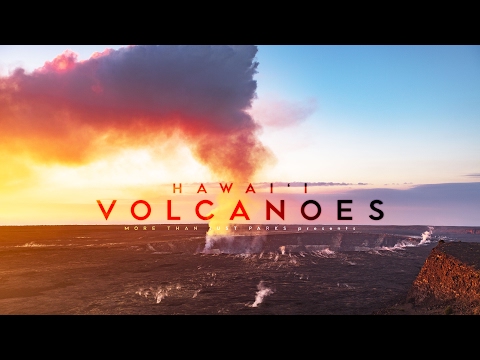
This film came out of those weeks on the Big Island filming one of the most active volcanoes on Earth. We caught the park before some of the bigger eruptions reshaped the landscape, so a few of these shots are now a record of places that have changed. Watch for the lava.
Where These Facts Come From
Every claim in this article was checked against the sources below in July 2026. Numbers that change over time, like annual visitation and eruption activity, are stated with the year they were reported. For what the volcanoes are doing right now, rely on the USGS Hawaiian Volcano Observatory and the park’s alerts, not on any article’s snapshot.
- NPS, Hawaii Volcanoes National Park Fact Sheet, for acreage, wilderness, establishment, elevation, and designation years
- NPS Stats, official visitor use data, for 2025 visitation
- USGS, Kilauea, with the USGS Puu Oo eruption history and the NPS Kilauea geology page, for Kilauea’s activity history, the 1983 to 2018 eruption, summit eruptions since December 2020, and Halemaumau as the traditional home of Pele
- USGS, Mauna Loa and the USGS 2022 eruption chronology, for Mauna Loa’s size figures and the November 27 to December 10, 2022 eruption
- USGS, 2018 Lower East Rift Zone Eruption and Summit Collapse, for structures covered and new land created in 2018
- USGS, Geology and History of Mauna Kea, for the five volcanoes and their eruption histories
- NPS, Exploration, Seafaring and Navigation in Hawaii, with the NPS Native Hawaiian Heritage and Culture and Hawaii Volcanoes nature overviews, for Polynesian voyaging and settlement, the second migration from the Society Islands, and the archipelago’s isolation
- NPS, Buffalo Soldiers at Hawaii Volcanoes, for the 25th Infantry, the 1915 Mauna Loa trail, and the Wreckers
- NPS, Mark Twain at Kilauea, for the 1866 visit and quotations
- NPS, Volcano House, for the hotel’s history and dates
- NPS, Puuloa Petroglyphs and the NPS Puuloa history page, for the petroglyph count, lava dating, and piko tradition
- UNESCO World Heritage Centre, Hawaii Volcanoes National Park, for the 1987 inscription
Keep Exploring Hawaii Volcanoes
- Hawaii Volcanoes National Park Guide, our full trip planning hub
- Best Things To Do In Hawaii Volcanoes National Park
- Hawaii National Parks Worth Visiting
- Haleakala National Park Facts, the other half of the original 1916 park
- All 63 US National Parks Ranked
- Before you go, check live eruption alerts and air quality on our national park conditions dashboard
What to Bring to Hawaii Volcanoes
Gear we recommend for Hawaii Volcanoes. Affiliate links support our work at no cost to you.
More Than Just Parks may earn a small commission from purchases made through these links, at no extra cost to you. We only recommend gear we would actually use.
Affiliate disclosure: Some links on this page earn us a small commission at no extra cost to you. We only recommend gear we actually use.
More Than Just Parks Film Watch our 8K film of Hawaii Volcanoes We spent weeks in Hawaii Volcanoes, one of our favorite public lands destinations, capturing it the way it deserves. Take a few minutes and see it for yourself.


