

Katmai National Park in Alaska protects the largest run of sockeye salmon left on Earth, and the brown bears that gather to eat it. Every October, those bears become the stars of Fat Bear Week, a single-elimination bracket run by the park and Explore.org that draws millions of online votes. This guide covers how the event works, how to watch it live, and the biology behind why these bears get so enormous.
Some links below are affiliate links. If you book lodging or buy a recommended guidebook through them, we may earn a small commission at no extra cost to you.
What Is Fat Bear Week?
Fat Bear Week tracks the brown bears of Katmai as they fatten up through a short Alaskan summer of salmon for the long winter ahead. Cameras placed around Brooks Falls and the Brooks River let anyone watch the bears bulk up in real time.
Katmai rangers and the team at Explore.org run the event together. Alongside the live cameras and online chat, a single-elimination tournament each October lets the public vote for the year’s chunkiest bear. The matchups pit before-and-after photos against each other, and viewers pick which transformation wins.
Love Katmai? It's one of 109 threatened public lands destinations we're tracking. Get the free weekly briefing.
Fat Bear Week usually lands in the first or second week of October. You can follow the bracket on the official Fat Bear Week page. What follows is the background that makes voting more fun, from how the bears are identified to how they fish.
Teacher’s Pet: Get your classroom involved in Fat Bear Week with these NPS resources.
The Bears of Fat Bear Week
The bears of Katmai were studied long before social media made them famous. Park biologists have tracked many of them for years, which is how the public knows the personalities behind the numbers.
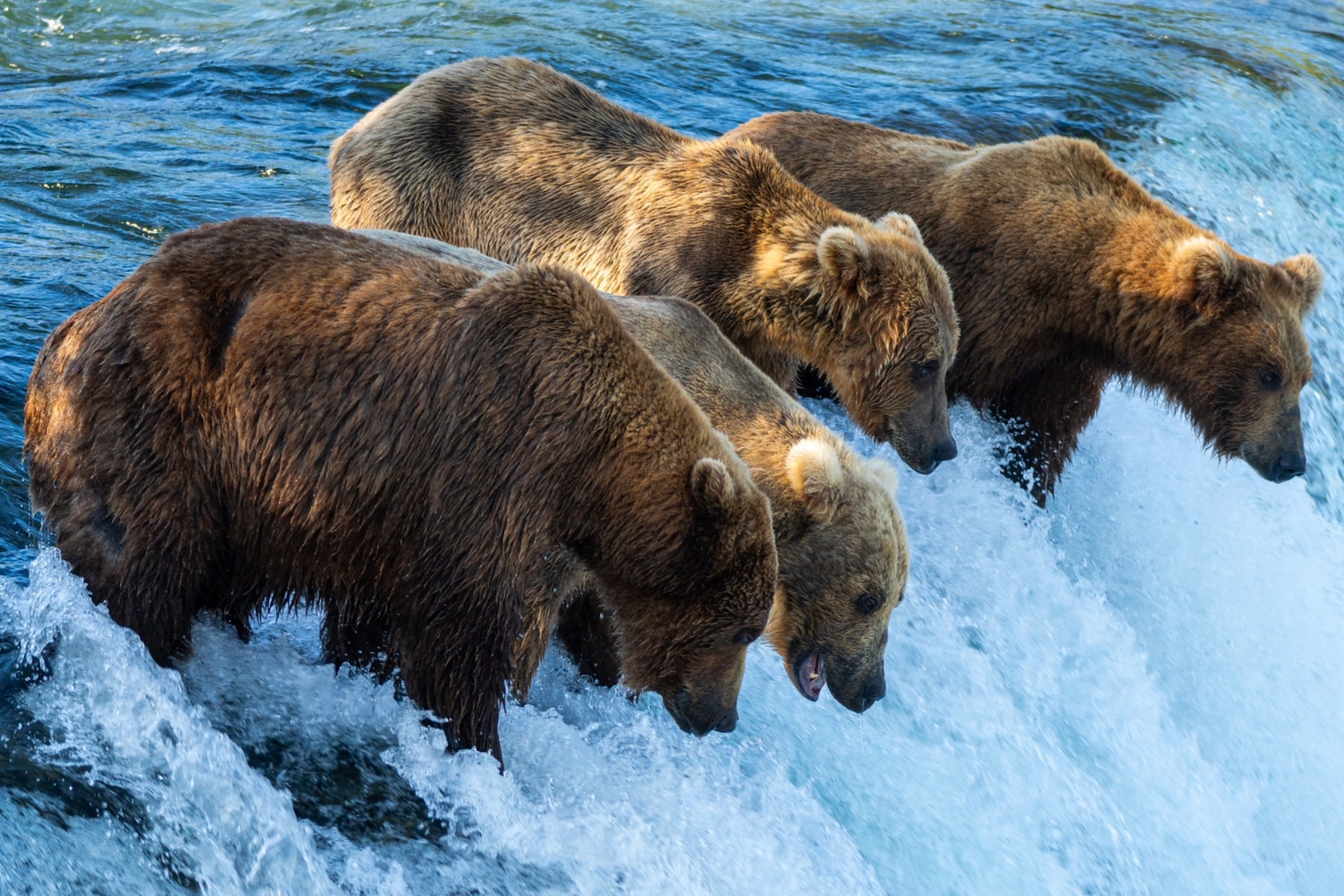
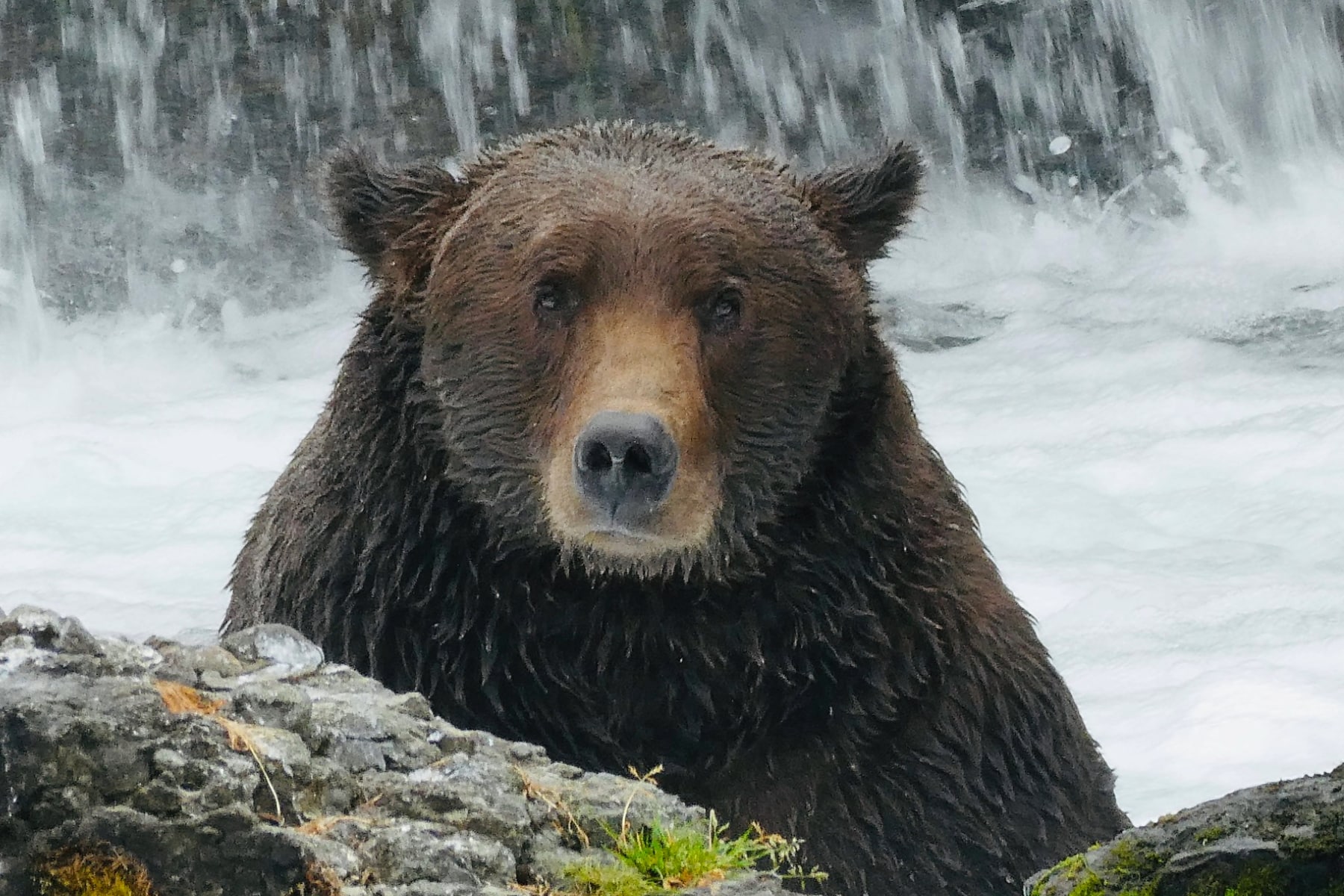
Only brown bears live here, aside from a lone black bear spotted years ago. The brown bears that gather along the coastal salmon streams of Alaska, including Katmai, are often called coastal brown bears. They are the same species as the grizzly, just much heavier thanks to a diet built on protein-rich salmon.
FAT BEAR FACT: A large male Katmai bear can top 1,000 pounds in the fall. Interior grizzlies, like those in Yellowstone, rarely come close, averaging roughly 300 to 700 pounds because their diet has far less salmon.
Types of Bears in North America

North America is home to three bear species: the American black bear, the brown bear (which includes grizzlies and coastal browns), and the polar bear. The old hiking rhyme, “If it’s black, fight back. If it’s brown, lie down. If it’s white, goodnight,” is a rough memory aid, not a survival plan. Here is where the Katmai bears fit.
American Black Bear
Average Weight: 90 to 600 pounds (males larger than females)
Location: Found across North America, including Great Smoky Mountains, the Appalachians, and much of the western U.S.
The black bear is the smallest of the three. Not all black bears are black. They range from black to brown to cinnamon, and a few are even blond or near-white. Black bears lack the prominent shoulder hump and have a straighter facial profile than brown bears.
Grizzly Bear
Average Weight: 300 to 700 pounds (inland populations)
Location: Yellowstone, Glacier, and much of interior Alaska and western Canada.
Grizzlies are brown bears that live inland, away from the big salmon runs. Look for the distinct shoulder hump (a mass of muscle that powers their digging) and a dished facial profile. The hump and the long front claws are the easiest field marks separating a grizzly from a black bear.
Coastal Brown Bear (Katmai Bear)
Average Weight: 600 to 900 pounds, with large fall males topping 1,000 pounds
Location: Coastal Alaska, including Katmai National Park and Preserve.
Coastal brown bears are the same species as grizzlies, but their access to salmon lets them grow far heavier. These are the Fat Bear Week bears. Their size, more than anything else, is what sets them apart from the inland grizzly.
Polar Bear
Average Weight: 900 to 1,600 pounds (males)
Location: Arctic regions, including northern Alaska and Canada, primarily on sea ice.
Even the biggest Katmai bears are matched by polar bears, the largest land carnivore on Earth. Polar bears have black skin to absorb heat and translucent fur that appears white for camouflage on the ice.
Where can I see a polar bear?: Not at Katmai. In the National Park System, polar bears turn up at Bering Land Bridge National Preserve and Cape Krusenstern National Monument.
How the Teddy Bear Was Born
President Theodore Roosevelt shaped the early conservation movement during his time in office from 1901 to 1909, setting aside millions of acres of forests, parks, and monuments. He also lent his name, by accident, to one of the most popular toys in the world.
On a 1902 bear hunt in Mississippi, Roosevelt’s attendants tied an exhausted black bear to a tree so the president could shoot it. He refused, calling it unsportsmanlike. The episode became a famous Washington Post cartoon by Clifford Berryman.
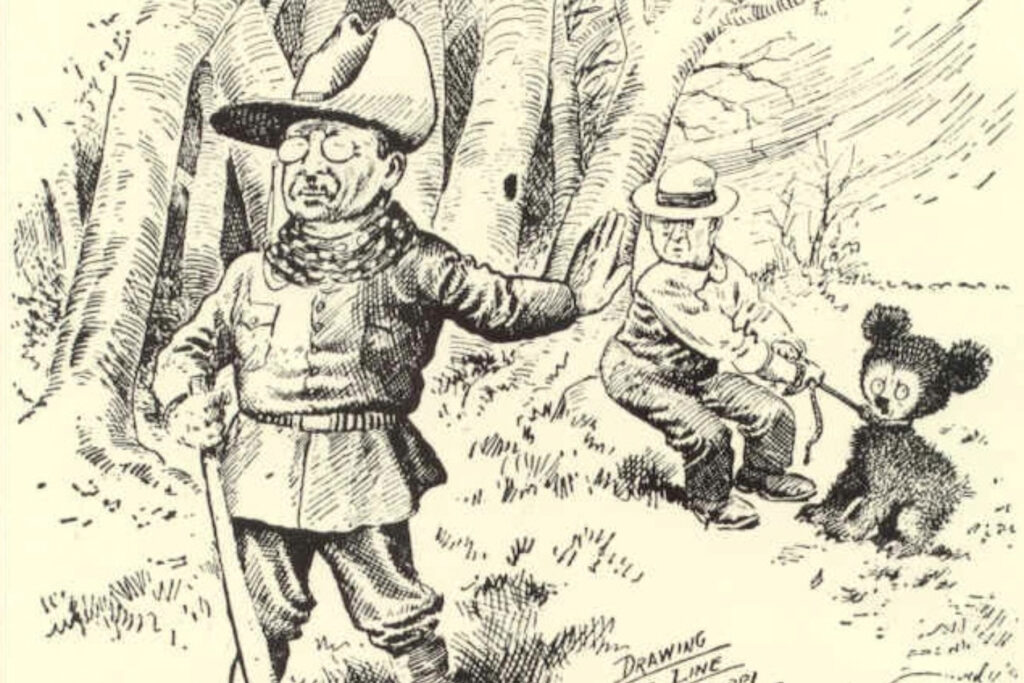
A Brooklyn shop owner named Morris Michtom and his wife Rose made a stuffed bear, called it “Teddy’s Bear,” and asked the president for permission to use his name. He agreed. The Ideal Toy Company grew out of it, and the teddy bear became a multibillion-dollar fixture of American childhood.
Did You Know? Bears are also called ursines, from ursus, the Latin word for bear.
Why the Bears Have Numbers, Not Names
Look at the Fat Bear Week bracket and you’ll see a number beside each bear. Those are park ID numbers, used for tracking. Keeping the bears as numbers helps avoid anthropomorphizing wild animals. A handful have picked up nicknames over the years, like Otis (for his O-shaped ears) and 747, dubbed “Bear Force One” for his sheer size.
How Rangers Tell Bears Apart
Katmai bears are not tagged or collared, a deliberate choice to keep human contact to a minimum. So how do rangers tell one 700-pound brown bear from another? They read the details.
- Scars: Distinctive marks identify many bears. Bear 32, “Chunk,” has a scar near his right eye.
- Fur color and shed pattern: Each bear has its own coat color and a unique pattern as it sheds through the season.
- Body features: Bears have signature looks. 504 has a goatee, 477 a droopy lower lip, 273 close-set eyes.
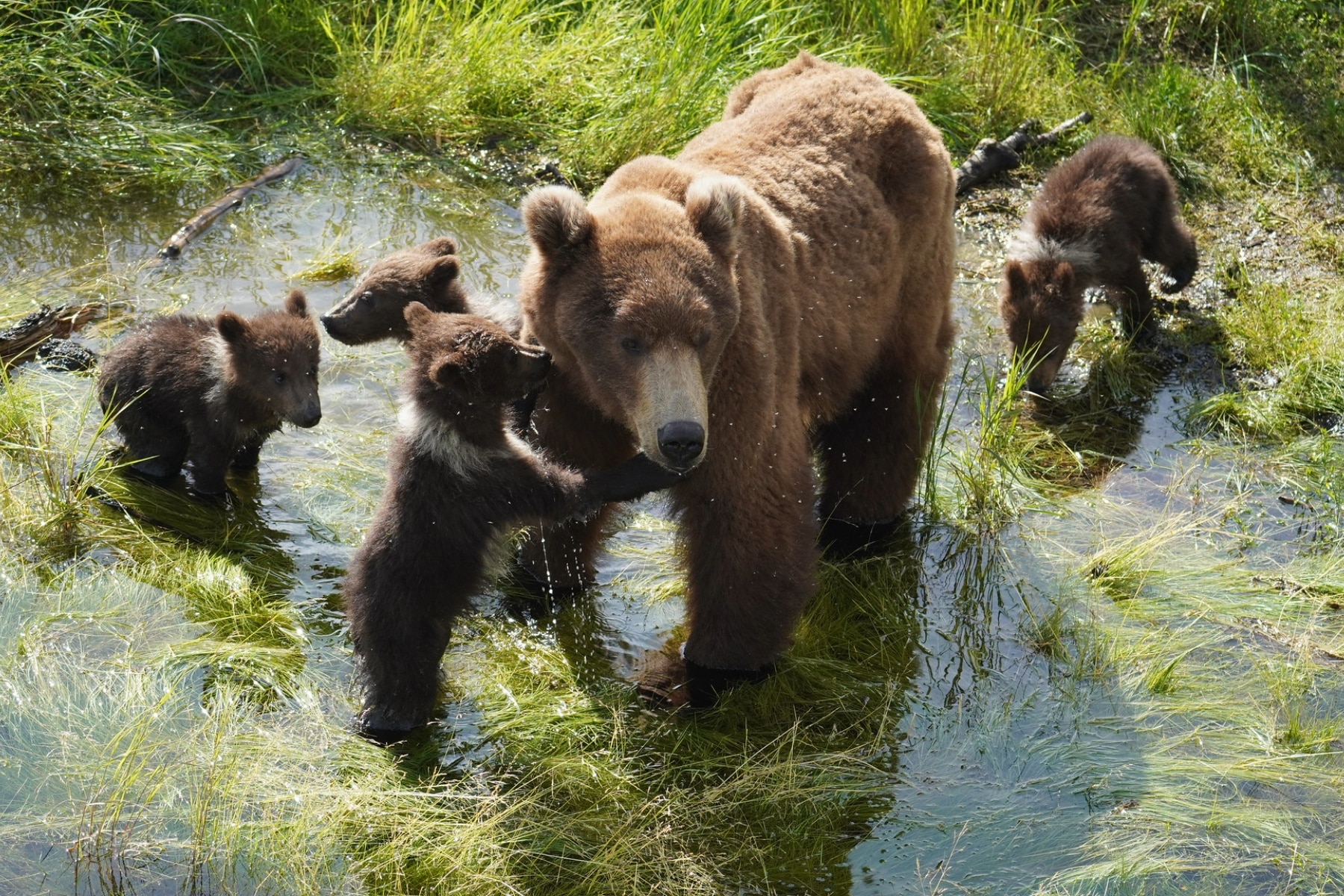
- Body size and sex: Males run larger. Rangers sex bears by anatomy, urination posture, and whether cubs are in tow. Sows raise cubs alone, so a bear trailed by cubs is female.
- Personality: Behavior is a tell. Some are bold, some mild. Many return to the same fishing spot year after year.
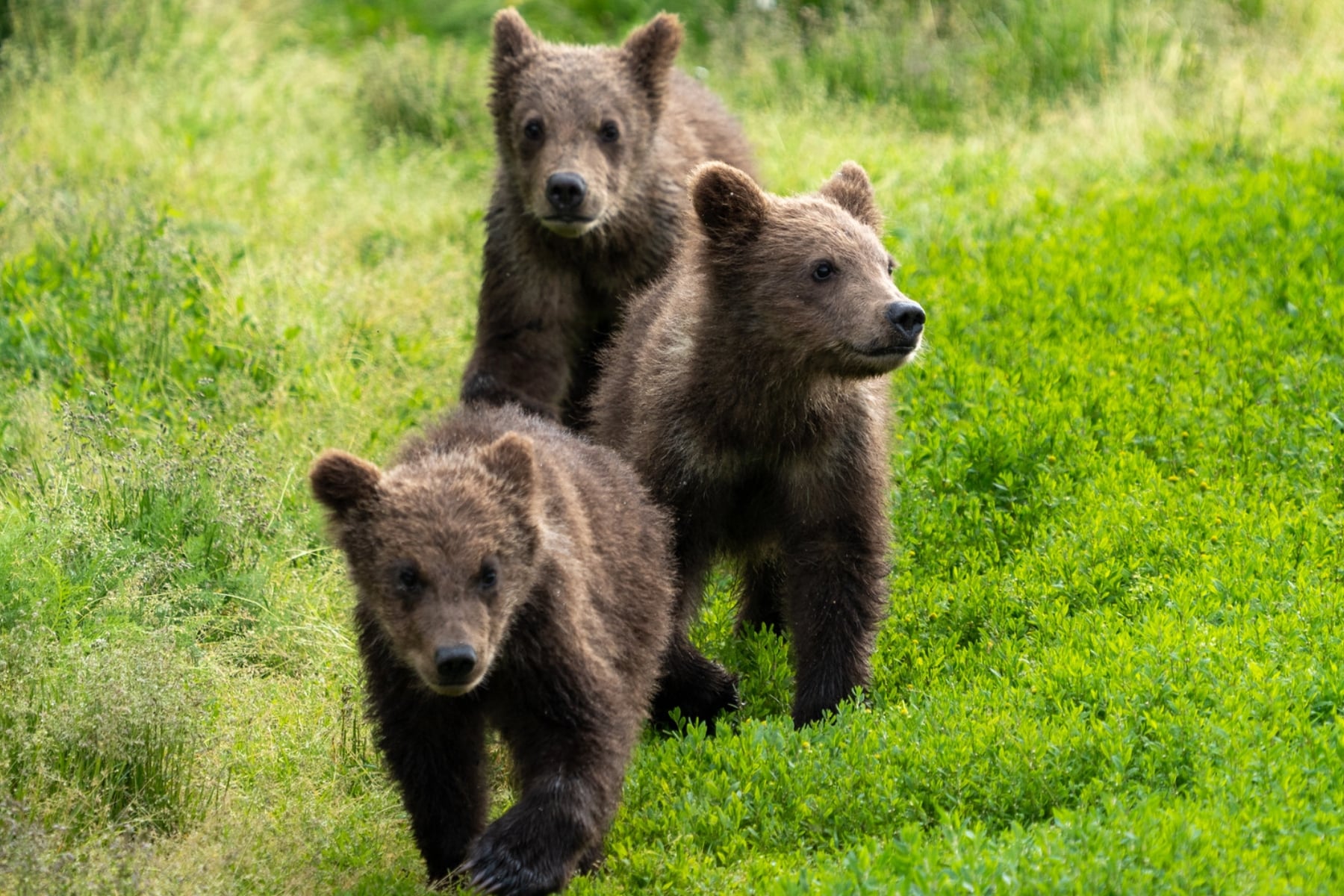
A NOTE ON CUBS: Katmai researchers do not name cubs, because the mortality rate before adulthood is roughly 50 percent. As the National Park Service bear book puts it, “The chances of that cub surviving to adulthood are low, so we set ourselves up for heartbreak by becoming attached to them.”
The Year in a Katmai Bear’s Life
A Katmai bear’s whole year bends around one goal: eat enough salmon to survive winter. Here is the cycle that builds a Fat Bear Week champion.
Waking From Hibernation (Late Winter to Early Spring)
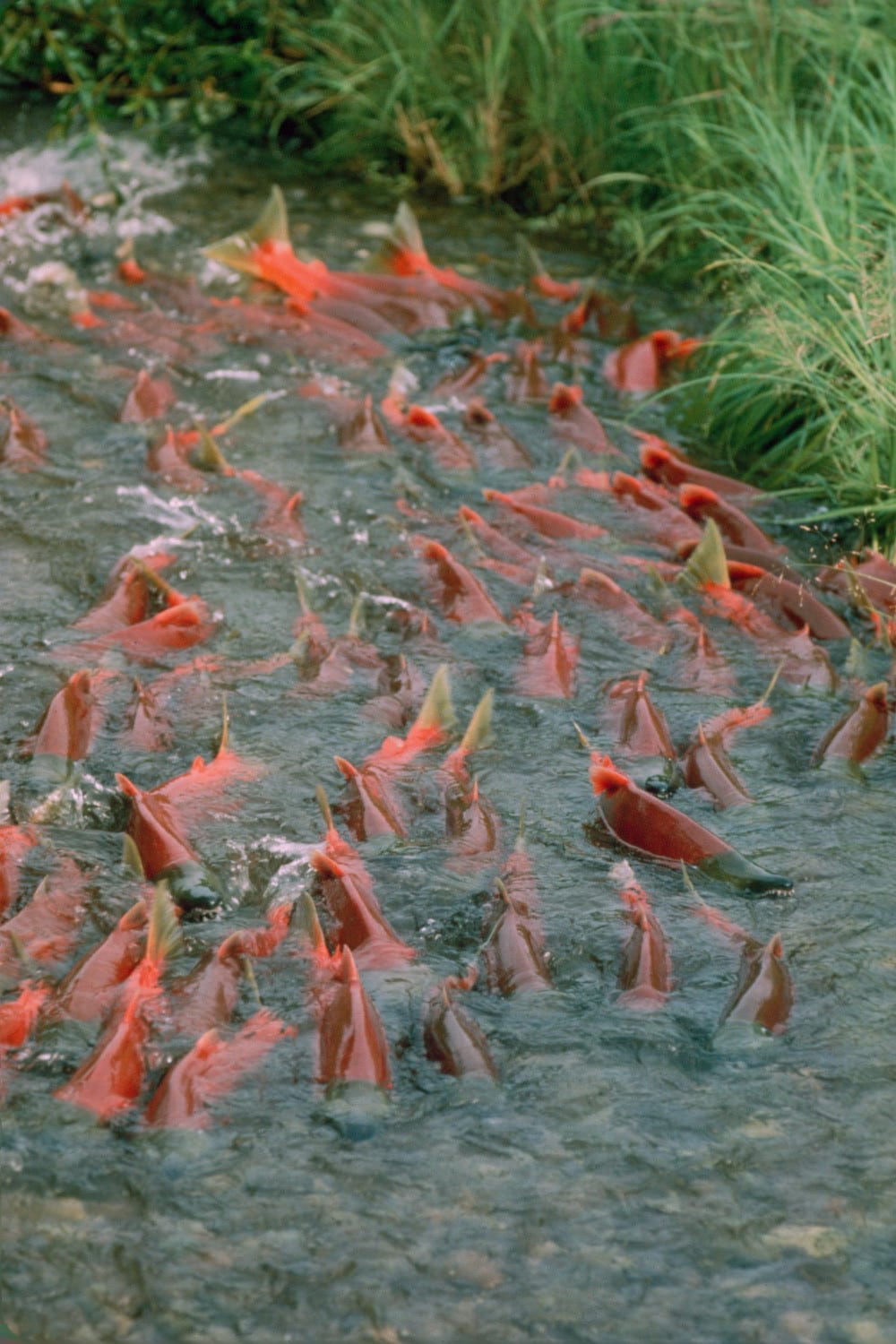
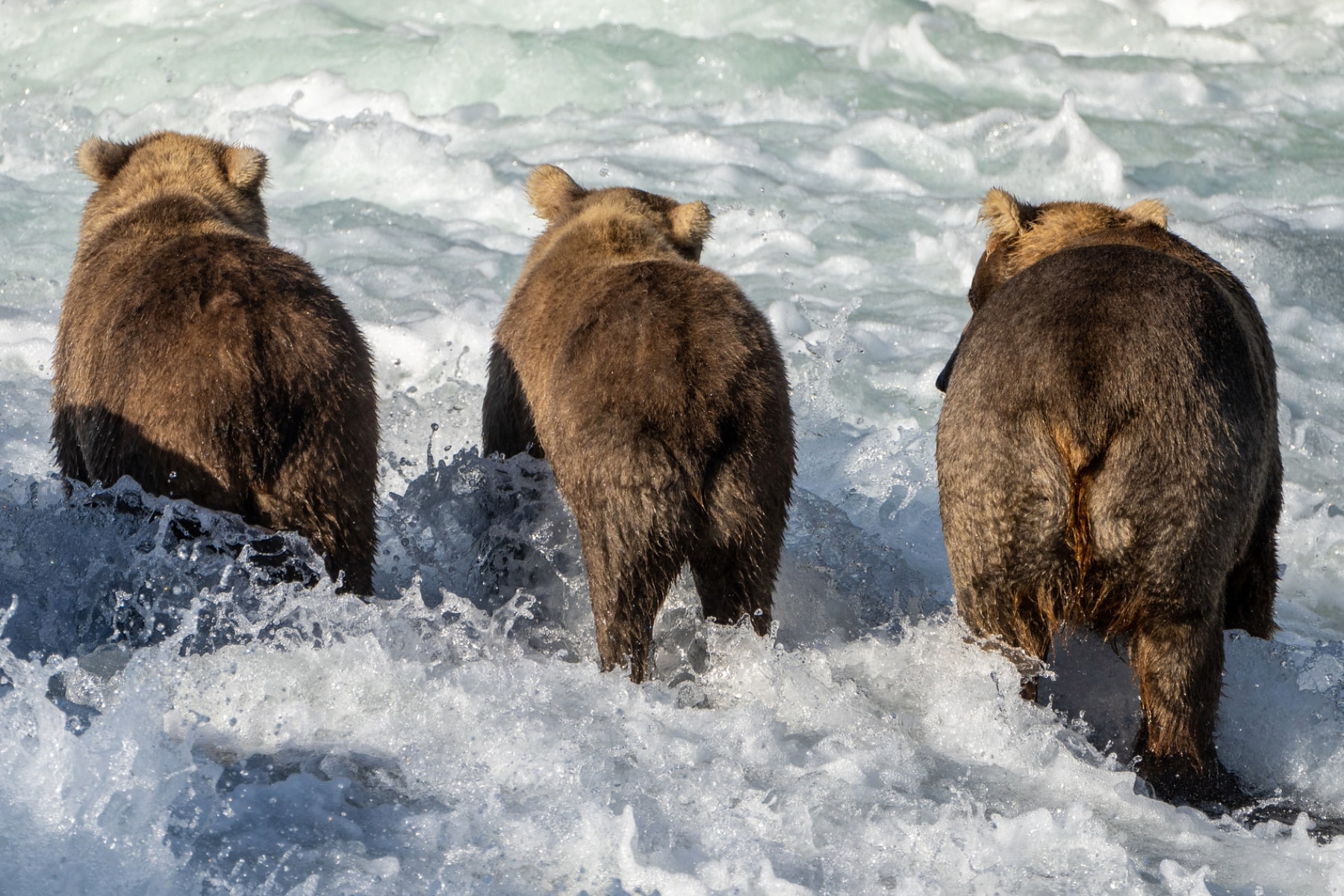
Bears emerge from their dens in late winter or early spring, lean and sluggish after months on stored fat. They stay near the den at first, feeding on early vegetation and any winter-killed carcasses they can find.
BEAR NOTE: Because the bears are not tagged and rangers keep their distance, there is no way to know where each bear dens. Spring is a waiting game to see who reappears.
Spring Feeding (Late Spring)
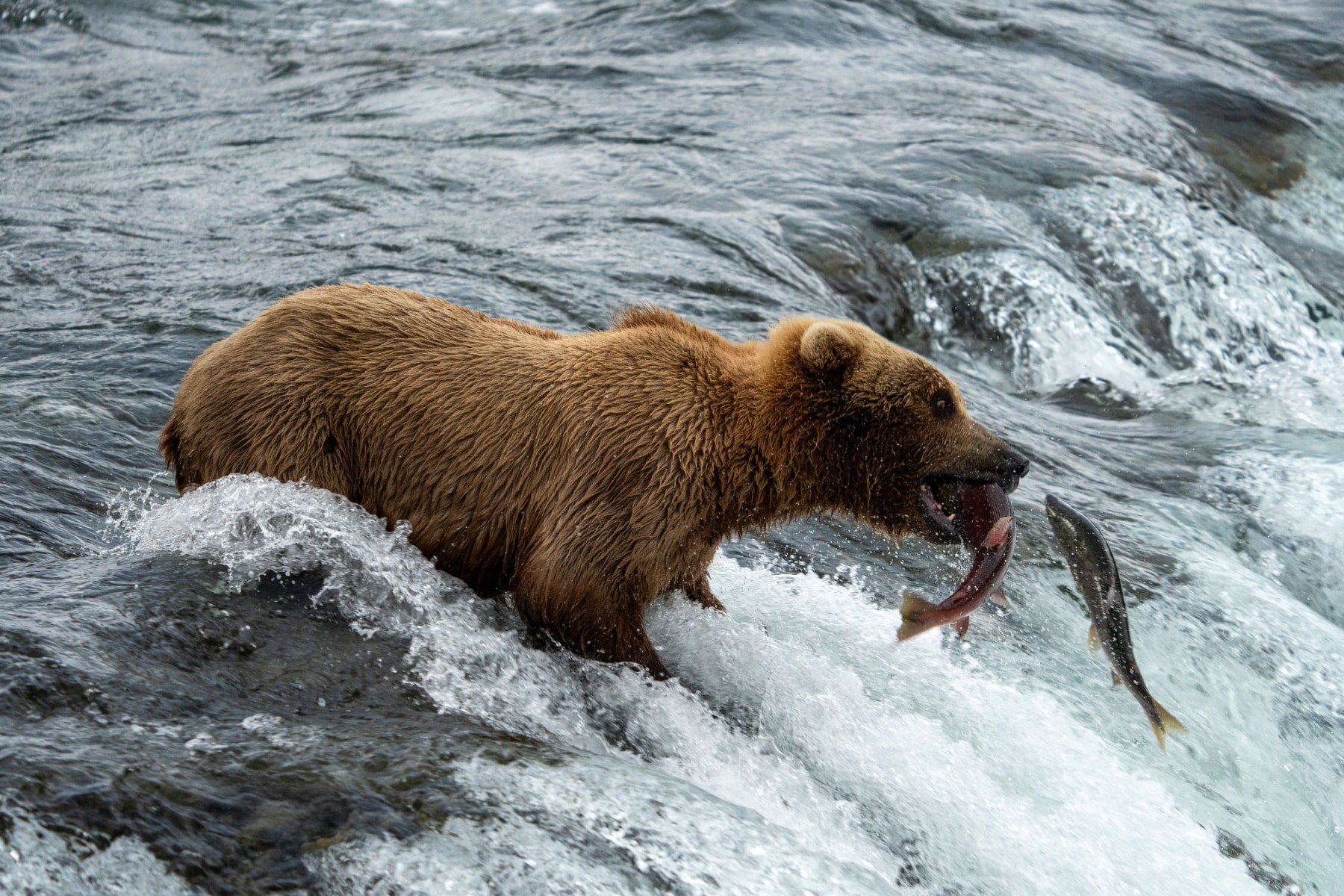
As spring warms, plants, roots, and grasses fill out, and the bears graze to rebuild energy. This is also the season for dominance displays and the start of mating behavior.
Summer Feeding and the Salmon Run (Summer)
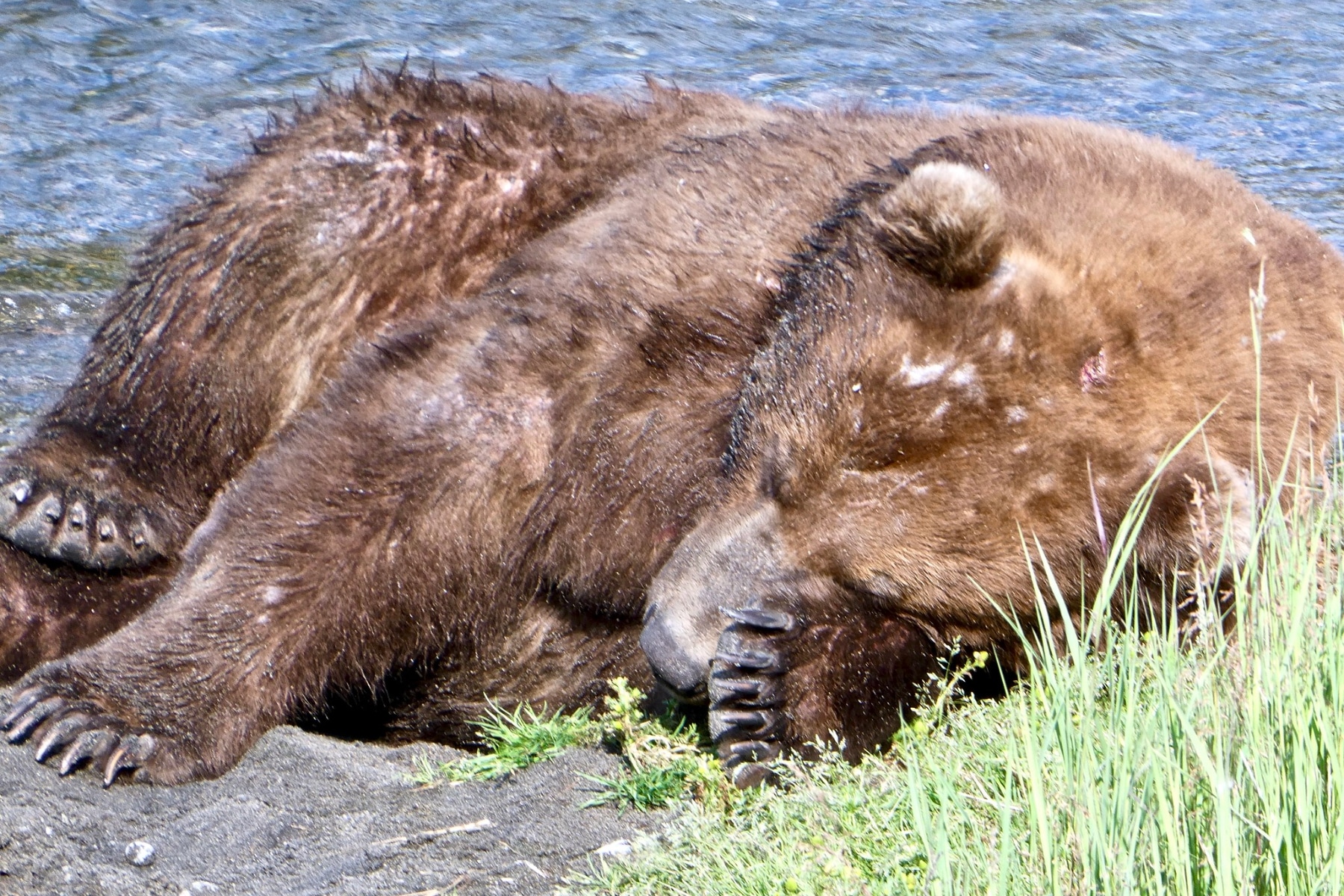
Through summer the bears eat constantly to lay down fat for hibernation, working through berries, salmon, and the occasional small mammal. This is hyperphagia, the period when a bear’s body shifts into round-the-clock eating to build the reserves it needs to last up to six months in the den.
Salmon are the main event. Runs on the Brooks River begin in summer and continue off and on into September. Brooks Falls is a prime spot because the salmon have to leap the falls to keep heading upstream, and hundreds of thousands pass through in a good year.
The biggest bears eat the fattiest parts of the salmon first, the skin, brain, and eggs, and leave the rest for smaller bears waiting downstream.
Preparing for the Den (Late Fall)
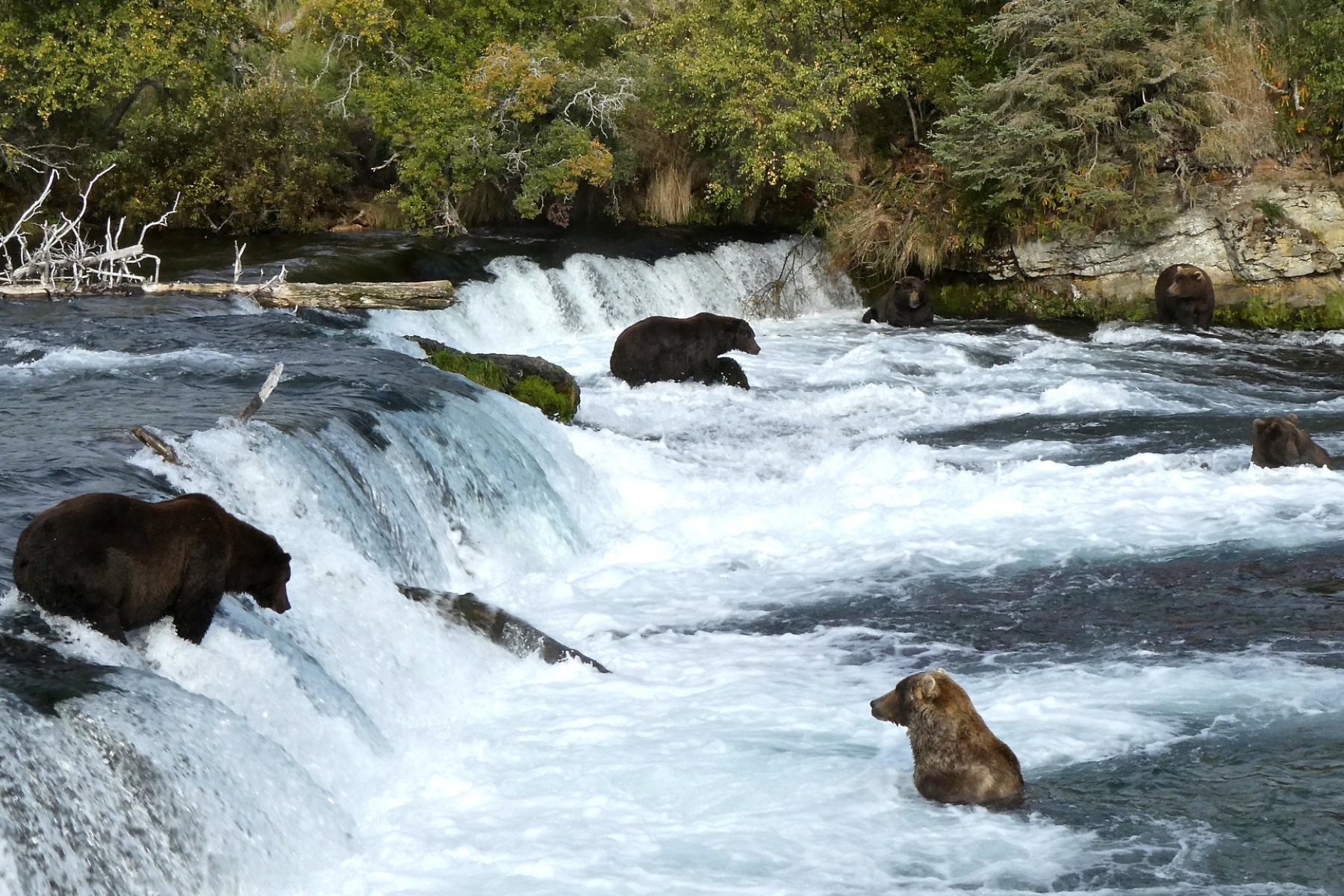
As winter nears, the bears chase the highest-calorie food they can find and grow more solitary. This is when they dig their dens. Hyperphagia runs until the food gives out, then the body switches into a deep cycle of preservation and survival.
Hibernation (Winter)
In winter the bears den up to wait out the season when food is scarce. Their metabolic rate and body temperature drop, and they live entirely off stored fat. Bears den alone, except for sows that give birth in the den.
Hibernating bears do not urinate or defecate. Their bodies recycle waste into protein, which helps keep muscle and bone strong through months of rest.
Did You Know: Bear “hibernation” is really torpor. The bears sleep deeply but are not fully immobile for six months. They shift around and can rouse quickly if a predator approaches, one more reason rangers never try to collar them.
How Brown Bears Mate and Raise Cubs
Brown bear reproduction is built around fat. Mating peaks in early summer, but the biology that follows is what makes it remarkable. Sows are selective, sizing up the quality of a potential mate before committing.
“All bears are promiscuous and are open to mating with multiple partners. So it’s absolutely possible for a single litter to have multiple fathers.”
Kim Grossman, Katmai National Park
Brown bears use delayed implantation. A sow mates in summer, but the fertilized eggs do not implant until fall, and only if she has built enough fat. If she has not put on roughly 20 percent extra body fat, the eggs never implant. It is a built-in safeguard: no cubs unless the mother can survive the winter and feed them.
Gestation runs about three months once implantation happens. Cubs are born in the den weighing roughly a pound, and a sow typically has one to four cubs, with two or three being most common.
How Katmai Bears Fish
Each bear has its own fishing style, shaped by size, patience, and rank. Here are the techniques you’ll see on the cameras.
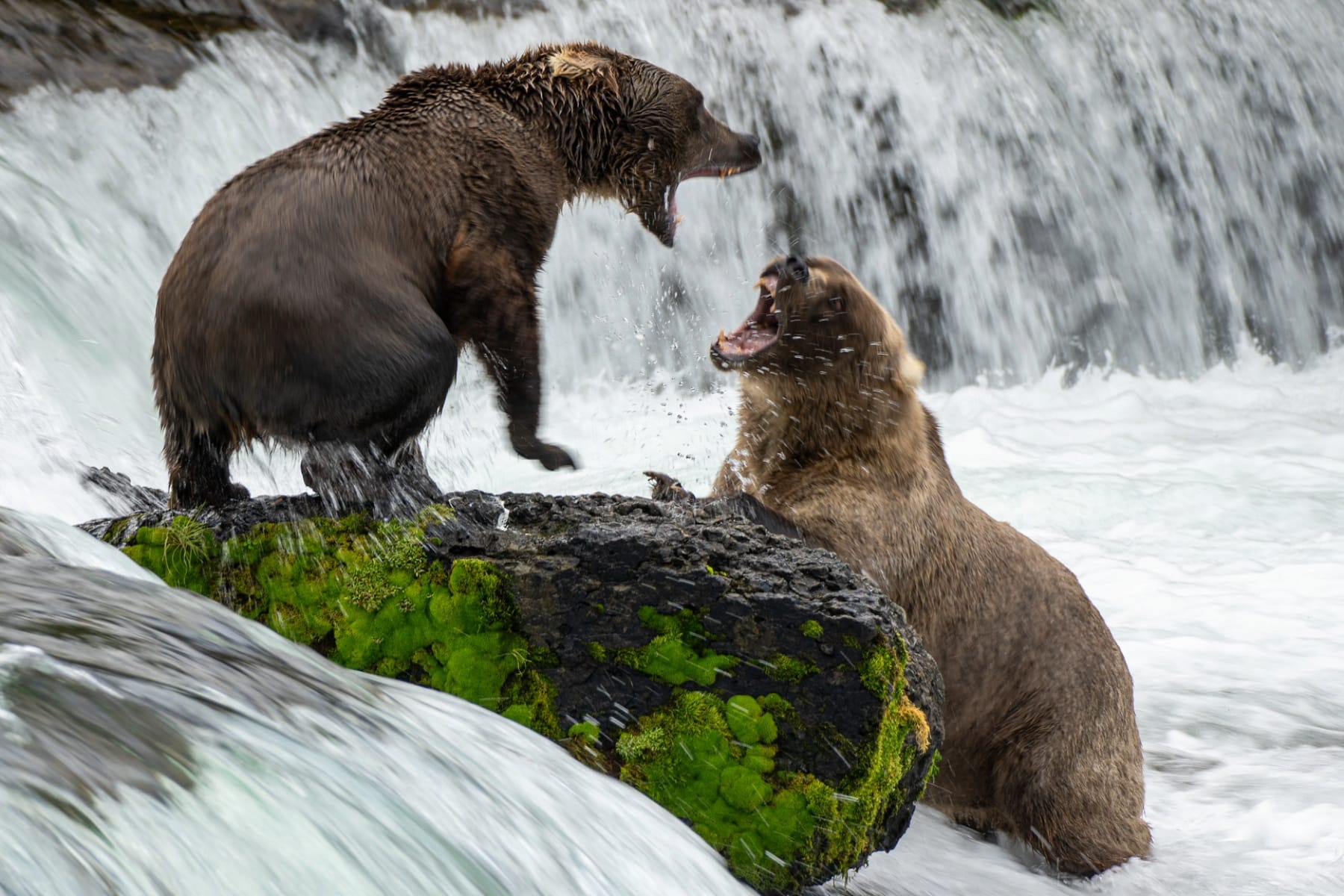
- Standing on the lip: The top spot atop the falls goes to dominant bears, who simply wait for leaping salmon to land in their mouths.
- Sitting at the base: Bears that park themselves at the foot of the falls let the current push fish into them, then snatch.
- Pouncing: Some bears chase and slap at salmon with their paws. It works when fish are thick and burns energy when they’re not.
- Snorkeling: Katmai bears can keep their heads underwater for a few minutes, scanning the bottom for spent fish.
- Diving: Diving for sunken salmon is a last resort. Bears would rather not burn the calories.
- Stealing: A few bears just take what others catch. If you see a bear bolt with a fish, it has probably been robbed before.
- Begging and waiting: Smaller bears hang downstream and wait for scraps to drift their way.
A Day in the Life of a Bear Researcher
If all this has you wanting to study bears for a living, here is what tracking the Katmai bears actually looks like on the ground.
When a Live Cam Saved a Hiker
The cameras are pointed at bears, but in 2023 the Dumpling Mountain cam helped save a person. A man walked up to the lens and spoke, but the camera has no audio. A viewer noticed him mouthing the words “help me” and alerted Explore.org, which contacted rangers. He was rescued.
The hiker was about two miles off the nearest trail, in fog thick enough to erase any landmark.
“Dumpling Mountain is in a remote section of Katmai, and this is the first rescue that I’ve heard of in that area.”
Peter Christian, public information officer, Katmai National Park
How to Watch Fat Bear Week Live
You don’t have to fly to Alaska to follow along. These Explore.org and YouTube live cameras run through the season, and the bracket goes live on the official site each October:
- Brooks Falls, lower angle
- Dumpling Mountain
- Brooks River
- Brooks River riffles
- Lower river salmon cam
- Official Fat Bear Week bracket and vote
Fat Bear Week FAQ
Fat Bear Week usually runs the first or second week of October. The exact dates and bracket are posted each year on the official Explore.org Fat Bear Week page.
No. Under Katmai’s no-interaction rules, bears are never weighed. Fat Bear Week is decided by public vote based on before-and-after photos, not scales.
Yes. Fishing is popular at Katmai and requires an Alaska fishing license. Catch-and-release is allowed, but bears always have right of way: anglers must stop fishing and cut their line if a bear comes within 50 yards.
Visiting Katmai National Park and Preserve
The bears get the attention, but Katmai is far more than Brooks Falls. The park holds more than a dozen active volcanoes and the Valley of Ten Thousand Smokes, the ash-filled landscape left by the 1912 eruption of Novarupta, the largest volcanic eruption of the 20th century.
Katmai covers about 4.1 million acres, roughly twice the size of Yellowstone and several times larger than Grand Canyon. It is also one of the least-visited national parks, drawing only around 30,000 to 40,000 people most years. The reason is access.
Getting to Katmai
Katmai sits about 290 miles southwest of Anchorage, and there are no roads in. Most visitors fly from Anchorage to King Salmon, then take a floatplane to Brooks Camp. The park works with several authorized air and boat operators for the final leg.
Summer and early fall are the best windows to visit, both for weather and for bear activity. For day-trip and overnight planning, you can browse Alaska guidebooks here, and if you’re routing through King Salmon or Anchorage, you can check lodging in King Salmon and Anchorage.
Visiting in person: Brooks Camp has limited lodging and a popular campground that books out fast. Reservations open months ahead through Recreation.gov, so plan early.
More on Alaska’s National Parks
- Alaska parks overview: Guide to Alaska’s National Parks
- Glacier Bay: Facts about Glacier Bay National Park
- Denali: Things to do in Denali National Park
- Wildlife viewing: Best national parks for wildlife
What to Bring to Katmai
Gear we recommend for Katmai. Affiliate links support our work at no cost to you.
More Than Just Parks may earn a small commission from purchases made through these links, at no extra cost to you. We only recommend gear we would actually use.
Affiliate disclosure: Some links on this page earn us a small commission at no extra cost to you. We only recommend gear we actually use.


