White Sands National Park Facts! In this article, we provide you with 10 surprising facts about one of America’s most magnificent national parks. For planning your trip, see our guide to things to do in White Sands.
White Sands National Park Map
Interactive park map — click a pin to learn more
White Sands National Park at a Glance
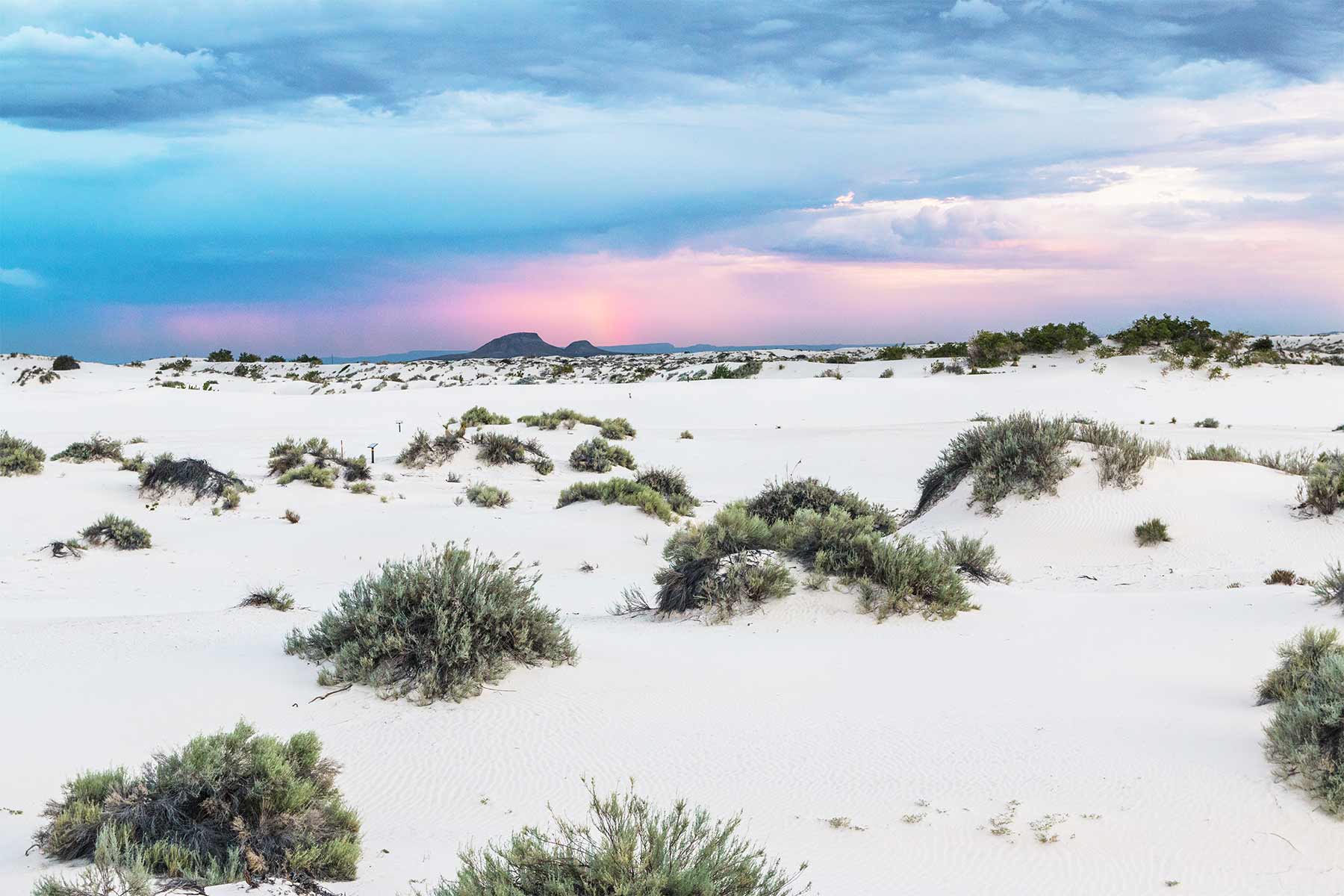
6 alertsWhite Sands National Park sits in the Tularosa Basin of southern New Mexico (not far from Carlsbad Caverns), and it is unlike any place I have ever visited. The park protects 275 square miles of brilliant white gypsum sand dunes, the largest gypsum dune field on the planet. Walking out into these dunes feels like stepping onto another world entirely. The sand is cool beneath your feet, the sky is impossibly blue above, and in every direction, rolling white dunes stretch to the horizon.
The park was originally established as a national monument in 1933 and was redesignated as a national park in December 2019. It covers 145,800 acres, and it draws over 600,000 folks a year to this remote corner of the American Southwest.
- Location Southern New Mexico, about 15 miles southwest of Alamogordo
- Acreage 145,800 acres
- Elevation 4,235 feet
- Entrance Fee $25 per vehicle, valid for 7 consecutive days. America the Beautiful passes accepted.
- When Did It Become a National Park? Established as a national monument in 1933 and redesignated as a national park in 2019.
- Climate June through August, daytime temperatures average 95 degrees Fahrenheit, with some days reaching 110 degrees. Evenings cool down to 50 to 65 degrees.

1. The First People Came to the Park Over 10,000 Years Ago
As a retired history teacher and lifelong history buff, I have always been fascinated with origin stories. Who were the earliest peoples and where did they come from?
For me, one of the more fascinating White Sands National Park facts is that over 10,000 years ago, the first people arrived in the Tularosa Basin in search of food, water, and shelter.
According to the National Park Service, little is known about these first people because so much of their culture was not preserved in the archaeological record. However, we do know that the first groups to enter the basin were exceptional stone tool makers and hunters. They used stone from the nearby mountains to craft intricate projectile points, known as the Folsom and Plano traditions. Evidence of Paleoindian occupation in the form of these projectile points and other stone tools has been found associated with ancient shorelines, streams, and hilltop rises above playas where these early hunters could track the movements of game animals drinking from watering holes below.
But here is where the story gets even more remarkable. In 2021, researchers announced the discovery of fossilized human footprints at White Sands that date back between 21,000 and 23,000 years. These footprints were made along the shores of an ice age lake that once filled the Tularosa Basin, and they represent some of the oldest evidence of human presence anywhere in the Americas. The prints were left by adults and children, and alongside them are the tracks of now-extinct megafauna, including mammoths, giant ground sloths, and ancient camels. Imagine it. Families walking these same lands more than 20,000 years ago, sharing the basin with creatures we only know from fossils.
Multiple dating techniques, including radiocarbon dating and luminescence dating, have confirmed the age of these prints. The discovery rewrote the timeline of human migration into North America, pushing it back thousands of years earlier than scientists had previously believed.

2. Hearth Mounds Represent the Most Amazing Evidence of Human Occupation at White Sands
Another of the fascinating White Sands National Park facts has to do with the story of the hearth mounds.
The hearth mounds found in the park are unique archaeological sites that provide extraordinary insights into the lives of the people who lived here thousands of years ago. These are the remains of fires built by prehistoric peoples, and they contain charcoal and ash that have been preserved over time. Surrounding these mounds, archaeologists have found other artifacts, including tools and pottery, that tell us something about how these ancient people lived their daily lives.
Now here is the fascinating part. The dune hearth mounds at White Sands are particularly significant because they are the result of a chemical reaction between gypsum, heat, and moisture. When gypsum is heated to a certain temperature, it turns into plaster of Paris, which hardens when moisture is added. This process cemented the hearth features in place, preserving them for thousands of years in a landscape where everything else shifts and changes with the wind.
Radiocarbon dating of the charcoal found in these hearth mounds shows they range from the middle of the Archaic period to recent history, giving us a chronological record of human occupation in the Tularosa Basin spanning several thousand years. Think about that for a moment. In a place defined by impermanence, where dunes march across the landscape and footprints disappear in hours, these ancient hearths endure.

3. A Beautiful Spanish Maiden Is Reported to Haunt the Dunes at White Sands
The most intriguing White Sands National Park fact I came across in my research has to do with the legend of a Spanish maiden who is said to haunt the glistening dunes.
The Legend of Pavla Blanca is said to be based on a real event, though it has been passed down through the centuries as a tale rather than a documented historical account. The story goes like this. A Spanish conquistador named Hernando de Luna was traveling through the Tularosa Basin when he was ambushed and killed by Apaches. His betrothed, Manuela, set out to find him but was never seen again.
According to the legend, Manuela’s ghost haunts the Great White Sands to this day, appearing in the dunes after sunset as a ghostly figure in a flowing white wedding gown. Folks with imagination who stroll through the silent, shimmering dunes after a fiery sunset may be fortunate enough to witness the unusual sight for themselves.
Is it true? Well, that is part of what makes it such a wonderful story. Some folks believe in the legend and find it fascinating. Others view it as a fanciful tale born of moonlight and loneliness and too much time in the desert. Either way, if you find yourself among those rolling white dunes at twilight, you might find your imagination working overtime.

4. The Park Was Part of a “Salt War”
Another of the fascinating White Sands National Park facts has to do with the story of a “Salt War.”
In the late 1800s, the area around the park was a vast desert, and the only source of salt for the region was a salt lake located within what is now the park. Salt was a vital resource for the local population, used for both human consumption and as a preservative for food. For generations, the local communities had gathered salt from the lake freely.
But then the federal government claimed ownership of the land and the salt. The local population, a mix of ranchers, farmers, and Native Americans, refused to give up access to the salt lake. What followed was a series of confrontations that lasted for several years, with folks on both sides digging in.
The conflict eventually came to an end when the government agreed to lease the salt lake to the local population for a nominal fee. It is a story that resonates today, a reminder of how natural resources can become flashpoints for conflict when they are scarce and when the people who depend on them feel their access is being taken away.
5. The History of White Sands National Park Is Closely Tied to the History of the American Frontier
Did I mention that I taught history? The story of the Tularosa Basin in the 1800s reads like a chapter from one of the textbooks I used in my classroom, except better, because it actually happened in this very landscape.
In the 1880s, a brief period of heavy rainfall supported the return of lush grasslands in the Tularosa Basin, and that attracted the attention of goat, sheep, and cattle grazers, predominantly from Texas, seeking to make their fortune in livestock. Large cattle drives pushed into the basin. Family homesteaders established ranches throughout the area. For sixty years, ranching was the dominant economy of the Tularosa Basin.
Several ranches were homesteaded on what is now park land before White Sands was established, including Walters Ranch, Watson Ritch Ranch, and the Lucero family ranches on the Lake Lucero shoreline. The Lucero family were among the most prominent ranchers in the area, with several ranches on the south shore of the lake that would eventually come to bear their name.
In 1940, the National Park Service took over ownership of the Lucero family properties with the appropriation of Lake Lucero and Alkali Flat. Today, the remnants of the Lucero family legacy are still visible on the landscape. Stock pens, a watering trough, a water well, and a fallen windmill stand as quiet reminders of the families who once made their living here. Folks can experience these remnants on a ranger-led tour to Lake Lucero during the cooler months of the year.

6. White Sands Has the Largest Gypsum Dune Field in the World
Now here is a fact that still blows me away every time I think about it. White Sands National Park is home to the largest gypsum dune field in the world. We are talking about 275 square miles of brilliant white sand, enough to cover the entire city of Chicago with room to spare.
So how did all this gypsum get here? The process starts in the mountains surrounding the Tularosa Basin. Rainwater and snowmelt dissolve gypsum from the rock and carry it down into the basin. Because the basin has no outlet to the sea, the water collects and evaporates, leaving behind selenite crystals. Strong prevailing winds then break these crystals into small, sand-sized grains that form the dunes.
The gypsum itself is naturally clear, but it appears brilliant white because the crystals are scratched and worn by the wind. Those scratches reflect sunlight in every direction, giving the sand its blinding white appearance. At sunrise and sunset, the dunes shift from white to gold to pink, and the shadows between the dune ridges turn deep blue. It is one of the most extraordinary things I have witnessed in any national park.
One more thing that sets this sand apart. Unlike silica sand at a beach, gypsum sand does not absorb heat from the sun. You can walk barefoot across these dunes in the middle of summer and the sand stays cool beneath your feet. Try that on any beach in Florida and you will be hopping.

7. Many Species Make Their Home at the Park
You wouldn’t expect a vast field of white sand dunes to support much wildlife. But you would be wrong, and the story of how these animals adapted is one of the most remarkable in all of the national parks.
White Sands is home to foxes, coyotes, bobcats, badgers, rabbits, porcupines, and a variety of rodents. There are seven species of amphibians and even a species of salamander. The park has recorded over 220 species of birds, including wrens, mockingbirds, larks, ravens, roadrunners, and raptors.
And then there are the fish. The White Sands pupfish is the only species of fish endemic to the Tularosa Basin and the only fish found in the park. It has dark eyes, silver scales, and grows to just 1.75 to 2.5 inches in length. It exists here and nowhere else on Earth.
Perhaps the most fascinating adaptation story belongs to several species that have evolved lighter coloration to match the white gypsum sand. The bleached earless lizard, the Apache pocket mouse, and the camel cricket have all developed paler coloring than their relatives living on the darker desert soils just outside the dune field. This is evolution you can see with your own eyes, happening right now, in real time. As a teacher, that is the kind of lesson that writes itself.

8. You Can Go Sledding on the Dunes
Just when you thought White Sands couldn’t surprise you any further, here is a fact that puts a smile on everyone’s face. You can go sledding at White Sands National Park. No snow required.
The steeper dunes along Dunes Drive, particularly near the Alkali Flat Trailhead in the middle of the park, are perfect for sand sledding on plastic saucer-style sleds. You hike up a dune, sit down, and fly back down the slope on a waxed sled. Kids go wild for it. Adults pretend they are doing it for the kids.
You can buy sleds at the park’s gift shop for about $25 new or $20 used (when available). The National Park Service recommends waxing the bottom of your sled to get the most speed. If you want to save a few dollars, Walmart in Alamogordo sells sleds for less, and Pistachio Land about 30 minutes from the park sells them for around $18.
A few tips from experience. The steeper the dune, the better the ride. A fresh coat of wax makes a real difference. And if you are visiting in summer, go in the late afternoon when the temperatures start dropping. Hauling a sled up a dune in 100-degree heat is no one’s idea of fun.

9. White Sands Sits on One of the Largest Military Bases in the U.S.
Now this one caught my attention as a history teacher. White Sands National Park sits squarely within the boundaries of one of the largest military installations in the United States, the White Sands Missile Range.
The missile range covers nearly 3,200 square miles of the Tularosa Basin and has been used for weapons testing since 1945, when the first atomic bomb was detonated at the Trinity Site just 60 miles to the north. Today, the military uses the range for missile testing, and that testing directly affects your visit to the park.
When missile tests are scheduled, Dunes Drive closes to all traffic for up to three hours. Highway 70, which runs between Las Cruces and Alamogordo right past the park entrance, also closes periodically during tests. The visitor center and gift shop remain open during these closures, but you cannot access the dunes themselves.
The park posts upcoming closure dates and times on its website, but notifications from the missile range sometimes arrive as little as 24 hours in advance. My advice is to check the NPS park closures page the day before your visit and again the morning of. If you are driving Highway 70, you can call (575) 678-1178 for the latest road closure information. There is nothing quite like driving two hours across the desert only to find the park road closed for a missile test. Plan ahead.

10. White Sands Is a Popular Location for Photographers and Filmmakers
White Sands National Park is one of the most photographed and filmed landscapes in the American Southwest, and it is not hard to understand why. The stark white dunes against a deep blue sky create a visual that looks otherworldly, and Hollywood has been coming here for decades.
The park has been used as a filming location for over 40 movies, documentaries, music videos, and television commercials. Among the most notable films with scenes shot at White Sands are Transformers (2007), Independence Day (1996), Hang ‘Em High (1968), The Mule (2018), Young Guns II (1990), The Man Who Fell to Earth (1976), and Tank Girl (1995).
For photographers, the golden hour at White Sands is something special. The low-angle light turns the white sand to gold and pink, and the shadows between dune ridges deepen to a rich blue-purple. Sunset is the most popular time, but sunrise is equally stunning and far less crowded. The sand reflects about 80 percent of the sunlight that hits it, which means the light bounces everywhere and fills in shadows in ways that make portrait photographers very happy.
The park also offers ranger-led sunset strolls, which are guided one-hour walks through the dunes timed for the best light of the day. These programs are popular and worth planning around. Check the park’s event calendar for dates and times.
Planning Your Visit to White Sands
A few practical things worth knowing before you go.
Dunes Drive is the 8-mile scenic road that takes you from the visitor center into the heart of the dune field. The round trip takes about 45 minutes if you don’t stop, but you will stop. The road opens daily at 7am, and closing times vary by season. In summer, the road stays open later, typically until 9pm. In winter, it closes earlier, around 6pm. Check the NPS hours page for the current schedule.
Best time to visit. Spring (March through May) and fall (September through November) offer the most comfortable temperatures. Summer visits are doable but plan for extreme heat. The sand stays cool, but the air temperature can reach 110 degrees, and there is zero shade on the dunes. If you visit in summer, go in the early morning or late afternoon. Winter is mild during the day but cold at night, which makes it a fine time for hiking.
The Alkali Flat Trail is the park’s longest and most remote hike at 4.6 miles round trip. It crosses open dune field with no shade, no water, and no facilities. Folks have gotten lost on this trail because the wind erases footprints within minutes and the landscape looks the same in every direction. If you cannot see the next trail marker, the Park Service says to turn around and go back the way you came. If you become disoriented, stay put and call 911. Do not try to hike out. People have died here from heat exposure and dehydration. Bring at least 2 liters of water per person, wear sun protection, and tell someone where you are going.
Backcountry camping. White Sands offers backcountry camping on 10 primitive sites accessible only by foot from the Backcountry Camping Loop along Dunes Drive. As of early 2026, backcountry camping is closed while the park rehabilitates the sites and trail. Check the NPS conditions page for updates before planning an overnight trip. When camping is available, permits must be obtained in person at the visitor center on a first-come, first-served basis.
White Sands is one of those national parks that surprises you. You arrive expecting sand, and you leave thinking about ancient footprints, ghost stories, sledding runs, military history, and animals that turned white to survive. For me, that is what makes it one of America’s most extraordinary places.