
Mammoth Cave National Park Facts! In this article, we provide you with 12 amazing facts about one of America’s most magnificent national parks.
Mammoth Cave National Park Map
Interactive park map — click a pin to learn more
Mammoth Cave National Park at a Glance
3 alertsMore Than Just Parks is your one-stop-shop for learning everything you’ll need to know about America’s national parks. We’ve got expert guides, beautiful photos, helpful tips, breathtaking films and so much more.
I’ve been to so many of these amazing places since retiring from teaching in 2018. Did I mention that I taught history? I spent a lifetime teaching about the history behind some of these natural wonders. Then I got to see them firsthand.
Love Mammoth Cave? It's one of 109 threatened public lands we're tracking. Get the free weekly briefing.
And now I’m sharing some of the incredible stories about these beautiful places with you. It doesn’t get any better than that!
More Than Just Parks takes a deeper dive with its national park facts. We’ve done our homework so that you’ll get more than you bargained for.
let’s get started.

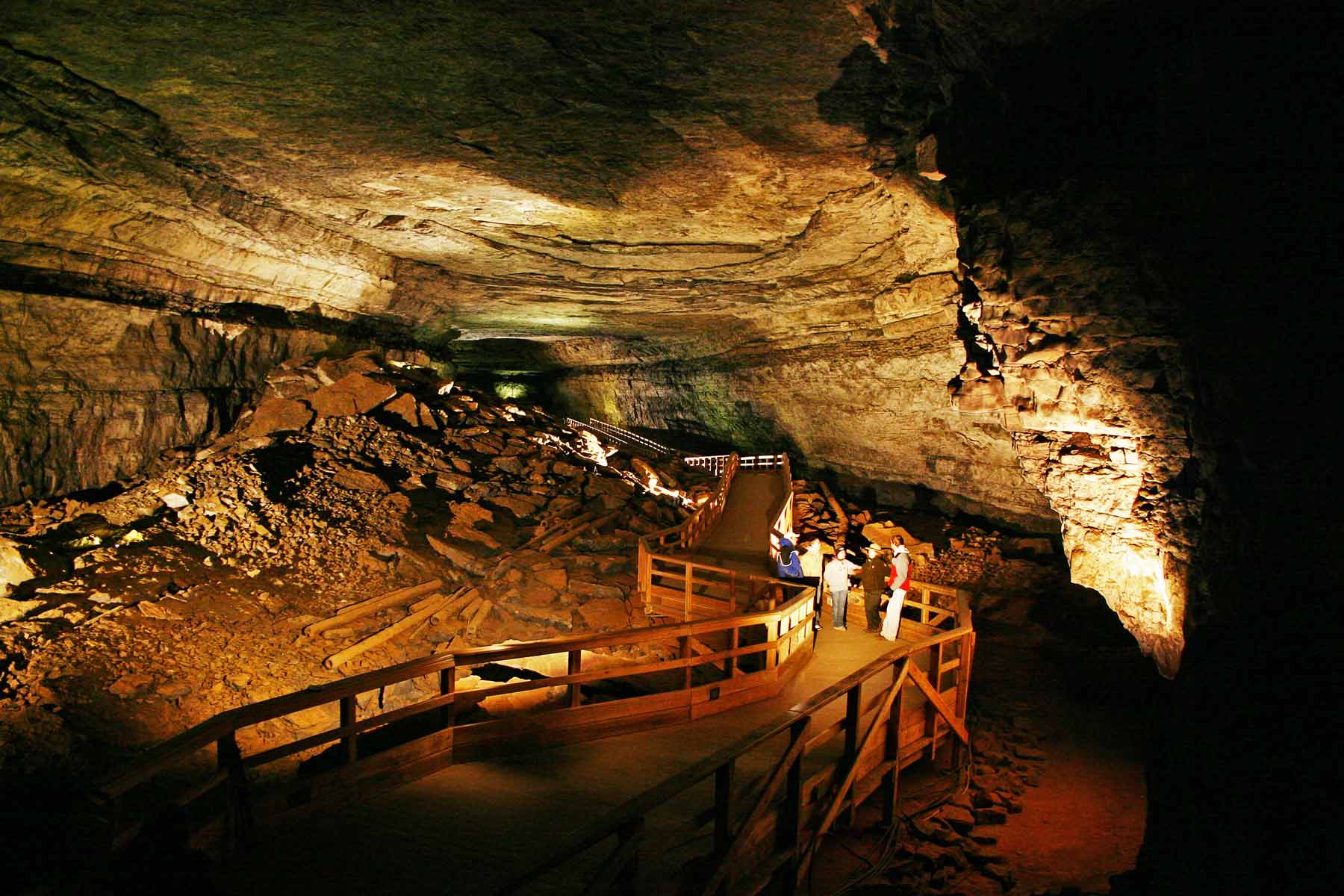
Mammoth Cave National Park is a national park located in central Kentucky. It’s home to the world’s longest known cave system, with more than 400 miles of underground passageways.
The park is named for the many mammoths that once roamed the area. The remains of these ancient creatures have actually been found in the cave.
The cave system is made up of a network of underground tunnels, chambers, and passageways that have formed over millions of years. The cave is formed by the dissolution of limestone and other sedimentary rocks, and the passageways are formed by the flow of underground water. It’s known for its unique geology and geomorphic features, including stalactites, stalagmites, and other formations.
In addition to the cave system, Mammoth Cave National Park also features a number of outdoor recreational activities, including hiking, biking, and horseback riding on the park’s trails.
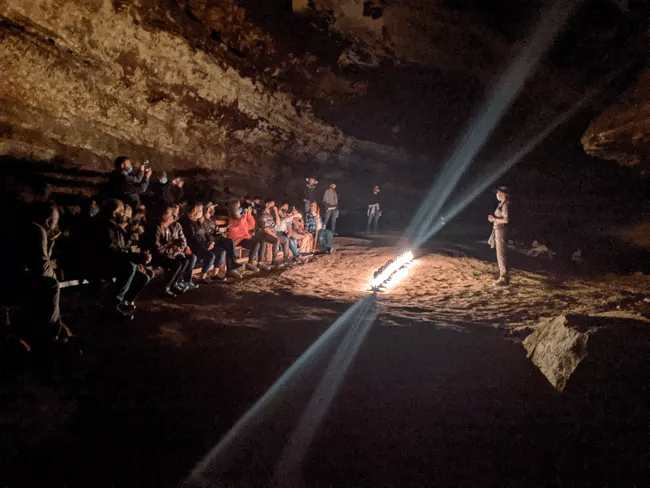
There’s also a number of ranger-led tours and educational programs available to visitors, as well as a number of amenities, including campsites, picnicking areas, and a visitor center.
The park is located about 85 miles south of Louisville, Kentucky, and is a popular destination for nature lovers and cave enthusiasts.
It’s a UNESCO World Heritage Site and has been designated as an International Biosphere Reserve.
Now Here Are Some Basic Facts
- Location: Kentucky
- Acreage: Today, Mammoth Cave National Park (the park) comprises approximately 52,830 acres in Edmonson, Hart, and Barren counties in the Commonwealth of Kentucky.
- Visitation: Over 2 million people a year visit the park and more than 500,000 of them take a cave tour.
- Highest Surface Elevation: 852 feet (260 meters) Brooks Knob.
- Lowest Surface Elevation: 411 feet (125 meters) Green River near Brownsville.
- Climate: Mammoth Cave National Park has a moderate climate, with often warm and humid conditions. Summers are very warm, and winters are cool but not usually cold. Southern Kentucky receives the highest average precipitation for the state, about 50 inches a year.
- When Did It Become A National Park? Mammoth Cave National Park was officially dedicated at as a national park by 1941. It then became a World Heritage Site in 1981 and an International Biosphere Reserve in 1990.
6 BEST Kentucky National Parks Worth Visiting
1. A Number Of Different Native American Groups Lived In The Green River & Mammoth Cave Area
As a retired history teacher and lifelong history buff, I’m fascinated by origin stories. Who were the earliest peoples to inhabit a given area and what clues did they leave behind?
The human history of the Mammoth Cave area began about 12,000 years ago.
The exploration of Mammoth Cave itself can be dated back between 5,000 to 4,000 years ago.
Archaeological studies reveal that a number of different Native American groups lived in the area thousands of years prior to the arrival of Europeans. These groups have been designated as the River People, the Kentucky Cliff Dwellers, Mound Builders, and the Mammoth Cave Indian.
What is truly surprising is that these Native Americans went far underground.
At Carlsbad Caverns evidence of prehistoric peoples is found only at the cave entrance, whereas in Mammoth Cave, evidence of their existence can be found miles back in the caves.
This suggests that the people of Mammoth Cave had a greater understanding and familiarity with the cave system than other prehistoric groups.

Artifacts Discovered
Many objects used by these Native Americans have been found in the cave. They include: textiles, wooden bowls, woven sandals, gourds, twisted cord, pottery and braided strands of grass.
What these objects tell us is that these people possessed a remarkable knowledge of the art of weaving. They also reveal unusual intelligence, artistic ability and imagination.
These early explorers visited the upper three levels of Mammoth Cave and discovered over 19 miles of cave passageways within Mammoth Cave National Park.
The minerals collected from the cave were obviously important resources to Early Woodland people.

2. According To Legend, The Cave Was Discovered By A Hunter Tracking A Wounded Bear
One of the more intriguing Mammoth Cave National Park Facts has to do with the story of how this incredible cave was first discovered.
John Houchin moved from Virginia and settled on the Green River near Mammoth Cave.
According to a legend, it was Houchin who discovered the cave while chasing a wounded bear into its entrance.
The story of Houchin’s 1797 discovery of the cave while hunting a bear, however, is considered to be fictional.
Nevertheless, a section of the cave became known as “Houchin’s Narrows,”which was named for the legend of that young hunter.
It’s also interesting to note that, along this path, also known as the twilight zone, light from the sun filters into the entrance.

25 Bucket List Famous Landmarks In America (MUST-SEE)
3. Mammoth Cave Played An Important Role In The War Of 1812
Believe it or not, Mammoth Cave actually played an important role in the War of 1812. And this may be one of our most surprising Mammoth Cave National Park Facts.
The war, otherwise known as the Second War of American Independence, was fought between Britain and the United States.
At the outset of the conflict, England embargoed needed supplies from foreign suppliers making it impossible to obtain nitrates. Nitrates are necessary in the manufacture of gunpowder.
Mammoth Cave was practically the only available source of nitrates which was indispensable for making the gunpowder necessary to conduct the war.
As a matter of fact, the presence of this valuable material caused the value of Mammoth Cave to increase tremendously.
On July 9, 1812, ownership of the cave area changed hands three times and increased in value from $116.67 to $3,000.
20 BEST Black History Sites In America For You To Visit
4. A Slave Made Mammoth Cave The Popular Site That It Is Today
Perhaps my favorite Mammoth Cave National Park Fact is the incredible story of the enslaved tour guide named Stephen Bishop.
In 1838, Bishop, then age 17, was brought to the cave by his owner, Franklin Gorin.
Gorin was a lawyer who wanted to turn the site into a tourist attraction. Using ropes and a flickering lantern, Bishop traversed the unknown caverns, discovering tunnels, crossing black pits, and sailing on Mammoth’s underground rivers.
Bishop faced a complex honeycomb filled with sinkholes, cracks, fissures, boulders, domes and underwater springs.
A blown-out lantern meant isolation in profound darkness and silence. With no sensory input whatsoever, the threat of becoming permanently lost was very real.
It’s therefore hard to overstate Bishop’s influence; some of the branches he explored weren’t found again until modern equipment was invented. The map which he made by his memory of the cave was used for decades.
An Amazing Explorer
J.W. Spaulding’s 1853 article in The Northern Inquirer refers to Bishop as “the most intelligent Negro … that I met with in all my travels. He can converse on geology and mineralogy with much fluency, and would put to the blush many who have seen much of Academic halls.”
While taking him through the cave, Bishop showed Spaulding gypsum-crystal “stars” that looked like the night sky. He also sang a song on the Echo River, his “clear, sonorous voice” filling the cave.
“There are two or three guides, who are procured at the hotel,” Spaulding writes.
“If possible, get Stephen.” (Source: Joy Lanzendorfer, “Enslaved Tour Guide Stephen Bishop Made Mammoth Cave the Must-See Destination It Is Today,” Smithsonian Magazine)

His Knowledge Of The Cave Was Second To None
So popular did Stephen Bishop become that he achieved world wide fame.
His knowledge of the cave and his intelligence made him invaluable to many scientists who came during the middle of the nineteenth century to explore Mammoth Cave.
He discovered and named many features of the Cave, including River Styx, Great Relief Hall, Fat Man’s Misery, Tall Man’s Misery, and Lake Lethe.
Numerous authors wrote about their Mammoth Cave tours with Bishop as their guide in books and magazines. Robert Barnwell Roosevelt, writing in The Knickerbocker, as “Barnwell” refers to Bishop as “Stephen, the best guide to the cave”.
Roosevelt states that Bishop told the group that he, Bishop, had learned to read and write by seeing previous tourists “…the gentlemen paint their names with the smoke of the torches on the walls, and then asking how they spelled them.”
Later, in 1854, Nathaniel Parker Willis, in A Health Trip to the Tropics, described Bishop as wearing “a chocolate-colored slouch hat, a green jacket, and striped trousers” as his working uniform.
10 BEST Civil Rights Sites In America
5. An NPS Guide Is The Descendant Of Slaves Who Served As Mammoth Cave Guides
For me, the most surprising and most incredible of the Mammoth Cave National Park Facts has to do with the amazing story of Jerry Bransford.
Sharing honors with Stephen Bishop were two other slave guides. They were brothers Mat and Nick Bransford.
When Matt Bransford died in 1886, his mantle descended to his son, Henry. Then it passed on to Henry’s sons, Mat and Louis.
It finally passed to his great grandson, Elzie Bransford.
For over 100 years, one or more members of the Bransford family guided visitors through Mammoth Cave. But that’s not the end of this incredible story.

Jerry Bransford
Jerry Bransford grew up just a few miles from Mammoth Cave National Park. As a kid, he knew a little of his family’s connection to the park, but as an adult he learned how much his family actually contributed to the history of the caves.
Bransford went to technical college. He was drafted into the Army in 1968 during the height of the Vietnam War.
While training at Fort Knox, he met Barbara who lived in Glendale. They married in 1968. He served his two years and then resided in Glendale.
In 1972, he began a 30-year career at Dow Corning in Elizabethtown. After retiring, a new adventure began.

An Incredible Story To Tell
Jerry Bransford started working in 2004 as an interpretive ranger, a fifth generation guide at Mammoth Cave National Park.
That’s when he began to share his family’s incredible story with the visitors.
Bransford’s father was born near Mammoth Cave in 1914, his grandfather in 1876 and, in 1849, his great-grandfather was born there into slavery.
His great-great-grandfather, Materson Bransford, or Mat, was owned by an Englishman named Thomas Bransford who came to Virginia in 1791.
Branford then moved to Nashville and was a member of the 1861 state senate.
It turns out that he was not only Materson’s owner, but his father as well.
“I’ve Been Chosen To Tell Their Stories”
The National Park Service officially assumed operations of Mammoth Cave in 1941.
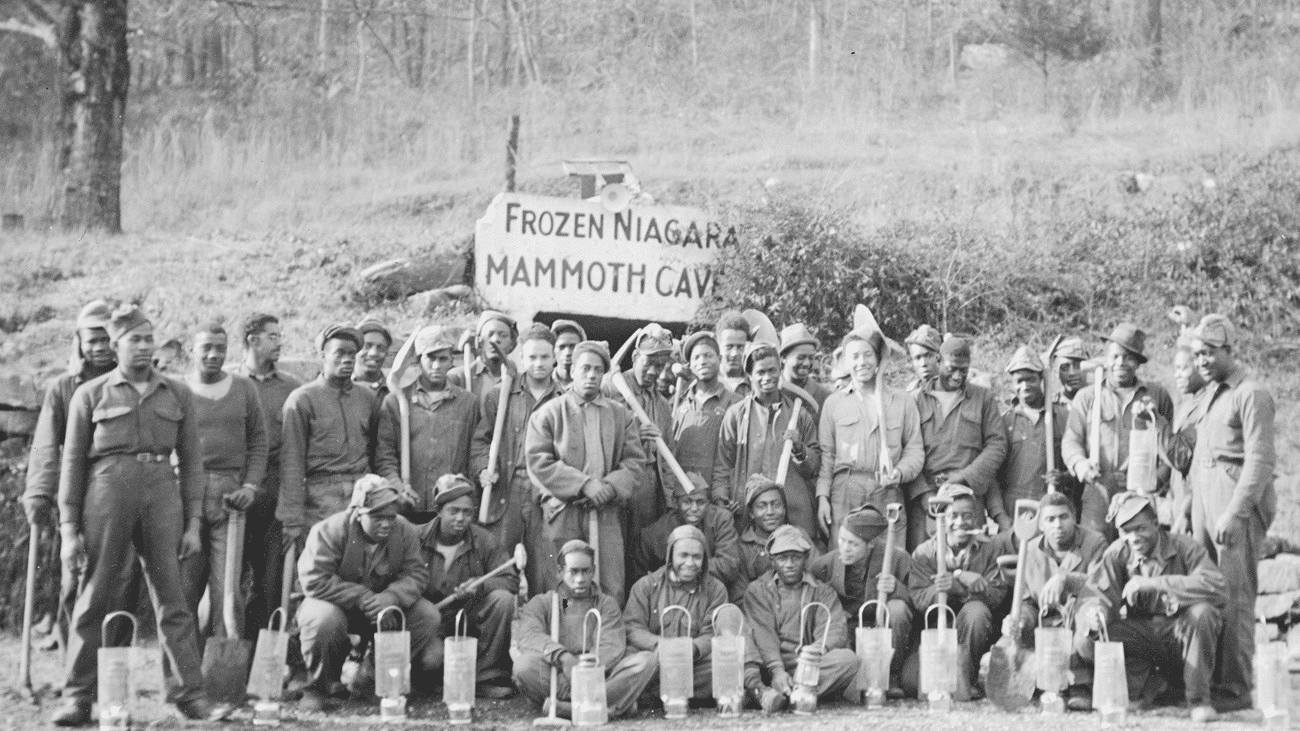
When the guide staff was assembled, none of the black guides were asked to stay on as cave guides, including the 4th generation Bransfords: Clifton, Arthur, Eddie, Elzie, and George.
This ended a century of both black and white cave guides working alongside each other and the legacy of Bransfords guiding at Mammoth Cave. (Source: NPS)
But the legacy of the Bransfords was not to be forgotten if their descendant Jerry had anything to do with it.
“It’s not about Jerry Bransford,” he said. “I believe I’ve been chosen as a representative to tell their stories, things that went untold for more than 170 years.” (Source: The News Enterprise)
Through Jerry Bransford, the incredible story of the Bransford Family and their connection to Mammoth lives on.

CHECK OUT: A Brief (& Informative) History Of America’s National Park Rangers
6. Some Notable People Visited Mammoth Cave
Another of the surprising Mammoth Cave National Parks Facts has to do with the number of notable people who visited the cave in the nineteenth century.
Two royal visitors to Mammoth Cave were Dom Pedro, Emperor of Brazil, and Grand Duke Alexis of Russia, who dined in the banquet hall on February 1, 1872.
Edwin Booth, considered to be America’s greatest actor of the time, recited Hamlet’s “Soliloquy” in what is today known as Booth’s Amphitheatre, which is located in the cave.
Booth wrote about his joke-telling cave guide in a letter to his daughter:
“We went laughing at his weak jokes; for it was funny to us actors to see this fellow throwing his wit at us, and our appreciation of his acting made him very happy.”

Edwin Booth Saved President Lincoln’s Son
Now here’s an incredible story: Robert Todd Lincoln was the eldest of Abraham and Mary Lincoln’s four sons.
He was a 17-year-old student at Harvard when the Civil War began.
The young Lincoln spent the majority of the war years at college.
Fate brought Lincoln and Booth together in a train station in Jersey City, N.J., in the midst of the Civil War.
At the time, Robert was on a holiday from Harvard. He was traveling from New York to Washington, D.C., while Booth was on his way to Richmond, Va., with his friend, John T. Ford (owner of Ford’s Theatre in Washington).
The exact date of the encounter is unknown, although Robert consistently recalled it as having occurred in 1863 or 1864.
Robert Lincoln wrote the most succinct account of the incident in a 1909 letter to Richard Watson Gilder, editor of The Century Magazine, who asked him to verify that the episode actually took place:
The incident occurred while a group of passengers were late at night purchasing their sleeping car places from the conductor who stood on the station platform at the entrance of the car. The platform was about the height of the car floor, and there was of course a narrow space between the platform and the car body. There was some crowding, and I happened to be pressed by it against the car body while waiting my turn.
-Robert Lincoln
In this situation the train began to move, and by the motion I was twisted off my feet, and had dropped somewhat, with feet downward, into the open space, and was personally helpless, when my coat collar was vigorously seized and I was quickly pulled up and out to a secure footing on the platform. Upon turning to thank my rescuer, I saw it was Edwin Booth, whose face was of course well known to me, and I expressed my gratitude to him, and in doing so, called him by name.
On April 15, 1865, Booth’s younger brother, John Wilkes, assassinated President Abraham Lincoln.

Mammoth Cave Also Hosted A “Swedish Nightingale”
Jenny Lind, known as the “Swedish Nightingale,” was a world-renowned opera singer who visited Mammoth Cave with her tour company on March 31, 1851.
She was a member of the Royal Swedish Academy of Music and visited the cave during her 1850-1852 North American Tour that was promoted by the famous showman Phineas Taylor (PT) Barnum.
When she arrived to the United States, more than 30,000 admirers greeted her in New York as she disembarked from the steamship Atlantic.
Lind made an impression on the cave guides during her time in the cave, and a well-known natural cave feature found in Gothic Avenue was originally known as the “Devil’s Armchair,” but was renamed “Jenny Lind’s Armchair” after she sat in the stone seat while on her cave tour.
It is unknown if Lind sang while inside Mammoth Cave, but the cave’s acoustics are well suited for musicians and singers alike.
Facts About Biscayne National Park
7. Mammoth Cave Includes The World’s Largest Cave System
Turning our attention to the extraordinary geology of the cave itself, another Mammoth Cave National Park Fact, which may or may not be surprising, is that it includes the world’s largest cave system.
Mammoth Cave is a limestone labyrinth with more than 400 miles of it explored, and the park estimates the potential for another 600 miles in its system.
As the National Park Service reports, there were three significant cave connections on the Flint Ridge side of the valley that took place between the 1950s and 60s that would pave the road for the famous 1972 connection.
The first was in 1955 when Crystal Cave was connected with Unknown Cave.
Five years later, in 1960, Salts Cave was connected to Colossal Cave and in 1961 Salts Cave was connected to Unknown Cave.
This meant that all four caves (Crystal, Unknown, Colossal, and Salts) were connected and identified as one: the Flint Ridge Cave System.
The Longest Cave In The World
On September 9, 1972, a team of six people entered the Austin Entrance on the Flint Ridge side of the valley in Mammoth Cave National Park.
They traveled through the cave for 12 hours before reaching Hanson’s Lost River, where they believed a connection to the Flint Ridge Cave System existed.
As a result of their efforts, the Flint and Mammoth Cave systems were connected, forming a total of 144.4 miles long cave system.
This made it the longest known cave in the world at the time, and it became known as the Mammoth Cave System because of the popularity of the name Mammoth Cave.

8. Mammoth Cave Is Home To A Wide Variety Of Wildlife
Just when you thought we couldn’t come up with any more Mammoth Cave National Park Facts we surprise you. Believe it or not, the cave is home to a wide variety of wildlife.
It’s home to home to a variety of birds, crustaceans, fish, insects, mammals, mussels, plants and reptiles. These animals thrive in the lush forests, waterways, and cave systems found throughout the park.
This includes over 70 species that are classified as threatened, endangered, or state listed such as the Kentucky cave shrimp and sheepnose mussel.
Mammoth Cave Is Known For Blind Or Eyeless Animals
Another fascinating fact related to the park’s wildlife is that Mammoth Cave is home to the blind or eyeless animals that have adapted themselves to living, generation after generation, in the total darkness of the cave.
As a matter of fact, the first blind animal known in the world was the Mammoth Cave Blindfish which was discovered about 1888 in Echo River.
Among the more than 100 species of animal life that have been found in the caves are blind or eyeless crawfish, cave crickets, beetles, spiders, snails and worms.

Everglades National Parks Facts
9. Mammoth Cave Is Also Home To A Wide Variety Of Plant Species
In addition to all of the wonderful wildlife which you will experience at Mammoth Cave, it’s also home to a wide variety of plant life.
Two beautiful rivers, the Green and the Nolin, flow into the park. This provides a wide variety of soil coupled with ample rainfall and a temperate climate. And all of this adds up to a variety of flora.
Along the trails and river bluffs are several hundred species of flowers and thirty-one variety of ferns can be seen from early spring to late fall.
There are also more than 100 different types of trees and shrubs, primarily deciduous, with some pines, cedars and other evergreens which make up the forests.
The National Park Service provides a Park Species List.

Facts About Grand Teton National Park
10. Mammoth Cave Is A UNESCO World Heritage Site
Another fascinating Mammoth Cave National Park Fact is that the park is a UNESCO World Heritage Site.
What does it mean to be a UNESCO World Heritage Site? World Heritage Sites are designated by UNESCO (United Nations Educational, Scientific and Cultural Organization) for having cultural, historical, scientific or other form of significance.
World Heritage is the designation for places on Earth that are of outstanding universal value to humanity and as such, have been inscribed on the World Heritage List to be protected for future generations to appreciate and enjoy.
UNESCO decided to officially protect Mammoth Cave National Park as a World Heritage Center in 1981, mainly due to the fact that almost every type of cave formation is present within the site.
The flora and fauna living in Mammoth Cave is the richest cave-dwelling wildlife known to man, with over 130 species within the cave system alone.
Facts About Great Smoky Mountains National Park
11. Mammoth Cave Is Also An International Biosphere
In 1990, Mammoth Cave National Park became an International Biosphere.
What is an International Biosphere?
Biosphere reserves are ‘learning places for sustainable development’. They are sites for testing interdisciplinary approaches to understanding and managing changes and interactions between social and ecological systems, including conflict prevention and management of biodiversity.
They are places that provide local solutions to global challenges. Biosphere reserves include terrestrial, marine and coastal ecosystems. Each site promotes solutions reconciling the conservation of biodiversity with its sustainable use. (Source: UNESCO)
Visitors can explore the Mammoth Cave Biosphere Region’s spectacular beauty where people and organizations are connecting to nature and improving regional environmental quality.
The world’s longest cave system, forests, river valleys, farmlands, and towns and thousands of years of human history earned this area the recognition of International Biosphere Reserve.

CHECK OUT: Facts About Guadalupe Mountains National Park
12. The Park Is Home To The Endangered Species Of Kentucky Cave Shrimp
The last of our surprising Mammoth Cave National Park Facts has to do with the Kentucky Cave Shrimp.
According to the National Park Service, the Kentucky cave shrimp (Palaemonius ganteri) is a federally endangered, fully cave adapted, freshwater shrimp found only in the immediate vicinity of Mammoth Cave National Park.
First described by W.P. Hay in 1901, these shrimp inhabit the lowest level cave passages in ten groundwater basins. Eight of these basins lie wholly or partially in the park and two lie just upstream from the park.
The designated critical habitat for Kentucky cave shrimp is the Roaring River in Mammoth Cave, which means that the park, along with the U.S. Fish and Wildlife Service (USFWS), is responsible for ensuring the survival of this extraordinary species.

ALL 63 Us National Parks Ranked By Experts
You should probably know that we don’t just make this stuff up out of thin air. We’ve spent our entire adult lives exploring and filming America’s national parks and public lands.
We’ve worked with the National Park Service, the Department of Interior, USDA, and the U.S. Forest Service for years creating films on important places and issues. Our work has been featured in leading publications all over the world and even some people outside of our immediate family call us experts on the national parks.
- A Number Of Different Native American Groups Lived In The Green River & Mammoth Cave Area
- According To Legend, The Cave Was Discovered By A Hunter Tracking A Wounded Bear
- Mammoth Cave Played An Important Role In The War Of 1812
- A Slave Made Mammoth Cave The Popular Site That It Is Today
- An NPS Guide Is The Descendant Of Slaves Who Served As Mammoth Cave Guides
- Some Notable People Visited Mammoth Cave
- Mammoth Cave Includes The World’s Largest Cave System
- Mammoth Cave Is Home To A Wide Variety Of Wildlife
- Mammoth Cave Is Also Home To A Wide Variety Of Plant Species
- Mammoth Cave Is A UNESCO World Heritage Site
- Mammoth Cave Is Also An International Biosphere
- The Park Is Home To The Endangered Species Of Kentucky Cave Shrimp

Helpful Articles
National Parks: All 63 National Parks Ranked By Experts
National Monuments: Ultimate List Of National Monuments
Landmarks: 25 Famous Bucket List Landmarks In America (MUST-SEE)
Park Rangers: A Brief (& Informative) History Of America’s National Park Rangers
Gifts: 50 BEST National Park Gifts For The National Park Fan In Your Life
Books: 45 BEST National Parks Books
Revolutionary War Sites: 10 BEST Revolutionary War Sites In America
Civil War Sites: 10 BEST Civil War Sites In America
Civil Rights Sites: 10 BEST Civil Rights Sites In America
National Parks In Movies: Look Familiar? 25+ CLASSIC Movies Filmed In The National Parks
Television Shows: Look Familiar? 10+ CLASSIC Television Shows Filmed In The National Parks
What to Bring to Mammoth Cave
Gear we recommend for Mammoth Cave. Affiliate links support our work at no cost to you.
Affiliate disclosure: Some links on this page earn us a small commission at no extra cost to you. We only recommend gear we actually use.