


The Quick Take
Everyone tells you Acadia is a top-5 national park. After visiting four times across three seasons, here’s what I actually think.
Acadia is a great park. It’s not a perfect park. And the gap between what people expect and what they actually get is wider than you’d think.
The good stuff is really good. The coastline is dramatic. The fall colors are otherworldly. Cadillac Mountain at sunrise is one of those moments that stays with you. But there are real problems here that nobody talks about. And if you go in with sky-high expectations you might come away wondering what the fuss was about.
I’m going to give you the honest version. The parts that live up to the hype, the parts that don’t, and the stuff that nobody mentions that might actually be the best part of the whole park.
Love Acadia? It's one of 117 threatened public lands destinations we're tracking. Get the free briefing.
At a Glance
| Lives up to the hype | Falls short |
|---|---|
| The rocky coastline and Ocean Path | Summer crowds on a tiny island |
| Cadillac Mountain at sunrise | Hiking is pleasant, not world-class |
| October fall foliage | Bar Harbor is crowded and overpriced |
| Popovers at Jordan Pond House | Mount Desert Island is small (3 days covers it) |
| The Rockefeller carriage roads by bike | Park Loop Road traffic in peak season |
The honest verdict: A little overrated, but only if you come in August and never leave the Park Loop Road. Visit in October, bring a bike for the carriage roads, and explore the quiet corners (Schoodic, Bass Harbor, Isle au Haut), and Acadia earns every bit of its reputation.
What Lives Up to the Hype
The Coastline
The rocky Maine coastline is legitimately spectacular. This is the real deal. Pink granite cliffs dropping into the Atlantic. Waves crashing against boulders that have been there since the last ice age. The smell of salt and pine mixed together in a way that only happens in this corner of the country.
Ocean Path from Sand Beach to Otter Cliff is one of the best coastal walks in America. It’s only about 2 miles but every turn gives you a new angle on the granite coastline. I’ve walked it in fog, in golden hour light, in the blue hour before sunrise, and it delivers every single time. The granite catches light differently depending on the time of day, going from cool grey to warm pink to almost orange at sunset.
Thunder Hole lives up to its name when the tide is right. The sound of the ocean compressing into that narrow channel and exploding upward is genuinely impressive. When the tide is wrong it’s just a wet rock with 40 disappointed folks standing around it. Check the tide tables before you go. You want to be there about two hours before high tide for the best show.
The Park Loop Road gives you most of these views from your car. That’s both a blessing and a curse. More on the curse part later.
Cadillac Mountain at Sunrise
Between October and March, Cadillac Mountain is the first place in the United States to see the sunrise. That’s a legitimate claim and a legitimate experience.
I’ve done it twice. Both times were worth the 4am alarm. Watching the sun break over the Atlantic from the highest point on the eastern seaboard (1,530 feet, which doesn’t sound like much until you realize it rises straight from sea level) is something you feel in your chest. The light turns the granite pink and the ocean goes from black to deep blue to gold in about ten minutes. I’ve photographed sunrises in dozens of national parks and this one is in my top five.
You need a vehicle reservation to drive up Cadillac Summit Road during the busy season, which runs roughly late May through late October. Check the exact 2026 dates on Recreation.gov before you book. The reservation system started in 2021 and honestly it improved the experience. Before that it was a zoo up there, with cars parked on the road for a quarter mile from the summit. Now you get a parking spot and enough room to actually set up a tripod without elbowing someone. The reservation costs $6 per vehicle and you book through Recreation.gov. Here’s the trick. 70% of sunrise reservations drop just two days in advance at 10am ET. Set an alarm. The 90-day-advance batch (the other 30%) sells out fast, but the two-day window is where most folks actually score their spot.
Fall Foliage
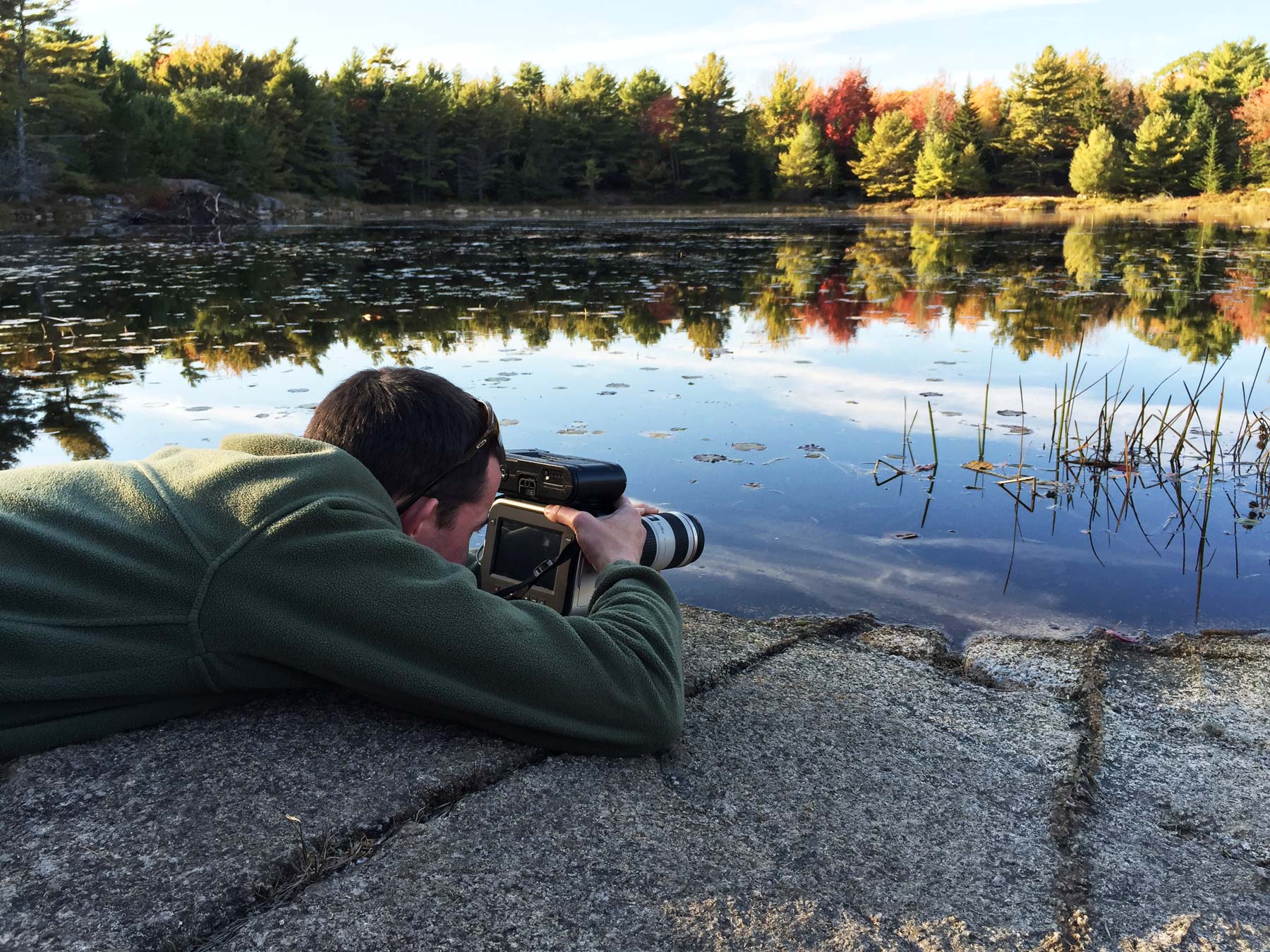
Acadia in October is something else. I don’t say that lightly. The combination of orange and red maples against the blue ocean and pink granite creates color combinations that look photoshopped but aren’t. I’ve shown people my October Acadia photos and had them accuse me of oversaturating the colors. Nope. That’s what it actually looks like.
Peak foliage usually hits in the second or third week of October. If you time it right, the drive around Eagle Lake and Jordan Pond is some of the best fall scenery in the entire country. Better than Vermont in my opinion because you get the ocean backdrop. Vermont gives you rolling hills and red barns. Acadia gives you all that color reflected in pristine lakes with the Atlantic Ocean a ten-minute drive away.
This is when Acadia is at its absolute best. If you can only visit once, come in mid-October.
Jordan Pond House
The popovers at Jordan Pond House are famous for a reason. Fresh-baked, served with butter and jam, eaten on the lawn overlooking Jordan Pond with the Bubbles reflected in the still water. It’s touristy and I don’t care. It’s one of my favorite traditions in any national park. The popovers themselves are light, airy, and about the size of a softball. Order two per person minimum.
Get there early or prepare to wait. The line gets serious by mid-morning in summer. I’ve waited 45 minutes in July. In October it’s more like 15 minutes and the experience is ten times better because you’re eating them surrounded by fall color.
What Doesn’t Live Up to the Hype
The Crowds Are Brutal
This is my biggest complaint about Acadia. The park gets about 4 million visits a year packed into a space that’s only 49,000 acres. For context, Yellowstone gets similar numbers but is 45 times bigger. Grand Canyon gets similar numbers but has ten times the space. Acadia is trying to handle Yellowstone-level traffic on a fraction of the real estate.
The result is that Acadia can feel suffocating in July and August. The Park Loop Road becomes a parking lot. Sand Beach fills up by 9am and the overflow parking situation gets desperate. Parking at every major trailhead is a competitive sport that starts at 7am and doesn’t let up until dinnertime. I’ve driven past Jordan Pond three times in a single morning trying to find a spot.
The Island Explorer bus system helps but it has its own crowds and schedule limitations. Some routes fill up and leave you standing at a stop watching full buses drive past. It’s free, which is great, but “free” means everyone uses it.
I visited in July once. Never again during peak summer. The park went from feeling like a natural sanctuary to feeling like a theme park with better scenery.
The Hiking Is… Fine
I’ll probably get hate mail for this but Acadia’s hiking is overrated.
The trails are short. The elevation gains are modest. The longest “major” hike in the park is maybe 5 miles. If you’ve hiked in the Rockies or the Sierra Nevada or even done serious sections of the Appalachian Trail, Acadia’s trails will feel like warmups. There’s nothing here that will test your fitness or make you question your life choices on a switchback.
The Beehive and Precipice trails are the exceptions. These iron rung ladder trails are genuinely thrilling and give you real exposure. Precipice especially will get your heart rate up even if you’re an experienced hiker. You’re climbing near-vertical rock faces on iron rungs hammered into the cliff, with genuine consequences if you slip. They’re the best trails in the park by a wide margin and they deliver an experience you can’t get in many other places east of the Mississippi.
But the rest? The Bubbles trail, Gorham Mountain, most of the Cadillac summit trails. They’re pleasant walks. Not challenging hikes. If you’re coming from out west expecting big mountain experiences you’ll be adjusting your expectations within the first hour.
What Acadia’s trails do well is variety. You can hike along the ocean, through forests, up granite faces, and around pristine lakes all in one day. The scenery-per-mile ratio is high even if the mileage is low. It’s just that none of them are particularly long or demanding.
Bar Harbor Is Overcrowded and Overpriced
Bar Harbor is the gateway town to Acadia and it suffers from the same disease as Gatlinburg near the Smokies. It’s become a tourist trap that barely resembles the fishing village it used to be.
The restaurants are mediocre and expensive. The lobster rolls are fine but you’ll pay $35-40 for something you could get better and cheaper in Portland, which is only about three hours south. The shops are filled with the same generic souvenirs you find at every tourist town in America. T-shirts, fudge, and shot glasses. The streets are packed shoulder to shoulder in summer and cruise ship days make it even worse.
Finding parking in Bar Harbor between June and September requires either rare luck or a willingness to walk half a mile from wherever you end up.
My advice is to stay in Southwest Harbor or Bass Harbor instead. Quieter side of the island. Better restaurants with more character. Easier access to the less-visited western side of the park. Thurston’s Lobster Pound in Bernard is where the locals eat, and the lobster there is better than anything in Bar Harbor at half the stress.
Mount Desert Island Is Small
The island that contains most of Acadia is only about 108 square miles. You can drive across it in 30 minutes. After 2-3 days you’ll have seen the major highlights and the park starts feeling repetitive. You run out of new ground to cover.
Compare that to parks out west where you could spend two weeks and still miss things. Glacier could occupy you for a month. Yellowstone has areas most folks never see. Acadia doesn’t have that depth. It’s a park you can thoroughly experience in 3 days, and honestly, 4 days feels like a stretch unless you really slow down. That’s either a pro or a con depending on your perspective, but it’s worth knowing before you book a week-long trip.
The Stuff Nobody Mentions
Here’s where Acadia gets interesting. The best experiences in this park are the ones that don’t make the Instagram highlight reels.
The Carriage Roads Are Actually the Best Part
John D. Rockefeller Jr. built 45 miles of crushed-stone carriage roads through Acadia in the early 1900s because he hated automobiles and wanted to preserve horse-drawn access to the park’s interior. The irony is that his anti-car crusade created the single best way to experience Acadia today, by bike.
The carriage roads are car-free, beautifully maintained, and wind through some of the prettiest scenery in the park. The 17 hand-built stone bridges are architectural gems, each one designed to blend into the landscape. The craftsmanship is remarkable. Rockefeller spent over $4 million (in early 1900s dollars) building these roads and it shows.
Most folks ignore the carriage roads because they’re not “trails” in the traditional sense. That’s a mistake. Biking the loop around Eagle Lake and Jordan Pond is the single best way to experience Acadia. You cover more ground than hiking, you avoid the road traffic entirely, and the gentle grades mean you can actually look around instead of staring at your feet. The dappled light through the birch and maple canopy, especially in fall, is the kind of thing that makes you stop pedaling and just sit there for a minute.
Rent a bike in Bar Harbor or bring your own. This is the thing I tell everyone to do and the thing most people skip. Don’t be most people.
Bass Harbor Head Lighthouse
The most photographed lighthouse in Maine and one of the most photographed in the country. It’s on the quiet side of the island and most folks never make it over there because it’s a 30-minute drive from Bar Harbor. The viewpoint is a short walk down some steep rocks and the sunset views are remarkable. The lighthouse perched on the cliff with the ocean stretching to the horizon and the last light of the day turning everything amber is a shot worth chasing.
Get there 45 minutes before sunset to claim a spot on the rocks. Bring a wide-angle lens if you’re a photographer.
The Stars
Acadia was designated an International Dark Sky Park and on clear nights the stargazing is remarkable. This is one of the darkest spots on the eastern seaboard, which makes sense when you realize there’s nothing between you and the open Atlantic. The Milky Way over the ocean from Sand Beach on a clear September night is one of my top experiences in any park. I’ve shot the Milky Way from dozens of locations across the country and Acadia’s combination of dark skies and compelling foreground subjects (the lighthouse, the rocky coast, the granite cliffs) puts it in elite company.
The park even hosts Night Sky Festivals and ranger-led stargazing programs. They’re free and genuinely well done.
Schoodic Peninsula
Most folks don’t even know this part of Acadia exists. Schoodic Peninsula is a separate section of the park located on the mainland, about an hour’s drive from Bar Harbor. It has the same dramatic rocky coastline as Mount Desert Island but with about 5% of the crowds. On a busy summer day you might share Schoodic Point with a dozen other people instead of a thousand.
The 6-mile loop road takes you past some of the most powerful wave action on the coast. Schoodic Point, where the ocean crashes against flat granite ledges, is hypnotic. I’ve sat there for an hour watching waves explode against the rock. The pink granite here is some of the most striking on the entire coast, worn smooth and flat by centuries of wave action. If you have a fourth day in the area, spend it here.
Isle au Haut
If Schoodic is the quiet alternative, Isle au Haut is the secret one. This is the most remote section of Acadia, accessible only by mail ferry from Stonington, about an hour’s drive south of Ellsworth. Fewer than 10,000 people visit Isle au Haut each year. For comparison, Mount Desert Island gets over 3 million. That ratio tells you everything you need to know.
The park occupies about half the island. The other half is home to a year-round population of a few dozen people that grows to a few hundred in summer. There’s an inn, a small grocery store, a lobster truck, and not much else. The hiking trails run through dense spruce forest and along rocky headlands with ocean views that rival anything on the main island. The difference is that you’ll have them almost entirely to yourself.
Isle au Haut requires planning. The ferry runs a limited schedule, and the number of day-trippers allowed on the island each day is capped. But if you want to experience Acadia the way it felt before 4 million annual folks found it, this is the closest you’ll get.
The 2026 Fee and Reservation Situation
A few logistics that changed for 2026 and will affect your planning.
Acadia’s standard entrance fee is $35 per vehicle for a 7-day pass, or $20 per person for walk-ins. The $80 America the Beautiful annual pass covers Acadia and every other federal fee area in the country. If you’re visiting from outside the United States, check current entrance fees on the official park page before you go, since federal fee policy has been in flux.
The Cadillac Summit Road vehicle reservation runs the busy season, roughly late May through late October (confirm the exact 2026 dates on Recreation.gov). It costs $6 per vehicle. Separate time slots exist for sunrise and daytime. The sunrise slots are the ones that sell out. Remember the two-day-advance window. 70% of all reservations drop at 10am ET just two days before. That’s your best shot.
Parking remains the biggest practical headache in the park. There’s no reservation system for most parking areas, which means it’s still first-come, first-served at Sand Beach, Jordan Pond, and every other popular trailhead. The NPS recommends arriving before 9am at popular spots during peak season, and honestly even that’s optimistic on a sunny July Saturday. The Island Explorer shuttle is free and runs from late June through Columbus Day, but it fills up too. There’s no perfect solution here. Just show up early or visit in shoulder season.
So Is Acadia Overrated?
A little. Yeah.
It’s overrated because people compare it to parks five or ten times its size and expect the same depth of experience. It’s overrated because July and August crowds make it feel more like a theme park than a national park. It’s overrated because the hiking gets hyped as world-class when it’s really just pleasant.
But it’s not overrated in October. It’s not overrated on the carriage roads at 7am with the fog lifting off Jordan Pond. It’s not overrated when you’re standing on Cadillac Mountain watching the first sunrise in America while the granite turns pink beneath your feet. It’s not overrated when you’re eating popovers on the lawn at Jordan Pond House with the Bubbles reflected in still water. It’s not overrated at 2am when the Milky Way arcs over the ocean and there’s not a single artificial light on the horizon.
And it’s definitely not overrated if you know where to look beyond the obvious. The folks who only do the Park Loop Road and Cadillac Mountain are getting maybe 60% of what Acadia has to offer. The carriage roads, Bass Harbor at sunset, Schoodic Peninsula, Isle au Haut. That’s where the park shows its real personality. The parts that don’t show up on the highlight reel are the parts that make you want to come back.
Acadia is a great park that gets treated like a perfect park. Adjust your expectations and you’ll love it. Come in shoulder season and you’ll understand why people rave about it. Come in August and you’ll wonder what all the fuss was about.
When to Visit Acadia
Best time overall: Mid-October. Peak foliage, manageable crowds, crisp weather. Daytime highs in the 50s and 60s. This is the move.
Runner-up: September. Summer crowds are gone, weather is still warm enough for comfortable hiking, early fall colors start appearing. The ocean is actually at its warmest for the year if you’re brave enough to swim at Sand Beach (the water is still about 60 degrees, so “warm” is relative).
Avoid: July and August unless you enjoy sitting in traffic on a one-lane park road. The weather is great but so is everyone else’s idea to visit. Parking is a nightmare. Everything requires a reservation or a 6am arrival.
Sleeper pick: Late May or early June. Wildflowers are blooming, migratory birds are everywhere (Acadia is one of the best birding spots in New England), and the summer crowds haven’t descended yet. Some facilities might not be fully open but the park is accessible and the shoulder-season quiet is worth the trade-off. The Cadillac Summit Road reservation kicks in around late May, so if you come early enough you can drive up without one.
Skip: Winter. Unless you’re into cross-country skiing on the carriage roads and extreme solitude. The park is open year-round but most facilities close by late October. The weather is brutal. Beautiful, sure, but brutal. Snow, ice, wind, and single-digit temperatures are standard.
How Many Days Do You Need?
Three days is the sweet spot. That gives you time for the Park Loop Road, a couple hikes including Precipice or Beehive, the carriage roads by bike, Cadillac Mountain sunrise, Jordan Pond House popovers, and Bass Harbor Head Lighthouse at sunset. That’s a full, satisfying trip with some breathing room.
Four days if you want to explore the Schoodic Peninsula section on the mainland, which most folks skip entirely. It’s much quieter and has great rocky coastline views without the crowds. Add a day and subtract the stress.
Five days if you want to take the ferry to Isle au Haut. That’s a full-day commitment with the ferry schedule and the hiking on the island, but it’s the most remote and uncrowded section of Acadia by a mile. Literally by miles. You’d be hard-pressed to see more than a handful of other people on the trails there.
Two days is doable but rushed. You’ll hit the highlights but miss the texture. And the texture, the fog rolling through the valleys at dawn, the quiet moments on the carriage roads, the unhurried lunch at Jordan Pond House, that’s what makes Acadia special.
The Bottom Line
Visit Acadia. It deserves to be on your list. Just come in the right season, bring a bike, and leave your Rocky Mountain hiking expectations at home.
It’s a beautiful, unique park that happens to be smaller and more crowded than its reputation suggests. When you catch it right, the combination of coastline, fall color, dark skies, and those Rockefeller carriage roads creates something genuinely magical. When you catch it wrong it’s a pretty island with a traffic problem.
Come in October. Trust me on this one.
What to Bring to Acadia
Gear we recommend for Acadia. Affiliate links support our work at no cost to you.
More Than Just Parks may earn a small commission from purchases made through these links, at no extra cost to you. We only recommend gear we would actually use.
Affiliate disclosure: Some links on this page earn us a small commission at no extra cost to you. We only recommend gear we actually use.
More Than Just Parks Film Watch our 4K film of Acadia We spent weeks in Acadia, one of our favorite public lands destinations, capturing it the way it deserves. Take a few minutes and see it for yourself.


