Historic Sites In Kansas. More Than Just Parks has 10 incredible must-see sites for you to visit.
I’ve been to so many of these amazing places since retiring from teaching in 2018. Did I mention that I taught history? I spent a lifetime teaching about the history behind these momentous sites. Then I got to see them firsthand. And now I’m sharing the stories of these incredible places with you. It doesn’t get any better than that!
I’m going to give you my list of the 10 Historic Sites In Kansas that you’ll want to see.
To be clear, this list includes national park sites (as in sites managed by the National Park Service) as opposed to national parks. It also includes sites that are not managed by the National Park Service. After all, we’re more than just parks!
If you are planning a trip to Kansas then you might want to pick up a copy of Kansas Off the Beaten Path: Discover Your Fun by Patti DeLano.
let’s get started.
10. Geodetic Center of North America
Kansas is known for its vast prairies, rolling hills, and natural beauty. The state has one of the most miles of river than any other state in the Great Plains and is home to the world’s largest contiguous tallgrass prairie.

It’s also home to some amazing historic sites which More Than Just Parks is thrilled to discuss. In fact, we’re giving you our list of the Top 10 Best Historic Sites In Kansas. And we’re kicking off our list at #10 with the Geodetic Center of North America.
The North American Continental Divide Marker #38 is a historical marker located in the countryside of Osborne, Kansas. It is considered the geographical center of North America, and was used by surveyors and mapmakers as a reference point to plot the continental United States.
The marker is located on privately-owned land, 18 miles southeast of Osborne, and is not open to the public.
However, an identical bronze monument, set by the Kansas Historical Society, the State Highway Commission, and the Osborne Area Chamber of Commerce, is located near the Osborne Post Office and can be visited to commemorate the marker site.
This monument is a way for people to celebrate this unique geographical location, that is considered a important part of American and Kansas history.
9. Augusta Historic Theater
We move from a historic marker to a historic theater. At #9 on our list of the Best Historic Sites In Kansas is the Augusta Historic Theater.

The Augusta Historic Theater is a unique and historic landmark located in downtown Augusta, Kansas. The theater was built in 1935 and is considered one of the last American movie theaters built in the 1930s.
Despite its age, the theater is still in operation today and continues to be a popular destination for locals and folks.
Visitors can enjoy the beautifully restored Egyptian-themed Art Deco interior of the theater, which adds to the ambiance and atmosphere of the venue.
The theater offers a variety of entertainment options, including modern-day movies, live theater performances, musical concerts, and various events.
The Augusta Historic Theater is a great place to enjoy a night out and experience a piece of American history while enjoying a good performance.
8. Monuments Rocks National Landmark
Kansas is a place known for its rolling plains, but there are also some geologic wonders to be explored as well. At #8 on our list of the Best Historic Sites In Kansas is the Monuments Rocks National Landmark.

Monument Rocks, also known as Chalk Pyramids, are a series of rock formations located south-southeast of Oakley, Kansas.
The site is a unique and significant geological formation, and it was the first landmark chosen by the U.S. Department of the Interior as a National Natural Landmark.
The rocks are made of chalk, and they are believed to have been formed during the Cretaceous Period, around 80 million years ago. This period marked when the Western Interior Seaway divided North America in half.
The rock formations are composed of massive chalk formations that rise up to 70 feet above the surrounding grasslands and are considered one of the most significant natural landmarks in Kansas.
Visitors can hike around the formation and take in the breathtaking views of the surrounding landscape, and learn more about the geology and natural history of the area.
7. Coronado Heights
Imagine a place that’s 300 feet above the surrounding valley floor, offering sweeping vistas of the surrounding countryside. Actually, you don’t have to imagine. You can see it for yourself. Welcome to Coronado Heights.
Coronado Heights Park is located in Saline County, Kansas. The park was originally constructed in 1932 as a Works Progress Administration (WPA) project and was designed to provide recreational opportunities for the public. After the WPA work was completed, the park was transferred to the Saline County Commissioners for management in 1936.
Fifty years later, in 1986, the Smoky Valley Historical Association (SVHA) took over the care of the park and made significant improvements. A stone shelter building and an observation deck were built, along with stone picnic sites, restrooms, and a stone front gate to the park.
a special monument was built by Lindsborg artist, John Whitfield and SVHA volunteers to commemorate the history of the park.
The eroded face of Coronado Heights reveals a panorama of geological history as well, covering 230 million years of time. At its base are gray and red shales that made up the floor of an ancient salt water sea.
Coronado Heights Park is a popular destination for hiking, picnicking and enjoying the natural beauty of Kansas. It offers spectacular views of the surrounding landscape, and visitors can also explore the monument, shelter building, and observation deck to learn more about the history of the park and its significance.
6. Seelye Mansion
We’re on to our next site which is is considered one of the most popular and well-known mansions in Kansas, and has been featured on the History Channel. At #6 on our list of the Best Historic Sites In Kansas is Seelye Mansion.
The mansion was built in 1883 by Dr. John Alexander Seelye, a prominent businessman and philanthropist. The mansion is a fine example of Victorian architecture and it is known for its intricate details, such as the ornate woodwork and stained glass windows.
To truly appreciate the Seelye Mansion, visitors can take a tour of the property, during which they will learn about the history of the mansion, its architecture, and the life of the Seelye family.
The tours are guided by experienced docents and they provide a unique opportunity to step back in time and learn more about the history and culture of Abilene and Kansas.
The tour may include the inside of the mansion, the gardens and the outbuildings. It is a great way to understand the lifestyle and culture of the late 19th century.
5. Nicodemus National Historic Site
We’re on to our Top 5 Historic Sites In Kansas. And, while we’re More Than Just Parks, our remaining sites our national park sites. Now you may be asking yourself what exactly is a national park which is why we have a wonderful article which answers that question for you.
At #5 on our list of the Best Historic Sites In Kansas is the Nicodemus National Historic Site.
It’s dedicated to preserving the history of one of the first and largest settlements of African Americans in the West after the Civil War.
Established in 1976, the site commemorates the history of Nicodemus, which was founded in 1877 as part of the Exoduster Movement, a mass migration of African Americans from the South to the West in search of better economic opportunities and to escape racial oppression.
Nicodemus became a thriving community with its own school, church, and businesses, but it also faced challenges such as droughts, grasshopper plagues, and economic depression. Despite these challenges, the town persevered and has remained a symbol of hope and resilience for African Americans.
Today, the Nicodemus National Historic Site reminds us of the history and culture of African Americans in the West, and offers visitors a glimpse into the past through preserved buildings, interpretive exhibits, and educational programs.
The site is a valuable resource for those seeking to learn more about the history of African Americans in the West and their contributions to American society.

Things To See
The historic site includes several buildings that are open to the public, including the First Baptist Church, the schoolhouse, and the Nicodemus Museum, which displays artifacts and exhibits that tell the story of the town’s history and the lives of its residents.
The site also includes a visitors center, where visitors can learn more about the history of Nicodemus, the struggles and achievements of its residents, and the legacy of African American settlement in the American West.
“Without a struggle, there can be no progress.”
-Frederick Douglass
20 BEST Black History Sites In America For You To Visit
4. Lewis & Clark National Historic Trail
We’re on to the “Final Four.” And at #4 on our list of the Best Historic Sites In Kansas is one of the most famous historic trails in America. Welcome to the Lewis and Clark National Historic Trail.

The Lewis and Clark National Historic Trail follows the historic outbound and inbound routes of the Lewis and Clark Expedition.
Commemorating the Lewis & Clark Expedition (1804-06), the Trail connects 16 states (Pennsylvania, Ohio, West Virginia, Kentucky, Indiana, Illinois, Missouri, Kansas, Nebraska, Iowa, South Dakota, North Dakota, Montana, Idaho, Washington and Oregon).
This trail is administered by the National Park Service. It’s not a hiking trail, but does provide opportunities for hiking, boating and horseback riding at many locations along the route.
What Can I See In Kansas That’s Connected To This Historic Trail
If you enjoy military history then you’ll love our next site. At #3 on our list of the Best Historic Sites In Kansas is Fort Larned National Historic Site.

What Can I See In Kansas That’s Connected To This Trail?
Excellent question. I recommend the Lewis and Clark Interpretive Pavilion. Located at White Cloud, Kansas, it describes the expedition’s passage through the area in 1804 and then again in 1806.
It’s a beautiful open-air pavilion located in Riverfront Park. It was constructed in preparation for the Lewis and Clark bicentennial Commemoration on July 3-4, 2004.
The pavilion contains an interactive touchscreen monitor and interpretive panels with information on the Lewis & Clark expedition, the Missouri River and the Kanza Nation.
While you’re there, I would also recommend a drive along the Frontier Military Historic Byway.
It was originally built to move soldiers and supplies. If you travel it today, however, you’ll find various landmarks such as Fort Leavenworth and the John Brown Museum.
10 MUST-SEE Historic Sites In Illinois
3. Fort Larned National Historic Site

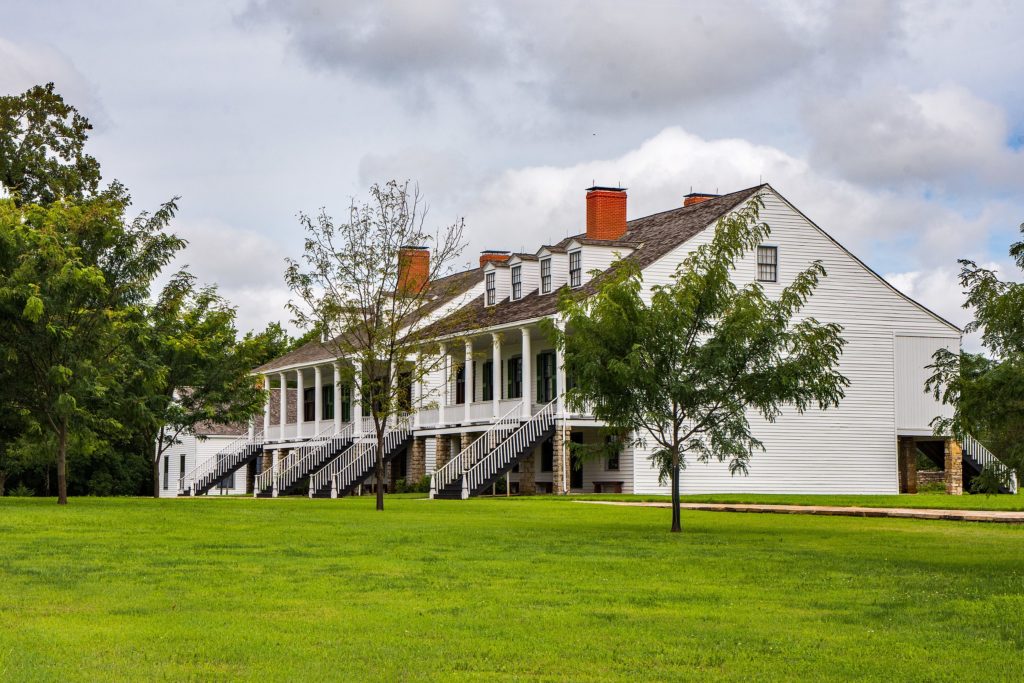
Fort Larned National Historic Site is located in Larned, Kansas that preserves the remains of Fort Larned, a military post that played an important role in the history of the American West.
The fort was established in 1859 as a base of operations for the protection of the Santa Fe Trail, one of the most important trade routes of the 19th century. The fort served as a military post until 1878 and it was also a home for the native American tribes that were relocated by the government.
Explore The Fort & Learn About Its History
The Fort Larned National Historic Site offers visitors the opportunity to explore the remains of the fort and learn about its history.
Visitors can take a self-guided tour of the fort, which includes restored and reconstructed buildings, such as officers’ quarters, a barracks, and a guardhouse, as well as an interpretive center and a museum that displays artifacts and exhibits that tell the story of the fort’s history.
A Glimpse Into The Lives On The Soldiers
The site also offers a glimpse into the lives of the soldiers and their families who lived at the fort, and the Native American tribes that were relocated to the area.
It also offers the chance to hike the nature trails and witness the wildlife, and the beautiful prairie landscape that surrounds the fort.
It’s a great place to learn more about the history of the American West, the role of the military in the frontier, and the interactions between the different cultures that lived in the area.
10 MUST-SEE Historic Sites In Oklahoma
2. Fort Scott National Historic Site
We’re down to our final two sites. And, in the runner-up spot at #2 is another historic fort. It’s Fort Scott National Historic Site.

Fort Scott National Historic Site is located in Fort Scott, Kansas. It preserves the remains of Fort Scott, a military post that played an important role in the history of the American West.
The fort was established in 1842 as a base of operations for the protection of the Santa Fe Trail, one of the most important trade routes of the 19th century, and the protection of the settlers in the area.
It served as a military post until 1853 and it was also a home for the native American tribes that were relocated by the government.
The Fort Scott National Historic Site offers visitors the opportunity to explore the remains of the fort and learn about its history.
Learn About The Role Of The Military On The American Frontier
Visitors can take a self-guided tour of the fort, which includes restored and reconstructed buildings, such as officers’ quarters, a barracks, and a guardhouse, as well as an interpretive center and a museum that displays artifacts and exhibits that tell the story of the fort’s history and the life of the soldiers and their families who lived at the fort.
The site also offers the chance to explore the surrounding area, including the historic downtown of Fort Scott and the beautiful prairie landscape that surrounds the fort.
Visitors can also learn about the role of the military in the frontier and the interactions between the different cultures that lived in the area. It’s a great place to learn more about the history of the American West and the role of the military in the westward expansion.
10 BEST Civil War Sites IN AMERICA
1. Brown V. Board Of Education National Historic Site
As the #1 Historic Site In Kansas, More Than Just Parks has chosen a place which celebrates one of the most consequential Supreme Court decisions in American history. Welcome to Brown V. Board Of Education National Historic Site.

Brown v. Board of Education of Topeka was a landmark Supreme Court decision. Handed down on May 17, 1954, the Court’s unanimous decision stated that “separate educational facilities are inherently unequal.”
The case originated in 1951. The local public school district in Topeka, Kansas, following a widespread practice known as “segregation” or “separate but equal,” refused to enroll the daughter of a local black resident at the school closest to their home.
Oliver Brown’s daughter was instead required to ride a bus to a segregated black elementary school farther away.
Thurgood Marshall
The Browns and twelve other local black families filed a class-action lawsuit claiming that the practice of “separate but equal” was unconstitutional.

Overturning an 1896 Supreme Court decision (Plessy v Ferguson) which had ruled that racial segregation was not in itself a violation of the Fourteenth Amendment’s Equal Protection Clause, the Court ruled it was unconstitutional.
Not only that, but led by attorney Thurgood Marshall, the plaintiffs were able to successfully argue that “separate but equal” was inherently unequal.
10 BEST Civil Rights Sites In America
“Where you see wrong or inequality or injustice, speak out, because this is your country. This is your democracy. Make it. Protect it. Pass it on.”
-Thurgood Marshall
Take A Deeper Dive
Believe it or not, I was one of those guys who sat in class taking notes and, when the professor threw out the name of what sounded like an interesting book, I not only wrote it down, I went out and purchased it. Yes, I am that guy which is why I ended up teaching history.
There’s a wonderful book about the landmark Supreme Court decision. Written by Richard Kluger, it’s titled Simple Justice: The History of Brown v. Board of Education and Black America’s Struggle for Equality. It’s a modern classic!
45 Best National Parks Books (Great Gifts For Park Lovers)
Today It’s A National Historic Site
Monroe Elementary School was one of the four segregated elementary schools for black children in Topeka.
The restored school was purchased by the National Park Service and reopened in 2004 as a National Historic Site.
Visitors will find exhibits, films, interactive activities as well as interpretive programs led by National Park Service staff. It’s open daily 9 a.m.-5 p.m., except on Thanksgiving, Christmas and New Year’s Day.
25 Famous Bucket List Landmarks In America
- Brown V. Board Of Education National Historic Site
- Fort Scott National Historic Site
- Fort Larned National Historic Site
- Lewis & Clark National Historic Trail
- Nicodemus National Historic Site
- Seelye Mansion
- Coronado Heights
- Monuments Rocks National Landmark
- Augusta Historic Theater
- Geodetic Center of North America
We’re Jim Pattiz and Will Pattiz, collectively known as the Pattiz Brothers and we absolutely LOVE the national parks.
You should probably know that we don’t just make this stuff up out of thin air. We’ve spent our entire adult lives exploring and filming America’s national parks and public lands.
We’ve worked with the National Park Service, the Department of Interior, USDA, U.S. Forest Service, and more for years creating films on important places and issues. Our work has been featured in leading publications all over the world and even some people outside of our immediate family call us experts on the national parks.
And, in 2018, our father – having spent a lifetime teaching history – joined us so that he could help us to tell the stories behind these amazing places.
Meet The Parks Brothers

We Hope You’ll Follow Our Journey
Our goal here at More Than Just Parks is to share the beauty of America’s national parks and public lands through stunning short films in an effort to get Americans and the world to see the true value in land conservation.
We hope you’ll follow our journey through the parks and help us to keep them the incredible places that they are. If you’re interested in joining the adventure then sign up below!