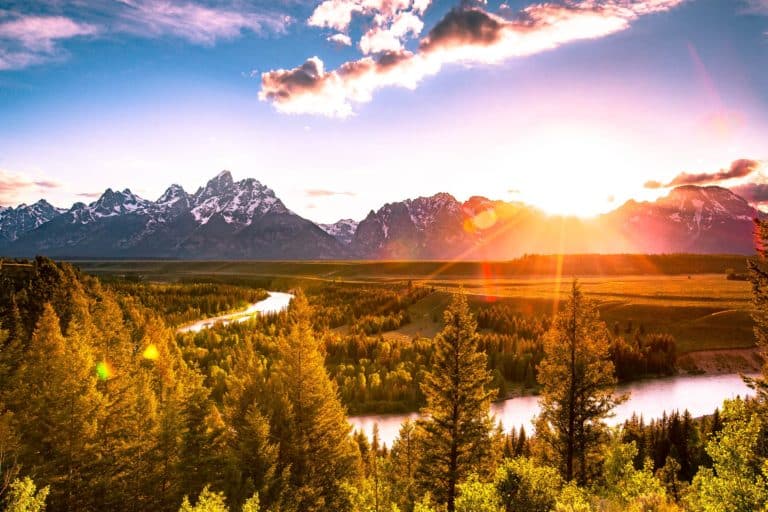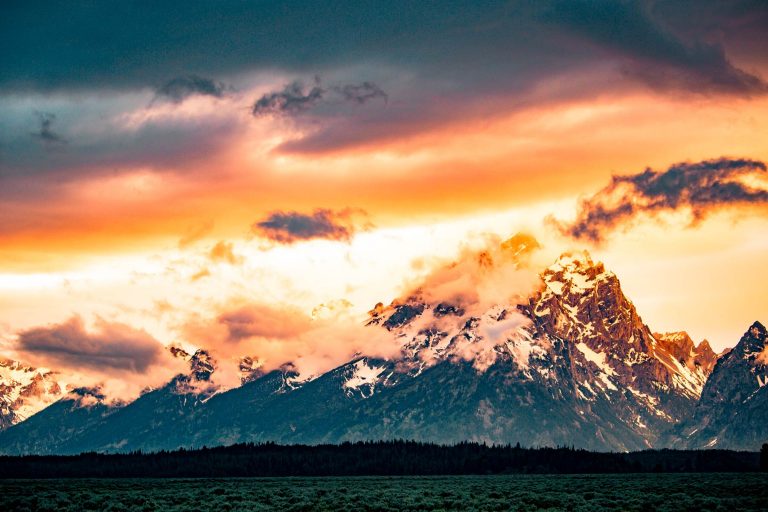


Grand Teton National Park is 310,044 acres of granite peaks rising straight out of the valley floor of Jackson Hole, Wyoming. No foothills, no warning. The mountains just go up, almost 7,000 feet of them, and the fault that lifted them is still at work under the sagebrush.
The mountains are only half the story. The human record here runs from hunters who worked this valley thousands of years before the pyramids to a Rockefeller buying ranches under a false name to save the view. What follows are 15 verified facts about the park. For trip planning, start with our full Grand Teton National Park guide.
Tony Pattiz taught American history for more than 25 years before he began writing it for this site. Every date, number, and name below has been checked against the National Park Service, the U.S. Geological Survey, and the primary sources listed at the end of this article. Last verified July 2026.
Grand Teton National Park Basics
- Location: Northwestern Wyoming, just south of Yellowstone
- Size: 310,044 acres, roughly 485 square miles, per the NPS Geodiversity Atlas
- Highest point: Grand Teton, 13,775 feet, the second highest peak in Wyoming after Gannett Peak
- Visitation: 3,800,648 recreation visits in 2025, per NPS Stats, a top-10 national park
- Established: February 26, 1929; expanded to its present boundaries on September 14, 1950
- Wildlife: Grizzly and black bears, bison, moose, elk, and pronghorn
1. Earthquakes Along the Teton Fault Built the Skyline
The skyline you came to see is the work of earthquakes, not slow erosion. The Teton fault runs about 40 miles along the base of the range, and the National Park Service estimates that each major quake moves the land roughly ten feet, the mountain block lurching up while the valley floor drops down.
Love Grand Teton? It's one of 117 threatened public lands destinations we're tracking. Get the free briefing.
Repeat that for ten million years and the ledger becomes hard to believe. The U.S. Geological Survey puts the total offset along the fault at almost 30,000 feet, most of it hidden because the valley side is buried in sediment. What remains in view is dramatic enough, nearly 7,000 feet of relief with no foothills to soften it. The fault is still active. Its last major earthquakes struck about 4,800 and 8,000 years ago, which in geologic terms is recent history.

2. People Have Lived With This Valley for More Than 11,000 Years
Who came first? Hunters were working Jackson Hole at the end of the last ice age, and the park’s record of human history and culture spans more than 11,000 years. Those early people moved with the seasons, hunting and gathering on the valley floor in summer and following the game out when the snow returned.
The valley never stopped being Native ground. The Eastern Shoshone, Shoshone-Bannock, Blackfeet, Crow, and Nez Perce are among the 24 tribes the park recognizes today as traditionally associated with this land. The valley fed people for thousands of years before anyone called it Jackson Hole.

3. French Trappers Gave the Tetons Their Indelicate Name
Here is the one everyone whispers about on the trail. French-speaking fur trappers working this country in the early 1800s looked at the three central summits and called them les trois tétons, which translates, politely, to “the three breasts.” The name attached itself to the Grand, Middle, and South Tetons and never let go.
It is a reminder that a lot of names on American maps came from whoever showed up first with a pencil and an imagination. Other peoples had older names for these peaks, among them the Three Brothers, but the trappers’ joke is the one the mapmakers kept.

4. A Carved Stone Keeps the John Colter Mystery Alive
John Colter left the Lewis and Clark Expedition on its way home and turned back west, into country no American had described. During the winter of 1807 to 1808 he explored the greater Yellowstone region, perhaps the first white man to do so, and he is widely considered the first of the mountain men. Whether he crossed Jackson Hole and stood under the Tetons is the part historians still argue about, because the middle stretch of his route was never recorded.
That is what makes the Colter Stone so tantalizing. In 1933, near Tetonia, Idaho, on the west side of the range, a piece of rhyolite turned up carved into the shape of a human head, with “John Colter” on one side and “1808” on the other. If genuine, it would put Colter over Teton Pass. The Park Service is careful to say the stone has never been fully authenticated. It remains an open question carved in rock.
5. Jackson Hole Is Named for a Fur Trapper Who Worked This Valley
The mountain men who followed Colter came for beaver, whose fur made the felt hats that were the height of fashion in the early 1800s. One of them, David “Davey” Jackson of the Rocky Mountain Fur Company, based his trapping operations in this valley. To the trappers, a “hole” was a high valley ringed by mountains, and this one became Davey Jackson’s Hole, a name credited to his partner William Sublette in 1829.
By the 1840s fashion had turned from beaver felt to silk, the streams were nearly trapped out, and the fur era faded. The name lost the apostrophe and the first name, but it held. So did Jackson Lake, Jackson, and the whole geography of the map you drive today.
6. The First Proven Ascent of the Grand Came in 1898
On August 11, 1898, William “Billy” Owen, the Reverend Franklin Spalding, and ranch hands Frank Peterson and John Shive reached the summit of the Grand Teton. Spalding, a veteran of many Colorado climbs, led the hardest stretch near the top, and the route they pioneered is still climbed today as the Owen-Spalding.
Were they actually first? Nathaniel Langford and James Stevenson claimed the summit in July 1872 during the Hayden Survey, and the argument over their claim has never been settled. As the Wyoming State Historical Society puts it, barring new evidence the controversy simply continues. What the 1898 party has that no earlier claim does is documentation, which is why their names went on the mountain’s most famous route.
7. President Chester Arthur Rode Through in 1883
The first president to see this country came decades before it was protected. In the summer of 1883, Chester A. Arthur crossed Wyoming on horseback on his way to Yellowstone, riding down the valley of the Gros Ventre River and north past the Tetons and Jackson Lake when the region was still roadless wilderness. The 1883 expedition entered Yellowstone on August 23.
He did not travel light. His party included Secretary of War Robert Todd Lincoln, son of the 16th president, and General Philip Sheridan of Civil War fame, who organized the whole trip and hoped the scenery would turn the president into an ally for Yellowstone. A photographer named Frank Jay Haynes came along to prove it all happened.
8. A Rockefeller Quietly Bought the Valley to Save It
This is one of the great conservation stories in America, and one of the most bitterly contested. The original 1929 park protected only the Teton Range and six glacial lakes at its base. After touring the valley in the 1920s and seeing shabby roadside development creeping in, John D. Rockefeller Jr., encouraged by park champion Horace Albright, began buying private land through a front called the Snake River Land Company, more than 35,000 acres for about $1.4 million. He hid his name because prices would have jumped the moment it surfaced.
Jackson Hole did not say thank you. When Franklin Roosevelt protected 221,000 acres as the Jackson Hole National Monument on March 15, 1943, furious ranchers drove 500 cattle across the new monument in armed protest, and Congress tried to abolish it outright. The standoff did not end until Rockefeller’s land finally entered federal hands on December 16, 1949, and on September 14, 1950, Harry Truman signed the law merging park, monument, and gift into the 310,000-acre Grand Teton National Park you visit today. The John D. Rockefeller Jr. Memorial Parkway, linking the park to Yellowstone, honors the man who would not take no for an answer.
I believe that every right implies a responsibility; every opportunity, an obligation; every possession, a duty.
John D. Rockefeller Jr., from his personal credo
9. Jackson Hole Has Been on Movie Screens for Almost a Century
Film crews found this valley early. A 23-year-old John Wayne made his debut as a leading man here in The Big Trail in 1930, a Western so early it predates the park’s modern boundaries.
The classics kept coming. Kirk Douglas floated through in The Big Sky (1952), and George Stevens shot Shane (1953) on the valley floor with the Tetons standing in for every mythic West a moviegoer ever imagined. Spencer’s Mountain (1963) put Henry Fonda under the same peaks. Later productions from Rocky IV to Quentin Tarantino’s Django Unchained came for the scenery too. Once you know this skyline, you start spotting it everywhere.

10. It Holds the Only Commercial Airport Inside a National Park
Jackson Hole Airport is the only commercial airport in the country located within a national park. You can land a jet with the Teton Range filling the cockpit windows, then drive to your trailhead without ever leaving park country.
The arrangement is an accident of history. The town of Jackson established the airfield in the 1930s, the 1943 monument drew a boundary around it, and the 1950 park absorbed it. Today it is the busiest airport in Wyoming. Most parks ask you to drive in. This one lets you land.
11. The Pronghorn Here Is the Fastest Land Animal in North America
Grand Teton puts you face to face with grizzlies, bison, moose, and elk, but the showstopper of the sagebrush flats is the pronghorn. It is the fastest land animal in North America, able to sprint at 60 miles per hour and, more impressively, to hold better than 40 miles per hour for a full mile.
Why so fast, when nothing alive here can catch one? Biologists point to predators that no longer exist, including the extinct American cheetah that once hunted these grasslands. The pronghorn are still running from a ghost. Each year the park’s herd also makes one of the continent’s great journeys, migrating up to 150 miles south past Pinedale, Wyoming, the second longest land migration in North America.
12. The Smallest North American Bird and the Largest Waterfowl Both Live Here
The park’s birds run from one extreme to the other. The calliope hummingbird, the smallest North American bird, weighs less than a tenth of an ounce. Look for it around blooming scarlet gilia in the canyons in high summer.
At the other end of the scale is the trumpeter swan, the largest waterfowl in North America, found at Oxbow Bend, Swan Lake, and Flat Creek in the National Elk Refuge just south of the park. Trumpeters are often seen in pairs, and those pairs mate for life.

13. The Teton Range Is the Youngest in the Rocky Mountains
This is the geology fact that gets garbled most often, so let me be precise. The U.S. Geological Survey calls the Tetons the youngest mountain range in the Rockies, and possibly in North America. The Teton fault only began moving about 10 million years ago, while most of the surrounding Rockies rose tens of millions of years earlier. The Tetons are still rising.
Young mountains, ancient scars. Cutting through the face of Mount Moran is a black diabase dike about 150 feet wide, formed when molten rock squeezed into cracks in far older stone somewhere between 1.3 billion and 775 million years ago. Similar dark stripes mark the Middle Teton and the Grand, visible from the Teton Park Road.

14. Some of the Park’s Rock Is 2.7 Billion Years Old
The peaks may be geologic adolescents, but the rock they are made of is among the oldest in North America. More than 2.7 billion years ago, seafloor sediments and volcanic debris were buried as much as 20 miles deep and cooked into the banded gneiss that makes up much of the range. Around 2.5 billion years ago, magma worked into the cracks and cooled into the pale granite of the highest peaks.
You do not need a rope to see any of this. The gneiss shows up right along the trail past Hidden Falls, which we cover in our guide to Inspiration Point at Jenny Lake. Stand below the Grand and you are looking at stone that records well over half of Earth’s history. New mountains, old bones.
15. The Park Runs One of the Few Hunts Allowed in a National Park
Most national parks ban hunting outright. Grand Teton is a rare exception, and it was written in from the start. The 1950 law that expanded the park included a provision for an annual elk reduction program, run jointly with the State of Wyoming, to help manage the Jackson elk herd, the largest elk herd in North America.
The Wyoming Game and Fish Department manages the herd toward an objective of 11,000 animals. The park decides each year whether a reduction is needed, and when it is, the program runs from early November into early December with both a park permit and a Wyoming elk license required. It is a working compromise between a healthy herd and a healthy valley, now three-quarters of a century old.

Why Are The Tetons So Jagged?
Because they are young and the ice sharpened them. The range has been rising for less than 10 million years, so erosion has had far less time to wear its peaks down than in the 50 to 80 million year old Rockies around it. Ice Age glaciers then sharpened the high summits and widened the canyons into U shapes.
What It Feels Like to Stand Under the Tetons
Facts only carry you so far. You set up in the dark on the valley floor, cold hands on tripods, and watch first light catch the summits while the sagebrush around you is still gray. The light works its way down the wall of the range like a curtain rising in reverse, and because there are no foothills, the whole 7,000-foot face ignites at once. Moose feed in the willow flats close enough that you can hear the branches pull, and by the time the sun finally reaches the valley floor, the show most people drive in to see is already over.
If you want that morning for yourself, our guide to the best things to do in Grand Teton National Park covers the viewpoints, lakes, and drives worth losing sleep for.
Watch Our Grand Teton Film

Bison, moose, bears, foxes, and beavers all made the final cut. The Tetons are in a class of their own, and this is the film that proves it.
Where These Facts Come From
Every claim in this article was checked against the sources below in July 2026. Numbers that change over time, like annual visitation, are stated with the year they were reported.
- NPS, Geologic Activity at Grand Teton, for the Teton fault, earthquake movement, and the Mount Moran dike
- USGS, Young Mountains, Old Rocks, and USGS, Geology of Grand Teton National Park, for the range’s age, fault offset, gneiss, granite, and dike ages
- NPS Geodiversity Atlas, Grand Teton, for acreage, relief, and establishment dates
- NPS, 2025 Visitation Statistics, and NPS Stats (IRMA), for 2025 recreation visits
- NPS, Associated Tribes of Grand Teton, for the 11,000-year human record and the 24 associated tribes
- NPS, Mystery of the Colter Stone, for John Colter’s travels and the stone’s discovery
- NPS, Grand Teton, and NPS, Jackson Lake Overlook, for the naming of the Tetons and Jackson Hole
- WyoHistory.org, Who First Climbed the Grand?, for the 1898 ascent and the 1872 controversy, and WyoHistory.org, The President Arthur Expedition, for the 1883 presidential trip
- NPS, Creation of Grand Teton National Park, for the 1929 park, 1943 monument, Rockefeller purchases, and 1950 merger
- NPS, Jackson Hole Airport, and the Jackson Hole Airport history, for the airport facts
- NPS, Path of the Pronghorn Turnout, NPS, Birds of Grand Teton, and NPS, Elk Management, for the wildlife facts
- LocalNews8, A Look Back at Movies Filmed in Jackson Hole, for the film history
Keep Exploring Grand Teton
- Grand Teton National Park Guide, our full trip planning hub
- Best Hikes in Grand Teton National Park, from lakeshore strolls to canyon climbs
- The Best Time to Visit Grand Teton
- Grand Teton to Yellowstone Planning Guide, for pairing the two parks
- Yellowstone National Park Facts, more history from next door
- Before you go, check live alerts and air quality on our national park conditions dashboard
What to Bring to Grand Teton
Gear we recommend for Grand Teton. Affiliate links support our work at no cost to you.
More Than Just Parks may earn a small commission from purchases made through these links, at no extra cost to you. We only recommend gear we would actually use.
Affiliate disclosure: Some links on this page earn us a small commission at no extra cost to you. We only recommend gear we actually use.
More Than Just Parks Film Watch our film of Grand Teton We spent weeks in Grand Teton, one of our favorite public lands destinations, capturing it the way it deserves. Take a few minutes and see it for yourself.