


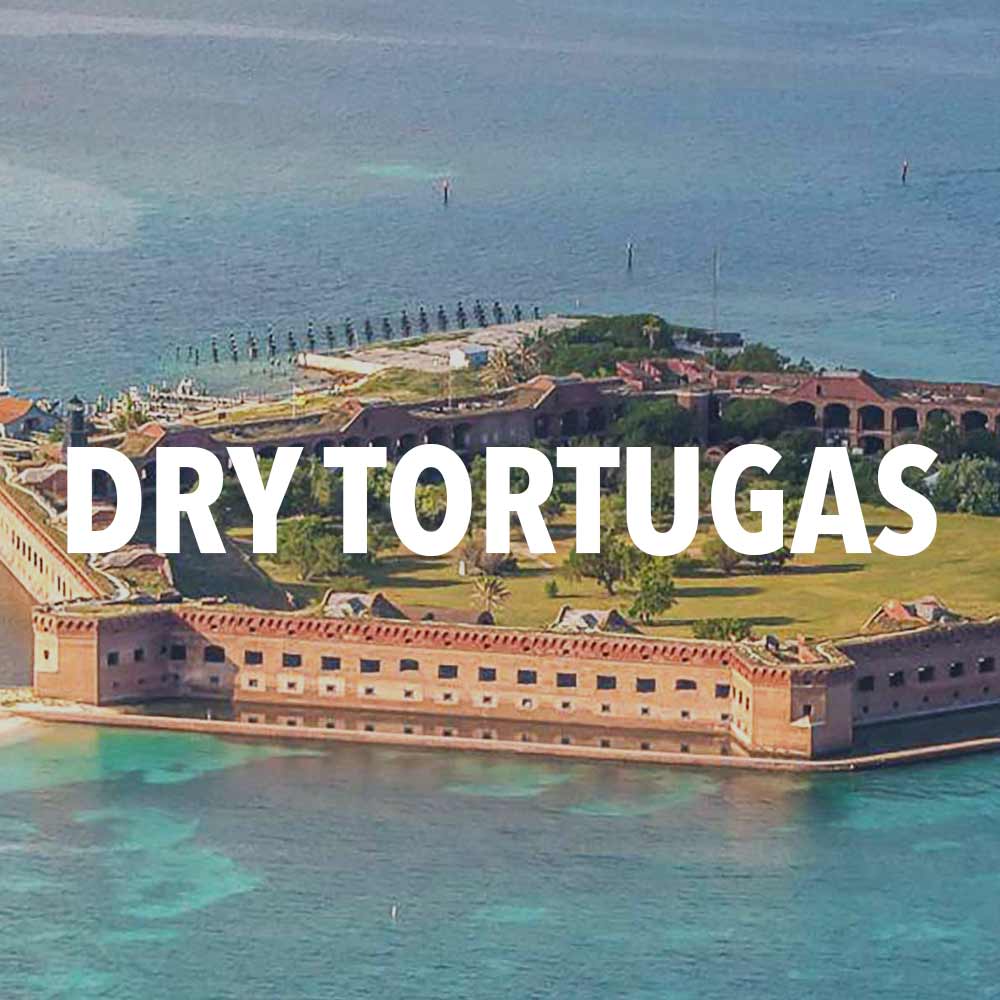
Almost 70 miles west of Key West, past the end of the road and nearly out of sight of land, sits one of the most remote parks in the country. Almost all of its 64,701 acres are open water, and at the center stands Fort Jefferson, a massive coastal fortress built from more than 16 million bricks, the largest masonry structure in the Americas.
Few parks pack this much history into so little dry land. There are Spanish treasure fleets, a Civil War prison that held one of the Lincoln conspirators, a warship on its way to a war, and the sea turtles that gave the islands their name. What follows are 12 facts about Dry Tortugas National Park, each checked against the record. For planning and current conditions, start with our full Dry Tortugas National Park guide.
Tony Pattiz taught American history for more than 25 years before he began writing it for this site, and Dry Tortugas is the kind of place he taught about for decades. It is also one of the few parks the More Than Just Parks brothers have not yet filmed, so this account leans on the National Park Service record, NOAA, and the naval and Lincoln-assassination histories rather than our own time on Garden Key. Every date, number, and name below has been checked against those primary sources. Last verified July 2026.
Dry Tortugas National Park Basics
- Location: Florida, almost 70 miles west of Key West in the Gulf of Mexico
- Size: 64,701 acres across seven small islands, over 99 percent of it open water
- Getting there: Reachable only by boat or seaplane, with no road to the park
- Visitation: 89,355 recreation visits in 2025, per NPS Stats
- Established: Set aside as Fort Jefferson National Monument on January 4, 1935, and redesignated Dry Tortugas National Park on October 26, 1992
Ferry schedules, seaplane options, camping rules, and fees change often, so we do not print them here. Check current conditions, closures, and alerts on our national park conditions dashboard before you plan a crossing.
Love Dry Tortugas? It's one of 117 threatened public lands destinations we're tracking. Get the free briefing.
1. Ponce De Leon Named The Islands For Their Turtles In 1513
The Spanish explorer Juan Ponce de Leon reached these low islands in 1513 and found the surrounding water thick with sea turtles. He called the place Las Tortugas, “the turtles,” and by the traditional account his crew took scores of them aboard for meat, along with seals and seabirds. The National Park Service traces the name to that 1513 landing.
So where did the “Dry” come from? Later sailors and mapmakers added it as a warning. For all the water around them, the islands hold no fresh water at all, a fact that would shape everything anyone tried to do here for the next four centuries.
2. The Caribbean Monk Seal Once Lived Here And Is Now Extinct
The seals Ponce de Leon’s men found were Caribbean monk seals, a species that once ranged across the warm waters of the Caribbean and the Gulf. Hunters killed them for the oil in their blubber through the 1700s and 1800s, and overfishing stripped away the reefs that fed them. The last confirmed sighting came in 1952.
After a five year review, the federal government removed the Caribbean monk seal from the endangered species list in 2008 because it had gone extinct. It is the only seal species driven to extinction by people. The turtles Ponce de Leon named the islands for are still here. The seals he found beside them are gone.
3. The Islands Anchor The Western End Of Florida’s Coral Reef
The geology here is young and alive. As the last ice age ended and seas rose by hundreds of feet, corals grew upward to keep pace with the water, building the reef that shelters these keys today. Florida’s Coral Reef runs more than 350 miles, from the St. Lucie Inlet on the Atlantic coast down and west to the Dry Tortugas, and it is the only living coral barrier reef in the continental United States.
The Dry Tortugas sit at the wild western end of that reef, far from the runoff and crowds of the mainland. Clear water, healthy coral, and near total isolation are exactly why the reef here has drawn scientists and divers for more than a century.

4. A Lighthouse And A Carnegie Laboratory Stood On Loggerhead Key
Loggerhead Key, the largest island in the park, has done more than mark a hazard. Because so many ships came to grief nearby, a brick lighthouse tower rose on the key in 1858, and the Loggerhead Key light still stands as one of the park’s landmarks. An earlier light had gone up on Garden Key back in 1825.
The same remote key later drew scientists. From 1904 to 1939 the Carnegie Institution ran the Tortugas Laboratory here, the first tropical marine research station in the Western Hemisphere. Researchers came to study coral, mangroves, and sea life in one of the clearest and least disturbed reef systems anywhere, work that still shapes how we understand these waters.

5. A 1622 Hurricane Sank A Spanish Treasure Fleet Nearby
One of the great maritime disasters of the age unfolded in these waters. In 1622 a fleet of Spanish galleons sailing from Havana toward Spain was caught by a hurricane. Several ships went down, including the Nuestra Senora de Atocha and the Santa Margarita. The first documented shipwreck in the Dry Tortugas, a 600 ton vessel the Spanish called the Nuestra Senora del Rosario, dates to that same storm.
Hundreds of sailors and passengers died, along with a fortune in gold, silver, and emeralds. The Atocha stayed lost for centuries. On July 20, 1985, after a search of more than 16 years, treasure hunter Mel Fisher found the main wreck near the Marquesas Keys, just east of the Dry Tortugas, in one of the richest shipwreck recoveries in history.
6. More Than 300 Shipwrecks Lie Around The Dry Tortugas
The Rosario was only the beginning. Shallow water, hidden coral and rock, strong currents, frequent storms, and, for centuries, poor charts turned these islands into a ship trap. The Park Service counts more than 300 sunken ships in and around the Dry Tortugas, ranging from the 1600s to the modern era and flying flags from around the world.
That underwater graveyard is now one of the reasons people come. Divers and snorkelers can explore wrecks and reef within sight of the fort, including the Windjammer, an iron hulled sailing ship that went down off Loggerhead Reef in 1907 and now sits in shallow, clear water.

7. Fort Jefferson Is The Largest Masonry Structure In The Americas
After the Louisiana Purchase, shipping through the Gulf of Mexico boomed, and the United States set out to guard the sea lanes. The answer was an enormous fort on Garden Key. Construction ran from 1846 to 1875, nearly thirty years of work, and it was never finished nor fully armed.
Named for Thomas Jefferson, the fort is a six sided giant ringed by a moat and built from more than 16 million bricks, which makes it the largest masonry structure in the Americas. It never saw a battle. During the Civil War the Union held it and used it as a military prison, and later it served as a coaling station for warships. The engineers who designed it could not have known that its most lasting fame would come not from cannon fire but from a single prisoner.

8. The Fort Imprisoned A Lincoln Conspirator
At the close of the Civil War, Fort Jefferson held four men convicted in the conspiracy that killed Abraham Lincoln. The best known was Dr. Samuel Mudd, the physician who had set the broken leg of Lincoln’s assassin, John Wilkes Booth, as Booth fled Washington. Mudd escaped the death penalty by a single vote of the military commission and drew a life sentence instead. He arrived at the fort in July 1865 with three fellow prisoners, Edman Spangler, Michael O’Laughlen, and Samuel Arnold. That fall Mudd tried to escape aboard a supply boat, was caught, and spent time in the fort’s dungeon.
A Prisoner Becomes The Fort’s Doctor
In the late summer of 1867, yellow fever swept the isolated fort. The post physician, Dr. Joseph Sim Smith, caught the disease and died within days, and nearly everyone on the island fell ill. Mudd, a prisoner with every reason to refuse, took over the hospital and treated the sick. Of some 270 cases, only 38 died, a strikingly low toll for yellow fever at the time. One of the dead was his fellow conspirator Michael O’Laughlen, who died on September 23, 1867.
The soldiers did not forget it. Nearly 300 officers and men at Fort Jefferson signed a petition praising Mudd’s work during the epidemic, and on February 8, 1869, President Andrew Johnson pardoned him. Mudd left the island a few weeks later.

9. The USS Maine Left The Tortugas On Its Way To Havana
Fort Jefferson served in more than one American war. In early 1898, the battleship USS Maine lay in Tortugas Harbor before steaming on to Cuba. According to the Park Service, the Maine departed the Tortugas on its fateful mission to Havana, which made this remote harbor the ship’s last stop in American waters.
On February 15, 1898, the Maine exploded and sank in Havana Harbor, killing 266 of her crew. “Remember the Maine” became a rallying cry, and the United States soon declared war on Spain. During the Spanish-American War that followed, Fort Jefferson worked as a supply and coaling base, and it was pressed into brief service again in both world wars.
10. Sea Turtles Still Nest On These Low Sandy Keys
The turtles that gave the islands their name have never left. Five sea turtle species swim the waters of south Florida, the loggerhead, green, hawksbill, Kemp’s ridley, and leatherback, and loggerheads and greens still crawl up the park’s beaches to lay their eggs. Park biologists have monitored nesting here since 1980, and the Dry Tortugas rank among the most productive turtle nesting grounds in the Florida Keys.
Here is a detail that always fascinates me. A sea turtle’s sex is not fixed at conception. It is set by the temperature of the sand around the eggs. Cooler nests tend to produce more males and warmer nests more females, which is one reason a warming climate worries the people who study these animals.

11. The Park Is One Of America’s Great Birding Destinations
Sitting on the flyway between the United States, Cuba, and the Caribbean, the Dry Tortugas act as a rest stop for birds crossing open water. The park’s bird list holds 299 species, and spring migration peaks from April into mid May, when more than 200 species can pass through. Birders travel a long way for a single April morning here.
The signature sight is the sooty tern. Each year up to 80,000 of them, along with thousands of brown noddies, nest on Bush Key, the only significant breeding colony of either bird in the continental United States. Bush Key closes to visitors through the nesting season, but the swirling, screaming cloud of terns can be watched with binoculars from the walls of Fort Jefferson.
12. It Is One Of The Least Visited And Hardest To Reach National Parks
All of this history sits behind 70 miles of open water. There is no bridge and no road. The only ways in are by boat or seaplane, which keeps the Dry Tortugas among the quietest parks in the system. In 2025 the park recorded 89,355 recreation visits, a rounding error next to the millions who pour into the Great Smoky Mountains or the Grand Canyon in the same year.
That distance is the point. Reaching Garden Key still takes real effort, and the reward is a fort, a reef, and a scatter of sandy islands that look much as they did when the boats were smaller and the maps were worse. For a park this remote, the practical details matter, so line them up before you go.
How To See This Yourself
We will be honest with you. The More Than Just Parks brothers have filmed across the National Park System, but Dry Tortugas is not yet one of the parks we have reached, so we will not pretend to describe the cool of the fort’s brick casemates from memory. What we can tell you is how to stand there yourself. Almost everyone arrives on Garden Key, either on the day ferry from Key West or by seaplane, and the fort is a short walk from the dock. Rangers lead walks through Fort Jefferson, the snorkeling starts right off the beach along the old moat wall, and the campground on Garden Key gives the few who stay the night one of the darkest skies in Florida.
Everything about a Dry Tortugas trip depends on the crossing, so plan the boat or seaplane first and check current conditions and alerts before you commit. When we do film here, you will be the first to know.
Where These Facts Come From
Every claim in this article was checked against the sources below in July 2026. Numbers that change over time, like annual visitation, are stated with the year they were reported.
- NPS, Dry Tortugas National Park, for the park’s size, the 16 million bricks, the largest masonry structure claim, and the 300-plus shipwrecks, with NPS, Windjammer Wreck for the iron hulled Avanti
- NPS, Florida: Dry Tortugas National Park, for Ponce de Leon, the 1513 naming, and the 1622 Rosario wreck
- NPS, Dry Tortugas History and Culture, for the 1935 monument and 1992 park dates, the seven islands, and the lighthouses
- NPS, Fort Jefferson, and NPS, Fort Jefferson place page, for the 1846 to 1875 construction, the Civil War prison, and the USS Maine departure
- NPS, Samuel Mudd, NPS, Dr. Mudd’s Cell, and Smithsonian Magazine, for Mudd, the 1867 yellow fever epidemic, and the 1869 pardon
- Federal Register, NOAA final rule (2008), for the extinction of the Caribbean monk seal
- NOAA, Florida Keys National Marine Sanctuary, for Florida’s Coral Reef and its 350-mile reach
- NOAA, Scientific Studies on Dry Tortugas, for the Carnegie Tortugas Laboratory, 1904 to 1939
- Mel Fisher’s Treasures, for the 1985 discovery of the Nuestra Senora de Atocha
- NPS, Sea Turtles of Dry Tortugas, for the turtle species, nesting since 1980, and temperature-dependent sex
- NPS, Birds of Dry Tortugas, and NPS, Bush Key, for the 299-species list and the sooty tern colony
- NPS Stats (IRMA), for 2025 recreation visits
Keep Exploring The Dry Tortugas
- Dry Tortugas National Park Guide, our full trip planning hub
- Florida National Parks Worth Visiting
- Biscayne National Park Facts, more history from South Florida’s waters
- Best Things To Do In Everglades National Park
- National Parks Near Miami Worth The Trip
- All 63 US National Parks Ranked
What to Bring to Dry Tortugas
Gear we recommend for Dry Tortugas. Affiliate links support our work at no cost to you.
More Than Just Parks may earn a small commission from purchases made through these links, at no extra cost to you. We only recommend gear we would actually use.
Affiliate disclosure: Some links on this page earn us a small commission at no extra cost to you. We only recommend gear we actually use.


