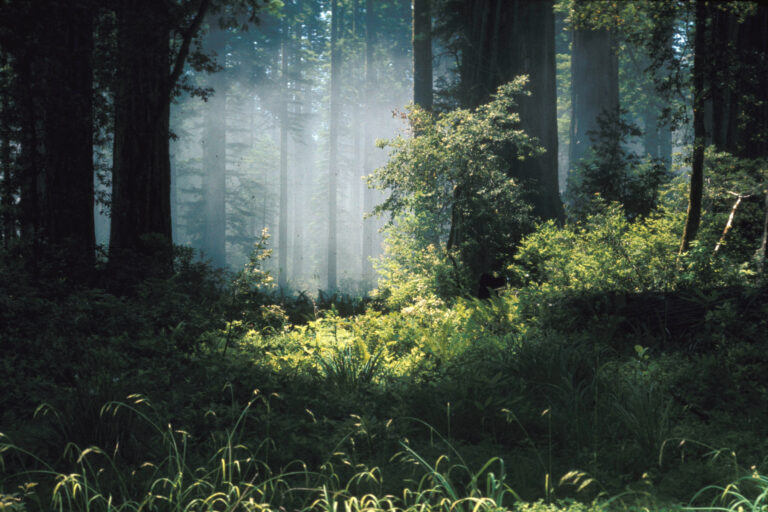


The tallest living things on Earth grow in a strip of foggy coastline in California’s far northwest corner. The tallest of them all, a coast redwood named Hyperion, has been measured at more than 380 feet, roughly 75 feet taller than the Statue of Liberty, torch included. Redwood National and State Parks protects the finest of what remains of these forests, including 45 percent of the old-growth coast redwood left in California.
What follows are 12 verified facts about the redwoods, the people who have lived among them since time immemorial, the loggers who nearly erased them, and the unlikely coalition that saved what stands today. For trails, groves, and trip planning, start with our full Redwood National Park guide.
Tony Pattiz taught American history for more than 25 years before he began writing it for this site. Every date, number, and name below has been checked against the National Park Service and the primary sources listed at the end of this article. Last verified July 2026.
Redwood National and State Parks Basics
- Location: Del Norte and Humboldt counties on California’s far north coast, between Crescent City and Orick
- Size: 131,983 acres of combined federal and state parkland, including 38,982 acres of old-growth redwood forest, per the NPS park facts
- Coast and elevation: 37 miles of coastline, with elevations from sea level to 3,262 feet
- Visitation: 1.2 million recreation visits to Redwood National Park in 2025, and nearly 2.5 million across the joint parks, per NPS Stats
- Established: Redwood National Park on October 2, 1968, expanded March 27, 1978; the three state parks date to the 1920s
- Managed: Jointly by the National Park Service and California State Parks since 1994
- Designations: UNESCO World Heritage Site (September 5, 1980); named part of the California Coast Ranges International Biosphere Reserve in 1983
1. This Is Really Four Parks Managed As One
Why is it called Redwood National and State Parks, plural? Because the name is a merger, and the merger is the story. California moved first, creating Prairie Creek Redwoods State Park in 1923, Del Norte Coast Redwoods State Park in 1925, and Jedediah Smith Redwoods State Park in 1929 to shelter groves the timber industry had not yet reached.
Love Redwood? It's one of 117 threatened public lands destinations we're tracking. Get the free briefing.
The federal government did not arrive for another four decades. President Lyndon B. Johnson signed the act creating Redwood National Park on October 2, 1968, and President Jimmy Carter signed a major expansion in March 1978. Then, in 1994, the National Park Service and California State Parks agreed to manage all four parks as a single unit, a partnership the NPS still calls by its full name, Redwood National and State Parks. Rangers from both agencies work side by side to this day.
2. Nearly Half Of California’s Remaining Old-Growth Redwood Grows Here
The numbers behind these parks are sobering. Of the original old-growth coast redwood forest, 96 percent has been logged. Redwood National and State Parks protects 45 percent of the old-growth that survives in California, some 38,982 acres of trees that were already ancient when the Spanish missions were built.
Walk among them and the statistics fall away. No writer has captured the feeling better than John Steinbeck, who drove through these forests in 1960 and gave the trees a title no committee could improve.
The redwoods, once seen, leave a mark or create a vision that stays with you always. From them comes silence and awe. They are ambassadors from another time.
John Steinbeck, Travels with Charley, 1962
3. People Have Lived Among These Trees Since Time Immemorial
Long before anyone spoke of parks, the redwood coast was home. The NPS names the Yurok, Tolowa, Chilula, Hupa, Karuk, and Wiyot among the peoples of this coast, and four of their languages, Tolowa, Yurok, Hupa, and Karuk, are still spoken here today.
These were river and coast people, living in scores of villages rather than under any single government. The Yurok alone lived in more than 70 villages along the coast and the lower Klamath River. And the redwood itself was the great provider. Family homes and sweathouses were built from planks split out of fallen redwoods, and canoes were carved from fallen trunks, dugouts sturdy enough to work the Klamath and the open coast. The trees were not treated as timber. They were regarded as living beings, and the Yurok Tribe carves redwood canoes by traditional methods to this day.
4. Part Of The Park’s Gateway Is Being Returned To The Yurok Tribe
That living connection produced one of the most remarkable park stories of this decade. On March 19, 2024, the Yurok Tribe, Save the Redwoods League, the National Park Service, and California State Parks signed an agreement to return ‘O Rew, a 125-acre property on Prairie Creek near Orick, to the Yurok Tribe.
The site sits at the center of Yurok ancestral territory and spent more than 50 years as a lumber mill before Save the Redwoods League bought it in 2013 and began restoring it. Under the agreement, the land transfers to the Tribe in 2026, and ‘O Rew will become a southern gateway to Redwood National and State Parks, with more than a mile of new trails, a visitor center telling the Tribe’s story, and a traditional village site with plank houses and a sweathouse. The NPS calls the arrangement the first of its kind, tribally owned land serving as a formal gateway to a national park.
5. A Spanish Missionary Wrote The First Record Of The Redwoods In 1769
Who was the first outsider to see these trees? Legend offers a candidate from an unexpected direction. One old account has a Chinese merchant named Hee-li blown off course across the Pacific around 217 B.C., reaching a coastline forested with what were apparently redwoods. It is a wonderful tale, and historians treat it as exactly that, a tale no evidence confirms.
The first record that survives scrutiny was written by Father Juan Crespi, the Franciscan diarist of the Portola expedition, which marched from San Diego toward Monterey Bay in 1769. On October 10 of that year, hundreds of miles south of today’s park, Crespi wrote in his journal, “In this region, there is great abundance of these trees and because none of the expedition recognizes them, they are named red wood (palo colorado) from their color.” The name stuck. Palo colorado, redwood.
6. Jedediah Smith’s Party Needed Ten Days To Cover Twenty Miles Here
In 1828 the American frontiersman Jedediah Strong Smith led the first documented party of non-Native travelers overland through this redwood country. Smith was already famous as a trapper and pathfinder, and his trek up the north coast proved these forests could be crossed at all.
Barely. The terrain was so rough and the forest so dense that at one stretch the party spent nearly ten days covering about 20 miles, losing horses and mules to exhaustion along the way. That is an average of two miles a day, through trees wider than the animals were long. The region remembers him everywhere you look. The Smith River carries his name, and so does Jedediah Smith Redwoods State Park, the northernmost of the four parks and home to some of the densest old-growth groves on Earth.

7. Logging Took 96 Percent Of The Original Redwood Forest
The original coast redwood forest covered roughly 2 million acres. Then came the Gold Rush. Gold was discovered in the region in 1850, settlers poured in, and by 1853 nine sawmills were already running in Eureka. Redwood lumber, straight-grained, rot-resistant, and slow to burn, became a building wood of choice up and down the Pacific coast.
The mills did not stop for a century. By the time the cutting slowed, 96 percent of the original old-growth coast redwoods had been logged.
The League That Fought Back
The rescue began in 1918, when three scientists, Henry Fairfield Osborn, Madison Grant, and John C. Merriam, founded Save the Redwoods League to buy the groves before the mills reached them. Between 1920 and 1960 the League purchased more than 100,000 acres of redwood forest through donations and matching state funds, and those purchases became the state parks that today anchor the entire system. It is one of the clearest cases in American history of private citizens buying a forest to give it to the future.
8. Three Presidents Gathered To Dedicate One Grove Of Redwoods
On August 27, 1969, a helicopter set down near a ridge-top grove above Redwood Creek, and out stepped an extraordinary guest list. President Richard Nixon had come to dedicate the Lady Bird Johnson Grove, honoring the former First Lady whose advocacy had helped carry the park bill a year earlier. Standing with him were former President Lyndon B. Johnson and California Governor Ronald Reagan, with the Reverend Billy Graham delivering the invocation.
A past president, the sitting president, and a future president, together in one redwood grove. Lady Bird earned the tribute. As First Lady she had championed the Highway Beautification Act of 1965, remembered as Lady Bird’s Bill, and lent her voice to a wave of conservation laws that reshaped how America cares for its wild places. Her grove remains one of the most beloved walks in the park.

9. The World’s Tallest Known Living Tree Hides In The Park
Somewhere in the Redwood Creek watershed stands Hyperion, the tallest tree ever measured. Naturalists Chris Atkins and Michael Taylor found it on August 25, 2006, and a tape drop that year put it at just over 379 feet. By 2019 it had grown to 380 feet 9.7 inches, per Guinness World Records. The Statue of Liberty, base to torch, stands 305 feet. Hyperion is not even unusually thick; taller keeps quieter company than bigger, and the largest tree on Earth by volume is General Sherman, which we cover in our Sequoia National Park facts.
Do not go looking for it. The park has never marked the tree’s location, and after years of trampled ferns, social trails, and trash left by bushwhacking visitors, the NPS closed the surrounding area in 2022. Entering it now risks a $5,000 fine and up to six months in jail. The forest offers hundreds of giants you can stand under legally, and from the ground, honestly, no one can tell the difference.
10. Redwoods Drink Fog And Shrug Off Fire
How does a tree pump water 380 feet into the air? Partly, it doesn’t. It drinks from the sky instead. The NPS reports that redwoods get up to 40 percent of their water from summer fog, caught by specialized needles high in the canopy and dripped down to the forest floor. Add 60 to 140 inches of winter rain a year and you have the wet, mild strip of coast these trees refuse to grow far from.
The rest of the tree is just as well engineered. Bark up to a foot thick, loaded with bitter tannins and carrying almost no flammable pitch, lets mature redwoods survive fires that clear out the competition. And the roots defy belief in the other direction. A 380-foot tree stands on roots that reach only 10 to 13 feet deep, spreading 60 to 80 feet sideways and interlocking with the roots of neighboring redwoods so the grove holds itself up as a community. Built like that, a coast redwood can live 2,000 years, with 500 to 700 counted as an average old age.

11. Hollywood Turned These Forests Into Endor
When George Lucas needed the forest moon of Endor for 1983’s Return of the Jedi, he did not build it. He drove north. The Endor scenes were filmed in Del Norte County, on private timberland and in Jedediah Smith Redwoods State Park. The alien moon audiences saw on screen was this stretch of the California coast.
The redwoods kept working. Forest scenes for E.T. the Extra-Terrestrial were shot around Del Norte County and in Redwood National Park, where the giant trunks made the little alien look even smaller. And in 1997, Steven Spielberg brought The Lost World, the Jurassic Park sequel, to Fern Canyon in Prairie Creek Redwoods State Park, casting its fern-draped canyon walls as a dinosaur-stalked jungle. A note for trivia night, the original Jurassic Park was not filmed here; it was the sequel that came to the redwoods.

12. The Parks Shelter Roosevelt Elk And More Than 400 Bird Species
The trees get the headlines, but the parks are just as much a wildlife refuge. The star is the Roosevelt elk, the largest of the six recognized elk subspecies in North America, with bulls weighing up to 1,200 pounds. Seven herds live in the parks, from Gold Bluffs Beach to the Bald Hills, where the largest herd numbers around 250 animals. Seeing them graze a prairie ringed by old-growth redwoods is one of the great sights in the national park system.
The count only climbs from there. More than 400 migratory and resident bird species have been recorded across the parks, and the habitat mosaic of ancient forest, rivers, prairie, and 37 miles of coastline supports seven federally threatened species, including the marbled murrelet, a seabird that nests high in old-growth redwood canopies, and the northern spotted owl.
What It Feels Like To Stand Under Them
It rolls off the Pacific and through the trunks, and when the sun finally cuts through, the light comes down in visible shafts, like the forest is lit from a projector booth. The thing no photograph carries is the quiet. Old-growth groves swallow sound; you hear your own footsteps on the duff and not much else. They would set up a shot, stop talking, and realize minutes had passed without either of them saying a word. Then you drive ten minutes and you are on an empty beach, or watching an elk herd graze at the forest edge. No other park pairs those worlds so casually.
If you are planning your own visit, our guide to the best things to do in Redwood National Park ranks the groves, trails, and scenic drives worth your time.

Our Redwood Film

We tell people a trip to the redwoods belongs on every list, and this three-minute film is our pitch for why. Watch it big and loud.
Where These Facts Come From
Every claim in this article was checked against the sources below in July 2026. Numbers that change over time, like annual visitation and tree measurements, are stated with the year they were reported.
- NPS, Redwood Park Facts, for acreage, coastline, elevations, designations, wildlife counts, and establishment dates
- NPS, Redwood Frequently Asked Questions, for the old-growth percentages, joint management, rainfall, and redwood lifespan
- NPS news release, April 2026, for 2025 visitation
- NPS, Redwood Area History, for the tribes and languages, the logging boom, and Save the Redwoods League
- NPS news release, March 2024, for the ‘O Rew agreement with the Yurok Tribe
- Redwood Ed, California State Parks, for the Hee-li legend, the Crespi journal entry, Yurok villages and plank houses, and the Jedediah Smith trek
- California State Parks, Jedediah Smith Redwoods, for the park named in Smith’s honor
- Save the Redwoods League, About Us, for the League’s work, with its founding and purchases per the NPS area history above
- The American Presidency Project, for President Nixon’s August 27, 1969 dedication remarks
- Guinness World Records, Tallest Tree Living, and NPR, August 2022, for Hyperion’s measurements, discovery, and closure
- NPS, Fog, Redwoods and a Changing Climate, and NPS, Coast Redwood, for fog drip, bark, roots, and fire resistance
- NPS, Roosevelt Elk, for the elk subspecies, herds, and weights
- Visit Del Norte County, Map of the Movies, for the film locations
Keep Exploring Redwood
- Redwood National Park Guide, our full trip planning hub
- Best Things To Do In Redwood National Park, the groves and trails ranked
- California National Parks Ranked
- Best National Parks Near San Francisco
- Death Valley National Park Facts, more California superlatives
- Before you go, check live alerts and air quality on our national park conditions dashboard
What to Bring to Redwood
Gear we recommend for Redwood. Affiliate links support our work at no cost to you.
More Than Just Parks may earn a small commission from purchases made through these links, at no extra cost to you. We only recommend gear we would actually use.
Affiliate disclosure: Some links on this page earn us a small commission at no extra cost to you. We only recommend gear we actually use.
More Than Just Parks Film Watch our film of Redwood We spent weeks in Redwood, one of our favorite public lands destinations, capturing it the way it deserves. Take a few minutes and see it for yourself.