


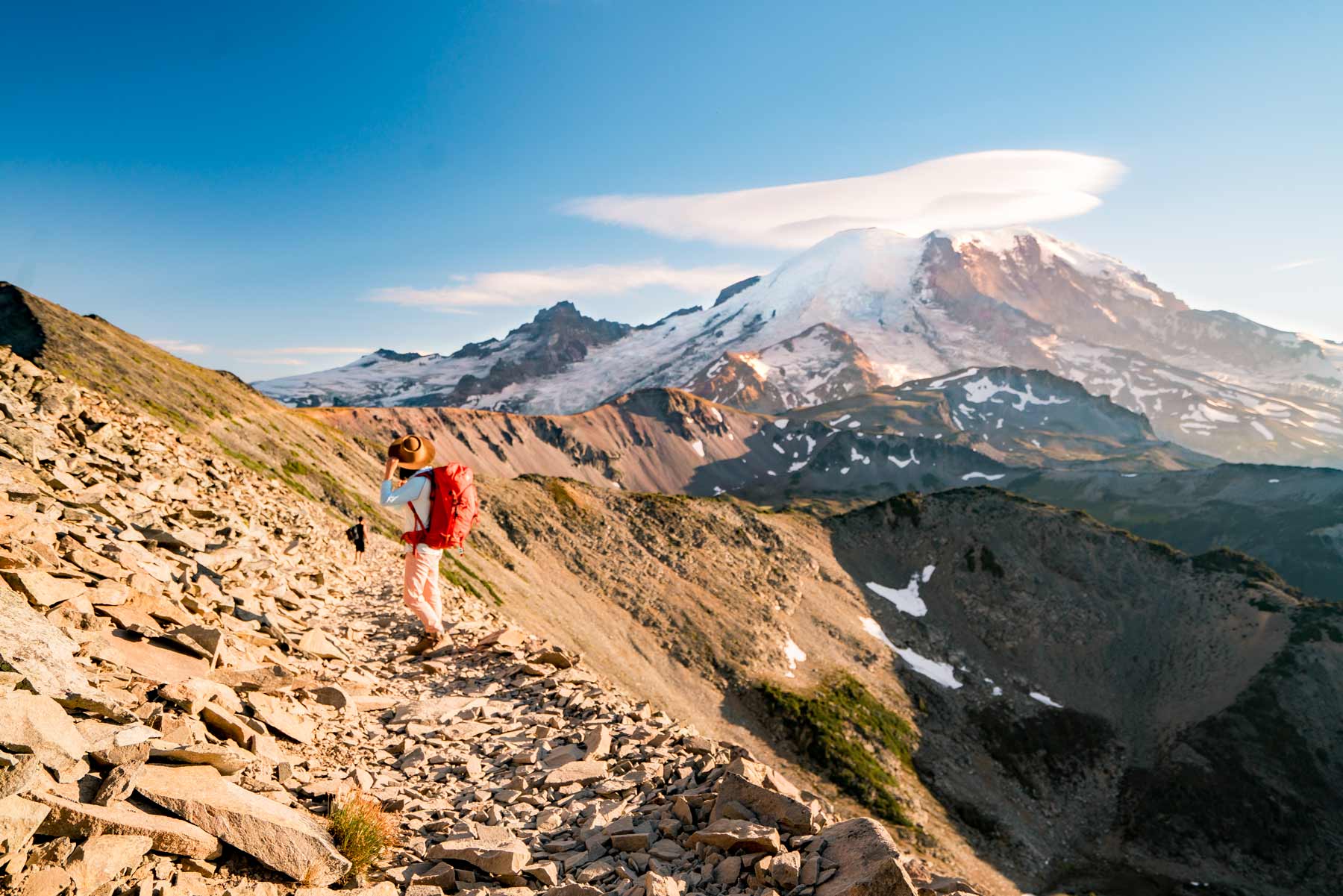
Seattle has one of the best national park doors in the country, and most people who live here only use a fraction of it. There are three real national parks within driving distance, and they are about as different from one another as three parks can be. A glaciated volcano, a wall of alpine wilderness almost nobody visits, and a million-acre peninsula that hides a rainforest, a mountain range, and a wild coast all at once.
Here is the honest math. From downtown Seattle you can be at the Nisqually gate of Mount Rainier in about two hours. North Cascades is closer to two and a half to three hours northeast, and Olympic is two and a half to three hours west once you factor in the ferry. None of these are casual day trips. They are big parks, mostly a full day at minimum and better as overnights, and the drive times you see on other sites tend to forget about I-5 traffic and ferry lines (both real, plan for both). More Than Just Parks has filmed in two of the three, Rainier and Olympic, so a lot of what follows is from standing in these places with a camera at first light rather than reading a brochure.
I have ordered these three by drive-cost versus payoff, closest and easiest first. I have also been straight about the parts nobody puts on a postcard, like the parking lots at Rainier that fill before breakfast on a summer Saturday, the seasonal highway that locks half of North Cascades away for five months a year, and the long peninsula driving that turns Olympic into a two-day park no matter what you planned. If you only have one trip in you, skip to the planning section at the bottom and I will tell you where to point the car.
Seattle’s Parks At A Glance
Drive times are from downtown Seattle and assume reasonable traffic. Fees are the standard private-vehicle rate, good for 7 days, as of 2026. Good news for international visitors, none of the three Seattle-area parks carry the $100 per-person nonresident surcharge that hits the highest-demand parks like Yellowstone and Yosemite.
117 public lands destinations are under threat. Get the free briefing that 27,000+ people use to stay informed and take action.
| Park | Drive from Seattle | Best season | Signature draw | Entrance fee (per vehicle) |
|---|---|---|---|---|
| Mount Rainier NP | ~2 hr to Nisqually | Jul to early Oct | 14,411-foot volcano, Paradise wildflowers | $30 (no timed entry in 2026; lots fill early) |
| North Cascades NP | ~2 hr 30 min to 3 hr | Jul to Sep | Diablo Lake, 300+ glaciers, near-empty trails | Free |
| Olympic NP | ~2 hr 30 min to 3 hr (ferry option) | Jul to Sep | Rainforest, Hurricane Ridge, wild coast | $30 |
1. Mount Rainier National Park
Drive time from Seattle: about 2 hours to the Nisqually Entrance (roughly 90 miles via I-5 south and WA-7), then another 20 minutes up to Paradise
Entrance fee: $30 per vehicle, good for 7 days, and covered by the $80 America the Beautiful annual pass. Rainier ran a pilot timed-entry reservation for the Paradise and Sunrise corridors in 2024 and 2025, but the park dropped it for 2026, so entry is first come, first served again. Read the caveats below, because that puts the parking pressure back on you.
If you do one of these three, do this one. It is the closest, the drive is easy, and the mountain itself is the kind of thing that resets your sense of scale. At 14,411 feet, Rainier is the tallest peak in the Cascades and the most heavily glaciated mountain in the lower 48, with 25 named glaciers feeding the rivers that cut through its wildflower valleys. It became the country’s fifth national park in 1899. Locals have a phrase for the days the clouds part and the peak fills the southern skyline, “the mountain is out,” and when somebody says it, everybody looks.
What to actually do here. Paradise, at 5,400 feet on the south side, is the headliner. In late July and August the meadows go off with lupine, paintbrush, and avalanche lily in one of the best wildflower shows in North America, and the Skyline Trail loop puts you right in the middle of it with the glaciers hanging overhead. For the quieter, higher angle, drive around to Sunrise on the northeast side at 6,400 feet, the highest point you can reach by car in the park. The Mt. Fremont Lookout trail from Sunrise gives you the full broadside of the mountain and a real shot at mountain goats on the ridgelines. If you want old growth instead of alpine, the short loop through the Grove of the Patriarchs near the Stevens Canyon entrance walks you past some of the oldest trees in the park. For more on the park, see our Mount Rainier facts.
Honest caveats. With the timed-entry pilot gone for 2026, the lots do the gatekeeping instead. The Paradise lot on a sunny July weekend fills by 9 or 10am and the park holds cars at the gate once it is full, so arrive early or come on a weekday. The Sunrise road opens late, usually late June or early July, and closes by early October, so it is a summer-only stop. Paradise itself averages 640 inches of snow a year, which is why much of the high country stays buried well into summer. The Nisqually gate is doable as a day trip, Paradise is 20 minutes past it, and if that is all the time you have you will still leave happy. Give it two days if you can, one for Paradise and one for Sunrise, and base out of Ashford by the Nisqually gate or Packwood 20 minutes south.
Watch Our Mount Rainier Film
Will and Jim made a film at Mount Rainier as part of our national parks series. You can watch it along with the rest of our work on our films page.
2. Olympic National Park
Drive time from Seattle: about 2 hours 30 minutes to 3 hours to the Port Angeles area, either via the Bainbridge Island ferry (a 35-minute crossing plus the wait) or the long way around the south end of Puget Sound on US-101, no ferry
Entrance fee: $30 per vehicle, good for 7 days, and covered by the America the Beautiful pass.
Olympic is the most ecologically varied park in the country, and that is not a figure of speech. Packed into its 922,000 acres are glaciated peaks, the wettest temperate rainforest in the lower 48, and one of the last long stretches of undeveloped Pacific coast in the country. You can stand on an alpine ridge in the morning, walk under moss-hung old growth at midday, and watch the sun drop behind sea stacks that evening, and each of those would justify a national park on its own. The catch, which I will get to, is that those three worlds are spread around a huge peninsula with no road through the middle.

What to actually do here. Start with Hurricane Ridge, the most accessible alpine in the park, a 17-mile climb out of Port Angeles that gains 5,200 feet and drops you on a ridgeline looking across the Strait of Juan de Fuca to British Columbia. The July and August wildflowers up here go toe to toe with Rainier. Then make time for the Hoh Rain Forest on the west side, where up to 170 inches of rain a year build a forest so green every surface drips with moss. The Hall of Mosses is a flat 0.8-mile loop and the easiest way to feel like you stepped into something prehistoric. Save an evening for the coast, where Rialto Beach, Ruby Beach, and Second Beach line up driftwood, sea stacks, and tide pools, none of them the warm kind of beach and all of them better for it. Lake Crescent and the short walk to Sol Duc Falls round out the list.
Honest caveats. The peninsula is the whole challenge. Hurricane Ridge is on the north side, the Hoh is on the west, the coast is southwest, and driving between any two of them runs two to three hours on winding two-lane roads. Trying to do all three in a day means you spend the day in the car. Pick two areas a day and you will actually enjoy them. Hurricane Ridge Road runs daily in summer and on a reduced winter schedule when weather allows. Port Angeles is the best base for the ridge and Lake Crescent, and Forks puts you next to the Hoh and the beaches. For the deeper dives, see our guides to things to do in Olympic and the best hikes in Olympic.
Watch Our Olympic Film
Olympic is one of the parks More Than Just Parks filmed for our series. You can watch it and the rest of our films on our films page.
3. North Cascades National Park
Drive time from Seattle: about 2 hours 30 minutes to 3 hours to the Diablo Lake area (roughly 110 to 130 miles via I-5 north and WA-20 east)
Entrance fee: free. North Cascades is one of the few national parks in the country with no entrance fee at all.
Here is a fact that should not be true. North Cascades is one of the least-visited national parks in the country, and it sits less than three hours from a metro of nearly four million people. Part of it is age, the park was not established until 1968 and never got the century of fame that Rainier and Olympic have. Part of it is access, since most of its half-million acres is roadless wilderness with jagged, Alps-style peaks and more than 300 glaciers, the most of any park in the lower 48. You have to want to be here, and that is exactly why the trails feel empty when the big parks are packed.

What to actually do here. The easy win is Diablo Lake, whose almost cartoon-turquoise color comes from glacial flour suspended in the water. The Diablo Lake Overlook on WA-20 is one of the most photographed views in Washington state and it asks nothing more than a short walk from the lot. For a real hike, Cascade Pass is the signature route, 7.4 miles round trip climbing through old growth and meadow to a pass with glaciers on both sides, and you can push on up Sahale Arm for one of the great views in the Northwest. Ross Lake, the park’s biggest body of water, runs north to the Canadian border and is reachable only by trail, by boat from Diablo, or by a gravel road from Canada, which keeps it wild.
Honest caveats. The big one is the road. WA-20, the North Cascades Highway, is the only paved route through the park and it closes every winter, typically from late November into April, buried under snow and slide risk. If you are planning anything from late fall through early spring, check the WSDOT real-time road conditions page before you commit, because when WA-20 is shut the Diablo Lake overlook and the whole eastern side are off the table. Summer, July through September, is the window. A day trip works if all you want is the lake and the drive, but Cascade Pass and Ross Lake earn an overnight. Marblemount is the western base, and Winthrop, a quirky Old West town on the east end of the highway, is my pick for multi-day trips. For more, see our guide to things to do in North Cascades.
How To Pick, And A Week-Long Plan
If you only get one trip, here is how I would choose.
- Easiest first trip: Mount Rainier. Closest, biggest payoff per mile, and a full day at Paradise is enough to fall for it. Just get there early on summer weekends before the lot fills.
- Most variety in one park: Olympic. Rainforest, alpine, and coast in a single boundary, as long as you accept the peninsula driving and give it two days.
- Best escape from crowds: North Cascades. Genuinely empty trails this close to a major city is a rare thing. Go in summer and confirm WA-20 is open.
If you want all three in one shot, a week does it without burning you out behind the wheel.
- Days 1 to 2, Mount Rainier. Day one at Paradise, day two at Sunrise. Camp in the park or stay in Ashford or Packwood.
- Days 3 to 4, Olympic. Drive around through Olympia. Day one at Hurricane Ridge and Sol Duc Falls, day two at the Hoh and the coast. Sleep in Port Angeles or Forks.
- Day 5, back toward Seattle. Take the Bainbridge Island ferry, a 35-minute crossing that drops you right downtown, then reposition north.
- Days 6 to 7, North Cascades. Up I-5 and east on WA-20. Diablo Lake overlook, Cascade Pass, and the Ross Lake area. Stay in Marblemount or Winthrop.
One honest note on what counts as near. If you want a true short outing rather than a national park, the Mt. Baker-Snoqualmie National Forest sits just over an hour from the metro and gives you snow-capped peaks, fishing, and hiking with none of the reservation systems or parking battles. It is the closest big wild place Seattle has, and it is free. If you are weighing all the state’s options, our guide to Washington’s national parks lays them out.
Frequently Asked Questions
Mount Rainier National Park is the closest, about a 2-hour drive from downtown Seattle to the Nisqually Entrance via I-5 south and WA-7. North Cascades and Olympic are both closer to 2.5 to 3 hours away.
Mount Rainier draws the most visitors of the three, helped by its short drive and the fact that the peak is visible from the city on clear days. It ran a timed-entry reservation pilot for the Paradise and Sunrise corridors in 2024 and 2025, but the park dropped it for 2026, so entry is first come, first served. The lots fill early on summer weekends, so arrive before mid-morning.
No. WA-20, the North Cascades Highway, closes every winter, typically from late November into April, because of snow and avalanche risk. Always check the WSDOT road conditions page before you drive, since the eastern side of the park and the Diablo Lake overlook are unreachable from the west when it is closed.
Yes. A week-long road trip from Seattle covers Mount Rainier, Olympic, and North Cascades comfortably. The drives between them run roughly two to four hours, and each park is worth at least two full days.
A word on who is telling you this. More Than Just Parks is a family operation. My sons Will and Jim are filmmakers who have worked in these parks, including Rainier and Olympic, on projects with the National Park Service, the Department of the Interior, the USDA, and the U.S. Forest Service. I taught American history for 25 years, and I write our history and travel guides. The ferry math and the parking warnings above come from our family making those trips, at first light with a camera, not from reading a brochure.


