
Corpus Christi sits on the Gulf Coast with salt air, fresh seafood, and a laid-back beach-town atmosphere that makes it easy to stay put. But some of the most extraordinary national park sites in the Southwest are within striking distance. If you want to see how these parks stack up against the rest, check out our ranking of all 63 national parks. And I mean extraordinary.
I’ve been to so many of these amazing places since retiring from teaching in 2018. Did I mention that I taught history? I spent a lifetime teaching about the history behind these momentous sites. Then I got to see them firsthand. And now I’m sharing the stories of these incredible places with you. It doesn’t get any better than that!
From the longest undeveloped barrier island beach in the world to desert canyons the size of Rhode Island to the largest underground chamber in the Western Hemisphere, these four national park sites will show you a side of the American Southwest that most folks never see. Some are long drives from Corpus Christi. I won’t pretend otherwise. But every single one is worth the gas.
1. Padre Island National Seashore
Distance from Corpus Christi. 25 miles southeast, about 43 minutes via TX-358 East and Park Road 22
Entrance Fee. $25 per vehicle for a 7-day pass, or $10 for a single day. All folks 16 and older must pay. The America the Beautiful pass ($80) covers you here.
Why Padre Island Is Special
If you visit Padre Island National Seashore then you’ll experience a truly magical place. We’re talking about 66 miles of coastline, dunes, prairies, and wind tidal flats teeming with life. This is the longest stretch of undeveloped barrier island beach in the world. Let me say that again. The longest in the world.
It’s also one of the last remaining nesting grounds for the critically endangered Kemp’s ridley sea turtle, the smallest and most endangered sea turtle species on Earth. Padre Island has a history that includes Spanish shipwrecks from 1554, and today it serves as a haven for over 380 bird species. For a place this close to Corpus Christi, the wildness of it is almost hard to believe.

Things to Do at Padre Island
I’m a history guy, but for Padre Island the surf’s up. On this 113-mile barrier island, the second-longest island in the contiguous United States, there are so many wonderful aquatic activities. Beachcombing, swimming, fishing, kayaking, and bird watching are all fair game here. You can drive your vehicle right onto the beach for the first 5 miles on paved road, and 4WD vehicles can continue another 55 miles down the island on the sand.
Parks Featured in This Guide
3 parks mapped — click a pin for details
But the real draw at Padre Island might just be the sea turtles. Public Kemp’s ridley hatchling releases happen from mid-June through August at 6:45 a.m. on Malaquite Beach. These are unpredictable and first-come, first-served. Call the Hatchling Hotline at 361-949-7163 or check the park’s Facebook page to find out if a release is happening. Standing on the beach at dawn watching dozens of tiny sea turtles scramble toward the Gulf is one of the most moving wildlife experiences you’ll find anywhere in the national park system.
The campgrounds are open year-round, and the Malaquite Visitor Center is a good place to get oriented before heading further down the island. One important note. GPS sometimes misplaces the visitor center by several miles. Use the coordinates 27.42425 N, 97.29908 W or search for “Malaquite Visitor Center” directly.
While you’re in the area I recommend checking out Laguna Atascosa National Wildlife Refuge. It’s a favorite place for resident birds and their snowbird cousins, fish, mammals, amphibians, and countless insects. The birding alone makes the side trip worthwhile.

2. Big Bend National Park
Distance from Corpus Christi. 533 miles west, about 7 hours 45 minutes to the Persimmon Gap entrance via I-37 North and US-90 West (or roughly 9 hours 30 minutes to the Chisos Basin, deeper inside the park)
Entrance Fee. $30 per vehicle, valid for 7 days. The park is cashless as of 2024, so you’ll need a credit or debit card at the gate. The America the Beautiful pass works here too.
Why Big Bend Belongs on Your List
Now here’s a fascinating fact. Big Bend National Park contains more species of birds than any other national park in the United States. More than 450 species have been documented here. And that’s just the beginning of what makes this 801,163-acre park one of the most remarkable places in the entire system.
I’ll be honest with you. The drive from Corpus Christi is long. But Big Bend rewards the effort in ways that few parks can match. We cover the park in depth in our complete guide to things to do in Big Bend. The park sits in a massive bend of the Rio Grande along the United States-Mexico border, and its landscapes range from scorching Chihuahuan Desert lowlands to cool forests in the Chisos Mountains that rise to over 7,800 feet. The scale is almost impossible to comprehend until you’re standing in it.
The isolation is part of the appeal. Big Bend is one of the least visited national parks in the lower 48, which means you can hike for hours without seeing another soul. At night, the park’s designation as an International Dark Sky Park means the stargazing is some of the best in North America. The Milky Way here doesn’t just appear. It commands the entire sky.
And the history here is remarkable. For thousands of years, Indigenous peoples lived along the Rio Grande in this area. Spanish explorers arrived in the 1500s, and the region later became a haven for ranchers, miners, and even the occasional bandit. The ruins of old homesteads and mining operations are scattered throughout the park, quietly telling the story of everyone who tried to make a life in this unforgiving landscape.
Things to Do at Big Bend
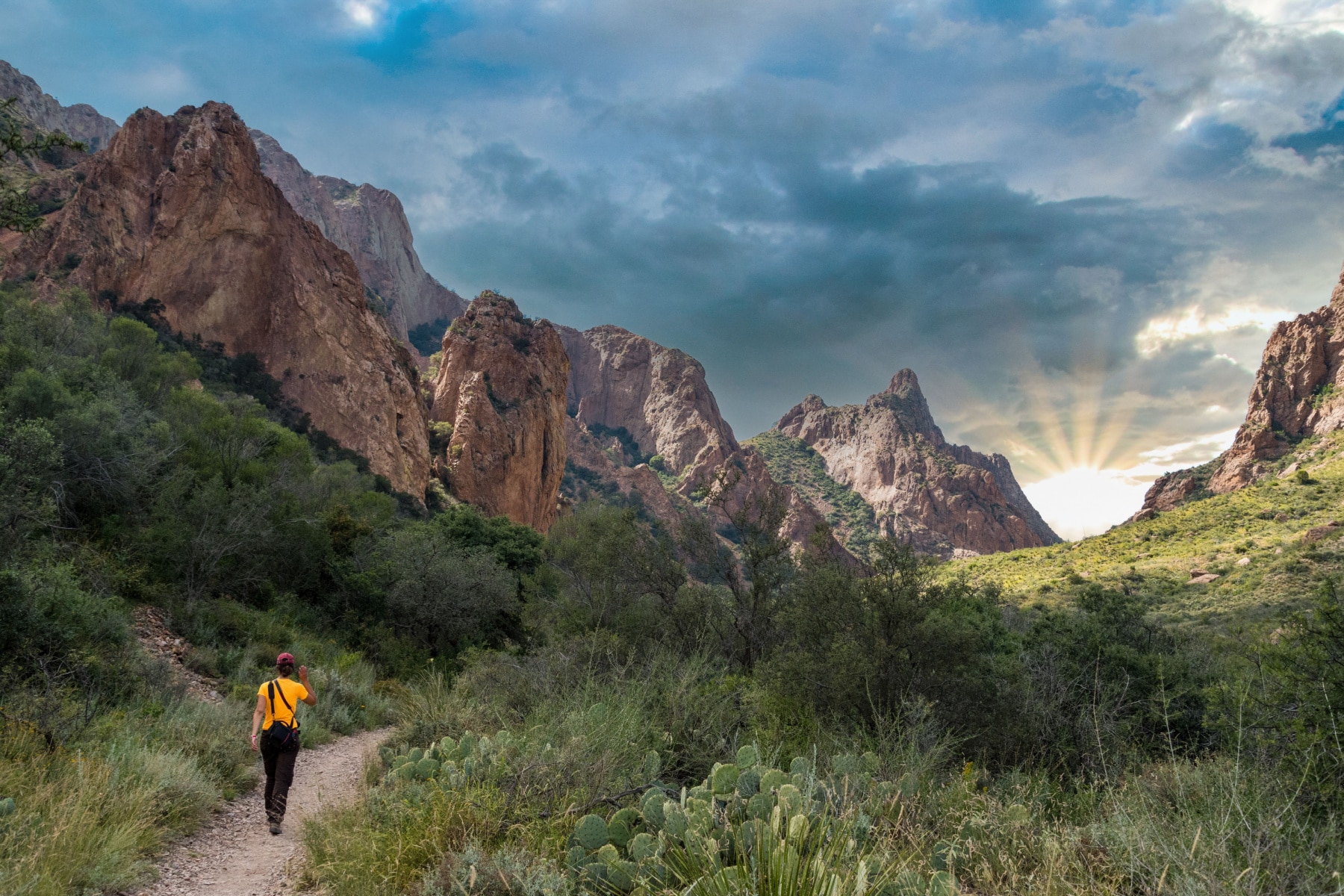
The Chisos Basin is the heart of the park and should be your first stop. For a deeper look at the trails, see our guide to the best hikes in Big Bend National Park. The Window Trail, a 5.6-mile round trip, descends through a canyon to a narrow gap in the rocks that frames the desert basin below. It’s one of the most iconic views in Texas. For a bigger challenge, the Emory Peak trail climbs 4.8 miles to the highest point in the park at 7,832 feet.
Santa Elena Canyon is another must-see. The canyon’s 1,500-foot limestone walls tower over the Rio Grande, and the 1.7-mile round-trip trail takes you right along the river at the base of those walls. It is one of the most dramatic short hikes I’ve ever done.
The Ross Maxwell Scenic Drive covers 30 miles through the western part of the park and delivers one stunning viewpoint after another. No hiking required. Just pull over, get out, and take it all in.
One more thing. Big Bend operates on a 24/7 honor-system entry, with no reservations required and no limit on how many folks can enter each day. It’s one of the most accessible parks in the system from a logistics standpoint. Just show up, pay at the gate (remember, card only), and go explore.
3. Guadalupe Mountains National Park
Distance from Corpus Christi. 534 miles northwest, about 7 hours 30 minutes via I-37 North and I-10 West to the Pine Springs Visitor Center
Entrance Fee. $10 per person (16 and older), valid for 7 days. Under 16 is free. You can pay at the self-service station at Pine Springs or buy your pass online through Recreation.gov before you go.
Texas’s Best-Kept Secret
For me, one of the most intriguing things about Guadalupe Mountains National Park is how few people know it exists. This park sits in far West Texas, on the border with New Mexico, and it contains the highest point in the entire state. Guadalupe Peak reaches 8,751 feet. And yet it draws fewer than 250,000 folks a year. Compare that to Big Bend’s 300,000 or Yellowstone’s 4 million.
The park exists because of a geologist named Wallace Everette Pratt, who fell in love with McKittrick Canyon so completely that he built a stone lodge inside it and then donated 6,000 acres of his land to help create the park. It was formally opened to the public in September 1972.
Things to Do at Guadalupe Mountains
The signature experience here is hiking Guadalupe Peak. The trail covers 8.4 miles round trip with 3,000 feet of elevation gain, climbing through Chihuahuan Desert scrub into high-elevation conifer forests before reaching the rocky summit. Plan 6 to 8 hours for the round trip. At the top, a stainless steel pyramid marks the highest point in Texas, and the 360-degree views stretch across the desert floor in every direction.
McKittrick Canyon is the other marquee attraction, and in my opinion, it might be even more special than the peak. The canyon shelters a riparian oasis fed by mountain springs. Bigtooth maples, velvet ash, and chinkapin oaks line the canyon floor, and in late October and early November, the fall colors here are among the most vivid in the Southwest. The trail runs 4.8 miles to the historic Pratt Lodge and continues with steep switchbacks up to “the Notch” at around 7,200 feet.
One thing to know before you go. This park has very limited services. No restaurants, no gas stations, no lodging inside the park. The nearest town is Whites City, New Mexico, about 35 miles north, or Carlsbad, New Mexico, 55 miles north. Fill your tank and pack your food before you arrive.
If you’re combining Guadalupe Mountains with Carlsbad Caverns (which I strongly recommend), the two parks are only about 40 miles apart on US-62/180. You can easily visit both in a two-day stretch.
4. Carlsbad Caverns National Park
Distance from Corpus Christi. About 570 miles northwest, roughly 8 hours 30 minutes via I-37 North and I-10 West to US-285 North (just 40 miles north of Guadalupe Mountains)
Entrance Fee. $15 per adult, free for children 15 and under. Self-guided tour reservations are $1 per person and can be booked through Recreation.gov. Reservations are strongly recommended.
One of America’s Great Underground Wonders
Now here’s a story that still gives me chills. In the early 1900s, a young cowboy named Jim White was riding near the Guadalupe Mountains when he spotted what looked like a column of smoke rising from the desert floor. He thought something was on fire. So he went to investigate. What he found instead was a massive swarm of Brazilian free-tailed bats spiraling out of a cave entrance. That cave turned out to be Carlsbad Caverns, and Jim White became its first explorer and most passionate champion.
Today, Carlsbad Caverns National Park protects more than 119 known caves formed in a fossil reef from an ancient sea that covered this region 265 million years ago. The Big Room, the main chamber, is the largest natural limestone chamber in the Western Hemisphere. At 8.2 acres and up to 255 feet high, it is genuinely breathtaking. Words don’t do it justice, and honestly, neither do photographs.
Jim White spent years exploring the caverns with nothing more than a homemade wire ladder and kerosene lanterns. He would descend hundreds of feet into the darkness, mapping passages and naming formations. People in the nearby town thought he was crazy. But in 1923, the General Land Office sent a mineral examiner named Robert Holley to investigate White’s claims. Holley emerged from the cave and wrote in his report that it was “the most spectacular I have ever seen.” Within a year, President Calvin Coolidge designated it a national monument. It became a full national park in 1930.
Things to Do at Carlsbad Caverns
You have two options for entering the cavern on a self-guided tour. The first is the Natural Entrance Trail, a steep 1.25-mile paved path that descends 750 feet through the cave’s natural mouth. It is the more dramatic option and the one I recommend if your knees can handle the descent. The second is to take the elevator from the visitor center directly down to the Big Room level.
Either way, you’ll walk the 1.25-mile Big Room loop once you’re down there. The formations are extraordinary. Stalactites, stalagmites, columns, draperies, and flowstone formations that took millions of years to build. The temperature inside the cave stays at a constant 56 degrees Fahrenheit year-round, so bring a jacket even if it’s 100 degrees outside.
A few important logistics for 2026. Self-guided tour reservations cost just $1 per person and can be booked on Recreation.gov. You select an entry time window, and you must enter the cave between your reserved time and 2:30 p.m. when cave entry closes. All ranger-led guided tours (Lower Cave, King’s Palace, Slaughter Canyon) remain temporarily suspended due to staffing issues. So for now, the self-guided tour is your only option.
The elevator operates daily but be prepared for long wait times on the way back up, especially on summer weekends and holidays. If you entered through the Natural Entrance, you can only exit via the elevator, so factor in potential waits of 30 minutes or more during peak periods.
And don’t miss the Bat Flight Program. From late May through October, hundreds of thousands of Brazilian free-tailed bats spiral out of the cave entrance at dusk. The park offers a ranger program at the outdoor amphitheater near the cave entrance where you can watch the flight. No reservations needed for the bat program, and it is absolutely free. Just show up about 30 minutes before sunset.
Planning a Multi-Park Road Trip from Corpus Christi
Here’s the honest truth. Big Bend, Guadalupe Mountains, and Carlsbad Caverns are all long drives from Corpus Christi. But they’re relatively close to each other, which makes combining them into a single road trip the smartest approach. For more itinerary inspiration, see our guide to the best road trips in America.
Day 1. Start at Padre Island National Seashore. It’s less than an hour from Corpus Christi and makes the perfect warm-up. Spend the day on the beach, catch a sea turtle release if the timing works, and camp overnight or head back to town.
Day 2-3. Drive west to Big Bend (about 7 hours 45 minutes to Persimmon Gap). Spend two full days exploring the Chisos Basin, the Window Trail, Santa Elena Canyon, and the Ross Maxwell Scenic Drive. Stay at the Chisos Mountains Lodge inside the park or camp at one of the park’s several campgrounds.
Day 4. Drive north from Big Bend to Guadalupe Mountains National Park (about 4 hours on US-385 North to I-10 West). Hike Guadalupe Peak or explore McKittrick Canyon. Camp at Pine Springs Campground (first-come, first-served, 39 sites).
Day 5. Drive 40 miles north to Carlsbad Caverns. Explore the Big Room, walk the Natural Entrance Trail, and stay for the bat flight at dusk. Carlsbad, New Mexico (about 25 miles from the park) has plenty of hotel options.
Day 6. Drive back to Corpus Christi (about 8 hours 30 minutes via I-10 East and I-37 South).
That gives you a full week with time for the highlights of each park without rushing. You could trim it to five days if you’re willing to push the driving, but I wouldn’t recommend less than that.
When to Visit
Padre Island is a year-round destination, though summer brings the sea turtle releases and the best swimming conditions. The Gulf water is warmest from June through September.
Big Bend is best in late fall, winter, and early spring. Summer temperatures in the desert lowlands regularly exceed 110 degrees. The Chisos Basin, at higher elevation, stays cooler, but the lower canyon trails become dangerously hot from June through August. November through March is the sweet spot for comfortable hiking weather.
Guadalupe Mountains is similar. Spring and fall are ideal. McKittrick Canyon’s famous fall colors peak in late October and early November, making it one of the best times to visit the park.
Carlsbad Caverns is comfortable year-round because the cave stays at 56 degrees regardless of what’s happening on the surface. The bat flights run from late May through October, so aim for that window if you want the full experience.
Frequently Asked Questions
What is the closest national park to Corpus Christi?
Padre Island National Seashore is the closest National Park Service site, just 43 minutes from downtown Corpus Christi. It’s technically a national seashore, not a full national park, but it is managed by the NPS and every bit as special.
Is the drive to Big Bend worth it from Corpus Christi?
Absolutely. The drive is long (around 8 to 10 hours depending on your entrance point), but Big Bend is one of the most underrated national parks in America. The desert landscapes, the canyons along the Rio Grande, and the night sky alone justify the trip. Just make sure you plan for at least two nights in the park.
Can you combine Guadalupe Mountains and Carlsbad Caverns?
Yes, and you absolutely should. The two parks are only 40 miles apart on US-62/180. You can hike Guadalupe Peak in the morning and be at Carlsbad Caverns by early afternoon. Many folks visit both in a two-day trip.
Do I need reservations for Carlsbad Caverns?
Reservations are strongly recommended and cost $1 per person through Recreation.gov. You pick a time window and must enter the cave by 2:30 p.m. Walk-ups are sometimes possible, but during peak season (summer and holidays) you risk being turned away without a reservation.
Final Thoughts
Corpus Christi might not be the first city that comes to mind when you think about national park gateways. But between Padre Island right on your doorstep and the extraordinary trio of Big Bend, Guadalupe Mountains, and Carlsbad Caverns out west, this stretch of Texas and New Mexico offers one of the most diverse national park road trips you can put together anywhere in the country.
You get beaches, desert canyons, the highest peak in Texas, and one of the largest underground chambers on Earth. All from a single home base. That’s a pretty remarkable run for one trip.
Our goal here at More Than Just Parks is to share the beauty of America’s national parks and public lands through stunning short films in an effort to get Americans and the world to see the true value in land conservation.
We hope you’ll follow our journey through the parks and help us to keep them the incredible places that they are. If you’re interested in joining the adventure then please sign up below!